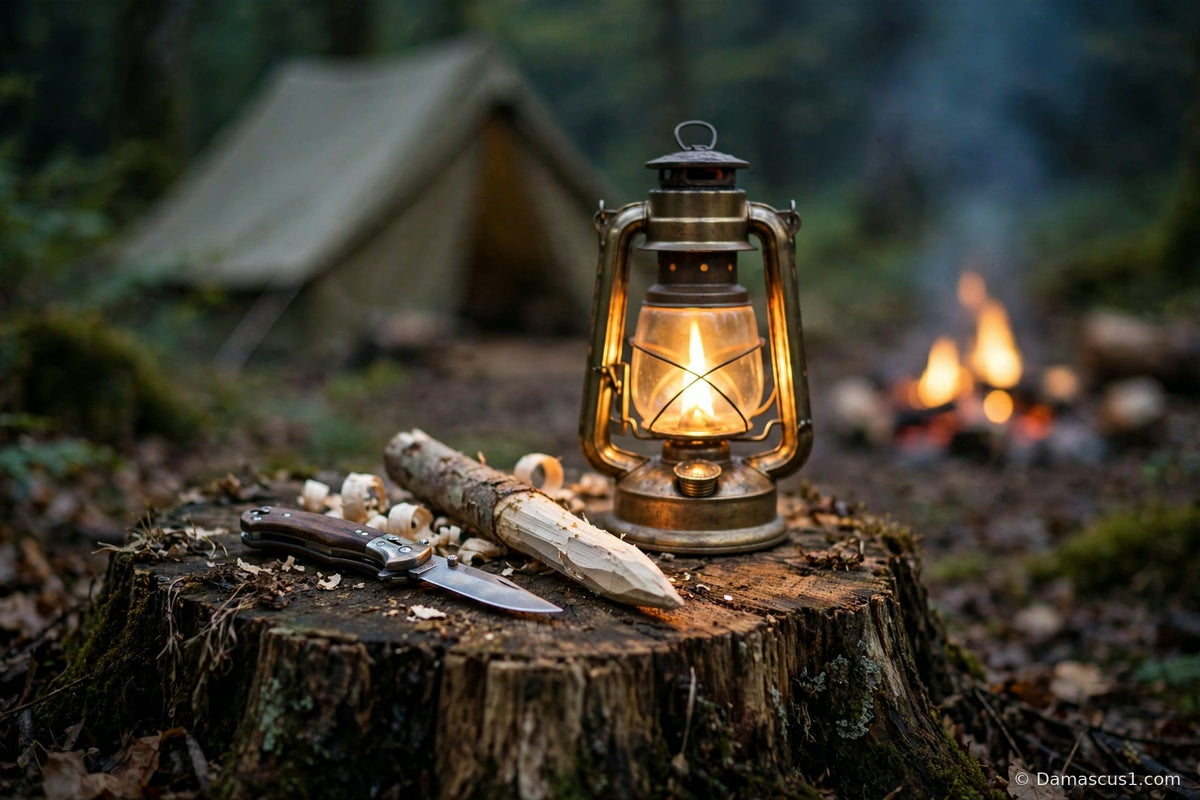
The short answer: There is no single legal age for a child's first pocket knife in the UK — but there is a hard legal line around buying one: you must be 18 to buy a knife, and a child cannot buy one for themselves. What matters instead is readiness, and for most children that arrives around eight or nine, which is also where the Scouts begin pocket-knife instruction. The first knife should be small, simple, used only with an adult beside them, and treated as a privilege they earn by showing they can follow rules — not as a birthday present that arrives on a date.
Every parent who has ever watched a child eye a pocket knife knows the moment this question comes from. It is not really a question about age. It is a question about trust: can I trust my child with a sharp edge, and can I trust myself to teach them properly? The answer to the first half is a checklist, not a birthday. The answer to the second half is a method — soap before wood, rules before cutting, supervision before independence — that the Scouts have refined over a century and that this guide sets out in full.
One thing needs saying at the top, before anything else, because it shapes the whole guide: the knife at the centre of this site's gift guides — the Olive Wood Damascus Pocket Knife at $39.99 USD — is not a child's first knife. It is a locking folder with a sharp Damascus blade, made for an adult's hand and an adult's pocket, and this guide presents it as what it honestly is: the keepsake milestone at the end of the journey, the eighteenth-birthday or graduation knife a young adult receives when the years of supervised practice have done their work. A child's first knife is a different, smaller, simpler object, and pretending otherwise would be dishonest and unsafe. The rest of this guide is about that first knife, and about the road that leads, years later, to the Damascus folder.
What does the law actually say about children and knives?
Start with the hard lines, because they are not negotiable and they are widely misunderstood.
Buying: 18. It is illegal to sell a knife to anyone under 18 in the UK, and illegal for a retailer to deliver a bladed product to a person under 18. The offence sits in s.141A of the Criminal Justice Act 1988, and the online-sale rules sit in the Offensive Weapons Act 2019: the seller must run a genuine age-verification system — a self-declared date of birth alone is not enough — the parcel must be marked, and it must be delivered into the hands of an adult aged 18 or over. Bladed products cannot go to lockers or click-and-collect, and they cannot be left on a doorstep. A parent or grandparent buying a knife for a child to use under supervision is buying it themselves, as an adult, and that is the only lawful way a first knife enters a family. Our full guide to the buying process is Can you buy knives online in the UK. General information, not legal advice.
There is a narrow statutory exception worth knowing about, and worth handling honestly: the legislation excepts a folding pocket knife with a cutting edge of 3 inches or less that does not lock, and in Scotland 16- and 17-year-olds can buy kitchen knives and cutlery. Different official and legal sources describe the scope of that exception differently, and the practical position for any parent is simple — treat 18 as the rule, buy the knife yourself, and do not rely on an exception you have not verified on GOV.UK. The exception exists in the statute; the safe course does not depend on it.
Owning and using at home: no minimum age in law. There is no statute that says a child of a given age may not hold a knife at home under an adult's supervision. A child whittling at the kitchen table with a parent beside them is not breaking the law. What the law does do is draw a hard line around public places: under s.139 of the Criminal Justice Act 1988, it is an offence to have a bladed article in a public place without good reason or lawful authority, and a child has no good reason to carry a pocket knife in public. The only folding pocket knife that can be carried in public without a reason is a non-locking folder with a cutting edge of 3 inches or less — and a child carrying even that, without an adult and without a purpose, is in territory no parent should allow. The rule for a first knife is absolute: it is used at home, in the garden, or at a supervised camp, and it never goes to school, never goes to a friend's house, and never goes in a pocket on the street. Our explainers go deeper: UK legal pocket knife and Are locking knives legal in the UK.
Schools: never. A knife on school premises is a matter for the school's safeguarding and behaviour policies and, in the worst cases, for the police. No first knife ever goes to school, for any reason, even to show a friend. Tell the child this on the day the knife arrives, and tell them again every time they use it. It is one of the few rules in this guide that admits no exception and no discussion.
How old should a child be for their first pocket knife?


Most children are ready for their first pocket knife between seven and eleven, with supervision, and the centre of that range — around eight or nine — is where the Scouts begin. That is not a legal threshold. It is a practical one, drawn from a century of watching children learn, and it rests on what a child can do, not on how many candles were on their last cake.
Scouting America starts pocket-knife instruction in the Bear rank, third grade, about eight or nine years old, in the Whittling adventure, and the British Scouting tradition follows the same shape: knife work comes when a child can be trusted with a tool, and it comes with a badge and a set of rules that can be taken away. The Whittling Chip — the card a Cub Scout earns and can lose, a corner cut off for each violation — is the clearest expression of the idea: a knife is a privilege a child earns by demonstrating habits, not a reward for reaching a birthday.
The parenting guides that have actually tested this agree on the shape of it. One widely read guide puts it plainly: most children can start using a rounded-tip knife with supervision around the age of five, may be ready for their own knife around eight, when Scouts usually start whittling badges, and may be ready for unsupervised use only around ten — and even then, only the responsible ones. Another puts the range at seven to eleven with supervision. A third, written by a knife maker, says there is no age at all — there is a set of behaviours, and a child who shows them is ready whether they are seven or eleven. All three are saying the same thing in different words: watch the child, not the calendar.
The readiness checklist — the citable asset
Use this before you buy anything. If the answer to any row is no, wait. The knife will still be there in six months, and the child will be readier for it.
| Readiness sign | What it looks like | Why it matters |
|---|---|---|
| Follows a three-step instruction | "Pick it up, open it, put it down" — done in order, first time | Knife safety is a sequence, not a single rule |
| Sits still for fifteen minutes | Can whittle or carve without fidgeting away | A moving child and a sharp edge do not mix |
| Stops immediately when told | Freezes mid-cut on "stop" — no finishing the stroke | The stop command is the only emergency brake you have |
| Reports problems instead of hiding them | Tells you about a cut, a slip, a loose blade | Hidden mistakes become repeated mistakes |
| Respects rules when unwatched | Puts tools away without being told | The knife will one day be used when you are not there |
| Understands it is a tool, not a toy | Never points it, never throws it, never shows it off as a weapon | A child who treats a knife as a toy will use it as one |
| Asks permission before using it | Every single time, without exception | Permission is the habit that keeps the knife supervised |
Two signs matter more than all the rest, and they are the ones parents most often miss: the child follows a rule when you are not watching, and the child closes and puts away a tool without being told. If both are true, the child is ready to learn. If either is false, the child is ready to learn about knives — which is a different lesson, and comes first. Talk about knives, show them yours, let them watch you work, and wait. Waiting is not a failure. It is the lesson.
What should a first pocket knife actually be?
Small, simple, and theirs. That is the whole specification, and every word in it is doing work.
Small means a blade of two to three inches — enough for any task a child has, and short enough that a slip is a small slip. A child's first knife should not be a full-sized folder. It should fit a small hand, close easily, and feel like a tool made for them rather than a grown-up's knife they have been allowed to borrow.
Simple means a manual two-hand opener — a blade that takes a deliberate two-handed motion to open, because the motion is the lesson. It should not be an automatic. An automatic opens at a touch, with no effort and no chance to think, and that is exactly what makes it an adult tool and a bad first knife. A two-hand nail-nick opener, the traditional way a pocket knife has always opened, forces a pause between wanting the blade and having it, and that pause is where safety lives. For the youngest children, a rounded tip is worth having: it stops stabs, though it does not stop cuts, and it should never be presented as making the knife safe. A knife with a rounded tip is still a knife.
Theirs means it belongs to the child, is kept in a known place, and is used only with permission. A first knife that lives in a drawer with the adult's tools is not theirs; it is borrowed, and borrowed tools are used carelessly. Give the child a place for it — a box, a shelf, a sheath on a hook — and a rule that it returns there after every use.
There is an honest debate about fixed versus folding for a first knife, and it is worth stating both sides. A fixed blade is safer in one specific way: it cannot fold onto fingers, and it is sturdier for whittling and making tinder. Several parenting guides recommend a small fixed blade with a rounded tip and a finger guard as the safest first knife. A folder teaches a different lesson — how to open and close safely, how to respect a mechanism — and it is the shape of knife the child will use as an adult. Either is defensible. What is not defensible is a large folder, a locking blade a small hand cannot close safely, or anything with a spring. Start small, start simple, and let the knife grow with the child.
The teaching method: soap before wood, rules before cutting
The Scouts have taught knife safety for a century, and the method works because it is slow. It treats the knife as a privilege a child earns by demonstrating habits, and it builds the habits before the blade ever touches wood.
Step one: the rules, before the knife. Sit down with the child and agree the rules together. Write them down. The classic set, adapted from Scouting practice, is: a knife is a tool, not a toy; never cut towards yourself; keep fingers away from the blade; only use it with an adult's permission and supervision; always ask before using it; never use it as a weapon; if you can touch anyone, do not open it — the Scouts call this the blood circle, or safety circle, and it is the one rule a child will teach their own children one day; close the knife when you are not cutting; hand it to someone handle-first, never blade-first; and tell an adult immediately about any cut, however small. Ten rules sounds like a lot. It is not, once the child has heard them three times and practised them twice.
Step two: soap. In Scouts, children first practise whittling on bars of soap. It sounds like a joke and it is not: soap gives the feel of a knife without the resistance of wood, and a slip in soap is a lesson rather than an injury. Let the child carve a bar of soap into a simple shape — a boat, a fish, a rough spoon — and watch how they hold the knife, where their fingers go, whether they cut away from their body. Correct gently and often. When the soap is mastered, move to soft woods like basswood or hazel, and then to a walking stick.
Step three: the first real cut, with you beside them. Sit beside the child, not across from them. Your hands are near theirs, not on them. Let them make the cut. Let them make the small mistakes — the awkward grip, the cut that goes the wrong way and stops short — and correct after, not during, unless safety demands it. A child who is corrected mid-cut learns to flinch. A child who is corrected after learns to think.
Step four: the privilege, and the price of losing it. Tell the child plainly that the knife can be taken away, and mean it. The Scouts cut a corner off the Whittling Chip card for each violation and take the card away on the fourth. Your version can be simpler — a warning, a week without the knife, a month — but it must be real, and the child must know it is real before they ever hold the blade. A privilege with no price is not a privilege. It is a gift, and gifts do not teach responsibility.
What a first knife is not — and the Damascus milestone
A first knife is not a Damascus folder. It is not a locking blade. It is not a keepsake, an heirloom, or an object worth $39.99 USD. It is a small, cheap, replaceable tool that a child can drop, blunt, and lose without tears — because they will drop it, blunt it, and probably lose it, and that is part of the learning.
The Damascus folder belongs at the other end of the journey. When the child who learned on soap and hazel is eighteen — old enough to buy their own knife, old enough to carry the responsibility the law assumes — that is the moment for the Olive Wood Damascus Pocket Knife: a handmade folder with a pattern-welded blade of 1095 and 15N20 steels, about 276 layers, hardened to 58–60 HRC, with an olive wood handle. Its warmer-toned stablemate, the Orange Wood 6.5" Hunting Pocket Knife, also $39.99 USD, makes the pair a natural eighteenth-birthday gift for twins or for a young adult and a parent to mark the milestone together. It is a manual two-hand nail-nick opener with a back-lock — the same deliberate opening the child learned on, now in a knife made to last a lifetime. Engraving is available on request, quote-based, up to 25 characters, with proof, price and timing confirmed before custom work starts — a name, a date, a short message — and for an eighteenth birthday or a graduation, that turns the knife from a purchase into a milestone. Our engraving guide, Engraved pocket knife gift, covers the wording and the lead time.
That framing matters for the law as well as for sentiment. The hero folder locks, so it is legal to own and collect at home, and legal to carry in public only with a good reason — it is never "UK legal carry", and no honest guide should call it one. An eighteen-year-old receiving it as a keepsake is receiving an adult's knife, for an adult's pocket, under an adult's responsibilities. That is the right ending to a story that starts with a bar of soap.
The age bands, honestly labelled
These bands are editorial guidance drawn from Scouting practice and maker guidance — not law. Use them as a map, and the readiness checklist above as the compass.
| Age band | What suits them | What to watch for | The honest truth |
|---|---|---|---|
| Under 6 | No real edge; a toy knife for pretend play | Any real edge, even a rounded one | Too young for a real blade — let them watch and ask questions |
| 6–8 | Rounded-tip knife, used only with you beside them | A rounded tip stops stabs, not cuts | Supervision is total; the knife never leaves your sight |
| 8–11 | Small two-hand-opening folder, about 2 oz, supervised | Blades that do not lock can fold onto fingers | The classic first-knife years; Scouts begin whittling here |
| 11–14 | Small Scout's pocket knife, growing independence | Two cutting edges on small tools; overconfidence | Old enough to be trusted, young enough to need checking |
| 14–17 | Full-size folder, still supervised in practice | One-hand opening: quick to open, and to open by mistake | Years of practice behind them; still cannot buy their own |
| 18 and over | Any knife, including the Damascus folder | The law now treats them as an adult — so must you | The keepsake milestone; the training wheels come off |
The bands are rough, and the child in front of you is the real test. A careful ten-year-old is readier than a reckless fourteen-year-old, and no band in a table knows your child the way you do. Trust the checklist more than the table, and trust your own judgement more than either.
What to do when it goes wrong
It will go wrong, in small ways. A child will cut themselves. Probably not badly — a nick on a thumb, a shallow slice on a finger — but it will happen, and how you react in that moment teaches more than any rule you agreed beforehand.
First, stay calm. A child who sees panic learns that knives are frightening, which is the wrong lesson; a child who sees a calm adult clean a cut, apply a plaster, and talk about what happened learns that mistakes are manageable, which is the right one. Second, talk about it: what went wrong, which rule was broken, what the child will do differently next time. Third, do not take the knife away forever. A single cut is not a failure of the whole project. It is a data point. Take the knife away for a day, or a week, if the mistake was carelessness — but bring it back, with the lesson attached, or the child learns that one mistake ends the privilege, and stops telling you about the next one.
Keep a small first-aid kit where the whittling happens, and make sure the child knows where it is. Plasters, antiseptic, a clean cloth. The kit is not there because you expect disaster. It is there because a child who knows where the plasters are is a child who will deal with a cut instead of hiding it — and a hidden cut, however small, is the one that gets infected.
The Olive Wood Damascus Pocket Knife Set — $39.99
Real Damascus steel, an olive wood handle and a genuine leather sheath included — the knife our readers ask about most.
Shop the Olive Wood Damascus Pocket Knife Set — $39.99 · Free US shipping on orders over $50.
Frequently asked questions
What age can a child legally buy a knife in the UK?
Eighteen. It is illegal to sell a knife to anyone under 18, and illegal to deliver a bladed product to a person under 18. A parent or grandparent must buy the knife as an adult. A narrow statutory exception for small non-locking folding pocket knives is described differently by different sources — treat 18 as the rule and verify on GOV.UK before relying on any exception.
What age should a child get their first pocket knife?
There is no legal age for supervised use at home, and readiness matters more than birthdays. Most children are ready between seven and eleven, with the centre around eight or nine — where the Scouts begin pocket-knife instruction. Use the readiness checklist in this guide: follows three-step instructions, sits still, stops immediately, reports problems, and respects rules when unwatched.
Can a child own a pocket knife in the UK?
Yes, at home, under adult supervision — there is no minimum age in law for a child using a knife at home with an adult beside them. But a child must never carry a knife in public, never take one to school, and never carry one without a good reason and an adult. The knife is used at home, in the garden, or at a supervised camp.
Can a 12-year-old carry a pocket knife in the UK?
No — not in public, not in a pocket, not on the street. A twelve-year-old has no good reason to carry a blade in public, and doing so is an offence under s.139 of the Criminal Justice Act 1988. The knife stays at home or at camp, in its sheath, and is used only with an adult's permission and supervision.
What is the best first pocket knife for a child?
Small, simple, and theirs: a blade of two to three inches, a manual two-hand opener, and a rounded tip for the youngest children. It should not be an automatic, and it should not be a locking blade a small hand cannot close safely. Several guides recommend a small fixed blade with a rounded tip and finger guard as the safest first knife; a small folder teaches open-and-close discipline. Either is defensible — large and complicated is not.
Can children take a knife to Scouts?
Only under the Scout group's own rules, with the leader's permission, and only for the activity in question — whittling, camp craft, cooking. The child earns the right through the group's training, such as the Whittling Chip, and the knife travels in a bag to the meeting and home again, not in a pocket on the street. Never send a child to Scouts with a knife the leader has not agreed to.
Can I give my son a knife for his birthday?
You can give him a first knife as a supervised tool at home — you buy it, as an adult, and you teach him to use it. What you cannot do is buy a knife for a child to carry, or present a locking Damascus folder as a child's knife. The Damascus folder is the eighteenth-birthday milestone: the keepsake at the end of years of supervised practice, not the beginning of it.
What is the Whittling Chip?
It is the Scouts' knife-safety card: a child earns it by learning the rules and demonstrating safe handling, and a corner is cut off for each violation, with the card taken away on the fourth. It is the clearest expression of the idea behind this whole guide — a knife is a privilege a child earns by showing they can follow rules, not a reward for reaching a birthday.
The honest close: A first pocket knife is not a present. It is a project — months of soap and softwood, rules agreed and kept, a privilege earned and, sometimes, briefly lost. Do it slowly, do it supervised, and do it with a small, simple knife that fits a child's hand. And when the child who learned on that knife turns eighteen, give them the Damascus folder: a handmade knife, engraved if you like, that says you noticed the years of practice and you are proud of them. That is the whole journey, and it is worth every bar of soap. DRAFT — awaiting Faisal's word before anything is published.
Leave a comment: