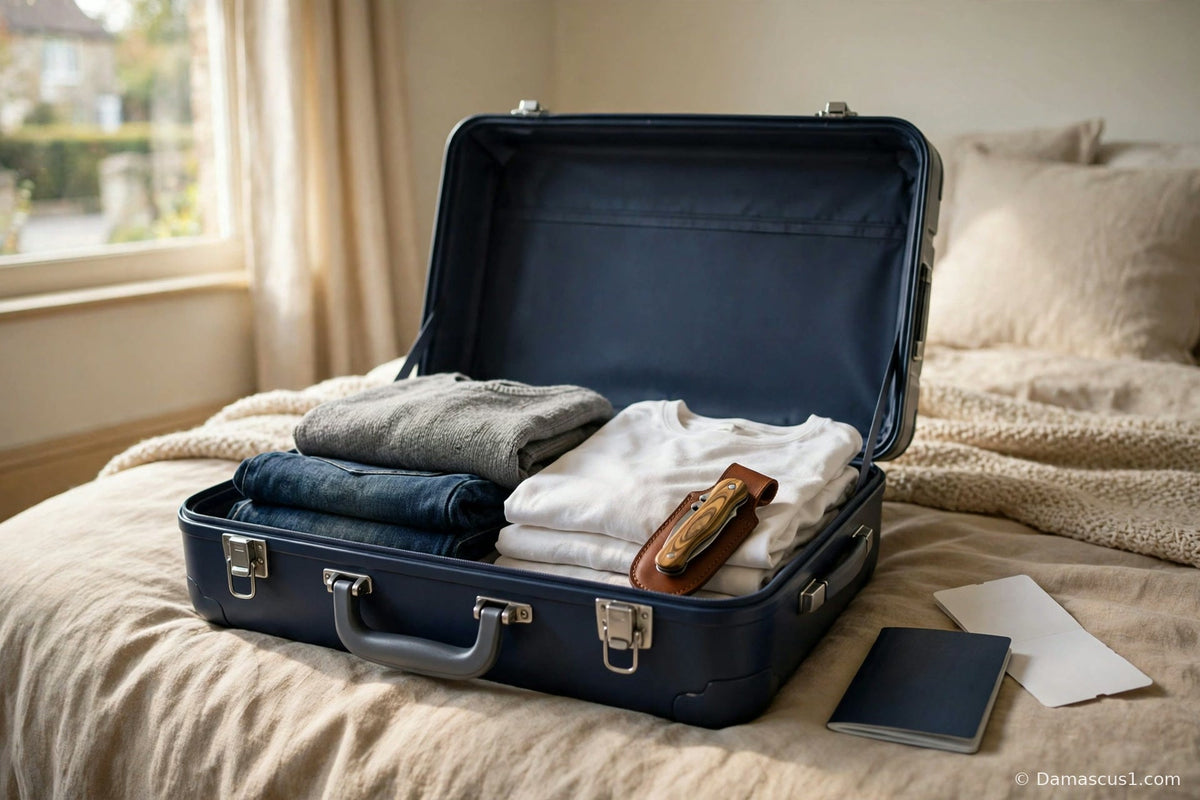
The short answer: No — you cannot take a pocket knife in hand luggage on a flight from the UK. GOV.UK bars any knife with a sharp or pointed blade, or a blade longer than 6cm, from the cabin. Pack it in your hold luggage instead, folded shut, in its sheath, wrapped so it cannot injure a baggage handler, and check your airline's own rules before you travel, because airlines can be stricter than the government list.
It is the kind of question people only ask twice: once before a trip, and once at the security tray, holding a knife they love and watching an officer drop it into a surrender bin. The first time costs a search. The second time costs the knife. This guide exists so you only ever have the first kind of experience.
The rule itself is simple, but the edges around it are where good knives get lost — the penknife that seems too small to count, the multi-tool in the laptop bag, the kitchen knife bought as a souvenir, the folder packed in the wrong bag on the way home. So this guide works through the rule as GOV.UK states it, the reason small blades do not escape it, exactly how to pack a knife in hold luggage so it arrives safely, what happens if you forget, how the rules change on the way home, and what to do when you are travelling with hand luggage only. The knife at the centre of the packing advice is the Olive Wood Damascus Pocket Knife at $39.99 USD — a handmade folder with a real pattern-welded Damascus blade — because it is exactly the kind of knife people travel with: small, useful, and painful to lose to a security bin.
What does GOV.UK actually say about knives in hand luggage?


GOV.UK's hand luggage restrictions page lists, under personal items, a single line that settles the question: a knife with a sharp or pointed blade and/or a blade longer than 6cm is not allowed in hand luggage, and is allowed in hold luggage only with a note to check with your airline. The same page carries a second line that matters just as much: airport security staff will not let anything through that they consider dangerous, even if it is normally allowed in hand luggage. The officer at the belt has the final say, and the list is a floor, not a ceiling.
Read that line carefully, because two details in it catch people out. First, the test is "sharp or pointed blade and/or blade longer than 6cm" — either condition alone is enough. A small, sharp penknife fails on sharpness even if its blade is well under 6cm. A blunt, long blade fails on length. Second, the hold-luggage column does not say "yes" unconditionally; it says "check with your airline". The government permits it in the hold, and your airline may still refuse it, or require it packed in a particular way. Both of those are your problem to solve before you reach the airport, not at the desk.
The Northern Ireland direct government guidance (nidirect) states the same rule in a table: knife with a sharp or pointed blade and/or a blade longer than 6cm — no in hand baggage, yes in hold baggage, check with the airline. Small scissors with blades no longer than 6cm are allowed in the cabin; large scissors are not. A Stanley knife is not allowed in the cabin. A tool with a blade or shaft longer than 6cm is not allowed in the cabin. The pattern is consistent across every official source: the cabin is for blunt, short, harmless things, and everything else goes below.
Why doesn't a small penknife get through?
Because there is no permitted size for a sharp blade in the cabin, and that is the single most common misunderstanding in this whole subject. Travellers reason — quite naturally — that a two-inch penknife is harmless, that it is smaller than the scissors they are allowed to carry, that the security officer will surely use common sense. The rule does not work that way, and the reason is not bureaucratic stubbornness. It is that a cabin rule has to be enforceable in seconds, by an officer looking at a tray, with a queue behind you. A rule that said "small sharp blades are fine, large ones are not" would require measuring every blade and arguing about every edge. A rule that says "no sharp blades in the cabin" requires none of that.
The American TSA rules make the same point from the other side: they ban virtually all knives from carry-on bags, with no exception for blade length or knife type, and the only exceptions are round-bladed, blunt butter knives and plastic cutlery. The European Union's rule bars knives with blades of more than 6cm from cabin baggage, and sharp objects that are not allowed in hand luggage must be surrendered at the checkpoint or packed in hold luggage. The UK's wording is the strictest of the three in one respect — the "sharp or pointed" condition — and it is the wording that governs your flight out of a British airport.
That also answers the question people ask about multi-tools. A multi-tool with a blade is a knife for this purpose. The blade is what the officer sees, and the pliers and screwdrivers attached to it do not change the answer. The same goes for a Swiss Army knife, a craft knife, a box cutter, and a kitchen knife in a picnic bag. If it has a sharp edge or a point, it does not fly in the cabin. Leave the multi-tool in the hold with the knife, or leave it at home.
There is one more thing worth saying plainly, because it is the kindest version of this advice: do not test the rule. Do not pack the penknife in your coat pocket "just to see". If it is found, you lose the knife, you lose time, and you may miss your flight while the matter is dealt with. The surrender bin at security is not a lost-property office. Things that go in do not come back.
What happens if security finds a knife in your hand luggage?
You surrender it. That is the normal outcome for an ordinary pocket knife found in a cabin bag at a UK airport: the item is confiscated, you are allowed to continue your journey, and the knife is gone. There is generally no fine for an honest mistake with an ordinary folding knife, and no arrest — but that is the best case, and it depends on the circumstances being plainly innocent. A large blade, a concealed blade, a prohibited type such as a flick knife or gravity knife, or any suggestion that the knife was being carried as a weapon, is a different matter entirely and can lead to police involvement. Do not give the officers a reason to wonder which case yours is: be calm, be honest, hand it over, and move on.
The practical cost is usually worse than the legal one. A Damascus folder at $39.99 USD is not an expensive knife in the world of handmade blades, but it is a handmade object with a pattern that never repeats, and the one in the bin was yours. If you bought it as a gift, the loss is doubled — the money and the occasion. And if it happens on the way home, after a trip where the knife earned its keep, the loss stings in a particular way, because you know exactly what you are losing. None of that is recoverable from the airport. The only reliable protection is to never put yourself in that position.
One honest note on timing: if you realise at the airport, before security, that the knife is in your hand luggage, you still have options. Step out of the queue, repack it into your hold bag if you have one and it has not been checked in yet, or hand it to whoever is seeing you off. If your hold bag is already gone, ask at the airline desk whether the bag can be retrieved — sometimes it can, sometimes it cannot, and it is always worth asking before you walk through the scanner with a knife in your pocket. If none of that works, the honest choice is to leave the knife with someone, post it home if the airport has a service for that, or accept the loss. What you should not do is try to smuggle it through and hope. Hope is not a packing strategy.
Can I put a knife in checked luggage?
Yes — that is where it belongs. GOV.UK permits knives in hold luggage, subject to checking with your airline, and the TSA's rule is the same: knives are generally allowed in checked bags, sheathed or securely wrapped to prevent injury to baggage handlers and inspectors. The packing matters, though, because a hold bag is thrown, stacked, dropped and opened by strangers, and a loose blade in a suitcase is a hazard to the people who handle it and a risk to everything else in the bag.
Here is the method, step by step, and it works for a folding knife, a fixed blade, or a kitchen knife:
- Close and lock it. Fold the knife shut. If it has a lock, engage it. A folding knife that can work open in transit is a loose blade in a suitcase.
- Sheath it. Put it in its sheath. The Olive Wood Damascus Pocket Knife arrives as a set with a leather sheath — use it. A knife without a sheath should be wrapped in a way that covers the edge completely.
- Wrap it. Wrap the sheathed knife in a soft cloth or a piece of clothing, and tape the bundle closed. The wrap does two jobs: it stops the sheath slipping off, and it cushions the knife against the rest of the bag.
- Bury it in the middle. Put the bundle in the centre of the suitcase, surrounded by soft clothes on all sides. Never pack a knife against the outside wall of the case, where it can press against the shell or be felt through the fabric.
- Keep it dry. Carbon steel — and the hero knife's 1095 steel is a carbon steel, not stainless — rusts if it travels damp. Dry the blade, wipe it, and give it a light coat of oil before a long trip, especially if the case will sit in a cold hold or a humid destination. Our care guide, Damascus folding knife care, covers the routine in full.
- Do not declare it unless asked. There is no general requirement to declare an ordinary knife in hold luggage on a UK flight, and no form to fill in for one. If an airline or an airport asks, say so plainly. If you are carrying several knives, or a knife that might look unusual on a scan, a word to the check-in desk costs nothing and can save a bag search later.
That is the whole method, and it is worth doing properly every time, because the failure mode is not a fine — it is a damaged blade, a cut hand belonging to a baggage handler, or a suitcase opened and searched at the other end.
Do airlines have their own rules on top of the government's?
Yes, and this is the part people skip. GOV.UK tells you what the government allows; your airline tells you what it will carry, and the airline's answer can be stricter. Budget carriers in particular have their own restricted-items pages, and some treat knives as items that must be declared, packed in a hard case, or carried only in checked baggage of a certain kind. Blue Islands, for example, publishes that sharp objects including knives are not permitted in cabin baggage, and that work tools with blades must go in the hold. Other airlines fold the same rule into their conditions of carriage, where nobody reads it until it matters.
The practical advice is short: before every flight, open your airline's restricted-items or dangerous-goods page and search for "knife". It takes two minutes. Do it again on the way home, because the return airline may not be the same one, and the rules at the departure airport abroad are the rules of that country, not Britain's. A knife that flew out legally in your hold bag can still cause trouble on the way back if the return airport's rules differ, or if the destination country treats the knife differently on arrival — which brings us to the part of this guide that matters most once you land.
What about the law where you land?
Flying with a knife is two problems, not one: the aviation rules, and the law of the place where you land. The aviation rules get the knife onto the plane. The destination's law decides what happens when you pick up your bag and walk out of the airport with it in your pocket.
In Britain, the law on carrying a knife in public is set by s.139 of the Criminal Justice Act 1988: it is an offence to have a bladed article in public without good reason or lawful authority. The only folding pocket knife you can carry without needing a reason is a non-locking folder with a cutting edge of 3 inches or less. The hero knife in this guide locks — its back-lock holds the blade open while it is used — so it is legal to own and collect at home, and legal to carry in public only with a good reason: a camping or fishing trip in progress, work, transport to and from a legitimate use. "Just in case", "I forgot it was there" and self-defence are not good reasons, and the burden of proving the good reason falls on the carrier. Our full explainers go deeper: UK legal pocket knife and Are locking knives legal in the UK. General information, not legal advice.
That framing matters on a trip, because a holiday is exactly the situation where "good reason" gets fuzzy. A locking folder in your rucksack on a Lake District walk, with a flask and a map, is a tool on a trip. The same knife in your jeans pocket on a night out in the town you flew into is not. The rule of thumb that keeps you safe is to treat the knife the way you treat the rest of your kit: in the bag, on the way to the activity, and back in the bag when the activity is over. Never in a pocket on a night out, never loose, never carried "just in case".
Abroad, the rules vary widely, and this guide will not pretend to summarise them all — that is exactly the kind of false confidence that gets people into trouble. What it will say is this: some countries are stricter than Britain, some are more relaxed, and a few treat particular knife types as prohibited weapons at the border, with customs seizure as the consequence. Australia, for example, classifies certain knives as prohibited weapons and requires permits. Before you fly anywhere with a knife in your hold bag, spend ten minutes on that country's customs or police website and check two things: whether your knife type is allowed in at all, and whether carrying it in public there needs a reason. If you cannot find a clear answer, leave the knife at home. A holiday without a pocket knife is a minor inconvenience. A holiday that starts with a customs seizure is not.
What if you are travelling with hand luggage only?
This is the most common real-world version of the problem, and it has only three honest answers: check a bag, ship the knife, or leave it behind.
Check a bag. If the knife matters to the trip — a camping trip, a fishing trip, a working trip — pay for a hold bag and pack the knife properly, using the method above. On a budget airline the hold bag costs money, and that money is the price of taking the knife. Compare it honestly with the price of the knife itself: a $39.99 USD folder and a £30 hold bag is still cheaper than replacing the folder at the destination, and you get the bag's space for the rest of your kit as well. Travelling as a pair, or carrying a spare, is worth considering too: the olive wood hero and its warmer-toned stablemate, the Orange Wood 6.5" Hunting Pocket Knife, also $39.99 USD, travel together at $79.98 combined — one in use, one in reserve.
Ship it. If you are going to a fixed address — a cottage, a friend's house, a hotel that will hold a parcel — you can post the knife ahead of yourself. In the UK, posting a knife requires the same age-verified, adult-handover discipline as any online knife sale: the parcel must be marked, and it must be delivered into the hands of an adult aged 18 or over. Our guide to the process is Can you buy knives online in the UK. Internationally, posting a knife across a border is a customs matter, and you should check the destination's import rules before you post anything.
Leave it behind. If the trip is a city break, a beach holiday, or a weekend where you will not actually use the knife, the honest answer is to leave it at home. A pocket knife is a tool, and a tool you will not use is dead weight in a bag that has no room for it. Buy a cheap local knife at the destination if you find you need one, or borrow one. The Damascus folder will be waiting on your desk when you get home, which is a better outcome than watching it disappear into a surrender bin at Gatwick.
Trains, ferries and Eurostar: is it the same rule?
Not exactly, and the differences are worth knowing because they catch people who assume all transport works like aviation. Eurostar runs airport-style security at St Pancras and its other terminals: bags are screened, and knives are treated the same way as at an airport — not in your hand baggage, packed away in your luggage. Ferries are looser: there is generally no bag screening on a cross-Channel ferry, and a knife in your luggage is a matter for the law of the country you land in, not for the ferry company. Domestic trains in Britain have no bag screening at all, and a knife in your luggage on a train is governed purely by the public-carry law — s.139, good reason, and the same framing as above.
The practical point is that the mode of transport changes the screening, not the law. A locking folder in your pocket on a train to the Lakes is lawful if you are on your way to a legitimate use, and unlawful if you are not, regardless of whether anyone screened your bag. The train does not make the knife legal; the reason does. And on the way home from a ferry port, the same rule applies in reverse. Keep the knife in the bag, in its sheath, on the way to the activity, and you will not have a problem. Keep it in your pocket on a night out, and the absence of a scanner will not save you.
Bringing a knife home from abroad
The souvenir knife is the classic version of this problem. You are in a market in Spain, or a shop in Japan, and there is a beautiful blade at a price that seems too good to miss. Before you buy it, ask three questions.
First, can it fly home in your hold bag? If it is an ordinary folding or fixed-blade knife, yes, packed as above. If it is a prohibited type in the UK — a flick knife, a gravity knife, a disguised blade, a butterfly knife — no, and buying it is a waste of money at best, because UK customs can seize it on arrival. Our guide to spotting a real Damascus blade, How to spot a fake Damascus knife, is also worth a read before you buy abroad: the market stall is where fake Damascus lives, and the pattern that stops at the ground edge is the tell.
Second, can it come through UK customs? An ordinary pocket knife bought abroad is not a customs problem in itself, but it must be declared if it is above your duty-free allowance in value, and it must be the kind of knife that is legal to own in Britain. Keep the receipt. Pack it in the hold, sheathed and wrapped, exactly as you would a knife from home.
Third, is it worth it? A $39.99 USD handmade Damascus folder with named steels, about 276 layers, and an olive wood handle is already at the price a souvenir knife is trying to reach, and it comes with a seller you can contact afterwards. The souvenir's romance is real, but so is the risk of buying a fake in a market, and the packing problem on the way home. If the knife is genuinely special — a regional pattern, a maker's mark, a style you cannot buy at home — buy it and pack it properly. If it is merely cheap, leave it.
The travel rules, compared
| Route | Hand luggage | Hold luggage | Notes |
|---|---|---|---|
| UK domestic flight | No — sharp/pointed or over 6cm barred | Yes — check with airline | Security officer has final say |
| UK to EU flight | No — EU bars blades over 6cm from cabin | Yes — check with airline | Destination carry law applies on landing |
| UK to USA flight | No — TSA bans all knives from carry-on | Yes — sheathed or securely wrapped | No blade-length exception in the cabin |
| Eurostar | No — airport-style screening | In luggage, packed away | Same practical rule as flying |
| Cross-Channel ferry | No screening in practice | In luggage | Destination law governs on landing |
| UK domestic train | No screening | In luggage | s.139 public-carry law governs |
| Hand luggage only, no hold bag | No | Not applicable | Check a bag, ship it, or leave it |
The packing checklist — the citable asset
Use this before every flight. If any row is a no, fix it before you leave the house.
| Step | Pass looks like | The Damascus folder |
|---|---|---|
| Cabin bag clear | No blade, no multi-tool, no craft knife in hand luggage | Closed, sheathed, in the hold — never in the cabin |
| Knife closed and locked | Blade folded shut, back-lock engaged | Manual two-hand nail-nick opener; back-lock holds it shut |
| Sheathed | In its leather sheath, edge fully covered | Arrives as a set with a leather sheath |
| Wrapped | Sheathed knife wrapped in cloth, taped closed | Cloth wrap stops the sheath slipping in transit |
| Buried in the middle | Surrounded by soft clothes, away from the case walls | 6.5-inch model, flat and easy to bury |
| Dry and oiled | Blade dry, light coat of oil before a long trip | 1095 carbon steel — not stainless, keep it dry |
| Airline checked | Restricted-items page read for this airline, this route | Rules can be stricter than GOV.UK — check every time |
| Destination checked | Import and public-carry rules read for where you land | If no clear answer, leave it at home |
| Return planned | Same packing method for the flight home | The way home is where most knives are lost |
The Olive Wood Damascus Pocket Knife Set — $39.99
Real Damascus steel, an olive wood handle and a genuine leather sheath included — the knife our readers ask about most.
Shop the Olive Wood Damascus Pocket Knife Set — $39.99 · Free US shipping on orders over $50.
Frequently asked questions
Can I take a pocket knife in hand luggage in the UK?
No. GOV.UK bars any knife with a sharp or pointed blade, or a blade longer than 6cm, from hand luggage on UK flights. Pack it in hold luggage, folded shut, sheathed and wrapped, and check with your airline first. Security staff can refuse items they consider dangerous even if they are normally allowed.
Can I take a small penknife on a plane?
No — not in the cabin. There is no permitted size for a sharp blade in hand luggage. A small penknife, a Swiss Army knife and a multi-tool with a blade all go in hold luggage. The only cabin exceptions are round-bladed, blunt butter knives and plastic cutlery.
What happens if airport security finds a knife in my hand luggage?
You will normally be asked to surrender it, and the knife will be confiscated. For an ordinary folding knife and an honest mistake, that is usually the end of it. A prohibited type, a concealed blade, or any suggestion of weapon use can lead to police involvement. The knife is not returned.
Can I put a knife in checked luggage in the UK?
Yes. Knives are allowed in hold luggage, subject to checking with your airline. Pack the knife folded shut, in its sheath, wrapped in cloth, buried in the middle of the case surrounded by soft clothes. There is no general requirement to declare an ordinary knife in hold luggage.
Do I have to declare a knife in checked luggage?
Not normally, for an ordinary knife on a UK flight. If the airline or airport asks, say so plainly. If you are carrying several knives, or a knife that might look unusual on a scan, a word to the check-in desk can save a bag search later. Customs declaration is a separate question and depends on value and destination.
Can I take a knife on Eurostar?
Eurostar runs airport-style security screening, and knives are treated the same way as at an airport: not in your hand baggage, packed away in your luggage. Ferries do not generally screen bags, but the law of the country you land in still applies the moment you step off.
Can I bring a knife back from abroad to the UK?
Yes, if it is an ordinary knife that is legal to own in Britain, packed in hold luggage, sheathed and wrapped, with the receipt kept. Prohibited types — flick knives, gravity knives, disguised blades — can be seized by UK customs on arrival. Check the destination country's export rules too.
Is a multi-tool allowed in hand luggage?
No, if it has a blade. A multi-tool with a knife blade is treated as a knife for security purposes, and it goes in hold luggage. A multi-tool without any blade can travel in the cabin, but check the airline's list — some restrict other tools as well.
The honest close: A pocket knife and a plane are not enemies; they just travel in different bags. Keep the knife folded, sheathed, wrapped and buried in the middle of your hold luggage, check the airline and the destination before you fly, and it will be waiting for you at the other end — on the fell, at the campsite, at the riverbank — instead of sitting in a surrender bin at security. That is the whole rule, and it is worth the two minutes it takes to get right. DRAFT — awaiting Faisal's word before anything is published.
Leave a comment: