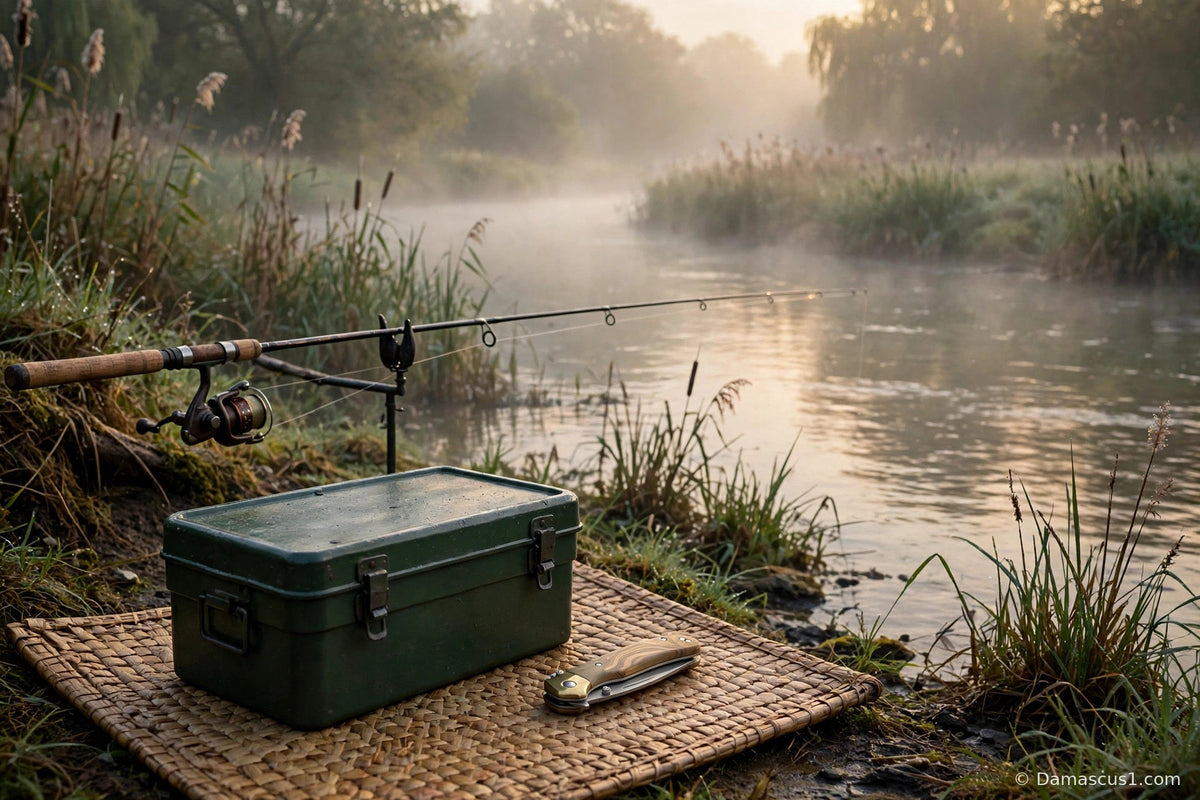
The short answer: The best gift for a fisherman in the UK is the folding knife his tackle box is missing: a handmade Damascus folder at $39.99 USD with a patterned 1095 and 15N20 blade, an olive wood handle and a back-lock. A fishing trip in progress is a genuine good reason to carry it, and the non-stainless blade asks for one honest habit after a wet session — wipe it dry, oil it lightly, sheath it dry.
Ask a British fisherman what he wants for Christmas and he will give you one of two answers. The first is "nothing, I've got everything" — which is untrue, because no fisherman has everything, and the second is a list of tackle so specific it might as well be written in code: a particular float in a particular size, a spool of braid in a breaking strain you have never heard of, a lure in a colour that exists only in one shop in Norfolk. Both answers are a problem for the gift-giver, and both are solved the same way: stop trying to buy tackle, and buy the tool that serves all of it.
That tool is a folding knife. Not a fillet knife — he already owns three, and the fourth would be a judgement on his taste. Not a multi-tool — he owns one, it lives in the bottom of his tackle box, and he uses two of its fourteen functions. A folding pocket knife: the thing that cuts line, trims a knot, opens a packet of hooks, slices an apple at lunchtime, prepares bait, and does the hundred small cutting jobs that a day on the bank produces. It is the most-used object in a fisherman's kit after his rod, and it is the object most fishermen have never been given a good version of, because the people who buy them gifts keep buying tackle instead.
This guide is the riverbank-led answer to "gifts for fishermen uk": the knife, the reason it belongs in a tackle box, the honest comparison with the fillet knives and multi-tools that currently own page one, the law — because a fisherman carrying a knife is the clearest good-reason case in British law, and it deserves to be stated properly — and the rust honesty, because a Damascus blade is not stainless and a wet session is the worst thing that can happen to it, and a gift guide that hid that would be a dishonest one.
Why is a folding knife the fisherman's missing tool?
Stand on a British riverbank at dawn — the mist on the water, the rod on its bank stick, the tackle box open on the mat — and watch what a fisherman actually does with his hands. He ties knots. He cuts line. He trims a tag end. He opens a packet. He cuts a slice of bread for the flask tea. He prepares bait. He does all of it, all day, with whatever edge is nearest, and for most fishermen the nearest edge is a blunt penknife bought a decade ago, or the scissors on a multi-tool, or — most often — his teeth.
A folding knife changes that day in a way no lure ever will, because it is the tool that serves every other tool. It is small enough to live in the tackle box lid, where our photograph shows it, or in a jacket pocket, where it is always within reach. It opens with two hands — a manual nail-nick opener, no spring, no flick, no button — which matters on a wet bank, because a two-hand opening is a deliberate opening, and a deliberate opening is a safe opening when your hands are cold and wet. It locks open, because a back-lock holds the blade firm while it is worked, and a blade that folds on cold fingers is a blade that cuts the wrong thing. And it is, in the case of the knife in this guide, a beautiful object: a pattern-welded Damascus blade of 1095 and 15N20 steels, about 276 layers, hardened to 58–60 HRC, with an olive wood handle that does not go slippery when wet the way polished plastic does.
The knife at the centre of this guide is the Olive Wood Damascus Pocket Knife at $39.99 USD — a 6.5-inch model, single-edged, manual two-hand opener, back-lock, with a 4.9/5 buyer rating on its product page. It is not a fishing knife in the specialist sense, and this guide will not pretend otherwise: it is a folding pocket knife that happens to be the best general tool a fisherman can carry, and the riverbank is where that generality earns its keep.
The good-reason case: can a fisherman carry a knife in the UK?

Yes — and a fishing trip is the clearest good-reason case in British law. Here is the short version, and our full explainers go deeper: UK legal pocket knife and Are locking knives legal in the UK.
The knife in this guide locks — its back-lock holds the blade open while it is used. That is a virtue on the bank, and it is also the reason this guide will never call it "UK legal carry": under s.139 of the Criminal Justice Act 1988, the only folding pocket knife you can carry in public without needing a reason is a non-locking folder with a cutting edge of 3 inches or less. A locking folder is legal to own and collect at home, and legal to carry in public with a good reason — and a fishing trip in progress is a textbook good reason. The trip itself is the reason: the knife is being carried to the river, used on the river, and brought home from the river, as part of an activity that needs a blade. The same applies to camping, to work, and to transport to and from a legitimate use.
What is not a good reason is everything else: "just in case", "I forgot it was there", self-defence. The burden of proving the good reason falls on the carrier, so the honest advice is to carry the knife as part of the fishing kit — in the tackle box, in the fishing bag, with the rod and the net — and not loose in a coat pocket on the way home from the pub after the fishing is done. Keep it with the kit, keep the kit with the trip, and the law and the fishing stay on the same side. The maximum penalty is up to 4 years' imprisonment and an unlimited fine, stated hedged as the statute provides. That sounds severe, and it is meant to: the law is written for public safety, and the way to respect it is to treat the knife as a tool for a purpose, not a habit. General information, not legal advice, as ever.
Two more rules matter for a Christmas gift. Under-18 sales are banned — you cannot buy a knife for a young angler, and this guide's knife is an adult gift, full stop. If the fisherman in your life is under 18, buy him tackle, not a blade. And online sales require real age verification: under the Offensive Weapons Act 2019, the seller must run a genuine age-verification system (a self-declared date of birth alone is not enough), the parcel must be marked and delivered into the hands of an adult aged 18 or over, and bladed products cannot go to lockers or click-and-collect, or be left on a doorstep. Our full guide to the process is Can you buy knives online in the UK. Plan the handover before you order, especially at Christmas.
Folding knife vs fillet knife vs multi-tool: the honest comparison

Page one for "gifts for fishermen uk" is dominated by two kinds of answer: gift guides that recommend a fillet knife and a sharpener, and tackle-shop guides that recommend a multi-tool. Both are reasonable. Both miss the point. Here is the honest comparison.
| Damascus folder (this guide) | Fillet knife | Multi-tool / pliers | |
|---|---|---|---|
| Price (as listed) | $39.99 USD | Varies — a decent fillet knife is a similar price | Varies — a good one costs more |
| What it does best | Everything small: line, knots, packets, bait, lunch | One thing brilliantly: filleting a fish | Many things adequately: pliers, scissors, screwdriver |
| In the tackle box? | Yes — lives in the lid, always to hand | Yes — but only used at the end of the day | Yes — but heavy, and the blade is an afterthought |
| One-handed use | No — two-hand nail-nick opener, deliberate and safe | Yes — fixed blade, always ready | Sometimes |
| Lock | Yes — back-lock holds it open under load | N/A — fixed | Sometimes |
| Looks like a gift? | Yes — patterned Damascus, olive wood | No — a work tool | No — a work tool |
| After a wet session | Wipe dry, oil lightly, sheath dry (see below) | Wash, dry, oil | Dry the joints, oil the pivots |
| The catch | Not stainless — needs the 30-second routine | Not a pocket tool — too long, too specialised | The knife blade is the weakest part of it |
The fillet knife's case is real and this guide will not argue against it: if the fisherman in your life keeps his catch and fillets it at the bank or at home, a long, thin, flexible fillet blade is the right tool for that one job, and a folding knife cannot replace it. The fashion and tackle guides on page one are right about that. But a fillet knife is a specialist, and a specialist is a poor gift for a man who already owns three — which, if he keeps his catch, he does. The folding knife is the generalist, and the generalist is the gift, because it is the tool he will use on every trip, whether he keeps a fish or not. Buy the fillet knife for the man who has told you, specifically, that he wants a fillet knife. Buy the folder for every other fisherman.
The multi-tool's case is weaker. A good multi-tool is a fine object, and the tackle-shop guides that recommend pliers and multi-tools are not wrong that a fisherman needs pliers. But a multi-tool's knife blade is always a compromise — short, thick, hard to sharpen, and buried among fourteen other tools — and a fisherman who already owns a multi-tool does not need a second one. What he needs is a proper blade, and that is the folder.
Stainless vs Damascus: the rust honesty
This is the section a dishonest gift guide would skip, and it is the most important section in this post. The Damascus blade in this guide is not stainless. Its steels are 1095 and 15N20 — high-carbon steels, chosen because their contrast makes the pattern visible and because they take a keen, easily sharpened edge. High-carbon steel rusts. Stainless steel, by comparison, resists rust because of its chromium content, and it is the reason most fishing knives are stainless: a fishing knife lives in a wet world, and stainless forgives the wet.
So why give a fisherman a non-stainless knife? Because the trade is honest and the price of the trade is small. The Damascus blade holds a keener edge, sharpens more easily, and looks — there is no polite way around this — far better than any stainless blade in the same price range. The cost is a thirty-second habit after every wet session, and that habit is the subject of the next section. If the fisherman in your life will not do thirty seconds of care after a wet day — and you know him well enough to judge that — then buy him a stainless folder instead, and this guide will have done its job by telling you so. If he will — and most fishermen, who already dry their reels and oil their rods, will — then the Damascus blade is the better knife, and the better gift.
One more honest point. The pattern on a Damascus blade is revealed by etching, not created by it, and the etch lives on the surface of the steel. That means the pattern is vulnerable to exactly the things that damage any etched surface: coarse abrasives, wire wool, and neglect. The care routine below protects both the edge and the pattern, and it is the same routine whether the knife is a week old or ten years old. Our US hub Can Damascus steel rust covers the same question in its American form, and our care guide Damascus folding knife care is the full ownership routine this section summarises.
The 30-second routine after a wet session

Do this at the bank, before the knife goes back in the tackle box, or at home before it goes in a drawer. It takes thirty seconds, and it is the difference between a knife that lasts decades and a knife that blooms with rust by February.
- Open the blade and wipe it dry. A soft cloth, both sides, the spine, the edge. Pay attention to the pivot and the nail nick, where water hides. The photograph shows exactly this: hands, a cloth, a wet bench, a bottle of oil.
- Wipe the handle dry too. Olive wood is dense and naturally oily, but it is still wood, and standing water in the pivot or under the scales is what causes trouble. A dry handle is a happy handle.
- Oil the blade lightly. A drop of food-safe mineral oil on a cloth, wiped over the blade, is enough. You are not marinating it; you are leaving a whisper of oil on the steel, which is what keeps the air and the moisture off it between sessions.
- Oil the pivot. One drop, worked in by opening and closing the blade a few times. A wet pivot that is never oiled is a stiff pivot by spring.
- Sheath it dry, store it dry. The knife in this guide comes as a set, and the leather sheath is part of the gift — but a leather sheath that is wet inside is a rust incubator, not a protector. If the sheath is wet, dry it separately and sheath the knife only when both are dry. Store the knife dry, in its sheath or its box, never loose in a damp tackle box or a wet bag.
- Check it monthly in winter. A quick look, a quick wipe, a drop of oil. Five minutes a month through the wet season is all the maintenance a Damascus folder asks for, and it is less time than the fisherman already spends on his reel.
What never to do: never leave the knife wet in the tackle box overnight, never put it in the dishwasher, never attack rust with wire wool or a coarse abrasive (which will also strip the pattern), and never store it in a damp shed or garage through a British winter. If surface rust does appear, the remedy is a baking-soda paste and a soft cloth, worked in straight lines, then dried and oiled — and the full rust guide is [PLANNED: how-to-remove-rust-from-a-damascus-knife-uk, Day-6 topic in this series, link at publish]. The UK sharpening edition is [PLANNED: how-to-sharpen-a-damascus-knife-uk, Day-3 draft in this series, link at publish], and the real-vs-fake edition is [PLANNED: how-to-tell-if-damascus-steel-is-real-uk, Day-3 draft in this series, link at publish].
Which fisherman, which gift?


Not all fishermen fish the same way, and the gift should match the water.
The coarse angler — the man on the riverbank at dawn in our cover photograph, rod on a bank stick, tackle box open on the mat — is the folder's natural owner. His day is knots, line, bait and lunch, all of it small cutting, all of it the folder's work. Give him the olive wood hero, and add a small bottle of food-safe mineral oil and a cloth to the parcel, so the thirty-second routine starts on day one.
The fly fisherman is the most demanding recipient, because his kit is the most refined and his standards are the highest. He will appreciate the Damascus pattern — a fly fisherman notices craft — and the two-hand opening, which is deliberate and safe with cold, wet hands. He will also be the quickest to notice if the blade is not sharp, so include the honest note that the blade arrives sharp and is easily kept sharp with a small stone.
The sea angler fishes in the hardest environment for carbon steel: salt water, salt air, wet everything. The Damascus folder will serve him well, but only if the thirty-second routine becomes a salt-water routine — rinse the blade in fresh water first, then dry, then oil, every single time. If you doubt he will do that, buy him stainless. This guide would rather lose a sale than sell a knife into a life it does not suit.
The pike or predator angler carries heavier kit and does heavier cutting — unhooking tools, wire traces, bigger bait. The folder still earns its place as the general tool, but pair it honestly: the folder for the small work, and let him keep his dedicated tools for the heavy work. Do not pretend a folding knife is a wire cutter; it is not, and the fisherman will know that before you finish the sentence.
The Christmas fisherman — the man who fishes twice a year, once at Easter and once in August, and talks about it all year — is the easiest gift of all, because for him the knife is as much a symbol as a tool: the promise of the next trip, kept in a pocket. Give him the hero in its gift box, with a float and a sprig of holly on top, as in our Christmas photograph, and let the knife do the promising.
What else goes in the parcel?
A knife alone is a complete gift. A knife with the right companions is a better one, and the companions are cheap.
- A small bottle of food-safe mineral oil and a soft cloth. The thirty-second routine, ready on day one. The single most useful addition to this gift.
- A leather sheath, if the set does not already include one. Confirm the set contents on the product page before ordering; the page itself advises confirming current sheath and companion pieces.
- A fishing float and a sprig of holly, on top of the wrapping. Not a product, but the difference between a parcel and a present.
- A second knife, for the fishing partner. Two heroes at $39.99 USD each is $79.98 combined, which crosses the store's $50 free-shipping threshold — and a fishing trip is a two-person activity, so the gift doubles neatly. The warmer-toned stablemate, the Orange Wood 6.5" Hunting Pocket Knife, also $39.99 USD, lets you tell the two apart at a glance.
- An engraving. A name, initials, or "TIGHT LINES" — up to 25 characters, quote-based, with proof and timing confirmed before work starts. Our engraving guide is [PLANNED: engraved-pocket-knife-gift-uk, sibling draft in this series, link at publish]. Order early; engraving is not a last-minute addition.
For the fisherman who also cooks his catch, the Premium Kitchen Knife Block Set at $169.99 USD is the kitchen half of the same story — but that is a main gift, not a tackle-box gift, and it belongs under the tree rather than in the stocking. If this is his first Damascus knife, our UK buyer's guide sets out the full case, and the under-£40 gift roundup places the same knife among the other gifts at this price.
The riverbank gift test — the citable checklist
| Test | Pass looks like | The Damascus folder |
|---|---|---|
| Used on every trip | In the tackle box lid, not the drawer at home | Daily cutting: line, knots, bait, lunch |
| Good reason to carry | The trip itself — fishing in progress | A fishing trip is a textbook good reason; never "just in case" |
| Survives the wet | A 30-second routine the owner will actually do | Wipe dry, oil lightly, sheath dry — non-stainless, honestly stated |
| Feels like a gift | Pattern, wood, weight — made, not moulded | Pattern-welded 1095/15N20, ~276 layers, olive wood |
| Legal to give | Adult recipient, age-verified delivery | 18+ only; marked parcel, adult handover, no lockers |
| Honest price | Stated as listed, no invented conversion | $39.99 USD as listed; checkout in USD |
The Olive Wood Damascus Pocket Knife Set — $39.99
Real Damascus steel, an olive wood handle and a genuine leather sheath included — the knife our readers ask about most.
Shop the Olive Wood Damascus Pocket Knife Set — $39.99 · Free US shipping on orders over $50.
Frequently asked questions
What is the best gift for a fisherman in the UK?
The folding knife his tackle box is missing. A handmade Damascus folder at $39.99 USD is the strongest single answer: it is used on every trip, it fits the tackle box lid, it feels like a gift, and it lasts for years with a thirty-second wipe-and-oil routine after wet sessions.
Can a fisherman legally carry a pocket knife in the UK?
Yes, with a good reason — and a fishing trip in progress is a textbook good reason. The knife in this guide locks, so it is legal to own at home and legal to carry on a fishing trip, but it is not a "UK legal carry" knife: the only folders that can be carried without a reason are non-locking with a cutting edge of 3 inches or less. Carry it with the kit, on the trip. General information, not legal advice.
Will a Damascus knife rust if it gets wet fishing?
Yes, it can — the blade is 1095 and 15N20 carbon steel, which is not stainless. The remedy is a thirty-second routine after every wet session: wipe the blade dry, oil it lightly with food-safe mineral oil, dry the pivot, and sheath it only when both knife and sheath are dry. Done every time, the knife will last for decades.
Is a folding knife or a fillet knife better for a fisherman?
Different jobs. A fillet knife is the specialist for filleting a kept fish, and a fisherman who keeps his catch probably already owns several. A folding knife is the generalist for everything else — line, knots, bait, packets, lunch — and it is the tool he will use on every trip, whether he keeps a fish or not. Give the folder unless he has specifically asked for a fillet knife.
What should I put with a pocket knife as a fishing gift?
A small bottle of food-safe mineral oil and a soft cloth, so the after-session routine starts on day one. A leather sheath if the set does not include one. An engraving — a name or "TIGHT LINES" — turns it into a keepsake. A second knife for the fishing partner crosses the $50 free-shipping threshold at $79.98 combined.
Can you buy a knife online as a gift in the UK?
Yes, with age verification. The seller must run a genuine age-verification system, the parcel must be marked and delivered into the hands of an adult aged 18 or over, and bladed products cannot go to lockers or click-and-collect, or be left on a doorstep. Order to an address where an adult will be in, and keep the gift a surprise by delivering to yourself, not the recipient.
Is an engraved pocket knife a good gift for a fisherman?
Yes — engrave a name, initials, or "TIGHT LINES", up to 25 characters, quote-based with a proof confirmed before work starts. It turns the tackle-box tool into a keepsake, and it is the one engraving a fisherman will see every time he opens his box. Order early, because engraving adds lead time.
How do I keep a Damascus knife from rusting after fishing?
Wipe it dry immediately, oil it lightly with food-safe mineral oil, dry the pivot, and store it dry. After salt water, rinse in fresh water first, then dry and oil. Never leave it wet in the tackle box overnight, never use wire wool, and never put it in the dishwasher.
The honest close: Buy the fisherman a knife, not more tackle. The Olive Wood Damascus Pocket Knife at $39.99 USD, folded into the tackle box lid, carried on the trip that gives it its good reason, wiped dry and oiled after every wet session — that is a gift that will be in his hands on every riverbank for years. DRAFT — awaiting Faisal's word before anything is published.
Leave a comment: