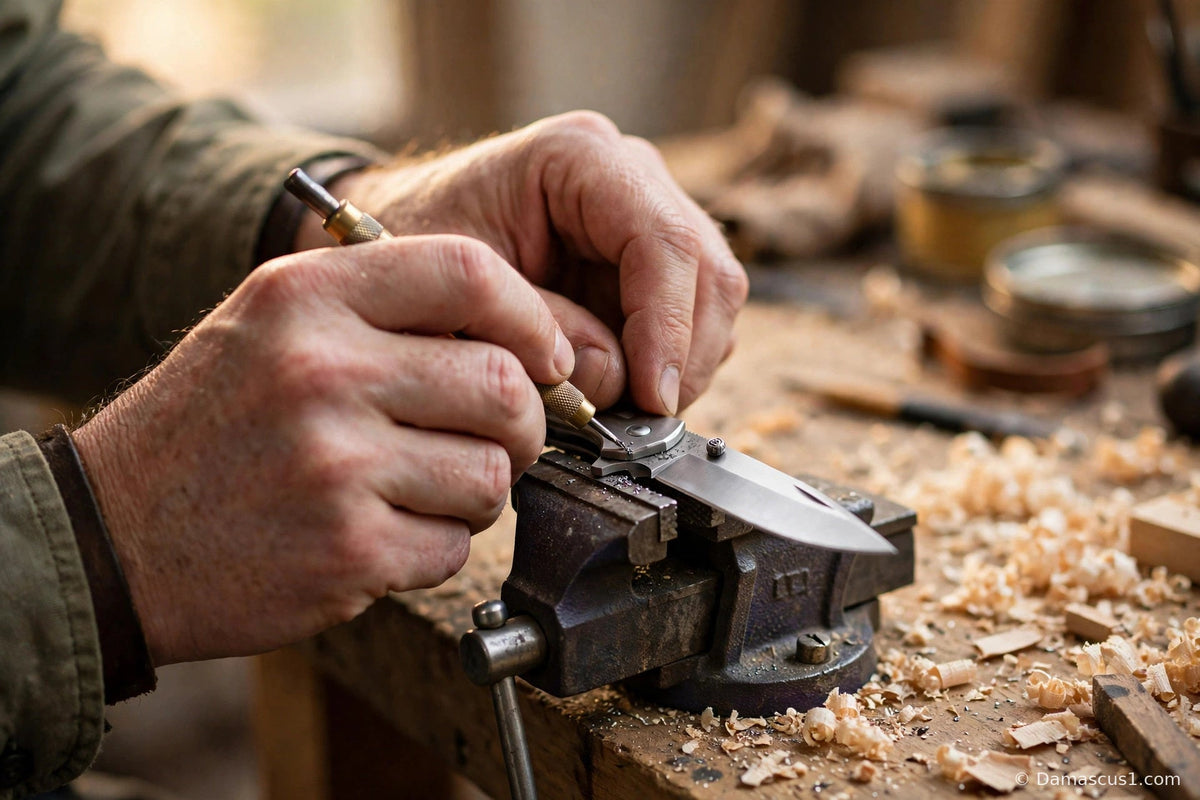
The short answer: An engraved pocket knife is the personalised gift that actually gets kept, because the engraving turns a useful object into a named one. A handmade Damascus folder at $39.99 USD, with engraving available on request for a name, initials or short message up to 25 characters, suits groomsmen, retirements, milestone birthdays and fathers — ordered early, delivered to an adult aged 18 or over with real age verification.
There is a particular kind of gift that every British family knows: the personalised object. It arrives at Christmas, at a wedding, at a retirement do, and it is unwrapped in front of people, read aloud, and then — this is the part that matters — it is kept. Not used for a week and forgotten, not admired once and shelved, but kept: in a pocket, in a drawer that matters, on a desk where it is seen every day. Most personalised gifts fail that test. A mug with a name on it chips. A keyring with initials on it snaps. A plaque with a date on it gathers dust on a wall nobody looks at. The reason they fail is simple: the personalisation is the whole gift, and the object underneath it is not worth keeping.
An engraved pocket knife inverts that formula. The object underneath is already worth keeping — a handmade Damascus folder with a patterned blade of 1095 and 15N20 steels, about 276 layers, hardened to 58–60 HRC, with an olive wood handle — and the engraving is the thing that makes it his. That is the whole argument of this guide, and it is why an engraved knife is the rare personalised gift that survives the occasion it was bought for. The rest of this guide is the practical part: what to engrave, who it suits, how the ordering works, what it costs (and what it does not cost, because the engraving price is quoted rather than published), and the law — because a knife is a gift with responsibilities in Britain, and the delivery rules matter more, not less, when the gift is personalised and cannot be returned and re-gifted.
Why does engraving change a knife?
A knife without engraving is a tool. A knife with a name on it is a possession in the older sense of the word — something that belongs to a person, not merely something a person owns. The difference is visible in how people treat the two objects. An unmarked knife is lent, lost, left in a tackle box. A knife with initials on the blade is carried, oiled, sharpened, and handed down. The engraving does not make the knife better at cutting — it makes the knife harder to lose, harder to lend, and harder to forget, which for a gift is a more valuable improvement than sharpness.
There is also a quieter reason engraving suits a knife better than it suits most objects. A knife is a private object. It lives in a pocket, not on a shelf; it is used alone, not displayed. Engraving on a knife is therefore a private message — a name, a date, a short line — carried close and seen mostly by its owner. That intimacy is what makes it right for the occasions this guide covers: a wedding, a retirement, a fiftieth birthday, a father's Christmas. These are not occasions for a joke or a slogan. They are occasions for a name and a date, done well, on an object that will still be legible in twenty years.
The engraving itself, on the knife in this guide, is done on request. The store's product page puts it plainly: request an engraving design quote for a name, initials or short message of up to 25 characters, and proof, price and timing are confirmed before any custom work starts. That last clause matters, because it means you see the design before it is cut — there is no blind engraving, no guessing how a name will look on a blade. It also means the price is quoted per job rather than published as a flat rate, and this guide will not invent a figure for it. What it can say is that the knife itself is $39.99 USD, the engraving is an addition quoted on top of that, and the total remains, by any honest measure, a modest sum for a keepsake.
What should you engrave? The 25-character rule
Twenty-five characters is not many. It is enough for a name, or initials and a date, or a short line — and the discipline of the limit is part of the gift's quality, because it forces you to choose the words that matter and leave the rest out. Here is what works, by occasion, and what does not.
Names and initials. The safest and most enduring choice. "J. HARRISON", "DAD", "GRANDAD", a full first name — a name on a blade does not date, does not depend on a joke landing, and is legible to anyone who picks the knife up in thirty years. If the recipient has a nickname that has followed him for decades, use the nickname; a knife engraved with the name his friends actually call him is a better gift than one engraved with the name on his birth certificate.
Initials and a date. The classic. "T.W. — 14.06.2026" for a wedding, "R.J. 1976–2026" for a fiftieth, "EST. 1989" for a couple's anniversary year. Dates are the most durable form of personalisation there is, because they anchor the object to a day, and a knife that carries a date becomes a record, not just a tool. Keep the format British — day, month, year — and keep it short; the blade is not a headstone.
A short line. Up to 25 characters allows a fragment, not a sentence: "ALWAYS WITH YOU", "FOR THE LONG ROAD", "TIGHT LINES, DAD", "TO THE BEST MAN". A short line works when it is something the two of you actually say — a family phrase, a fishing farewell, a line from a shared joke. It fails when it is a generic sentiment copied from a gift website, because a generic line on a personal object reads as a contradiction. If you cannot think of a line that only the two of you would recognise, engrave the name instead. The name is always right.
What not to engrave. Long messages, full sentences, song lyrics, anything that needs a second line. The blade is a narrow surface and crowded engraving is illegible engraving. Avoid anything you would be embarrassed to have read aloud at the wedding breakfast, because it will be read aloud at the wedding breakfast. And never engrave a knife for a child — under-18 sales are banned, and this guide's knife is an adult gift, full stop.
Our US hub, Engraved pocket knife gift, covers the same decision in its American form; this UK edition is the version with British delivery law, British dates, and British occasions.
Who is an engraved pocket knife for?


The short answer is: anyone whose occasion deserves a named object. The longer answer, by recipient, is where the guide earns its keep.
The groomsmen. This is the single best use of an engraved knife, and the reason the photograph at the top of this section shows three matching folders in a row. A wedding party needs a gift that is identical in value, different in identity, and useful after the day. Three — or four, or five — of the same knife, each engraved with a different name or a different role ("BEST MAN", "USHER", "FATHER OF THE BRIDE"), solves the problem completely: the same object, the same price, a different name on each, and every one of them carried for years afterwards. The arithmetic is honest: three heroes at $39.99 USD each is $119.97 USD before engraving, and the three together cross the store's $50 free-shipping threshold several times over. Order three to six months ahead for weddings — the lead time is not the knife, it is the engraving queue, and a wedding has a fixed date that does not move. Our groomsmen guide, Groomsmen knife gift, covers the wider groomsmen decision; this page is the engraving half of it. For the same knife in its festive context, see Damascus knife gift for men in the UK and the US hub Damascus knife gift for him.
The retiree. A retirement is the occasion a personalised knife was invented for, because it is the one moment in a working life when a person is given an object that is supposed to last as long as the career it marks. Engrave the name, the years of service, or the date of the last day: "J. CARTER — 1989–2026", "THANK YOU, 37 YEARS". The knife then sits on a desk or in a drawer as a daily reminder, and — unlike a carriage clock or a crystal vase — it is used. The olive wood handle deepens in colour with handling and oiling, so the knife genuinely looks better in its second year than its first, which is a rare quality in a retirement gift.
The father, at Christmas or on a milestone birthday. Dad's engraved knife is the upgrade of the stocking-filler case made in our companion guide [PLANNED: stocking-fillers-for-men-uk, sibling draft in this series, link at publish]: the same $39.99 USD folder, but with his name or initials on it, in a presentation box rather than a stocking. It is the difference between a gift and a keepsake, and it is the right call for a fiftieth, a sixtieth, or the Christmas when Dad has finally stopped pretending he wants nothing.
The fisherman and the outdoorsman. Engrave a fishing farewell — "TIGHT LINES" — or the name of a river, a loch, a stretch of coast. An outdoorsman's knife is the most-used object he owns after his boots, and an engraved one is the one he will not lend and will not lose. Our riverbank guide [PLANNED: gifts-for-fishermen-uk, sibling draft in this series, link at publish] takes the same knife to the water.
Who it is not for. It is not for a colleague you barely know, because a named knife is an intimate gift and intimacy without a relationship is awkward. It is not for a child, because under-18 sales are banned. It is not for someone who has told you they do not like knives, because no amount of engraving fixes a gift the recipient did not want. And it is not a last-minute gift: engraving is done on request, with a proof and confirmed timing, and a personalised object ordered the week before Christmas is a gamble this guide will not recommend.
How does ordering an engraved knife actually work?
In four steps, none of them complicated, all of them worth doing in order.
Step one: choose the knife. The knife in this guide is the Olive Wood Damascus Pocket Knife at $39.99 USD — a 6.5-inch model, pattern-welded 1095 and 15N20, about 276 layers, 58–60 HRC, olive wood handle, manual two-hand nail-nick opener, back-lock, single edge. Its warmer-toned stablemate, the Orange Wood 6.5" Hunting Pocket Knife, also $39.99 USD, is the alternative for a recipient who would suit a warmer wood, or for a set where two knives need to be told apart at a glance. For a wedding party, order the same knife for everyone; for a family, the two woods let you distinguish Dad's from Grandad's without reading the engraving.
Step two: request the engraving quote. On the product page, request an engraving design quote for a name, initials or short message up to 25 characters. This is the step where you supply the exact text — check the spelling twice, check the date twice, and check that you have not used more than 25 characters including spaces and punctuation. The store confirms proof, price and timing before any custom work starts, so you will see the design and the price before the blade is touched. Do not order the plain knife and ask for engraving afterwards; the engraving is part of the making, not an addition to a finished object.
Step three: approve the proof. Read the proof as if it were going to be read aloud in front of people, because it will be. Check the spelling of the name — the single most common engraving error in the world is a misspelt name, and a misspelt name on a blade cannot be undone. Check the date. Check the capitalisation. Then approve, and only then does the work start.
Step four: plan the delivery. This is the step British buyers most often get wrong, and it is the subject of the next section. An engraved knife is a personalised, non-returnable object, so the delivery must land in the right hands, on the right day, with the recipient old enough to receive it. Plan the handover before you order, not after.
Delivery and the law: plan the handover before you order
A knife bought online in the UK is not delivered like a book. Under the Offensive Weapons Act 2019 and the Criminal Justice Act 1988, the seller must run a genuine age-verification system — a self-declared date of birth alone is not enough — the parcel must be marked and labelled, it must be delivered into the hands of an adult aged 18 or over, and bladed products cannot go to lockers or click-and-collect, and cannot be left on a doorstep. Our full guide to the process is Can you buy knives online in the UK.
For a personalised gift, those rules have three practical consequences. First, the buyer must be 18 or over and the recipient must be 18 or over — under-18 sales are banned, and an engraved knife for a child is not a gift, it is an offence. Second, someone must be in to receive it: the parcel is handed to an adult, not left on the step, so order to an address where an adult will be present — your own home, not the recipient's, if you want the gift to stay a surprise. Third, allow time: the engraving proof, the custom work, and the age-verified delivery each add days, and a personalised gift ordered in the last week before a wedding or Christmas is a gift that may arrive after the occasion. For weddings, the honest lead time is months, not weeks; for Christmas, order in November.
One more law point, because it is the one every British knife guide must state and this one is no exception. The knife in this guide locks — its back-lock holds the blade open while it is used. That makes it an own, collect and good-reason knife, and it is the reason this guide will never describe it as "UK legal carry": under s.139 of the Criminal Justice Act 1988, the only folding pocket knife that can be carried in public without a reason is a non-locking folder with a cutting edge of 3 inches or less. A locking folder is legal to own and collect at home, and legal to carry in public with a specific, current good reason — a fishing trip in progress, a camping trip, work — but "just in case", "I forgot it was there" and self-defence are not good reasons, and the burden of proving the good reason falls on the carrier. The maximum penalty is up to 4 years' imprisonment and an unlimited fine, stated hedged as the statute provides. Our full explainers are UK legal pocket knife and Are locking knives legal in the UK. General information, not legal advice, as ever.
Engraved vs plain: which should you buy?
| Plain Damascus folder | Engraved Damascus folder | |
|---|---|---|
| Price | $39.99 USD as listed | $39.99 USD + quoted engraving (price confirmed before work starts) |
| Lead time | Standard shipping | Longer — proof, custom work, then shipping |
| Best for | Stockings, everyday carry, a first Damascus knife | Groomsmen, retirements, milestone birthdays, fathers |
| Returnable | Under the store's returns policy | Personalised — assume not returnable; check the proof twice |
| The risk | None — it is a beautiful knife | A misspelt name, or a late delivery; both avoidable by ordering early |
| The reward | A daily-use object | A keepsake that carries a name and a date for decades |
The honest rule is simple: engrave when the occasion has a name and a date; buy plain when it does not. A Christmas stocking filler does not need engraving — our stocking guide [PLANNED: stocking-fillers-for-men-uk, sibling draft in this series, link at publish] makes that case. A wedding, a retirement and a fiftieth birthday do, because those are the occasions where the gift is meant to be a record. If you are unsure, buy plain: a beautiful unmarked knife is a better gift than a badly engraved one, and the engraving can always be the next gift's reason.
What the page-one listings get wrong
The current page one for "engraved pocket knife gift uk" is, like most gift keywords, a shelf of listings rather than a guide. Amazon offers a 67-layer Damascus VG10 rosewood folder already engraved, and a personalised Damascus folder from a craft seller; laser-engraving services offer engraved Buck knives with a one-to-three-day lead and no minimum order, free shipping; Etsy offers a personalised groomsman knife from around $9.62, engraved with up to 10 characters; bulk engravers want a minimum of 12; a British engraving house quotes five to ten business days and advises ordering three to six months ahead for weddings. None of them is a bad product. But none of them is a guide either — they sell objects, and they leave the buyer to work out, alone, what to engrave, who it suits, how the delivery works, and whether the knife underneath the engraving is worth keeping.
The gaps are the reason this guide exists. No page-one result explains the 25-character discipline, or the proof step, or the difference between engraving a keepsake and engraving a novelty. No page-one result sets out the British delivery rules — age verification, adult handover, no lockers, no doorstep — that govern an engraved knife bought online. And no page-one result is written in British English about a handmade Damascus folder at a stocking-filler price with a named steel and a named layer count. This guide is the first page-one-shaped answer to do all three, and its advantage is not that it sells a cheaper knife — the Etsy groomsman knife is cheaper — but that it tells the truth about the whole decision, including the parts (the proof, the lead time, the law) that a listing has no reason to mention.
Caring for an engraved knife
An engraved knife is cared for exactly like an unengraved one, with one extra rule: never polish the engraving. The blade is 1095 and 15N20 Damascus, which is not stainless — keep it clean and dry, wipe it after use, and oil it lightly, as our care guide Damascus folding knife care sets out (linked here as the US hub; the UK care edition is [PLANNED: how-to-sharpen-a-damascus-knife-uk, Day-3 draft in this series, link at publish]). The engraving itself is a shallow cut in the steel; aggressive polishing, wire wool, or a coarse abrasive will soften its edges and blur its letters, and a blurred name is worse than no name. Clean the blade with a soft cloth, dry it thoroughly — around the pivot twice over — and oil the blade lightly with food-safe mineral oil. Oil the olive wood handle with the same food-safe mineral oil every month or two through the central-heating season, when dry indoor air pulls moisture from the wood. Store the knife dry, in its sheath or its presentation box, never loose in a damp shed. The pattern on a Damascus blade is revealed by etching, not created by it, and the same care that protects the pattern protects the engraving: gentle, dry, oiled, and out of the dishwasher entirely.
The engraving decision — the citable checklist
| Question | If yes | If no |
|---|---|---|
| Does the occasion have a name and a date? | Engrave — a wedding, retirement, milestone birthday | Buy plain — a stocking, a first knife, a thank-you |
| Is the recipient 18 or over? | Proceed | Stop — under-18 sales are banned |
| Can you order weeks (weddings: months) ahead? | Engrave — the proof and custom work need time | Buy plain — a late engraved gift misses the occasion |
| Do you know exactly what to write (25 characters or fewer)? | Engrave it | Buy plain — a vague engraving is worse than none |
| Is someone 18+ available to receive the parcel? | Proceed — age-verified adult handover | Arrange a delivery address where an adult will be in |
| Will the recipient use it, not just display it? | Engrave — the knife is a daily object | Consider a different gift — a display piece is not a knife's job |
The Olive Wood Damascus Pocket Knife Set — $39.99
Real Damascus steel, an olive wood handle and a genuine leather sheath included — the knife our readers ask about most.
Shop the Olive Wood Damascus Pocket Knife Set — $39.99 · Free US shipping on orders over $50.
Frequently asked questions
Can you get a pocket knife engraved in the UK?
Yes. Engraving is available on request for the knife in this guide — a name, initials or short message up to 25 characters, with proof, price and timing confirmed before custom work starts. Laser-engraving services in the UK also engrave supplied knives, typically with a one-to-three-day lead and no minimum order, but ordering the knife and the engraving together avoids posting a blade twice.
How much does it cost to engrave a pocket knife?
The knife itself is $39.99 USD as listed. The engraving price is quoted per job, not published as a flat rate, and is confirmed with a proof before any custom work starts — this guide does not invent a figure for it. As a sense of the market, British engraving houses typically charge a modest per-item fee, and bulk engravers often require a minimum order of around 12.
What should I engrave on a pocket knife for my dad?
His name or initials, or his initials and a date. "DAD", "J. HARRISON", "T.W. — 14.06.2026" — short, legible, and still meaningful in twenty years. Avoid long messages and generic sentiments; if you cannot think of a line that only the two of you would recognise, engrave the name instead.
Is an engraved pocket knife a good groomsmen gift?
Yes — it is the best use in this guide. The same knife for each groomsman, each engraved with a different name or role, is identical in value, different in identity, and useful for years after the wedding. Order three to six months ahead, because the engraving queue, not the knife, sets the lead time.
Can you buy an engraved knife online in the UK?
Yes, with age verification. The seller must run a genuine age-verification system, the parcel must be marked and delivered into the hands of an adult aged 18 or over, and bladed products cannot go to lockers or click-and-collect, or be left on a doorstep. Plan the handover before you order. General information, not legal advice.
Is it legal to carry an engraved pocket knife in the UK?
The knife in this guide locks, so it is legal to own and collect at home, and legal to carry in public only with a specific, current good reason — a fishing trip in progress, a camping trip, work. It is not a "UK legal carry" knife: the only folders that can be carried without a reason are non-locking with a cutting edge of 3 inches or less. Under-18 sales are banned.
How long does engraving take?
It depends on the engraver and the queue. The knife in this guide is engraved on request with a proof and confirmed timing before work starts; British engraving houses typically quote five to ten business days for the work itself and advise ordering three to six months ahead for weddings. Order in November for a Christmas gift, and months ahead for a wedding.
What happens if the engraving is spelt wrong?
That is why the proof step exists: proof, price and timing are confirmed before custom work starts, so you see the design before the blade is cut. Read the proof as if it were going to be read aloud at the wedding breakfast, check the spelling of the name twice, and only then approve. A misspelt name on a blade cannot be undone, so the proof is the most important step in the whole order.
The honest close: An engraved knife is the personalised gift that survives its occasion, because the object underneath the engraving is worth keeping and the engraving makes it his. Order the Olive Wood Damascus Pocket Knife at $39.99 USD, request the quote, read the proof twice, and give a man a knife with his name on it. DRAFT — awaiting Faisal's word before anything is published.
Leave a comment: