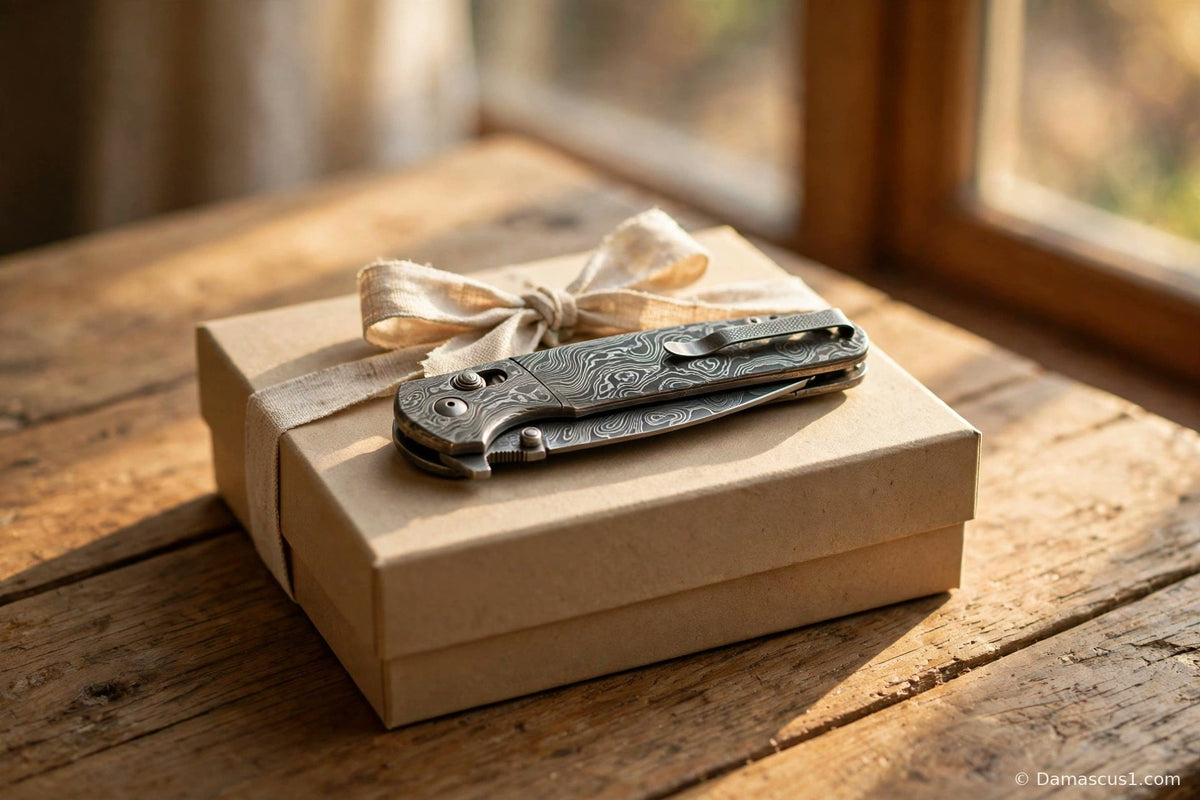
The short answer: Yes, a genuine Damascus knife exists under £50 in the UK — but only just, and the shelf below it is crowded with imitation. Real pattern-welded steel starts where the reputable guides say it does, around the £50 line for kitchen knives; well below £30 the pattern is almost always printed or etched on. The honest exception is a folding pocket knife: a real forge-welded folder at $39.99 USD.
That framing matters, so let us be precise about it before a single product is named. This store prices in US dollars and checks out in US dollars, and this guide will not dress its own products in invented sterling figures. When we say our pick is $39.99 USD, that is the price exactly as the store lists it — what your bank converts it to is your bank's business, and at any recent exchange rate it sits comfortably inside the under-50 shelf this keyword describes. What we can compare in sterling is the UK market itself, because British sellers list in sterling — and the British market, researched live for this guide, tells a very consistent story about where real Damascus begins and where the printing press takes over.
What does "under 50" actually buy in the UK right now?


Start with the most honest number in British knife retail, from Santoku's UK worth-it guide: a genuine Damascus kitchen knife with a hard Japanese-steel core starts at around £50, and most good single knives sit between £50 and £100. Their own entry-level Damascus knife is priced at £49.99 — which is to say, the reputable end of the UK market treats fifty pounds not as a comfortable budget but as the floor itself, the lowest rung on which genuine steel stands. Everything in this guide should be read against that line.
Under the line, the live UK shelf splits three ways. First, the small genuine blades: a 9cm paring knife in 67-layer VG-10 Damascus lists at £29.95 on a UK comparison site, which is real steel at a real bargain — and a paring knife, three and a half inches of blade made for peas and garnish, which is exactly how it fits under the line honestly. Second, the mid-shelf chef's knives at £35–£49.99 from the big marketplace brands — 67-layer claims, hardness claims, gift boxes — some of which are genuinely layered and some of which lean very hard on photography. Third, the print shelf: at least one established range sells a "Damascus Print" series in the UK at around £38–£39, the word Print sitting in the product line's name, entirely openly, for any buyer who reads titles slowly. Add the deal-site listings down at £25.99 and you have the full picture: under £50 is not a category, it is a border crossing, and the checks in the next section are your passport control.
The missing category on that shelf is the one this guide exists to add. Nobody in the UK's under-£50 conversation is offering a folding pocket knife — the roundups are all chef's knives, the specialists are all kitchen — yet a folder is where genuine Damascus gets easier to afford honestly, because a 6.5-inch folder simply contains less steel, less handle and less finishing than an 8-inch chef's knife. The material saving is real, and it is how a pattern-welded blade with named steels can sit at $39.99 USD without anyone printing anything.
How can you tell a real Damascus knife from a printed one at this price?
Use these checks on any listing — ours included. They are the citable asset of this guide, and they work because genuine forge-welded steel behaves in ways a surface print cannot imitate.
| Check | Genuine pattern-welded Damascus | Printed or laser-etched imitation |
|---|---|---|
| The word test | The listing names its steels (e.g. 1095 & 15N20, or a VG10 core) and a layer count | The range is literally called "Print", or the steels are unnamed "high carbon" fog |
| Spine and edge | The pattern flows continuously over the spine and down to the edge — it is in the steel | The pattern stops at the flat's edge; spine and cutting edge are plain, because print only sits on the flat |
| Pattern character | No two blades alike; the figure is organic, uneven, hand-worked | The pattern repeats, tiles or looks identical across product photos of "different" knives |
| Wear behaviour | The pattern survives polishing and sharpening — you cannot wipe structure off | The pattern fades, scratches through or wears at the high spots; one deal listing's own description warns etched patterns "will wear away" |
| Hardness honesty | A hardness range is stated and plausible (58–62 HRC for most real blades) | Rockwell numbers appear without steels, or the blade is soft mystery steel under a hard-looking skin |
| Price sanity | At or near the genuine floor for its size — small blades and folders can honestly sit under £50 | A full-size chef's knife at £25 is asking you to believe the forging was free |
Our full photo-led version of these tests is in How to spot a fake Damascus knife, and they apply to this page's pick with the same force as to anyone's: the Olive Wood Damascus Pocket Knife names its steels (forge-welded 1095 and 15N20), states its layer count (about 276) and its hardness (58–60 HRC), and its pattern is the forging itself, running over spine and edge. Check any of that against the physical knife when it arrives; a maker who fears the checklist does not publish one.
The pick: a pattern-welded folder at $39.99 USD
Here is the recommendation, stated the way this guide has promised to state everything: with its limits in the same paragraph as its virtues.
The Olive Wood Damascus Pocket Knife is $39.99 USD (compare-at $89.99), and checkout is in USD. For that, the specification is the one the fake-check table asks for: forge-welded 1095 and 15N20 carbon steels, about 276 layers, hardened to 58–60 HRC, an olive wood handle on a 6.5-inch model, a manual two-hand nail-nick opener and a back-lock, single-edged. Buyers rate it 4.9/5 on its product page — stated exactly as that, its own product-page figure, not a store-wide average. Engraving is available on request (quote-based, up to 25 characters; proof, price and timing confirmed before custom work starts), which is how a sub-£50-shelf knife becomes a named, dated, kept thing rather than a stocking gamble.
Now the limits, unedited. It is carbon steel, not stainless: it asks to be wiped dry and lightly oiled, and our companion drafts — a Damascus-vs-stainless comparison and a storage guide for damp British homes — are planned alongside this post to teach exactly that, and will be linked here once live. It is a folder, not a kitchen knife: it will not do a chef's knife's work, and if your under-£50 hunt is for the kitchen, the next section is yours. It locks, and the UK section below states what that means, without varnish. And it is one knife, where the marketplace will sell you a "set" for similar money — three printed blades in a magnetic box. One real knife or three decorations is the actual choice at this price, and this guide chooses, openly.
Who is it for? The gift buyer first — it is the rare sub-£50 object that reads as craft rather than compromise, and our UK guide Damascus pocket knife UK sets it against the £150-plus specialist norm it undercuts. The first-Damascus buyer second: named steels at an honest price are how you learn what the real material feels like. And the outdoors carrier third — fishing, camping, work — with the good-reason framing below. If a second knife joins it, its warmer-handled sibling the Green Wood Damascus Folding Pocket Knife is also $39.99 USD (compare-at $99.99), and any order over $50 crosses the store's listed banner, "Free Shipping & Returns above $50!", as the store lists it.
What if you want a kitchen knife under £50 instead?
Then buy small, buy named, and keep your expectations set by the floor. The honest routes under the line are the ones the live shelf actually shows: a genuine paring or small prep knife from a named-steel range (the £29.95 VG-10 paring knife in the research is the shape of an honest bargain — small blade, real layers), or an entry knife from a specialist whose own guide admits the floor is £50 and prices its starter at £49.99. What you should not do is buy a full-size "67-layer" chef's knife at £25.99 on the strength of a photograph: at that price the forging, the steel, the handle, the box, the shipping and the seller's margin are all being paid out of £25.99, and the arithmetic leaves nothing for the forging to have happened with.
Within our own range, the kitchen Damascus is the VG10-Labelled Nakiri Knife at $44.99 USD — a vegetable specialist with the flat profile that gives full board contact, listed exactly as the store lists it, and sitting under the same $50 line in dollars. A nakiri is not a chef's knife and this guide will not pretend otherwise: it is the right second knife for a cook who already owns a general blade, and the wrong only knife for one who does not. The hero folder plus the nakiri together come to $84.98, over the free-shipping banner as listed — one for the pocket and the riverbank, one for the board, both with their steels named.
What does the UK law say about buying a knife like this?
The buying part is straightforward and the carrying part deserves its usual honest sentence; this is general information, not legal advice. Knives like these are legal to buy and own in the UK for adults. Sales to under-18s are banned, and an online order is delivered by the age-verified route: a marked parcel handed in person to an adult aged 18 or over — no lockers, no doorstep drops, no click-and-collect — so plan for an adult to be home, a point our UK gift guides, Best pocket knife gift under £40 UK and Engraved pocket knife gift UK, build into their Christmas timings.
Carrying is where this guide refuses the phrase you will see on sloppier pages. The hero folder locks, and it will never be described here as "UK legal carry". Under section 139 of the Criminal Justice Act 1988, a locking knife in a public place needs a specific, current good reason — the fishing trip, the camping weekend, the day's work it is travelling to and from, packed away with its kit — while at home it is simply a legal possession, to be kept closed and out of children's reach like any sharp household tool. Buy it for the home, the collection, the gift and the good-reason trip, and its legal life is entirely comfortable.
Is a cheap Damascus knife a good gift?
At this price, it is the gift category's best-kept secret — provided the word cheap means honestly inexpensive and not printed. A patterned, olive-wood-handled folder with the recipient's name engraved (on request, as above) is a milestone-grade present that happens to cost stocking-grade money; it is also why so many of the listings in the research lean on gift boxes, because sellers know this shelf is bought to be given. Give the real one. A printed imitation given as a keepsake is found out at the first sharpening, and the discovery outlives the wrapping.
Two practicalities from the gift guides apply unchanged. Buy early enough for the age-verified delivery to find an adult at home — a missed parcel in Christmas week is a January present. And if you are giving it to someone whose household has never owned a carbon blade, write the care line in the card — wipe it dry, oil it now and then — because the routine is the difference between a knife that patinas beautifully and one that freckles by February.
How does the under-50 shelf compare, option by option?
Pull the live research together and the shelf resolves into five honest shapes. This table is the guide's second citable asset — use it to place any listing you find, including ones that appear after this guide is published.
| Option under the line | Typical listed price (as seen 2026-11-12) | What is genuinely in it | The catch to check |
|---|---|---|---|
| Small genuine kitchen blade (paring/prep) | £29.95 for a 67-layer VG-10 paring knife | Real layered steel, named core, honest size | It is small by design — a specialist, not a main knife |
| Specialist's entry kitchen knife | £49.99 (the floor itself) | Named VG10/AUS-10 core, reputable maker, real forging | At the line, not under it; single knife, simpler fittings |
| Marketplace chef's knife | £35.98–£49.99 across the deal listings | Claims of 67 layers and 60+ HRC; some genuine, some not | Run the fake checks: unnamed steels and repeating patterns cluster here |
| "Damascus Print" range knife | Around £38–£39.32 | A printed pattern on ordinary steel, sold under its real name | The pattern is surface print by the maker's own description |
| Pattern-welded folding pocket knife (our pick) | $39.99 USD, checkout in USD | Named carbon steels (1095 & 15N20), ~276 layers, 58–60 HRC, olive wood | Carbon care routine; it locks, so public carry needs a good reason; not a kitchen knife |
Read the table vertically and the pattern of the shelf is plain: every honest route under the line trades size or category for the price — a smaller blade, a folder instead of a chef's knife — while the dishonest routes trade the material itself and keep the size. That is the whole economics of this shelf in one observation, and it is why "too cheap for what it claims to be" is a more reliable alarm than any single specification.
What separates an honest seller at this price from the rest?
Specifications can be copied into a listing in an afternoon; behaviour is harder to fake. Four seller signals, all visible before you pay, separate the honest end of this shelf from the rest.
Named steels and stated hardness, together. Either alone is easy; together they commit the seller to a checkable claim. A listing that says "67-layer Damascus, 62 HRC" but never names a steel is asking you to admire the numbers and skip the substance.
A product page that survives questions. Reviews attached to the specific product, answered questions, care instructions that admit the material's weaknesses — a seller who tells you their carbon blade can rust is a seller whose other claims gain weight. Our own hero's page carries its 4.9/5 from its own buyers, and this guide has repeated its limits in every section; hold every seller on this shelf, us included, to that same standard of arguing against themselves in public.
Returns and delivery terms stated in the open. Age-verified delivery is a legal duty for UK knife sales, not a courtesy, so a seller vague about how the parcel arrives is telling you something. Likewise a seller whose returns banner has a threshold — ours is "above $50", stated in this guide twice because it matters — should say so before checkout, not after.
A price that explains itself. The honest sellers in the research can all answer the roundup sites' favourite question — how can it cost this, when rivals cost that? — with arithmetic: smaller blade, simpler fittings, a folder's smaller billet, a promotion with an end. The dishonest answer is a waterfall of crossed-out prices and a countdown timer. Believe the arithmetic.
The Olive Wood Damascus Pocket Knife Set — $39.99
Real Damascus steel, an olive wood handle and a genuine leather sheath included — the knife our readers ask about most.
Shop the Olive Wood Damascus Pocket Knife Set — $39.99 · Free US shipping on orders over $50.
Frequently asked questions
How much does a Damascus knife cost in the UK?
A genuine Damascus kitchen knife with a hard Japanese-steel core generally starts around £50, with most good single knives between £50 and £100 — that is the figure the UK specialists publish, and the live listings agree. Under the line, genuine exists in small kitchen blades and in folding pocket knives, like our pattern-welded folder at $39.99 USD, checkout in USD.
Is the Damascus pattern just for looks?
Mostly, yes — cutting performance comes from the steel, its hardness and the grind. But on a genuine blade the pattern is not decoration applied afterwards: it is the visible structure of forge-welded layers, running through the steel. That is exactly how it earns its keep at this price — as proof of the process. A printed pattern is just for looks, and wears like it.
Are Damascus knives worth the extra money?
At the honest end, yes: you are paying for real forge work over named steel. At the suspicious end, no: a "Damascus" knife far below the genuine floor, with unnamed steels, is charging you for a photograph. The fake-check table in this guide — steels named, pattern over the spine, wear behaviour, price sanity — is the difference between the two answers.
Is a Damascus knife harder to look after?
A stainless-core kitchen Damascus, no more than any good knife: hand-wash, dry, store protected. A carbon Damascus like our folder asks a little more — dry it after use and keep a light film of oil on the blade — because carbon steel is not stainless. It is a minute's routine, but it is a real one, and this guide would rather lose a sale to it than a reader.
Can you sharpen a Damascus knife normally?
Yes. You sharpen the edge, which is the core steel, on a whetstone — around 15° per side for a fine kitchen blade, a touch wider for a working folder. The pattern on the flats is untouched by sharpening on a genuine blade. On a printed imitation, by contrast, polishing and wear are exactly what rub the "pattern" away.
What happens if I order it and don't like it?
Judge any seller by its stated terms before you order — the roundup sites make buyer protection a ranking criterion for a reason. This store's banner, as listed, is "Free Shipping & Returns above $50!", and a single hero folder at $39.99 USD sits below that line, which is why this guide states the figure plainly rather than implying cover it does not have. Two items cross the line; one does not. Read every seller that way, us included.
The honest close: Under £50, Damascus is a buyer's market in both senses — genuine small blades and folders at honest prices, and a print shelf wearing the same word. Name the steels, check the spine, respect the floor, and the shelf gives up real knives. Ours is the folder: $39.99 USD, carbon, locking, beautiful, and described here exactly as it is. DRAFT — awaiting Faisal's word before anything is published.
Leave a comment: