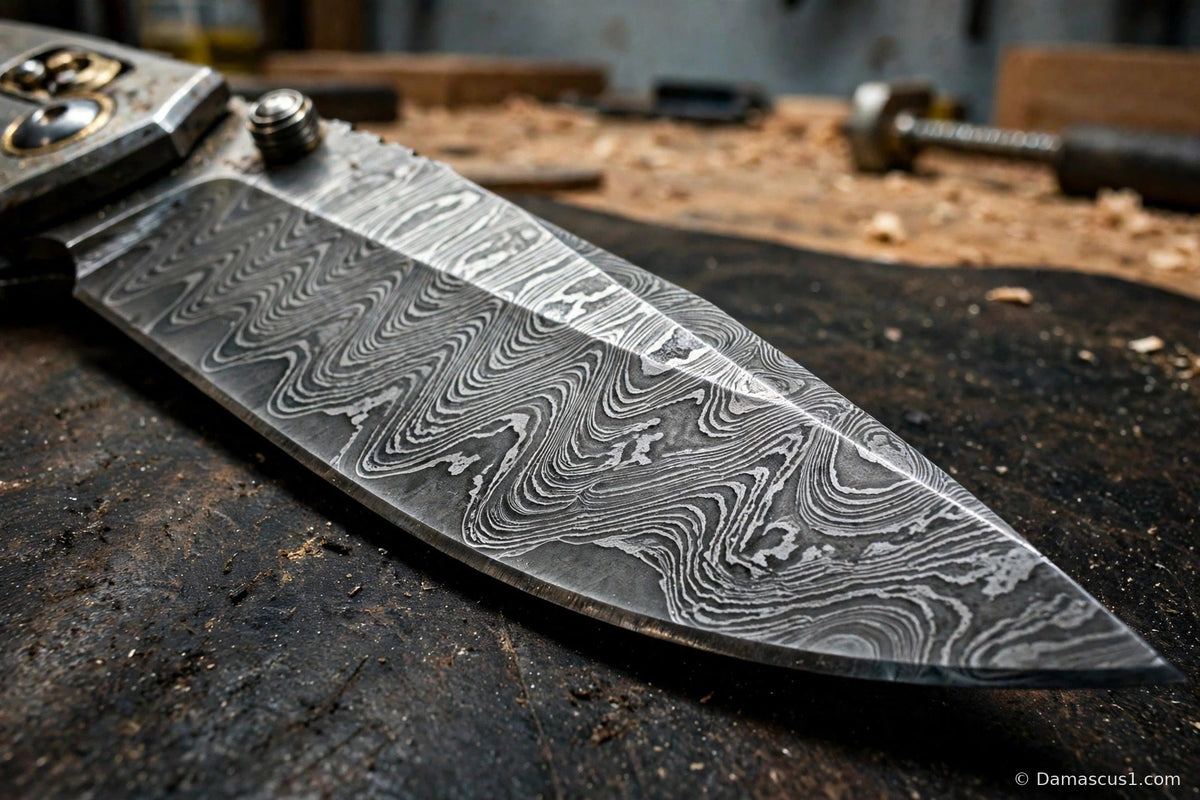
The short answer: Run five checks that take about a minute in total. One: the pattern continues over the spine and into the edge bevel. Two: it survives light sharpening instead of vanishing at the bevel. Three: it never repeats exactly. Four: under raking light you can feel faint etch depth with a fingernail. Five: the seller names the two steels and a hardness. Pass all five and the layers are real; fail the first two and the pattern is only on the surface.
This is the hands-on companion to our Canada guide to real versus fake Damascus steel. That guide owns the comparison — what layered steel is, what an etched or printed imitation is, and how the two differ as products. This guide owns the sixty seconds at the counter, at the market stall, or over the kitchen table when a knife is in your hand and the question is simply: is this one real? It is built from the checks the best pages on the internet actually agree on, tightened into a timed routine for a pocket knife specifically — because most of page one is written for kitchen knives, and a folder gives you different evidence: a spine you can turn in the light, a small bevel you sharpen yourself, and a seller whose listing either names the steels or does not.
The agreement on page one is unusually strong, and it is worth saying who agrees. Honed Knives, in a guide updated days ago, lists the spine, the edge bevel, repetition, the named core steel, the price, and the brand — six checks. Steel Snob's complete Damascus guide lists the edge and spine, the tang and ground areas, feel and light, repetition, and a price sanity check — five checks that map almost one-to-one onto Honed's. The Knife Making Courses wiki, written from the making side, reduces it to three: the pattern goes all the way through, the maker names the steels (its example is 1084 and 15N20), and the price reflects hours of skilled work. Three independent holders, one routine. This guide takes that consensus, reorders it into the sequence your hands naturally follow on a folder, puts a clock on it, and adds the Canada layer none of them has: what the checks mean at a Canadian price point, in a Canadian shop, for the specific $39.99 folder this series is built around — including the honest complication that a low price is a warning sign on page one, and a maker-direct folder is the exception you have to verify rather than assume.
One honesty note before we start, carried through this whole series: the photographs in this post are editorial scenes made for this guide — macros, workbenches, whetstones — not photographs of the specific knife sold further down the page. The cover macro, to take the clearest example, shows a thumb stud; the hero knife has no thumb stud, and the post never claims a photo is the hero. No knife was tested, sharpened, or etched for this guide, and none is claimed to have been. The checks below are the published checks of the holders named above, applied as instructions you can follow yourself — which is the point of a 60-second guide. You do not need to trust this page's hands. You need your own.
What are the 5 checks, in order?
Here they are in one place first — the citable asset of this post, designed to be copied into a phone note and used standing at a counter. Each check gets its own section after the table, with what to look for, what a fake does instead, and how long it should take.
| # | Check (about 10 seconds each) | Real layered Damascus | Surface-etched or printed imitation |
|---|---|---|---|
| 1 | Spine and edge: turn the blade over; follow the pattern over the spine and down into the edge bevel | Pattern continues over the spine as fine lines and runs into the bevel — the layers go through the metal | Pattern lives only on the flat faces and stops where the edge was ground; plain steel at the bevel |
| 2 | Sharpening survival: look at (or lightly refresh) the bevel; on an owned knife, sharpen gently and look again | Pattern is still there at the edge after sharpening, because new layers are exposed as metal is removed | Pattern thins or disappears at the bevel after sharpening — it was only ever skin-deep |
| 3 | Repetition: scan the whole blade slowly, then compare with a second knife of the same model if one is there | Pattern wanders, varies, and differs from knife to knife; no motif repeats exactly | The same motif repeats at a fixed interval down the blade, and matches the next knife exactly |
| 4 | Etch depth: tilt the blade under raking light; run a fingernail lightly across the pattern | Faint topography — the dark steel sits very slightly lower; the light catches the relief | Dead flat under the nail and under the light; sometimes slightly pixelated or too perfect |
| 5 | The seller test: ask (or read the listing) for the two steels and the hardness | The seller names both steels — for example 1095 and 15N20 — and a hardness range, without hedging | No steels named, no hardness given, or "Damascus steel" offered as if it were itself a steel name |
Sixty seconds is honest arithmetic, not a slogan: roughly ten seconds a check, with the fifth check done on the listing or with one question to the seller. None of the checks needs a tool beyond your eyes, a light, and a fingernail — except the second, which on a knife you do not yet own becomes a look at the bevel rather than a sharpening session, for the obvious reason that you do not sharpen a knife in someone else's shop. The sections below keep that distinction clean: what you can do before you buy, and what confirms it after.
Check 1: Does the pattern run over the spine and into the edge?

Yes — on real Damascus it must, because the layers are the metal, not a coating on it. This is the first check because it is the fastest and the most decisive, and every holder on page one leads with it in some form.
Steel Snob states it as the master test: on real pattern-welded steel the pattern continues through the edge bevel and over the spine, because the layers go all the way through the metal; on a surface-etched fake, the pattern stops at the freshly ground edge and you see plain steel there. Honed Knives splits it into its first two bullets — look at the spine, where real layered steel shows the layers as fine lines, and look at the edge bevel, where the pattern continues in. The Knife Making Courses wiki compresses it to one line: the pattern goes all the way through, showing on the spine and across the edge bevel; a pattern that stops at the bevel or looks printed on is a surface etch.
On a pocket knife, do it like this. Open the folder and turn it spine-up under the best light you have. The spine of a layered blade is a cross-section of the billet — hundreds of layers cut across — so it reads as fine, tight, parallel lines or a compressed version of the face pattern, not as a copy of the face and not as blank steel. Then follow the blade down to the edge. The bevel is ground after the blade is etched, which is exactly why it betrays a fake: grinding removes the surface, so a surface pattern is removed with it, while a layered blade simply exposes fresh layers that etch and show the same way. The spine-check image in this post is the posture: the knife tipped toward window light, the spine toward your eyes, your other hand free to turn it slowly.
What does a fail look like? A blade whose faces swirl beautifully and whose spine is smooth, bright, and featureless, with a bevel of plain uniform steel, is a blade with a picture on it. It may still cut — Steel Snob is fair about this, and so is this guide: a laser-etched knife on decent steel can be a perfectly fine user. It is just not Damascus, and it should not be priced, gifted, or described as if it were. One check, ten seconds, and you already know which conversation you are having.
Check 2: Does the pattern survive light sharpening?


On real layered steel, yes — sharpening removes metal and exposes the same layers underneath, so the pattern stays at the edge; on a surface imitation, sharpening is what erases it. Honed Knives puts it in one sentence: on real Damascus the pattern continues into the bevel and, on sharpening, it stays; a printed or etched surface pattern often disappears at the bevel or after sharpening. The making-side sources explain why the stronger version of this test works: polish a section of genuine Damascus until the pattern is gone and re-etch it in acid, and the pattern returns, because the layers were never only on the surface. You do not need the acid version at a counter. You need the logic: surface patterns are finite — they end where the surface ends — and layered patterns are structural.
For a knife you own, the gentle version is the right one, and the sharpening image in this post shows the posture: a whetstone, a light touch, the bevel only. Sharpen lightly, wipe the bevel clean, and look. Real layers show at the fresh edge the way they show everywhere else. If the bevel comes up bright, plain, and pattern-free while the faces still swirl, you have learned something no listing would have told you. Our Canada guide to sharpening a Damascus pocket knife (drafted 2026-11-06, awaiting Faisal's publish word) will cover the technique in full when it publishes; this guide needs only the observation, not the lesson.
For a knife you are considering, check 2 collapses into check 1: examine the bevel the maker already ground. A factory bevel is a sharpening that has already happened. If the pattern runs into it, the sharpening test has effectively been passed in front of you. That is why the two checks are ordered as they are — the spine and bevel first, because they are visible now; the sharpening survival second, because it is the same fact projected forward in time. A seller who understands the product will not object to you looking closely at the bevel. A seller who steers you back to the flat of the blade, every time, is telling you where the pattern lives.
Check 3: Does the pattern repeat?
Real Damascus never repeats exactly, because it is made by folding, twisting, and cutting a billet by hand and machine in a process with genuine variation in it. Steel Snob: forged patterns wander and vary; a machine-etched pattern frequently repeats the exact same motif at a fixed interval down the blade. Honed: a laser pattern often repeats identically from knife to knife and even along one blade; real Damascus varies. The comparison image in this post is the idea in one frame — the varied, organic blade beside the too-regular one.
Run the check in two passes. First, along the blade: pick the most distinctive swirl you can find — a tight knot, a sharp zigzag — and look for its twin further down. On a printed blade you will find it, at a regular spacing, like wallpaper. On a forged blade you will find cousins, not twins: the same family of curves, stretched, compressed, and interrupted by the forging. Second, across knives: if there are two of the same model on the counter, lay them side by side. Two real folders from the same billet family resemble each other the way two pieces of the same wood resemble each other — same species, different grain. Two printed folders match the way two posters match. One experienced seller quoted in the teardown literature makes the sharpest version of this point: a blade with the exact same pattern on both sides is a physical impossibility in real Damascus, because no forging process mirrors a pattern through the steel. Identical faces are not a sign of quality control. They are a sign of a printer.
A word of calibration, because this check can be over-run: variation is the signal, not messiness. A well-made billet produces flowing, coherent patterns — ladder, raindrop, twist — with a clear overall structure. What it does not produce is exact repetition. Look for the difference between organized and identical, and you will not mistake a good maker's discipline for a fake, or a fake's regularity for discipline.
Check 4: Can you feel the etch?

Lightly, yes — a real etch has faint topography, because the acid that reveals the pattern eats the two steels at slightly different rates. Steel Snob's formulation is the one to carry in your head: a true etch has faint topography, the dark steel sits very slightly lower; a laser or print pattern is dead flat and often looks too uniform, too repetitive, or slightly pixelated under raking light. The etch-light image in this post shows the technique — the blade tilted so light rakes across it, a fingernail drawn gently over the surface.
This is the subtlest of the five checks and the one to weigh least on its own. The relief is faint — you are feeling the difference between two steels etched in the same bath, not a carving — and a heavily polished real blade can feel almost flat, while finishes vary from maker to maker. Treat check 4 as a corroborating vote, not a verdict: flat plus a pattern that stops at the bevel is a fake with two witnesses against it; faint relief plus pattern through the spine is a real blade confirming itself. The light half of the check is as useful as the nail half. Tilt the blade slowly under a lamp or a window. A real etch changes as the angle changes — the dark lines sit in the surface and catch differently from the bright ones. A printed pattern sits on the surface and reads the same from every angle, the way ink does, because ink is what it most resembles.
Check 5: Does the seller name the steels?

A real seller can, and does — because for a layered blade, the steels are the product. The Knife Making Courses wiki: ask what steels were used; a maker will tell you, for example 1084 and 15N20, and cheap "Damascus" of unknown steels is often soft. Honed's version for kitchen knives asks for the core steel and the hardness, and warns that if neither is published, be cautious. Steel Snob's buying advice ends in the same place: decide on the steel you want, confirm the pattern is forged and not printed. Three holders, one question. The seller-desk image in this post is the setting: the listing, the spec, the notebook — the paperwork half of authenticity, which matters as much as the blade half when you are buying online, as most Canadian buyers of a US store's folder are.
Why does naming work as a test? Because a surface-etched blade has only one steel, and it is usually an unremarkable one the seller has no reason to advertise; the whole commercial point of the imitation is to sell the look of two steels without buying either of them. A layered blade, by contrast, is a recipe — a hard, dark-etching high-carbon steel and a bright, nickel-bearing partner — and the recipe is the maker's pride and the buyer's only basis for judging edge behaviour, rust behaviour, and sharpening. For the folder this series is built around, the answer is on the product page in plain text: 1095 and 15N20, roughly 276 layers, 58–60 HRC. You do not have to take this guide's word for any of that. It is the fifth check, passed in public, where you can read it yourself before any money moves.
Pair the steels question with its twin: what is the hardness? A hardness range tells you the blade was heat-treated as a product rather than decorated as an ornament, and it predicts how the edge will behave — harder holds an edge longer and asks more of your sharpening; the 58–60 HRC band is the working folder's traditional compromise. A listing that gives you pattern names, layer counts, and adjectives, but no steels and no hardness, has told you everything about its marketing and nothing about its metal. Walk away, or price it as the decorative knife the evidence says it is.
What about price — is a $39.99 Damascus folder automatically fake?
No — but page one is right to make you ask, and this guide will not pretend the question away. Steel Snob's sanity check is blunt: a "Damascus" blade sold for the price of a fast-food meal is surface-etched, full stop, because real forge-welding is labour and labour costs money. Honed's price table puts the under-$40 kitchen tier at "often a printed or laser-etched pattern, or real layers over an unnamed core — proceed with caution," and the honest hand-forged kitchen tier starting far higher. The Knife Making Courses wiki says the same from the bench: a real billet takes hours of skilled work, and very cheap Damascus rarely performs well. Against that consensus, a $39.99 folder needs an explanation, not a slogan. Here is the explanation, stated as a mechanism you can verify rather than a claim you have to trust.
First, size. A 6.5-inch folding pocket knife uses a fraction of the steel in a full-size chef's knife, and the price tiers on page one are kitchen tiers. Small blades are cheaper to billet, cheaper to finish, and cheaper to ship — the labour argument is real, but it scales with the object. Second, the model is maker-direct: the store sells its own product on its own site, without the wholesale and retail layers that sit between a forge and a kitchen-knife counter. Third — and this is the part that does the work — the folder passes check 5 in public and invites checks 1 to 4 in your hands: the steels are named (1095 and 15N20), the layers and hardness are published (~276 layers, 58–60 HRC), and the price is stated with its compare-at price ($89.99) beside it rather than hidden. The Olive Wood Damascus Pocket Knife Set is $39.99 USD (compare-at $89.99): a manual two-hand nail-nick folder with a back-lock, an olive wood handle, single-edged, not stainless — wipe it dry and oil it lightly, the way every carbon Damascus asks to be kept. Its product page carries buyer reviews at 4.9/5, cited as the page's own figure, not as this guide's testing.
The honest bottom line on price is a rule, not a verdict on any one knife: price is a reason to run the checks, never a substitute for them — in either direction. A $20 blade that fails the spine test is a print whatever its reviews say, and a $300 blade that fails it is an expensive print. Run the five checks on the knife in front of you, at whatever price, and let the steel answer.
The rest of the store's route, for readers applying the checks across the range: the Orange Wood 6.5" Hunting Pocket Knife at $39.99 USD (compare-at $99.99) is the second folder — same five questions, same demand for named steels. In the kitchen, the Premium Kitchen Knife Block Set at $169.99 USD and the VG10-Labelled Nakiri Knife at $44.99 USD are where the cladding question — pattern-welded-through versus layered-around-a-core — gets asked in its kitchen form, and the same spine-and-bevel logic applies. Two hero folders at $39.99 each come to $79.98 USD, crossing the store's "Free Shipping & Returns above $50!" banner as the store lists it. Engraving is available on request, quote-based, up to 25 characters, with proof, price, and timing confirmed before custom work starts. The standard cross-border picture applies: USD exactly as listed, possible GST/HST and a carrier handling or brokerage fee on arrival, no delivery date promised.
For the reading around this guide: the US hub guide to how to spot a fake Damascus knife is the live companion, our guide to the best Damascus pocket knife shows the checks applied across a buying guide, our Canada guide to whether Damascus steel can rust covers the care side of carbon layers, and our Canada hub on the Damascus pocket knife in Canada covers the folder itself. Two sibling Canada guides are planned as follow-ons — a carry-rules guide and a provenance guide to where Damascus knives are made — and will be linked here when they publish; until then they are drafts, not live pages.
What is actually on page one — and what it leaves out
Page one teaches the checks well and organizes them badly — for a pocket-knife buyer. Honed and Steel Snob between them name every check in this guide, but both write for the kitchen: cladding, core steels, santokus and gyutos, layer counts counted as cladding around a core. A folder is not built that way — its blade is layered through its whole thickness, which makes the spine and bevel checks more decisive, not less, and no holder on page one says so. None of them times the routine, orders it for hands at a counter, separates the before-you-buy version of the sharpening check from the after-you-buy version, or confronts the price question for a small maker-direct folder as opposed to a kitchen knife. And none of them is written for Canada — the cross-border listing, the USD price, the GST/HST picture. That is the gap this post fills: the same consensus checks, rebuilt as a 60-second folder routine for a Canadian buyer. The full teardown is in the research brief beside this draft.
Shop handmade Damascus pocket knives
Prices checked November 21, 2026. Prices are in US dollars. The product page on the day you order is the final word.
- Olive Wood Damascus Pocket Knife Set, 6.5 in.: $39.99
- Green Wood Damascus Pocket Knife Set, 6.5 in.: $39.99
- Buffalo Horn Damascus Pocket Knife Set, 6.5 in.: $39.99
- Stag Horn Damascus Folding Pocket Knife, 6.5 in.: $49.99
- Camel Bone Scrimshaw Damascus Folding Pocket Knife, 7.6 in.: $49.99
- Ram Horn Scrimshaw Damascus Pocket Knife, 7.6 in.: $59.99
Damascus pocket knives under $50 · All handmade Damascus pocket knives
Frequently asked questions
How can I tell if a knife is real Damascus?
Look for layers along the spine, a pattern that continues into the edge bevel, variation along the blade, and a named steel with a published hardness from a reputable maker — Honed Knives' FAQ answer, and the spine of this guide's five checks. Add the fingernail test for faint etch depth and the repetition scan, and you have the full 60-second routine: spine and edge, sharpening survival, non-repetition, etch depth, named steels.
Does the Damascus pattern wear off?
Real Damascus does not wear off with normal use, though its contrast can fade slightly over many years and can be restored by re-etching — the layers are the metal itself. Printed or laser-etched patterns can and do wear off, because they are only on the surface. That difference is check 2 in this guide: sharpen a real blade and the pattern is still at the edge; sharpen a printed one and the bevel comes up plain.
Is Damascus steel real, or is it just a pattern?
Both, depending on the knife — which is why the checks exist. Modern Damascus is real pattern-welded steel when it is made from layered steels forge-welded together and etched; the pattern is how the layers become visible. What people call "fake Damascus" is a single piece of ordinary steel with the pattern printed, laser-etched, or stencilled onto its surface — a picture of layers, with no layers underneath it.
What steels should a real Damascus seller name?
The pair the blade was actually welded from — a hard high-carbon steel that etches dark and a nickel-bearing steel that stays bright. The making literature's common example is 1084 and 15N20; the folder in this guide is 1095 and 15N20, at roughly 276 layers and 58–60 HRC, all published on its product page. The specific pair matters less than the act of naming: a seller who names both steels and a hardness is describing a recipe; a seller who says only "Damascus steel" is describing a look.
Is more layers better in Damascus steel?
No. Layer count controls how fine the pattern reads, not how well the knife cuts. A clean billet of a few hundred layers with a correct heat treatment outperforms a dirty high-count billet every time, and the making sources are unanimous that cutting performance comes from the steels and the heat treatment, not the number. Treat layer count as a description of the pattern's grain — finer at higher counts — never as a quality score.
Can I check a Damascus knife before I buy it online?
Yes — run the checks in their online order. Check 5 first: does the listing name both steels and a hardness? Then check 3 from the photographs: does the pattern vary, including against a second unit's photos, or does it repeat like wallpaper? Then checks 1 and 4 from any spine and raking-light photos the seller provides — and if the listing shows only flat, straight-on face photographs, ask for the spine. A real seller can supply it. On arrival, run all five in your hands; the spine and bevel will settle it in ten seconds.
Is a cheap Damascus knife always fake?
Not always — but cheap is a reason to check, not a reason to relax. Page one's consensus is that real forge-welding is labour and very cheap "Damascus" is usually a surface pattern or real layers over an unnamed core. Size and maker-direct selling can honestly bring a small folder's price down — the $39.99 USD folder in this guide names its steels, layers, and hardness in public for exactly that reason. The rule that survives every price point: run the five checks, and let the steel, not the sticker, answer.
The last word: sixty seconds, five checks, no faith required
The reason fake Damascus exists is that real Damascus is beautiful, and beauty photographs well — a printed blade and a forged blade look like cousins in a listing and like strangers in your hand. The five checks close that gap with evidence the seller cannot stage: layers that run through the spine and the bevel, a pattern that survives the stone, refuses to repeat, and sits in the steel with a faint depth your nail can find, and a seller who tells you what the steel is before you ask twice. None of it needs expertise. All of it together takes a minute.
So take the minute. At the counter, in the market, over the table when the parcel from across the border is opened — turn the blade over, find the spine, follow the pattern to the edge, and ask for the steels by name. If the knife in your hand is the Olive Wood Damascus Pocket Knife Set at $39.99 USD, the listing has already answered check 5 for you: 1095 and 15N20, roughly 276 layers, 58–60 HRC. The other four checks are yours to run — and a real knife is never afraid of them.
Leave a comment: