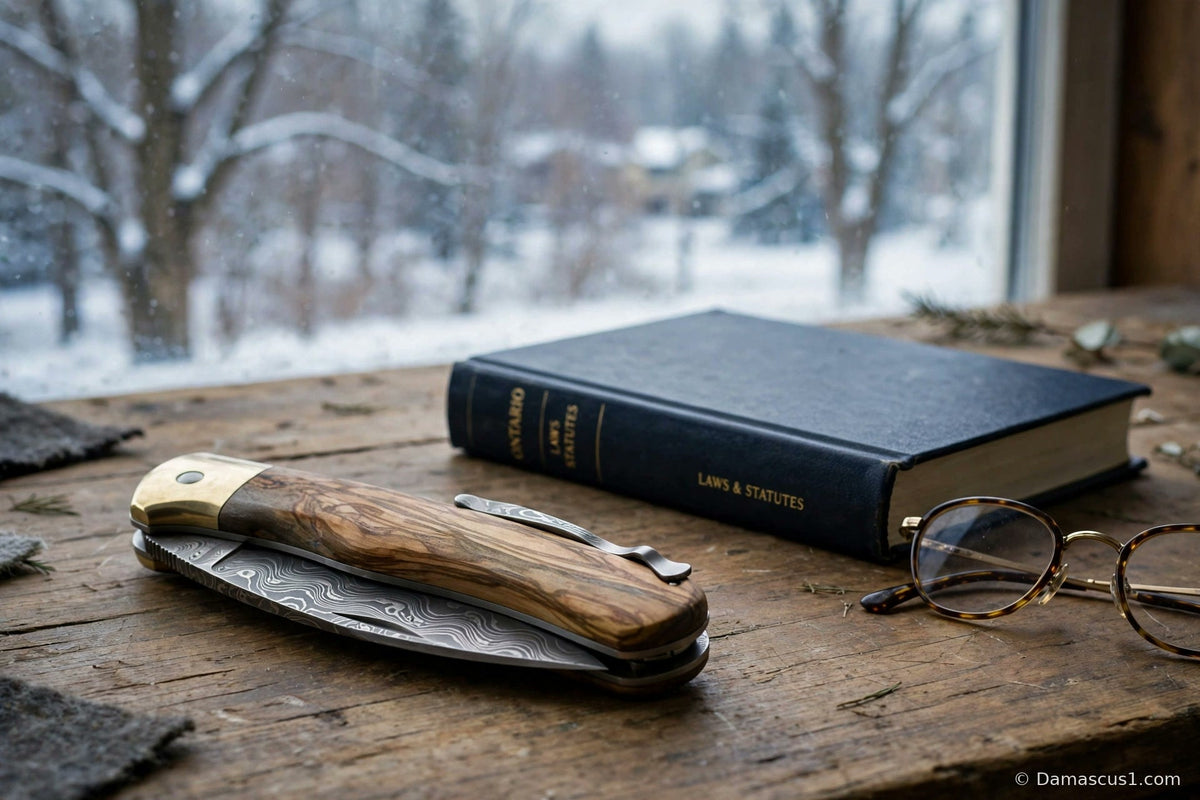
The short answer: In Ontario, knife law is federal, not provincial. The Criminal Code of Canada governs what you may own and carry: section 84 prohibits knives that open automatically, by gravity, or by centrifugal force; section 88 makes possessing any weapon for a dangerous purpose an offence; and section 90 covers carrying a weapon concealed. Ontario has no separate provincial knife statute of general application, and there is no blade-length limit. General information, not legal advice.
That answer surprises most Ontarians who search this question, because the search results wear Ontario clothing. The top holders are Toronto and Ottawa defence firms — Sewrattan Criminal Lawyers in Toronto, Céline Dostaler in Ottawa, Lichtman Law, Pyzer Criminal Lawyers — and a reader can easily come away believing there is an Ontario knife act somewhere, with Ontario penalties and an Ontario list of banned blades. There is not. Every one of those firms is explaining the same federal statute, because in Canada criminal law is federal: the Criminal Code is written in Ottawa and applies in Kenora exactly as it applies in Kingston. What changes inside Ontario is not the statute. It is the layer underneath it — municipal bylaws, transit and venue rules, school and workplace policies, and the discretion of the officer in front of you — plus the facts of your own situation: what the knife is, why you have it, and how you are behaving with it. This guide separates those layers cleanly, because most Ontario knife anxiety comes from mixing them up. It is distinct from our federal ownership guide and from our carry guide: this one answers the Ontario question Ontarians actually type.
One honesty note, carried through this whole Canada series: the photographs in this post are editorial scenes made for this guide — desks, campsites, workbenches, cabins — not photographs of the specific knife sold further down the page. The knife itself is described exactly as the store describes it, its price is the store's own listed price in US dollars, and nothing is converted into Canadian dollars, because a conversion the store did not make would be an invention. And nothing in this post is legal advice. It is general information drawn from the Criminal Code sections and the Ontario defence literature on page one, hedged wherever the law itself is fact-dependent — which, with knives, is often.
Is there an Ontario knife law separate from the Criminal Code?


No — and understanding why is the single most useful thing in this guide. In Canada, criminal law is an exclusively federal power. The offences that matter for knives — prohibited weapons, possession for a dangerous purpose, carrying concealed — live in the Criminal Code of Canada, and they read identically in every province. Ontario has no provincial knife statute of general application: no Ontario act that lists legal and illegal knives, sets an Ontario blade length, or creates an Ontario carry permit for a pocket knife. When an Ontario lawyer writes about "knife laws in Ontario," as every page-one holder does, she is applying federal sections to Ontario facts and Ontario courts. Sewrattan's page is explicit about the structure even in its headings: the penalties section is titled "Penalties for weapons possession in Ontario," but the offences it describes are sections 88, 91 and 92 of the federal Code. The province supplies the courtroom, the police service, and the Crown attorneys. Parliament supplies the law.
What Ontario and its municipalities can and do regulate sits beside criminal law, not inside it. A city can set rules for its own spaces — transit systems, arenas, libraries, licensed premises — and a venue can refuse entry to anyone carrying anything it dislikes, entirely lawfully, without your knife being illegal at all. Schools and employers set their own policies, and breaching a policy can cost you a job or a school placement without any criminal charge existing. Those rules vary from place to place and change without amending any statute, which is why this post hedges them rather than listing them: a Toronto transit rule, an Ottawa venue rule, and a small-town arena rule are three different documents, and the only reliable version of each is the one published by that body on the day you travel. The practical translation is simple. For "is this knife legal in Ontario," read the federal sections below. For "may I take it into this building, this stadium, this campus," check that place's own rules — and expect the answer to be no more often than the criminal law alone would suggest.
What does section 84 prohibit — and why is it about the mechanism, not the blade?
Section 84 of the Criminal Code defines a prohibited weapon, for knives, by how the blade opens. The definition captures a knife whose blade opens automatically by gravity or centrifugal force, or by hand pressure applied to a button, spring, or other device in or attached to the handle. Every holder on page one works from that same definition. Lichtman Law's list of prohibited knives follows it item by item: switchblades that open at a button press, butterfly knives that open by flipping, push daggers gripped in the fist, and knives disguised inside everyday objects such as comb-knives. Pyzer Criminal Lawyers adds the disguised-device detail — a device under 30 centimetres designed to conceal a blade, and the knife-comb specifically — and notes that hunting knives, search-and-rescue knives, and Swiss Army knives are not prohibited. Possession offences for prohibited weapons sit in sections 91 and 92: Sewrattan summarises them as criminalising possession of prohibited weapons and devices regardless of purpose, with section 92 adding the element that you knew the possession was unauthorised. The design point deserves emphasis, because it is the opposite of how most people shop. Canadian law does not ask how long the blade is, how sharp it is, or how it looks in a photograph. It asks what makes it open. A long, plain, fixed kitchen knife is an ordinary object. A short knife that springs open at a button is prohibited at any length, for any owner, for any stated purpose. Mechanism first, everything else second — that ordering runs through the whole of Canadian knife law, and it is why this series chose its hero knife by mechanism before it chose it by anything else.
The centrifugal part of the definition is where ordinary folders need care. A centrifugal knife is one that opens by flicking or spinning — by the force of the wrist rather than by a hand staying on the blade. A stiff manual folder that must be drawn open deliberately, with the thumb or two hands on the blade the whole way, does not open that way, and that stiffness is a legal feature, not a flaw. It is also the feature the Canada Border Services Agency tests at import, applying a flick test to folding knives entering the country: if the blade can be flicked open, the knife risks being treated as centrifugal however it was marketed. Holders and our own earlier guides converge on the same practical advice: the looser and faster a folder opens, the more legal surface it exposes, at the border and on the street. A deliberately stiff two-hand opener sits at the far, quiet end of that spectrum — which is a statement about design, not a guarantee about any individual encounter, and this post will keep saying so.
What does section 88 mean by a dangerous purpose — and why does intent decide so much?
Section 88 makes it an offence to possess a weapon for a purpose dangerous to the public peace, or for the purpose of committing an offence. The word that does the work is weapon, and section 2 of the Code defines it by use and intent: anything used, designed to be used, or intended for use in causing death or injury, or in threatening or intimidating a person. Céline Dostaler's Ontario explainer makes the consequence vivid — the same definition can reach a baseball bat, a screwdriver, or even a coffee mug, depending on context — and the Barrie criminal lawyers' page makes the matching point for knives: objects like knives, which have purposes outside harm, are generally treated as weapons where they are used or intended to intimidate or threaten. In other words, an ordinary pocket knife carried as a tool is an ordinary object, and the identical knife carried to frighten someone is a weapon, and the difference is not in the steel. It is in the purpose, proved by everything around the knife: what you said, what you were doing, where you were, and what happened next. Lichtman Law summarises the charge triggers the same way — intent, context, and design — and notes that even a non-prohibited knife can ground a section 88 charge if it is carried for a dangerous purpose. Sewrattan adds the sentencing reality: possession for a dangerous purpose is a hybrid offence carrying up to ten years on indictment, and a knife produced during a confrontation is treated far more seriously than the same knife in a toolbox.
Two corollaries matter for Ontario readers. First, self-defence is not a lawful carry purpose in Canada. Dostaler states it flatly, Sewrattan repeats it — carrying an item as a weapon against people, even defensively, engages the dangerous-purpose offence, and there is no self-defence carve-out for possession — and the JustAnswer Canada answer to a man mugged in London, Ontario, who asked about carrying a pocket knife for self-defence, reaches the same place through the same section. The honest sentence is the uncomfortable one: in Ontario you may carry a knife as a tool for the work of your day, and you may not carry one as a weapon for a fight you hope never happens, and telling an officer the second reason converts a lawful object into the core of a charge. Second, behaviour is evidence. The forum wisdom preserved in the old BladeForums Ontario threads — convince the officer it is a tool, be polite and courteous, do not open it aggressively — is folk phrasing of a real legal fact: purpose is inferred from conduct, so conduct is not decoration around the law. It is part of how the law reads you.
What does section 90 say about carrying a knife concealed?
Section 90 makes it an offence to carry a weapon, a prohibited device, or prohibited ammunition concealed, without lawful excuse. Dostaler's explainer flags the point readers miss: the concealed-carry offence can apply even where the item was not used, and not intended to be used, for a dangerous purpose — concealment is its own problem once the object counts as a weapon. Read together with the section 2 definition, the picture is nuanced in a way summaries often flatten. A pocket knife in a pocket is the ordinary way every folder in this country is carried, and a folder carried as a tool is not being carried as a weapon. But the moment the facts push the same object across the weapon line — purpose, threats, circumstances — concealment stops being a detail and becomes a charge of its own. That is why the old forum advice cuts in two directions at once and confuses people: one thread warns that carrying concealed is generally treated seriously in Canada, while another notes a city whose bylaw discouraged open carry, leaving a carrier squeezed between a local rule and a federal definition. This post will not pretend that tension away. The defensible habits are the boring ones: carry the knife as what it is, a tool, in the ordinary way tools are carried; be able to say, truthfully and specifically, what it is for today; and never carry anything whose design is prohibited, because no manner of carrying cures a section 84 problem.
Is there a blade-length limit in Ontario or anywhere in Canada?
No. Sewrattan's FAQ answers the question in the form page one keeps returning to: "Is it illegal to carry a knife in Canada? Not in itself. There is no blade-length law, and ordinary knives are lawful to own and carry for legitimate purposes. A knife becomes a criminal problem when it is a prohibited design, carried concealed as a weapon, or possessed for a dangerous purpose." That is the whole test, and length is not in it. The BladeForums Ontario thread preserves the street-level version — an officer quoted as saying there is no limit on knives in Ontario or Canada — and while forum posts are not authority, on this point the forum and the statute agree. What length does affect is everything around the statute: a very large blade is harder to explain as an everyday tool in a downtown context, more likely to breach a venue or workplace rule, and more likely to draw the question in the first place. Context scales with size even though legality does not. A 6.5-inch folding tool in a work bag at a job site reads as equipment. The same silhouette produced in a bar argument reads as evidence. Ontario readers searching for a number — two inches, four inches, a palm's width — are usually importing an American state rule or a British one; the UK genuinely does run on a three-inch folding exception, which our UK guides cover, and that rule stops at the Atlantic. In Ontario, the questions are design, purpose, and concealment. Anyone who sells you a knife on the promise that its length makes it "Ontario legal" is selling you a rule that does not exist.
How do municipal bylaws, transit rules, and venues change the picture in practice?
They change the day, not the statute — and for most carriers, the day is what matters. Think of Ontario knife life as three stacked layers, which is the citable asset of this post:
| Layer | Who makes it | What it controls | What happens if you breach it |
|---|---|---|---|
| Federal Criminal Code (ss. 2, 84, 88, 90, 91–92) | Parliament | Prohibited designs, dangerous-purpose possession, concealed weapons | Criminal charges; the penalties the defence firms list |
| Municipal bylaws and public-space rules | The city or town | Conduct in municipal spaces, transit property, parks, licensed premises conditions | Fines, removal, trespass notices — varies by municipality; check the local published rules |
| Venue, school, and workplace policies | The property owner or institution | Entry and presence on private or institutional property | Refused entry, confiscation at the door, job or school consequences — no criminal charge needed |
The table's lesson is that "legal to own" and "welcome here" are different questions with different answerers. A courthouse, a stadium, a concert hall, and many schools will exclude blades the Criminal Code has no quarrel with, and they are entitled to. Transit systems publish their own conditions of carriage. Employers in warehouses and plants set tool rules that bind on shift regardless of the Code. None of that is hypocrisy or a loophole; it is property and policy doing what property and policy do. The practical discipline for an Ontario carrier is therefore two questions, not one: is this knife lawful under the Code — design, purpose, concealment — and is it allowed where I am actually going today? The first question this post can answer in general terms. The second only the venue can answer, and it answers it on its own website and at its own door. When in doubt, the folder stays home or stays in the car, and the day loses nothing.
Which knife design sits lowest-risk under Ontario's federal frame?
The design that answers every federal question before it is asked. Run the checklist that the sections above build: the opening mechanism is manual — no button, no spring, no gravity, no flick — so section 84 is not engaged; the knife is plainly a tool, sized and styled for parcels, twine, food, and camp work, so a section 88 purpose conversation starts from honest ground; and it is carried in the ordinary pocket-or-bag way a tool is carried, with a truthful answer ready for what it is for. That is the specification this Canada series built its hero to, and it is worth stating exactly. The Olive Wood Damascus Pocket Knife Set is $39.99 USD (compare-at $89.99). As the store lists it: forge-welded 1095 and 15N20 steels at roughly 276 layers, hardened to 58–60 HRC, an olive wood handle, 6.5 inches overall, single-edged, and not stainless — it needs the clean, dry, lightly oiled care carbon steel always needs. It opens with a manual two-hand nail-nick and locks with a back-lock. Two-hand means exactly that: a hand stays on the blade, the blade is drawn open deliberately, and there is no flick in it to test. The product page carries buyer reviews of 4.9/5, stated here exactly as the page states it; the store's wider Amazon seller rating of 4.8 stars is a store-wide figure, not a score for this knife, and this post does not blur the two. Engraving is available on request — quote-based, up to 25 characters, with proof, price, and timing confirmed before custom work starts. None of that makes any knife "Ontario legal" as a guarantee, because no product can carry a guarantee about purpose and context that live with the carrier. It makes the design the low-risk one by construction, which is the strongest honest claim available — and the only kind this series makes.
Set the price in its Ontario frame, honestly. Two of the folders cross the store banner — "Free Shipping & Returns above $50!" as the store lists it — because two at $39.99 come to $79.98 USD: the warmer-handled Orange Wood 6.5" Damascus Folding Pocket Knife at $39.99 USD (compare-at $99.99) and the Green Wood Damascus Folding Pocket Knife at $39.99 USD (compare-at $99.99) are the natural second knives. A US order into Ontario can attract GST/HST and a carrier handling fee on arrival; budget for the possibility, and expect no delivery date to be promised, here or anywhere honest. The border point from the mechanism section bears repeating at the till: CBSA applies its flick test at import, a stiff two-hand nail-nick design is built to be genuinely two-hand, and no seller can guarantee a border outcome — mechanism choice is the buyer's one real control over that risk, and this design spends it correctly.
How does this Ontario guide fit with the rest of the Canada law picture?
Deliberately narrowly. Our federal guide — are pocket knives legal in Canada — owns ownership, the prohibited list, and the CBSA border question in full, and nothing here replaces it. Our carry guide, covering tool-versus-weapon in daily life, camp versus downtown, and transport in a vehicle, exists in this series as a draft — can you carry a pocket knife in Canada — and is a planned sibling, not a live page, so it is named here in words and linked nowhere until it publishes. This Ontario post owns the one thing neither of those does: the provincial layer question, answered honestly — there is no Ontario knife statute to quote, and the Ontario reality is federal law plus municipal and venue rules plus your own facts. Around that law cluster sits the trust cluster an Ontario buyer needs before any purchase: real versus fake Damascus steel for telling layered steel from a printed pattern, how to spot a fake Damascus knife for the sixty-second checks, and Damascus pocket knife Canada for the buyer's guide this series opened with. Today's sibling drafts — a review-literacy guide and a how-Damascus-is-made guide — join the cluster as planned mentions only, and will be linked when they are live pages rather than drafts.
Shop handmade Damascus pocket knives
Prices checked November 21, 2026. Prices are in US dollars. The product page on the day you order is the final word.
- Olive Wood Damascus Pocket Knife Set, 6.5 in.: $39.99
- Green Wood Damascus Pocket Knife Set, 6.5 in.: $39.99
- Buffalo Horn Damascus Pocket Knife Set, 6.5 in.: $39.99
- Stag Horn Damascus Folding Pocket Knife, 6.5 in.: $49.99
- Camel Bone Scrimshaw Damascus Folding Pocket Knife, 7.6 in.: $49.99
- Ram Horn Scrimshaw Damascus Pocket Knife, 7.6 in.: $59.99
Damascus pocket knives under $50 · All handmade Damascus pocket knives
Frequently asked questions
Is it illegal to carry a knife in Canada?
Not in itself — this is Sewrattan Criminal Lawyers' exact FAQ question, and its answer is the spine of this post: there is no blade-length law, and ordinary knives are lawful to own and carry for legitimate purposes. A knife becomes a criminal problem when it is a prohibited design under section 84, carried concealed as a weapon under section 90, or possessed for a dangerous purpose under section 88. Ontario adds no separate provincial knife statute; municipal and venue rules vary on top of the federal frame. General information, not legal advice.
Can a knife be a prohibited weapon in Canada?
Yes — this is AEH Criminal Law's FAQ question, and its answer turns on the current legal definition rather than appearance or common name: the Criminal Code definition includes knives whose blades open automatically by gravity, centrifugal force, or pressure on a button, spring, or other device in or attached to the handle, and federal regulations prescribe further prohibited weapons. A manual two-hand nail-nick folder opens by none of those means, which is a design statement, not a guarantee about any individual case.
What is considered a firearms or weapons offence in Ontario?
AEH's question, answered in its own framing: weapons offences in Ontario include unauthorised possession, improper storage or transportation, and possession of prohibited or restricted weapons — all of them charged under the federal Criminal Code and heard in Ontario courts. For knives specifically, the working offences are sections 84, 88, 90, 91 and 92 as this post describes. If you are facing an actual charge, the answer you need is a defence lawyer's, not a blog post's.
Is carrying a pocket knife for self-defence illegal in Ontario?
The JustAnswer Canada exchange from a London, Ontario reader asks exactly this, and the answer given there matches the defence firms: yes, carrying for self-defence is the problem, not the exception. Section 88 criminalises possessing a weapon for a purpose dangerous to the public peace, Canadian law does not recognise self-defence as a lawful reason to carry a knife as a weapon, and Dostaler and Sewrattan both state there is no self-defence carve-out for possession. Carry a knife as a tool, for tool reasons, or do not carry it.
Can a firearms conviction result in a weapons prohibition?
Yes — AEH's FAQ again: some convictions require a prohibition order under section 109 of the Criminal Code, and section 110 permits a court to impose one in other circumstances. It is included here because Ontario readers meeting knife law through a charges page meet prohibition orders in the same breath; if a prohibition order touches your life, its exact terms — not this summary — are what govern what you may possess, and they need a lawyer's reading.
The last word: in Ontario, learn the federal test and mind the local layer
Ontario knife law is simpler than its search results look, and stricter than its folklore sounds. Simpler, because there is no provincial knife act, no blade-length number, and no permit to find: one federal test — design under section 84, purpose under section 88, concealment under section 90 — answers the legality question from Windsor to Ottawa. Stricter, because purpose is judged from your conduct and your own words, self-defence is not a carry reason, and the building in front of you may lawfully exclude a knife the Code permits. The carrier who thrives under that frame is the boring one: a manual two-hand tool, carried as a tool, with a truthful answer for what it is for today. The Olive Wood Damascus Pocket Knife Set at $39.99 USD was chosen as this series' hero because its mechanism answers the federal design question by construction — stiff, deliberate, two-hand, back-lock — leaving the Ontario carrier only the questions that were always his: purpose, place, and conduct. Answer those honestly, and Ontario's law, such as it is, is mostly the absence of a surprise.
Leave a comment: