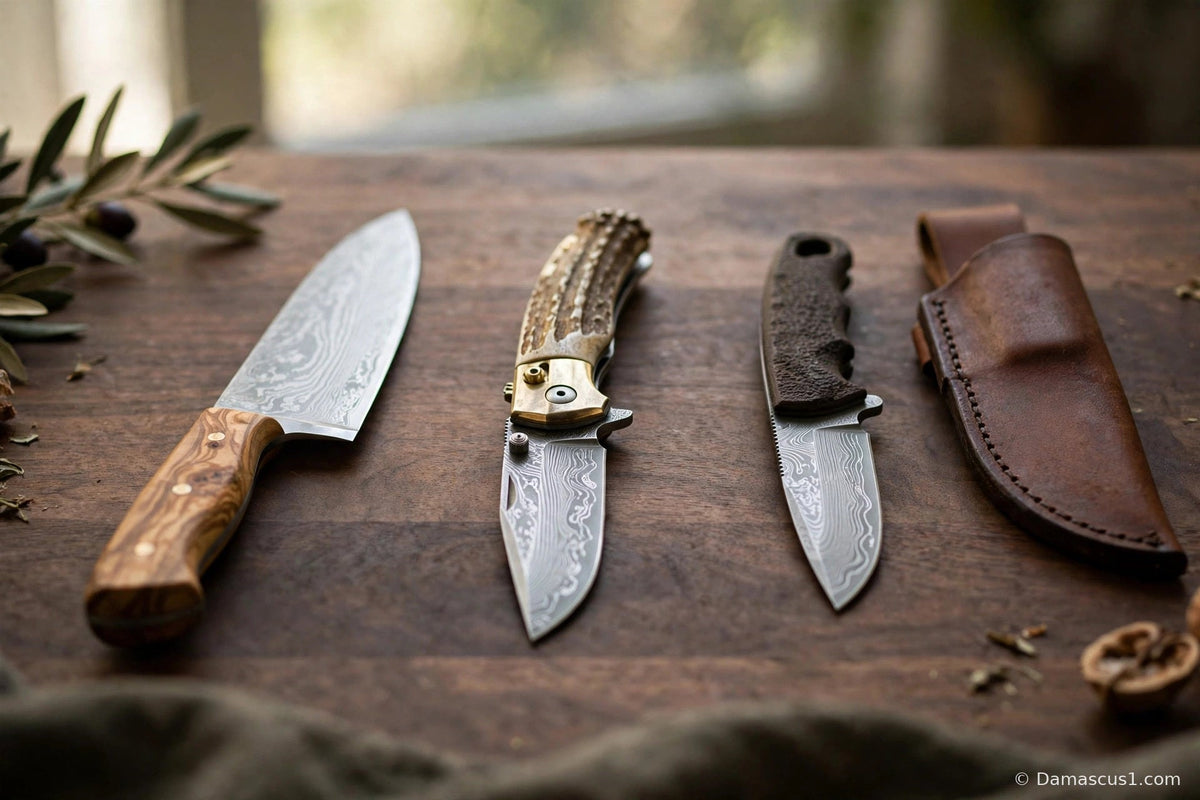
Direct answer: A Damascus knife is a knife whose blade shows a wavy, layered pattern because two or more steels were forge-welded together — or, on many kitchen knives, because layered steel wraps a separate hard core that forms the edge. The pattern is real structure in good blades and surface decoration on poor ones. It never, by itself, makes a knife sharper. What decides how a Damascus knife cuts is the steel at the edge, its heat treatment and its grind — and this brief guide explains each part in the order a first-time buyer actually needs it.
That ordering matters, because Damascus is the most mis-sold word in the knife market. A single search returns blades from under $30 to well over $1,000, all wearing the same swirling pattern and the same confident adjectives. Some are honestly built layered steel. Some are plain blades with the pattern printed on. The old version of this page did not help: it opened with superlatives — the most appealing knives on the market, guaranteed for a lifetime — and left it there. This rewrite keeps the page's job — a brief, complete introduction — and does it properly: what the word means, the three constructions hiding behind it, the types and patterns, a seven-point checklist for buying, what fair prices look like, and the short care routine that keeps a good blade good.
One boundary, stated up front because it shapes everything below. This guide is published by a store that sells Damascus knives, and it is written as guidance, not testimony: nothing here claims hands-on testing of other brands, and no layer count or hardness figure is assigned to any individual knife unless that knife's own listing states it. Where the wider market's published facts are used — the steels makers name, the constructions they describe — they are described as published facts. The priced knives near the end are this store's own, verified against the live catalogue today, and labelled for the jobs they genuinely do.
What is a Damascus knife?
A Damascus knife is any knife whose blade carries the layered pattern produced when different steels are bonded into one piece of metal and etched. The word describes a construction and a look — never a blade shape, a single alloy, or a guaranteed standard of quality. A chef knife, a pocket folder and a hunting blade can all be "Damascus," and two knives with identical patterns can be built completely differently underneath.
The name itself carries two histories, and keeping them apart clears up half the confusion in listings. The historical Damascus steel was a crucible steel — the famous wootz blades traded through the city of Damascus centuries ago — whose banded pattern came from the steel's own internal structure as it cooled. That original material is not what any modern knife is made from. The modern meaning is a method: pattern welding, in which strips of two or more steels are stacked, heated and hammered until they weld into a single billet, which is then drawn out, sometimes folded or twisted, ground into a blade and etched so the layers show. When a listing today says "Damascus," it means the modern method — or it means a surface pattern imitating it, which is why the constructions in the next sections matter more than the word.
What the pattern is, physically, is a map of the two steels. The steels in a billet react differently to the etchant: one darkens, the other stays bright, and the boundary between them draws the flowing lines. Because the layers run through the metal, a genuine pattern shows on every exposed surface — both faces, the spine, the edge bevel — and it survives sharpening, because sharpening exposes fresh layers rather than removing a coating. That single fact is the buyer's most useful test, and it gets its own section below.
The definition this blog uses everywhere, stated once in full, lives in the dedicated explainer on what the Damascus knife is. This guide assumes that definition and spends its length on the decisions that follow from it.
How is a Damascus knife made?

A Damascus knife is made by stacking two contrasting steels, forge-welding the stack into one billet at high heat, drawing and folding or twisting it to multiply and arrange the layers, then forging or grinding it to shape, heat-treating it, fitting a handle, and finally etching the finished blade so the layers become visible. Every stage after the welding is ordinary knifemaking; the welding and the etch are what make it Damascus.
In a little more detail, because each stage leaves evidence a buyer can read. The stack begins as alternating strips — commonly a high-carbon steel paired with a nickel-bearing steel that etches bright. Heated until the surfaces will bond and hammered or pressed, the strips become one bar. Folding that bar and welding it again doubles the layer count each time, which is why counts climb so fast in listings: a handful of folds turns a modest stack into hundreds of layers. Twisting the bar before flattening it produces spiral patterns; pressing it into carved dies or drilling and flattening it produces others. None of this is decoration added at the end — the pattern is decided here, in the billet, before a blade shape exists.
Heat treatment is the stage that decides whether the finished knife is a tool or an ornament. The blade is hardened and tempered so the edge steel reaches a working hardness — most kitchen and field Damascus sits somewhere in the high-50s to low-60s on the Rockwell scale, balancing edge-holding against brittleness — and this happens out of sight, which is exactly why it is the thing a cheap blade most often skips. A beautifully patterned blade with a poor heat treatment is soft where it should be hard, and no etch can fix that. The full forge sequence, stage by stage, is covered in the guide to how pattern-welded pocket knives are made.
The etch comes last and does the least work of any stage, despite getting the most attention. The polished blade is dipped in a mild acid; the two steels react at different rates, one recessing and darkening slightly, the other standing bright. That shallow relief is why a genuine etched pattern can be felt, faintly, under a fingertip — and why its absence on a suspiciously perfect blade is a warning sign rather than a quality mark.
What are the three constructions sold as Damascus today?
Three different constructions are sold under the one word: a fully pattern-welded blade, where layered steel runs through the whole blade including the edge; a clad blade, where a hard core steel forms the edge and layered steel wraps it as cladding; and a surface-patterned blade, where plain steel carries a printed or laser-etched imitation. The first two are genuine Damascus with different strengths. The third is a picture of Damascus, and it is the one to learn to spot.
| Construction | Best for | How to recognise it | The honest trade-off |
|---|---|---|---|
| Fully pattern-welded | Buyers who want layered steel throughout — most handmade folders, fixed blades and traditional kitchen knives | The listing names two steels (a high-carbon grade and a nickel-bearing grade are the classic pair); pattern shows on spine and bevel | If the steels are carbon, the whole blade needs carbon-steel care: rinse, dry, oil |
| Stainless-clad core (san mai style) | Kitchen buyers who want the Damascus look with the easiest care | The listing names a core steel (VG-10 and AUS-10 are common) plus a layer count for the cladding | The pattern is cladding only — it never reaches the edge, by design; performance is the core steel's |
| Surface-patterned | Nothing a buyer should pay a Damascus premium for | No steels named, or one plain steel; pattern identical across every knife in the listing; pattern stops at the bevel | It is a plain blade with decoration; priced as Damascus, it is simply overpriced |
The clad construction deserves a fair paragraph, because it is sometimes dismissed as "not real Damascus" and that is wrong. The cladding is genuine layered steel, forge-welded around the core; it protects the hard, more brittle core, it carries the pattern, and on Japanese kitchen knives it is the standard premium construction — makers such as Shun publish exactly this build, naming the core steel and the layer count of the wrap. What a clad blade's buyer should understand is only where the cutting happens: at the core. Judge a clad knife by its named core steel exactly as you would judge a plain knife of that steel, and treat the pattern as the beautiful, protective bonus it is.
The fully pattern-welded construction is the one this store's handmade range is built around: folders, trackers and kitchen blades where the layers run through the blade. The folder most buyers start with is the Olive Wood Damascus Pocket Knife Set, priced in full in the section below. Its care contract depends on the steels used — carbon pairings take a patina and ask to be dried and oiled; stainless pairings forgive more. Either way, the listing should name the steels. A seller who cannot or will not say what the blade is made from is asking to be paid for a pattern alone, and the pattern alone is the cheapest part of any knife.
What types of Damascus knives are there?

Damascus knives come in the same types as any other knives — the construction says nothing about the shape. The working types are kitchen knives (chef, santoku, nakiri and sets), folding pocket knives for everyday carry, fixed blades for hunting, camping and field work, and specialist blades such as fillet and boning knives. A first purchase should be the type that matches the work done most often, because geometry, not pattern, decides whether a knife suits its job.
| Type | Best for | What to check first |
|---|---|---|
| Chef knife and kitchen sets | Daily cooking; the first kitchen purchase | Core steel or named steels, blade length (8 inches is the all-round chef size), storage included or planned |
| Folding pocket knife | Everyday carry, gifts, camp and dockside small work | Overall length closed and open, handle material, sheath included, local carry rules |
| Fixed blade / tracker / hunting | Field dressing, camp work, heavy outdoor tasks | Blade length and thickness, full tang where stated, sheath quality, grip when wet |
| Specialist kitchen (nakiri, santoku, fillet, boning) | One repeated job done well: vegetables, fish, meat | That the job is genuinely repeated — specialists reward routine and punish occasional use |
The old version of this page listed fixed, folding and pocket knives as though they were three separate families. They are not: a pocket knife is a folding knife sized for a pocket, and the useful distinction is folding versus fixed. A folder trades some strength for carry — the pivot is a joint, and no honest seller claims a folder matches a fixed blade for rigidity, as the old page did. What a well-made folder offers instead is a blade that is present every day, in a sheath or a pocket, which for most small work beats a stronger blade left at home. The deep comparison of the folding range is in the best Damascus pocket knife guide, and the kitchen range is compared in the best kitchen knives guide.
Gifting cuts across all four types and changes what "best" means. A knife given at a wedding, a graduation or a retirement is carried and kept differently from a working purchase: handle material, presentation and the option of engraving matter more, and outright edge performance matters a little less. The personalized pocket knife engraving guide covers what can be engraved and where, and the priced section below includes the folder most often bought for exactly that job.
What are the main Damascus patterns — and do they change how the knife cuts?

The main patterns are raindrop, ladder, twist, feather and the flowing random pattern — all created by how the billet was folded, twisted or pressed before grinding. They are a record of the making, and they are beautiful, and they do not change how the knife cuts. Pattern choice is a matter of taste and of price, because elaborate patterns take more forge work; performance stays with the steels, the heat treatment and the grind.
Raindrop is made by drilling shallow pockets into the billet and flattening it, so the layers open into concentric circles, like rain on water. Ladder comes from cutting or pressing grooves across the bar and flattening, leaving rungs. Twist is the pattern of a bar that was literally twisted hot, then flattened — its spirals run diagonally and no two blades match. Feather is the most demanding of the common patterns: the billet is split and re-welded so the layers mirror down a centre line, and it is priced accordingly. The random or "wood-grain" flow is what an unmanipulated folded billet shows, and it is the pattern most handmade blades wear.
Two buying consequences follow. First, because the pattern is set in the billet, it varies — genuinely forged patterns wander, tighten and loosen along a blade, and differ between two knives of the same model. Perfect repetition is a machine's signature, not a forge's. Second, layer count, the number listings shout about, is a weak quality signal: it says how many folds happened, nothing about which steels were folded or how they were hardened. A modest count in named steels beats a huge count in anonymous ones every time. The full pattern library, with how each is made, is the guide to the basics of Damascus knife patterns.
Does a Damascus knife cut better than a plain steel knife?
Not because it is Damascus. A Damascus knife cuts exactly as well as its edge steel, heat treatment, blade geometry and sharpening allow — the same things that decide any knife. The pattern itself adds no sharpness and no edge life. What good Damascus construction can add is a hard edge supported by tougher material, a blade that is genuinely beautiful to own, and, on clad kitchen knives, softer layers that protect a hard core. That is the whole honest claim, and it is enough.
It is worth being precise about the three places the pattern is oversold, because each appears in listings every day. Sharpness first: an edge is a wedge of one steel at one angle; layers beside the edge do not sharpen it. Edge retention second: how long an edge lasts is set by the hardness and composition of the steel at the edge and by what it is cut on — glass and stone boards destroy fine edges of any construction, and wooden and plastic boards preserve them. Food release third: an etched surface has faint texture, and some cooks find food sticks marginally less; the effect is small and the grind does far more.
Where Damascus genuinely earns its premium is the combination, not a single superlative. A well-made layered blade pairs a hard, keen edge steel with tougher supporting steel in a way a single-steel blade approximates only by compromise — and it does so while looking like nothing else in the drawer. Buyers who want maximum cutting performance per dollar, and do not care how a blade looks, are honestly served by a plain knife in a good named steel; the comparison between Damascus and a single modern steel is worked through properly in Damascus vs VG-10. Buyers who want the object as well as the tool are the ones Damascus is for — and there is nothing second-rate about that reason, provided the knife underneath the pattern is honestly built. The longer verdict, with the cases for and against, is in four reasons a Damascus knife is worth the investment.
How can you tell a real Damascus knife from a fake?

Check where a surface pattern cannot follow. On genuine layered steel the pattern continues over the spine like end grain, flows into the sharpened edge bevel instead of stopping at its shoulder, and varies along the blade and between knives of the same model. On a printed or laser-etched fake it lives only on the flat faces, repeats identically, and leaves the bevel plain bright steel. Before buying, ask for a daylight close-up of the spine and bevel, and for the names of the steels. A real seller can answer both.
Those checks, in the order to run them on any listing, anywhere:
- Spine. Layer lines should be visible along the back of the blade. A plain, painted or mismatched spine is the commonest fake tell.
- Edge bevel. The pattern should continue into the ground bevel, often looking tighter there, because the grind cuts across the layers at an angle.
- Named steels. Two steels for a pattern-welded blade, or a named core for a clad one. "Damascus steel" with nothing behind it is marketing, not specification.
- Variation. Compare two examples of the same model if the listing shows them. Identical patterns mean a printing process.
- Wording. "Damascus pattern," "Damascus style" and "Damascus finish" are the seller's own quiet admission that the blade is not layered steel.
- Price sanity. Forge-welding is labour. A full-size "Damascus" chef knife priced like a takeaway meal is surface decoration, whatever the photographs show.
- The returns route. Buy where a knife that disagrees with its listing can go back. Honest sellers can afford returns; pattern printers rely on nobody checking.
Two cautions keep the checklist honest. Etching proves nothing by itself — genuine blades are etched too; the question is what the etch reveals. And price is a clue, never a proof, in either direction: real layered blades exist at modest prices, and expensive fakes exist. The complete test sequence, including the sand-and-re-etch proof and what sharpening reveals, is set out in how to spot a fake Damascus knife.
How much should a Damascus knife cost?
Expect honest Damascus to cost more than a comparable plain knife — the forge-welding, grinding and etching are real labour — and expect the range to be wide. As a rough map of the current market: handmade folding and small fixed blades in layered steel commonly sell from around $40 to $120; kitchen singles in clad or pattern-welded steel from around $35 to $250 depending on core steel and finish; multi-piece sets and elaborate patterns run higher. Any full-size blade far below those floors deserves the fake checks before it deserves your money.
Price inside this store, verified today, sits at the accessible end of that map, and the next section lists it exactly. Two general rules travel to any store. First, compare like with like: a clad VG-10 kitchen knife and a pattern-welded carbon folder are different products wearing one word, and their prices are not evidence about each other. Second, treat compare-at discounts — this store uses them too — as marketing furniture. The number that matters is the price you pay for a blade whose steels are named, checked against the same construction elsewhere.
Which Damascus1 knives fit each first purchase?
Six knives carry this section — one or two for each first-purchase job a beginner actually faces: a first kitchen knife, a first carry or gift folder, a first field blade, and a one-purchase kitchen set. Every price was verified against the live catalogue today. Shipping is free above $50, so the knives under that line carry a shipping charge alone and clear the threshold when paired; the tracker and the block set clear it on their own.
| Model | Price today | Form | Best for |
|---|---|---|---|
| G10-Handle Chef Knife | $34.99 (was $59.99) | Fixed kitchen blade | The entry-priced first kitchen knife for daily prep |
| Olive Wood Damascus Pocket Knife Set | $39.99 (was $89.99) | Folding pocket knife set | The first carry knife, and the safest first gift |
| Nakiri Knife 8" Japanese VG10 | $49.99 | Nakiri, fixed kitchen blade | Vegetable prep with flat, straight cuts |
| Stag Horn Damascus Folding Pocket Knife 6.5" | $49.99 (was $139.99) | Folding pocket knife | The gift folder — antler handle, milestone presentation |
| Olive Wood Damascus Tracker Fixed-Blade Knife | $79.99 (was $119.99) | Tracker, fixed blade | Camp, field and heavy outdoor work |
| Premium Kitchen Knife Block Set | $169.99 | Kitchen block set | One purchase covering the main kitchen jobs |
G10-Handle Chef Knife — $34.99 (was $59.99). The lowest-priced way into a Damascus kitchen: a chef-profile blade with a G10 handle for the daily board work of a home kitchen. Judge it as what it is — an entry-priced kitchen knife, not a handmade showpiece. View the G10-Handle Chef Knife.
Olive Wood Damascus Pocket Knife Set — $39.99 (was $89.99). The range's best-selling starting point: a 6.5-inch folding pocket knife in olive wood, sold as a set with its sheath, for everyday carry and the small work of a day. It is also the safest gift in the range, because it suits a recipient who has never owned a knife. View the Olive Wood set, or browse the full range in the everyday EDC pocket knives collection.
Nakiri Knife 8" Japanese VG10 — $49.99. A tall, flat-profile vegetable knife labelled for its VG10 steel: straight up-and-down cuts, clean sheets of cucumber, herbs and garnishes. A specialist, bought second by cooks who already own a chef knife and prep vegetables daily. View the Nakiri.
Stag Horn Damascus Folding Pocket Knife 6.5" — $49.99 (was $139.99). The gift folder: natural stag horn scales with their own ridged texture, in the same carryable 6.5-inch folding format. Bought for groomsmen, fathers and retirements — the occasions where the handle is half the present. Engraving options and timing are covered in the engraving guide. View the Stag Horn folder.
Olive Wood Damascus Tracker Fixed-Blade Knife — $79.99 (was $119.99). The field end of the range: a 9.5-inch fixed-blade tracker for camp and outdoor work, where a folder's pivot is the wrong tool. The hunting and field context around it is in the best hunting knife guide. View the Olive Wood tracker.
Premium Kitchen Knife Block Set — $169.99. The one-purchase kitchen option: the main jobs from a block, for a household equipping a kitchen rather than adding a knife. One honesty note, carried from experience with this listing: confirm the exact current packing list on the product page before ordering. View the Premium Block Set, or see the whole kitchen range in the kitchen blades collection.
How do you care for a Damascus knife?

Care for a Damascus knife the way you would any fine blade, with one addition for carbon steels: wash by hand in warm soapy water, dry it straight away, store it dry in a sheath, block or on a magnetic strip — never loose in a drawer — and keep a thin film of food-safe oil on a carbon blade that will sit unused. Sharpen on a whetstone, little and often. No Damascus knife of any construction belongs in a dishwasher.
The dishwasher ban deserves its reasons, because it is the rule new owners most often break. Machine detergent is abrasive and alkaline enough to dull an etch and attack an edge; the heat and rattling chip fine edges against racks and other cutlery; and natural handles — wood, horn, antler, bone — dry, swell and crack under repeated cycles. Two minutes at the sink is the entire cost of avoiding all three.
Rust is the other honest topic. Carbon pattern-welded steel will spot if it is put away wet, and acidic foods left sitting on a blade will mark it — this is a property of carbon steel, not a defect in a particular knife, and a light patina over time is normal and even protective. Stainless-clad blades forgive far more. Either way, a sheath that traps moisture against a blade overnight defeats any steel at any price. The full explanation of what rusts, what merely stains, and how to deal with early spotting is in the guide to whether Damascus steel can rust, and the complete sharpening sequence is in the whetstone sharpening guide.
Shop handmade Damascus pocket knives
Prices checked November 21, 2026. The product page on the day you order is the final word.
- Olive Wood Damascus Pocket Knife Set, 6.5 in.: $39.99
- Green Wood Damascus Pocket Knife Set, 6.5 in.: $39.99
- Buffalo Horn Damascus Pocket Knife Set, 6.5 in.: $39.99
- Stag Horn Damascus Folding Pocket Knife, 6.5 in.: $49.99
- Camel Bone Scrimshaw Damascus Folding Pocket Knife, 7.6 in.: $49.99
- Ram Horn Scrimshaw Damascus Pocket Knife, 7.6 in.: $59.99
Damascus pocket knives under $50 · All handmade Damascus pocket knives
Frequently asked questions
What is Damascus steel?
Damascus steel, in the modern sense, is steel made by forge-welding layers of two or more steels into one billet, then etching the finished blade so the layers show as a wavy pattern. The pattern runs through the metal, so it shows on the spine and bevel and stays after sharpening. The historical name belonged to a different, crucible-made steel; today's blades are pattern-welded, and honest listings use the modern meaning.
Is Damascus steel good for knives?
It can be — the construction is not the guarantee. A Damascus blade is as good as the steels in it and its heat treatment: a hard, well-hardened edge steel, properly supported, makes a genuinely good knife, and a soft or unnamed billet under a pretty etch makes a poor one. Judge the named steels and the seller's answers, not the pattern. The pattern's own contribution is beauty, and on clad blades, protection for the core.
How long does a Damascus knife last?
There is no honest fixed number, and any page that promises a lifetime is selling, not informing. A well-made Damascus knife, hand-washed, dried, stored dry and sharpened on a stone, can serve for decades of home use; most early deaths come from dishwashers, rust from wet storage, and edges ground away on pull-through sharpeners — all avoidable. The steel does not wear out on any normal timescale; the care decides.
Can a Damascus knife rust?
Yes, if its steels are carbon steels and it is left wet — carbon steel spots, and fish, fruit acids and salty residue speed it up. Stainless-clad and stainless pattern-welded blades resist rust far better but are not immune to neglect. The routine that prevents it is short: rinse, wash, dry immediately, store dry, oil carbon blades lightly before longer storage.
Are Damascus knives worth the extra money?
For buyers who value the object as well as the tool, yes — provided the knife under the pattern is honestly built, with named steels and a real returns route. For buyers who want only cutting performance per dollar, a plain knife in a good named steel is the rational buy, and this guide says so plainly. What is never worth money is a surface-printed blade sold at a layered-steel price.
What is the best first Damascus knife to buy?
The one matched to the work done most often. For a kitchen, an 8-inch chef knife; for carry and gifting, a folding pocket knife around 6.5 inches overall; for field work, a fixed blade. Within this store, verified today, those start at the G10-Handle Chef Knife at $34.99 and the Olive Wood Pocket Knife Set at $39.99 — each described, with its limits, in the priced section above.
The short version
A Damascus knife is a layered-steel knife: pattern-welded through the blade, or layered as cladding around a hard core — and those two genuine constructions, plus one printed imitation, are the whole market. The pattern records how the billet was made; it does not sharpen anything. Buy by construction, named steels, type and job, run the spine-and-bevel checks before paying a premium, wash by hand and dry at once, and the knife will repay ordinary care for a very long time.
Start where your work is. Cooks start with the G10-Handle Chef Knife at $34.99 or the block set; carriers and gift-givers start with the Olive Wood Pocket Knife Set at $39.99; field users start with the tracker. Every price above was checked against the live store today, and the product page on the day you order remains the final word.
Leave a comment: