The short answer: Yes. Ordinary manual pocket knives are legal to own in Canada, and there is no federal blade-length limit. What the Criminal Code prohibits is not knives but mechanisms — blades that open automatically by gravity, centrifugal force, or a button or spring. Carry, importing, and intended use are separate questions, answered below.
Ask a room of Canadians whether a pocket knife is legal and you will get three confident answers: yes, no, and "only if it's shorter than your palm." Two of those are wrong, and the third is folklore. There is no palm rule in Canadian law. There is no federal blade-length limit at all. And "no" is wrong for the knife most people actually mean — the ordinary folding knife in a grandfather's tackle box, a farmer's pocket, a camper's kit bag.
So why does the confusion survive? Because the real law is written around a word most summaries skip: mechanism. Canada does not ban a category of blade. It bans a category of opening — blades designed to deploy automatically, by gravity, by centrifugal force, or by pressing something in the handle. Everything confusing about Canadian knife law — the border seizures people post about, the flick test, the arguments about flippers and thumb studs — flows from that one distinction. Get the mechanism question right and the rest of the law becomes surprisingly readable.
This guide reads it with you, in plain English, carefully. It is general information about how the rules are commonly described by legal sources — not legal advice, and not a promise about any individual knife, officer, or border crossing. It covers what section 84 of the Criminal Code actually prohibits, what the Canada Border Services Agency does with a folding knife at import, why carrying is a different question from owning, and — the practical payoff — how to choose and order a folder whose design asks none of the hard questions in the first place.
What does Canadian law actually prohibit?
A short list of mechanisms, not a long list of knives. Section 84 of the Criminal Code defines a prohibited weapon to include a knife whose blade opens automatically — by gravity, by centrifugal force, or by hand pressure applied to a button, spring, or other device in or attached to the handle. Switchblades live there. So do gravity knives and butterfly-style balisongs that swing open. That is the design line the whole system is built on.
Read the definition slowly, because every word in it is doing work. "Opens automatically" — the opening is the event being regulated, not the sharpness, not the size, not the look. "By gravity or centrifugal force" — a blade loose or balanced enough to swing itself open when the wrist moves is treated as opening by physics rather than by the owner's deliberate hand work. "Or by hand pressure on a button, spring or other device in the handle" — the classic switchblade pattern, where the energy that opens the blade is stored in the mechanism and released by a press.
Now hold an ordinary pocket knife against that text. A traditional folder opens when you put a thumbnail into the nail nick — the small crescent slot in the blade — and pull the blade open with deliberate force against a stiff backspring, usually steadying the handle with your other hand. No gravity does it. No centrifugal force does it. No button or spring does it. Your hand does it, the slow way, the way pocket knives opened for a century before anyone thought to make them fast. That knife is simply not described by the prohibited definition, and ordinary manual folders are legal to own in Canada. Legal sources that walk the statute — including fact-checked explainers that quote s.84(1) directly — land in the same place: the prohibition is a mechanism list.
Two honest cautions belong right beside that clarity. First, the definition is applied to real knives by real officials, and a knife that can be made to behave like a centrifugal opener may be treated as one, whatever its maker called it — that is the border problem, and it gets its own section below. Second, provincial and municipal rules, and rules for specific places, can add their own layers; Saskatchewan, for example, has its own street-weapons framework that legal explainers flag. This guide describes the federal picture carefully and hedges the rest. Anyone who tells you Canadian knife law is one simple sentence is selling the sentence, not the law.
Is there a blade-length limit for pocket knives in Canada?

No — not at the federal level, and not for ordinary pocket knives. The palm-width rule, the four-finger rule, the "shorter than your hand" rule: none of them appear in the Criminal Code. They are imports from other countries' laws and other decades' folk wisdom, repeated so often in forums that they have acquired the texture of fact.
This matters practically, because the length myth sends buyers shopping for the wrong thing. A Canadian who believes length is the test will buy a very short automatic knife and feel safe — while owning the one design the law actually prohibits. A Canadian who understands the real test will look at a perfectly ordinary full-size manual folder and see it clearly: legal to own, because nothing about its opening is automatic. Mechanism first, measurements never. If a listing, a forum post, or a well-meaning uncle leads with blade length as the legality question in Canada, you are reading folklore, and you should go back to s.84 and read what it actually says.
What is the CBSA flick test, and why do knives get seized at the border?
Importing is where the mechanism definition meets a physical test. When a folding knife crosses into Canada — in a parcel, in luggage — the Canada Border Services Agency can assess whether it falls on the prohibited side of the definition. For centrifugal opening, the practical question is physical: can this blade be made to swing fully open and lock with a flick of the wrist?
Legal explainers describe the CBSA position in consistent terms: a knife that can be flicked fully open and locked with one brisk wrist motion can be treated as a prohibited centrifugal opener at import — and, critically, that assessment can apply even where getting there involved some minimal preliminary manipulation of a flipper tab or thumb stud first. If one brisk wrist motion finishes the opening and the blade locks, the knife is at risk, whatever the product page called it. That position traces to tribunal decision-making on exactly this question, which is why careful law guides keep citing it: it is the decided interpretation, not a rumour about one strict officer.
Now think about what modern knife design optimises for. Ball-bearing pivots. Flipper tabs. Blades tuned light and loose so they deploy with a gesture. Assisted openers with springs doing everything except being called automatic. Every one of those features is an engineering step toward the line the flick test patrols. Some individual knives stay on the legal side — pivot tightness, wear, and the specifics of the individual assessment all play a part — but that is precisely the uncertainty a buyer ordering from outside Canada cannot control. The listing says "manual." The parcel says otherwise, or might. And the person whose parcel is opened is not the seller in another country. It is you.
Against that background, the traditional design reads completely differently. The folder this guide is built around — our own example, examined honestly below — is a manual two-hand nail-nick opener with a back-lock: a thumbnail in a crescent slot, two hands, a deliberate pull against a stiff spring, a lock that clicks at the end. A wrist flick does nothing to it, because there is nothing for centrifugal force to work on; the blade is held closed by spring pressure and opens only as far and as fast as your thumb pulls it. That is what "low-risk by design" means, stated exactly as carefully as it should be: the design removes the mechanism the test exists to catch. It is never a guarantee of a border outcome — no seller can guarantee one, for any knife, and you should distrust anyone who does. Design can remove the question. It cannot sign the answer.
Fixed blades, for the record, sit outside this whole problem: a hunting or kitchen knife has no opening mechanism to test, which is why border guidance often describes fixed blades as the straightforward import. It is folders — and specifically fast folders — where the test lives.
Is carrying a pocket knife different from owning one?

Yes — and this is the distinction that actually governs daily life, far more than the prohibited list does. Owning an ordinary manual folder is legal. Carrying any knife as a weapon is a different matter entirely, and the Criminal Code has separate offences that attach to purpose and concealment rather than mechanism: carrying a weapon for a purpose dangerous to the public peace (s.88 territory, in the way legal guides summarise it) and carrying a concealed weapon (s.90) are the two that matter here.
The working principle, stated the way legal explainers state it: a knife carried as a tool, for a tool's reasons, is treated as a tool. Camp chores. Fishing line. Rope and twine. Work tasks. Food on a trail. The context is the argument — a folder in a tackle box in a boat, a folder in a tool roll in a truck, a folder in a pack on a hike all explain themselves. A knife carried for use as a weapon — including carried for self-defence — is not a lawful carry purpose in Canada, and saying "it's for protection" converts a tool into the thing the offences describe. Concealment compounds it: hiding a knife on your person is its own problem, whatever the knife is.
So the honest daily-carry rule is boring, which is how you know it's the real one. Carry a lawful knife, openly or in your kit, for reasons you could say out loud to an officer without editing: the jobs it does. Keep it in the toolbox, the tackle box, the pack, the glove compartment of a work truck — the places tools live. The moment the honest answer to "why do you have that?" is a person rather than a task, you have left tool territory. Context, place and circumstance always matter, local rules can add their own layer, and this section — like the whole post — is general information, not legal advice. But the tool/weapon line is the line. Everything else is commentary.
Which opening mechanisms should a Canadian buyer avoid — and which are calm?
Here is the whole post compressed into the table a buyer actually needs. Screenshot it before you shop; it is the decision asset none of the law explainers ranking today attach to real purchasing choices.
| Opening mechanism | How it opens | Canada picture (general information) | Best for |
|---|---|---|---|
| Automatic / switchblade | Button or device in the handle releases a spring-driven blade | Prohibited by design under s.84 | Nobody in Canada — do not buy, do not import |
| Gravity / balisong | Blade swings open by gravity or centrifugal motion | Prohibited by design under s.84 | Nobody in Canada — same answer |
| Flipper / ball-bearing one-hand | Flipper tab + wrist motion deploys the blade fast | Grey zone at the border: if it can be flicked fully open and locked with one brisk wrist motion, the CBSA can treat it as prohibited centrifugal — even after minimal flipper manipulation | Buying inside Canada from a retailer who already imported it |
| Assisted opening | Spring helps once you start the blade | Treat with real caution: spring-driven opening is the territory s.84 describes; assessments are individual | Specialist advice before any cross-border order |
| Thumb-stud one-hand, tight pivot | One thumb pushes the blade open against resistance | Varies knife by knife; the flick question decides at import | In-Canada purchase, where you can handle the actual knife |
| Manual two-hand nail-nick, back-lock | Thumbnail in a crescent slot, two hands, deliberate pull against a backspring | The calm design: nothing automatic, nothing centrifugal; low-risk side of the flick test BY DESIGN — no border outcome ever guaranteed | Cross-border ordering, gifts, camp/cottage/dock tool use |
Read the last row against the first three and the design philosophy snaps into focus. The law doesn't ask how sharp a knife is, how long it is, or how tactical it looks. It asks how it opens. A knife engineered to open as slowly and deliberately as a pocket knife opened in 1920 is not a compromised version of a modern folder — in Canada, it is the specification that keeps every other question simple.
If you order a pocket knife from the US, what should you check first?

Four checks, in order, and the order is the advice. Mechanism first: is it a manual two-hand opener — nail nick, stiff spring, no flipper, no bearings tuned for flicking, no spring assist, no button? If a listing uses the words "fast deployment," "snappy action," or shows the knife being flicked open in its own marketing video, that marketing is the warning. Design language second: does the seller describe the knife exactly — manual, two-hand, back-lock — or does the description blur into "one-hand convenience"? Precision in the listing is a proxy for honesty everywhere else. Price and currency third: a US store charges in USD, exactly as listed; convert it yourself at the day's rate, and never trust a page that shows you an invented local-currency price dressed up as the store's own. The whole cost last: shipping terms at checkout, plus the eyes-open fact that cross-border parcels into Canada can attract GST/HST and possibly a carrier brokerage or handling fee on arrival — not included in a US checkout unless the checkout explicitly says so, and no honest seller promises you a customs outcome or an arrival date.
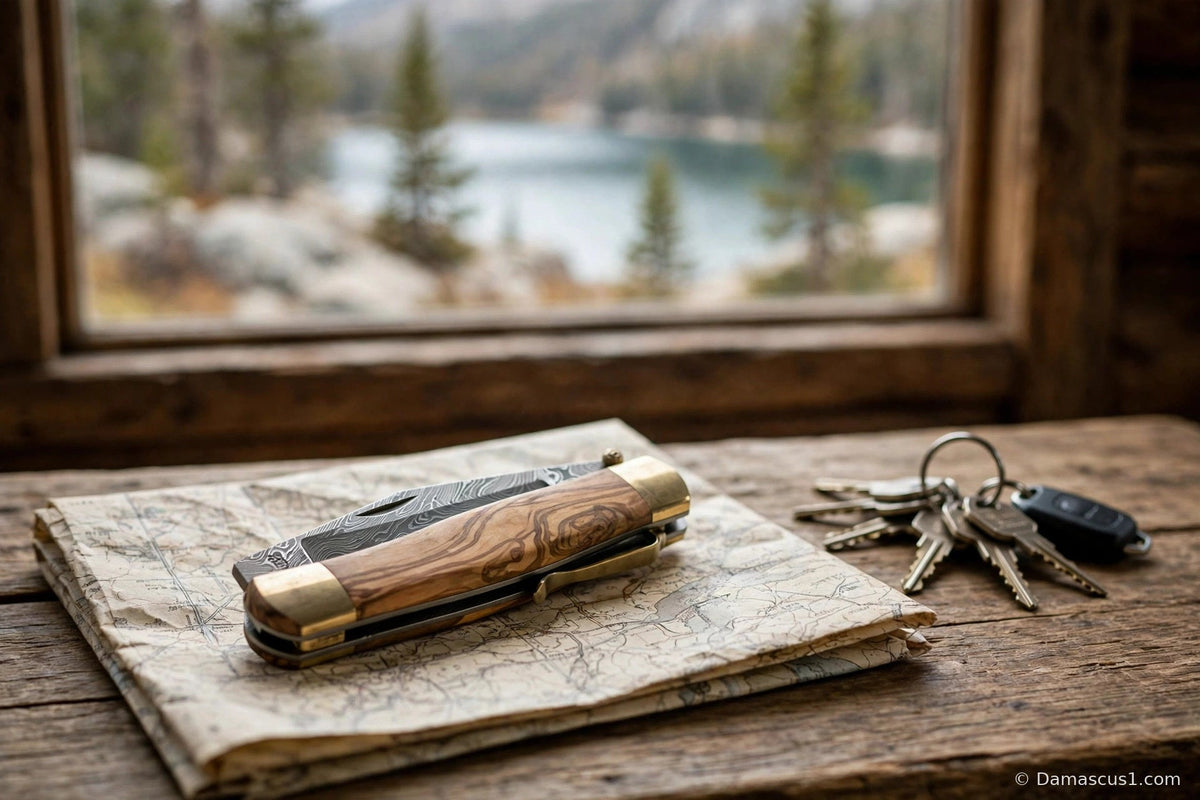
Our own example, put through its own checklist in public: the Olive Wood Damascus Pocket Knife Set is a handmade folder at $39.99 USD (compare-at $89.99) — pattern-welded Damascus steel (forge-welded 1095 and 15N20, roughly 276 layers, 58–60 HRC), an olive wood handle, and a manual two-hand nail-nick opening with a back-lock. It is not one-hand, not a flipper, not assisted, not automatic — and this guide will describe it no other way, because the mechanism is the legal story in Canada. The store's banner reads "Free Shipping & Returns above $50!" — two folders at $79.98 USD cross that line, which is the honest version of the gift arithmetic — and the cross-border tax picture above applies to it exactly as it applies to everyone. Low-risk by design, eyes open on cost, no guarantees made. That is the whole pitch, and it's the same pitch we'd make for any maker's genuinely manual folder.
For the buyer whose knife life is the kitchen rather than the campsite, mechanism law mostly evaporates — fixed blades have no opening to regulate — and the same handmade idea exists there: the VG10-Labelled Nakiri Knife at $44.99 USD, or the step-up Premium Kitchen Knife Block Set (7-pc) at $169.99 USD. Different tools, calmer law, same price honesty.
How does this guide's Canada coverage fit together?

This post is the law leg of a small Canadian library, and the legs are meant to be read in whatever order your question arrives. Start with the buying guide — Damascus pocket knife in Canada — for routes, prices and the decision table on where Canadians actually buy these knives. If the knife is a gift, Damascus knife gifts for men in Canada and the budget field guide, best pocket knife under 50 dollars in Canada, cover the occasions and the sub-$50 field respectively. For depth beyond Canada, the flagship best Damascus pocket knife guide goes long on the category itself, and two more links are planned from today's sibling posts — the Canada real-vs-fake Damascus guide and the French-language Québec guide — once they are live. [PLANNED links — do not add as live URLs until those posts publish.]
What happens if the border decides your knife is prohibited?
It is worth walking through plainly, because fear of this moment — vague, forum-flavoured fear — is what sends Canadians to the length myths in the first place. If an officer assessing an imported folder concludes it opens centrifugally and falls under the prohibited definition, the knife can be seized as a prohibited weapon rather than simply taxed or returned as an ordinary parcel problem. Importers generally have recourse routes — the seizure can be questioned through the CBSA's processes and, beyond them, the tribunal system whose decisions shaped the flick-test interpretation in the first place — but recourse is measured in paperwork and months, and the practical reality for a $40–$170 personal purchase is that the knife is, for the buyer's purposes, gone. There is no version of this story where the seller in another country absorbs the loss automatically; whatever a store's returns policy says, a seized prohibited-classified item is rarely a parcel that comes back for a refund.
Hold that consequence at its real size. It is a lost knife and a lost purchase price — annoying, not catastrophic, and nobody's criminal record for ordering an ordinary-looking folder in good faith through the mail. But it is entirely avoidable loss, and it is avoidable in exactly one place: before the order, at the mechanism choice. Nobody has ever had a stiff two-hand nail-nick folder seized for opening too easily, because the design does not open easily — that is not a slogan, it is the mechanical description. The flick test exists to catch stored energy and loose pivots: springs, buttons, bearings tuned for deployment speed. A backspring you fight with your thumbnail is the opposite technology. Buyers who internalise this stop shopping with their fingers crossed, which is the entire behavioural change this post exists to produce.
One neighbouring case deserves the same clarity: travelling within Canada with your folder. Domestic travel does not involve the import test at all, but context rules still apply — knives do not belong in cabin baggage on a flight regardless of mechanism (checked baggage and airline rules govern there), specific venues and events set their own conditions, and the carry-purpose principle from the section above travels with you: tool-shaped reasons, tool-shaped storage, in the kit bag rather than brandished in a pocket in places where that reads wrong. None of this is exotic. It is the ordinary etiquette of owning a sharp tool in a country that, read at the source, is considerably more reasonable about pocket knives than its folklore suggests.
Which myths about Canadian knife law should you stop repeating?

Three, in descending order of damage. "It has to be shorter than your palm." There is no palm rule and no federal length limit; repeating it sends buyers toward short automatic knives — the one prohibited design — and away from long, legal manual ones. "Any knife you can open one-handed is illegal." The statute prohibits automatic opening by gravity, centrifugal force, or a button/spring device; a tight thumb-stud folder you push open against resistance is a fact-specific question (and, at the border, a flick-test question), not a sentence in the Code. Collapsing "one-handed" into "prohibited" is how good knives get feared and bad purchases get made. "If a store sells it to Canada, it must be fine." A listing is a marketing document, not a legal opinion, and the person who bears the import assessment is the importer — you. A store can be honest, careful and still not control what an individual officer's test finds in an individual knife; that is why this guide keeps separating what design can do (remove the mechanism) from what nobody can do (guarantee the outcome).
Each myth survives because it is shorter than the truth. The truth, as this post has tried to show, is not actually long: mechanisms, not measurements; purpose, not panic; design first, steel second. It fits on an index card. It just doesn't fit in a rumour.
The Olive Wood Damascus Pocket Knife Set — $39.99
Real Damascus steel, an olive wood handle and a genuine leather sheath included — the knife our readers ask about most.
Shop the Olive Wood Damascus Pocket Knife Set — $39.99 · Free US shipping on orders over $50.
Frequently asked questions
Are pocket knives legal in Canada?
Yes. Ordinary manual pocket knives are legal to own in Canada, and there is no federal blade-length limit. What the Criminal Code (s.84) prohibits is a knife whose blade opens automatically by gravity or centrifugal force, or by hand pressure on a button, spring or similar device in the handle — switchblades, gravity knives and flick knives. Carrying is a separate question: a knife carried as a tool for a lawful purpose is treated as a tool; a knife carried as a weapon is not. This is general information, not legal advice.
What knives are illegal in Canada?
The prohibited list is about mechanisms: automatic switchblades, gravity knives, balisongs/butterfly knives and other blades that open automatically by gravity, centrifugal force, or a button/spring device in the handle. At import, the CBSA can also treat a folder as prohibited if it can be flicked fully open and locked with one brisk wrist motion — even after minimal manipulation of a flipper or stud. Ordinary stiff manual folders with a nail nick sit outside that definition.
Can you carry a pocket knife in Canada every day?
A manual folder carried as a tool — for camp, fishing, work, food, rope and parcel jobs — in a pocket, pack, tackle box or toolbox, is the ordinary lawful picture. Carrying a knife for use as a weapon, including for self-defence, is not a lawful purpose, and carrying one concealed raises separate offences (commonly summarised under ss.88 and 90). Context and local rules always matter. If your honest reason is a task, you are describing a tool; if it is a person, you are not.
Is there a maximum blade length for a pocket knife in Canada?
No federal blade-length limit exists for pocket knives in Canada. The palm-width and finger-count rules are folklore imported from elsewhere. Legality turns on the opening mechanism and on how and why the knife is carried — not on measurements. A short automatic knife is prohibited; a full-size manual two-hand folder is an ordinary legal tool.
What is the CBSA flick test?
It is the border's practical application of the prohibited definition to imported folders: can the blade be swung fully open and locked by centrifugal force — one brisk flick of the wrist? Legal explainers describe the CBSA as treating a knife that passes that test as a prohibited centrifugal opener, even if a flipper tab or stud needed a small preliminary nudge first. Tight, traditional two-hand nail-nick designs are built to have nothing for that test to find, though no border outcome can ever be guaranteed for any individual knife.
Can you order a pocket knife from the US to Canada?
Canadians do, routinely — with the mechanism chosen first. A manual two-hand folder is the calm design for a cross-border order. Expect the price in USD exactly as the store lists it, shipping terms at checkout, and possible GST/HST plus a carrier brokerage or handling fee on arrival. No seller can promise a customs decision or a delivery date, and any who does is promising something that isn't theirs.
Are flipper knives legal in Canada?
They are the grey zone this post exists to explain. A flipper is not named in the statute, but if the individual knife can be flicked fully open and locked with one brisk wrist motion — even after a minimal nudge of the tab — the CBSA can treat it as a prohibited centrifugal opener at import. Pivot tightness and wear change the answer knife by knife. The low-drama route is buying flippers inside Canada from a retailer who handled the import, and choosing a manual design for anything you order across the border yourself.
Is a Damascus pocket knife legal in Canada?
The steel is irrelevant to the law — Damascus is a blade material, not a mechanism. A Damascus folder with a manual two-hand nail-nick opener and a back-lock is an ordinary manual pocket knife: legal to own, and on the low-risk side of the border flick test by design. A Damascus flipper carries the same border question as any flipper. Judge the opening, not the pattern.
The last word: mechanism first, and the law gets simple
Canada's knife law frightens people mostly because it is summarised badly — as length limits that don't exist and bans that don't apply to ordinary tools. Read at the source, it is a short, mechanism-focused rule: blades that open automatically, by gravity, by centrifugal force, or by a button or spring are prohibited; ordinary manual folders are legal to own; carrying turns on purpose; and importing turns on whether a wrist flick can do the opening. Choose a knife designed on the calm side of every one of those sentences — a manual two-hand nail-nick folder like the Olive Wood Damascus Pocket Knife Set at $39.99 USD — and the law stops being a gamble and becomes what it should be for a tool: background. Buy the mechanism first, the steel second, and keep your reasons tool-shaped. That is the entire Canadian playbook, and it fits on an index card.
Leave a comment: