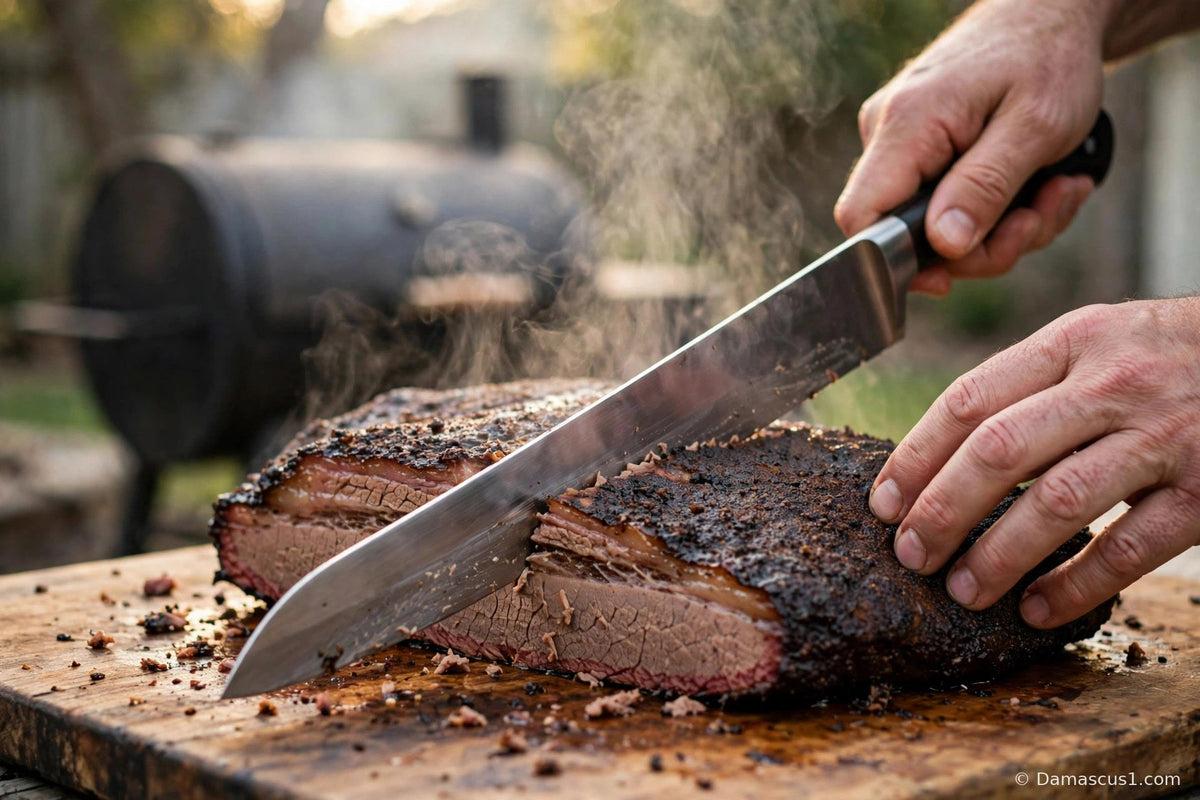
One long draw beside the smoker, bark intact, slices falling clean. Editorial scene — the knife shown is not a specific Damascus1 product.
Quick answer
The best brisket knife for slicing is a long, thin slicer — 11 to 12 inches at minimum, 14 if your briskets run wide — ideally with a granton (hollow) edge that releases each slice instead of dragging it. Trimming is a different job done earlier with a short boning knife. Rest the meat first. No single knife does both jobs well.
Here is the part most roundups bury, so we will put it second instead. Damascus1 does not sell that slicer. Our full catalog — 122 products, checked again on November 12, 2026 — contains no 11-to-14-inch brisket slicer and no granton-edge slicer at all. If slicing a whole packer brisket is the job in front of you, the honest specialist recommendation is the class of knife every serious page-one guide converges on: the Victorinox 12-inch granton slicer and its close cousins. Buy that class of knife for the slicing. What our shelf genuinely covers — and covers well — is everything around it: the trimming before the cook, the portioning after, and honest flat-only slicing on smaller briskets where a shorter blade's limits are stated, not hidden.
Why write a best brisket knife guide that opens by sending the headline purchase elsewhere? Because brisket is not one job. It is three jobs separated by about twelve hours: trim the raw packer, cook it, rest it, then slice it. Conflating those jobs is how people end up hacking a rested brisket with the same short knife they trimmed it with, tearing the bark, sawing instead of drawing, and blaming the meat. This guide splits the cook into its real parts — trim, rest, slice — matches each part to the knife shape that actually fits it, gives you a simple width-to-blade-length table so you can size a slicer to your briskets, and is honest about which rows of that table our products belong in and which they do not. Our trimming help starts with the AUS-10-Labelled Kitchen Knife in a boning profile at $59.99, and the full range lives in our chef's kitchen blades collection.
The knives at a glance
| Knife | Best for | Type / length class | Live price (Nov 12, 2026) |
|---|---|---|---|
| Victorinox Fibrox Pro 12" Granton Slicer (benchmark class) | Best for slicing whole packer briskets | 12" granton slicer | $86.99 as reported by Brisket & Bark (price as of Nov 11, 2026) — check the retailer on the day |
| Mercer Culinary Millennia 11" Granton (benchmark class) | Best budget slicer | 11" granton slicer | See retailer — the value pick across page-one roundups |
| Dalstrong Gladiator 12" (benchmark class) | Best upgrade slicer | 12" slicer | See retailer — the upgrade pick on All Things Backyard |
| Wüsthof Gourmet 14" (benchmark class) | Best for the widest briskets | 14" slicer | See retailer — the longest pick on All Things Backyard |
| Damascus1 AUS-10-Labelled Kitchen Knife (boning profile) | Best for trimming — fat cap and silver skin | Short boning profile | $59.99 |
| Damascus1 Serbian Chef Knife | Best for trimming help and portioning cooked brisket | High-carbon cleaver profile | $59.99 |
| Damascus1 Kitchen Knife, G10-Labelled | Best for small briskets, flat only — with limits | 8"-class kitchen knife | $34.99 |
| Damascus1 Premium Kitchen Knife Block Set | Best for the home BBQ station as a set | 7-piece block set | $169.99 |
Read the table the way a pit cook would. The top four rows are one tool in four price and length flavors: a long slicer. The bottom four rows are not failed slicers — they are the other tools the cook actually requires, and pretending otherwise is exactly the dishonesty this guide refuses. If you only read one section beyond this table, read the width-to-length table further down. It will tell you, in ten seconds, whether the knife in your drawer can cross your brisket in a single draw — and if it cannot, no amount of technique will fully rescue the slices.
What knife do pitmasters use for brisket?
Walk the serving line at any serious barbecue joint and the slicing knife you will see, over and over, is a long granton slicer in the 12-inch class — most often an inexpensive workhorse like the Victorinox Fibrox Pro rather than a showpiece. The reasons are practical, not romantic. A long blade crosses a wide flat in one draw. A granton edge lets the slice fall away. A grippy, washable handle survives a greasy service. And the price means a dull one gets replaced or re-honed without ceremony. Competition cooks add a second knife to the kit — a short, curved boning knife for the morning trim — because the trim and the slice reward opposite shapes. That two-knife reality is the consensus underneath every credible page-one guide, from X-Cutlery's retailer guide to Brisket & Bark's deliberately test-free roundup, and it is the structure of this guide too.
Notice what is absent from that serving line: the chef knife. An 8-inch chef knife is the best tool in most kitchens for most jobs — our best chef knife guide makes that case in full — but brisket slicing punishes its two defining traits. Its blade is too short to cross a wide flat without sawing, and its curved belly wants to rock when the job wants a flat, level draw. Pitmasters are not snubbing the chef knife. They are matching geometry to a specific, unforgiving task: a soft, bark-crusted, foot-wide piece of meat that tears the moment the blade changes direction mid-slice.
How long should a brisket knife be?

Longer than the brisket is wide, plus room to draw. That is the whole rule, and it produces a simple piece of arithmetic that no page-one rival currently tables — so here it is. Measure the flat of your cooked brisket at its widest point. Your slicer's blade should exceed that width by at least two inches, so the draw can start before the bark and finish after it without the tip or heel ever parking inside the meat.
The one-draw calculator: brisket width to minimum blade length
| Cooked flat width | Minimum blade length | What it means in practice |
|---|---|---|
| Up to 8 inches (small flats, flat-only packs) | 10 inches | A long chef or short slicer just crosses it |
| 9–10 inches (typical grocery packer flat) | 11–12 inches | The standard granton slicer class — the page-one consensus |
| 11–12 inches (large packers) | 13–14 inches | The 14-inch class earns its keep here |
| Over 12 inches | 14 inches, sliced in two passes planned in advance | Split the flat from the point first, then slice each narrower piece |
Now apply the rule honestly to short knives, ours included. An 8-inch-class blade — the class of our G10-Labelled Kitchen Knife at $34.99 — can only cross a flat about six inches wide in a true single draw. On a small, flat-only brisket, trimmed narrow, that can work, and we say so below with the limits attached. On a standard packer flat of nine or ten inches, the same blade must saw. Sawing tears bark, drags the fat layer, and turns the slice's face ragged. That is not a skill issue and it is not a sharpness issue. It is geometry, and geometry does not negotiate. Size the blade to the meat first; argue about steel brands later, if at all.
Length is not the only dimension that matters, but it is the gating one. After length comes thinness: a slicer should be thin behind the edge so it glides through a delicate flat instead of wedging it apart. Then flexibility — a slight give helps the blade follow the flat's surface, though brisket wants less flex than fish filleting does. And then the edge itself, which brings us to the dimples.
The flat, one draw at a time, each slice bending without breaking. Editorial scene — the knife shown is not a specific Damascus1 product.
Is a granton edge necessary for brisket?
Necessary, no. Genuinely helpful, yes — and the difference matters because it decides whether you can press an existing long knife into service or truly need to buy. A granton edge is the row of shallow oval hollows ground along the blade's flat just above the edge. Those hollows break the suction between a wide, moist slice and a wide, flat blade. Without them, a slice of brisket — damp, tender, and broad — clings to the blade, folds as it separates, and often tears at the bark edge. With them, the slice releases and lies down where you aimed it. On a narrow flat or a small brisket, a plain long slicer kept very sharp does fine work; the meat's contact patch is smaller and the drag is manageable. On a full packer, sliced to order for a table of people, the granton stops being a nicety. Every page-one roundup lands somewhere on that same spectrum — the granton Victorinox is the consensus best overall on All Things Backyard, the granton Mercer is the consensus value pick — and our reading matches theirs: treat the granton as strongly recommended for whole briskets, optional for small ones, and never as marketing decoration. If a blade is long, thin, sharp, and plain-edged, it will slice brisket well. If it is also granton-ground, it will slice brisket calmly.
What is the difference between trimming and slicing brisket?

Everything — timing, temperature, knife shape, and the cost of a mistake. Trimming happens before the cook, on cold, raw meat, and it is shaping work: rounding the flat's thin edges so they do not burn to chips, taking the fat cap down to an even layer roughly a quarter-inch thick so it can render and baste instead of shielding the bark, removing the thick, hard deckle fat between the flat and the point, and peeling silver skin that will never render and only toughens the bite. The knife for that work is short, narrow, and maneuverable — a boning profile that can turn corners, work under a fat seam, and shave rather than chop. A long slicer in the trim is a liability: too much blade to control around a cold, dense packer, and every slip costs meat you paid for.
Slicing happens after the cook and after the rest, on hot, fragile meat, and it is the opposite discipline: long, level, unhurried draws that change direction never. The flat and the point are separated first — they are two different muscles with grains running in different directions — and then each is sliced against its own grain. Same animal, same cook, two unrelated knife jobs. Any guide, or any set, that sells you one blade for both is selling you a compromise at the exact two moments a twelve-hour cook can be ruined in twelve seconds.
That split is where our shelf honestly enters this guide. The AUS-10-Labelled Kitchen Knife in a boning profile at $59.99 is the trimming knife in this story: short, pointed, made for following a fat seam and lifting silver skin in sheets rather than gouges. The Serbian Chef Knife at $59.99 — a high-carbon cleaver profile — backs it up for the heavier trimming moments and for portioning: squaring a cooked point into burnt-end cubes, dividing a flat into serving sections before the fine slicing, breaking down the trimmings themselves for grind. Neither is presented as a slicer. Both are presented as what they are: the right shapes for the jobs that happen before and around the slicing.
The point gets its own grain, its own cut, its own cubes. Editorial scene — the knife shown is not a specific Damascus1 product.
Priced picks: what to buy for each brisket job

For the slicing itself — buy the specialist class (not ours). A 12-inch granton slicer in the Victorinox Fibrox Pro class is the page-one consensus for a reason: it is the cheapest tool that satisfies the geometry completely. Brisket & Bark priced it at $86.99 as of November 11, 2026; retailer prices move, so check on the day. If budget rules, the 11-inch Mercer Millennia granton is the value pick across multiple roundups. If your packers run genuinely wide, step up to the 14-inch class rather than sawing with a 12.
For trimming — Damascus1 AUS-10-Labelled Kitchen Knife (boning profile), $59.99. The trim is where a handmade knife earns its place in a brisket cook. Fat-cap work is feel work: the blade rides the contour of the flat, taking fat down evenly without scalping meat, and a short boning profile with a fine point is the shape built for exactly that ride. Silver skin comes off in long peels when the tip starts the flap and the edge stays shallow. This is the knife we would put in a brisket cook's hand first, because the trim is the job our catalog genuinely fits. Product page.
For portioning and the heavy work — Damascus1 Serbian Chef Knife, $59.99. The cleaver profile does the jobs a slicer should never be asked to do: portioning a rested brisket into flat and point sections with authority, cubing the point, working through the cartilage-heavy edges of a raw packer during the trim. High-carbon, full-tang, broad — it is the anvil to the boning knife's scalpel. Product page.
For small briskets, flat only — Damascus1 Kitchen Knife, G10-Labelled, $34.99, with the limit stated. If you cook small, flat-only briskets — the kind sold trimmed in grocery trays — an 8-inch-class blade can slice the flat acceptably, provided you accept shorter strokes: you will draw in two connected passes rather than one, keep the blade freshly honed, and slice a touch thicker to keep each piece intact. That is a workable budget route, honestly labeled. It is not a whole-packer solution, and this guide will not call it one. Product page.
For the station as a whole — Damascus1 Premium Kitchen Knife Block Set, $169.99. A home BBQ station needs more than the brisket moment: the chef knife for the sides and slaw, the utility for the small work, a block that keeps it all separated and dry by the board. Our 7-piece Premium Block Set is the set-level route, and our best knife set guide and best kitchen knives hub compare it against the wider shelf. Pair the set with the specialist slicer above and the two-knife brisket kit is complete — one knife of which, honestly, is not ours. Product page.
Trim cold, trim patient: the cook is decided before the fire is lit. Editorial scene — the knife shown is not a specific Damascus1 product.
How do you slice brisket properly? The full technique

Technique is where brisket is saved or lost, and it matters more than any steel argument on this page — the page-one consensus says the rest matters more than the steel, and the slicing order matters almost as much. Work through it in sequence.
Rest first, without exception. A brisket sliced straight off the smoker pours its juices onto the board and dries in front of your guests. Rest it wrapped, in a warm hold, until the internal temperature settles and the juices redistribute — an hour is a sane minimum for a packer, longer in a proper hold is standard practice at joints that slice to order. The knife cannot fix an unrested brisket. It can only document the mistake in slices that weep and then dull.
Find the grain before the first cut — twice. A whole packer is two muscles. The flat is the long, lean, rectangular muscle; its grain runs lengthwise, so its slices are cut crosswise, across the short dimension. The point is the thick, fatty muscle stacked on top of one end; its grain runs in a different direction, roughly across the flat's. Slice the flat against the flat's grain and you get tender ribbons. Slice it with the grain and the same perfect cook chews like rope. Experienced cooks mark the direction before the cook — a small notch cut against the grain on the raw flat, while the grain is still easy to see — because bark and smoke will hide it later.
Split the flat from the point before slicing either. Run the slicer through the fat seam that separates the two muscles, following its natural curve. This is one of the few slicing-moment cuts where the long blade works as a separator rather than a slicer. Once apart, each muscle is narrower than the whole — which, per the table above, is also how an over-wide brisket becomes sliceable: a 13-inch whole becomes two pieces a 12-inch blade can cross cleanly.
Slice the flat pencil-thick, in single draws. The standard is a slice about the thickness of a pencil — roughly a quarter inch. The test pitmasters use is tactile: a proper flat slice drapes over a finger or the blade without breaking, pulls apart with the gentlest tug, and shows a smoke ring under an intact bark edge. Too thin and it crumbles; too thick and it chews. Each slice should be one draw of the full blade: start with the blade's rear portion at the bark, pull smoothly toward you — or push away, if that is your line's habit — using the whole length, with almost no downward pressure. The blade's length does the cutting. The moment you press down and saw, the bark tears and the slice's face goes ragged. Slow is not a flaw here. Slow is the method.
Turn the point, then slice or cube it against its grain. Rotate the point so you are cutting against its grain, which usually means turning it about ninety degrees from the flat's slicing direction. Slice it thicker than the flat — the point's fat carries it — or cube it for burnt ends, which is where the Serbian Chef Knife's cleaver profile takes over: decisive portioning cuts, then even cubes that go back into sauce and heat. Two muscles, two grains, two thicknesses. That sentence is, honestly, half of brisket slicing.
Slice to order, and keep the rest whole. A brisket dries slice by slice once cut. Joints hold the unsliced flat wrapped and slice against tickets for a reason: the interior of an uncut brisket stays moist in a way no sliced pile under a heat lamp ever will. At home, slice what the table will eat in the next few minutes, keep the remainder whole and wrapped, and go back for seconds with the knife. It is the easiest quality upgrade in this entire guide, and it is free.
Rested, bark set, grain marked before the cook — now, and only now, slice. Editorial scene — the knife shown is not a specific Damascus1 product.
Can you slice brisket with a chef knife?
You can, in the same sense that you can drive a nail with a wrench: the tool is hard, the job is soft, and the result shows the mismatch. An 8-inch chef knife fails a wide flat on geometry alone — the blade is shorter than the meat is wide, so every slice becomes a sawn multi-stroke cut — and its belly curve fights the level draw the cut wants. On a narrow flat-only brisket, with a very sharp edge, thin slices, and patience, a chef knife produces acceptable results; plenty of home cooks do exactly this with the small grocery flats described above, and our chef knife vs santoku vs nakiri guide explains the profile differences that decide these edge cases. But if whole packers are a regular event in your yard, the chef knife is the wrong resident tool and a $40–$90 class slicer is the correct purchase — again, a purchase our catalog does not currently fill. What our chef-class knives do fill, and fill daily, is the rest of the cook: the trim support, the sides, the portioning. Judge each knife, ours included, by the job it is shaped for.
How thick should brisket slices be?
Pencil-thick for the flat — about a quarter inch — and a touch thicker for the point. The flat's thickness is a tenderness dial: slice a slightly under-tender flat a fraction thinner and it will eat tender; slice an over-tender flat a fraction thicker or it will fall apart before it reaches the plate. Read the first two slices and adjust. If a slice crumbles under its own weight, go thicker. If it stands stiff and chews long, go thinner. The point, marbled and forgiving, takes half-inch slices or full cubes without complaint. None of this depends on the brand of knife. All of it depends on the slices being single, clean draws — crushed, sawn slices read as tough at any thickness, because the tearing, not the thickness, is what the teeth notice first.
How do you keep a brisket knife sharp?

Brisket is gentle work for an edge — cooked meat, no bone, no board-scraping — so a slicer stays sharp for many cooks if it is honed before service and stored protected. The failure mode is not the meat; it is the moments around it: the blade knocked against the smoker grate, the edge buried in a drawer, the well-meant trip through a pull-through sharpener that grinds a wavy bevel into a precision tool. Hone lightly before a slicing session to stand the edge back up. Sharpen on a stone when honing stops restoring the glide — and for Damascus blades like the trimming and portioning knives in this guide, stone technique matters doubly, because the same stone that renews the edge can mar the patterned cladding if it is used carelessly. Our how to sharpen a Damascus knife guide covers the grit progression and the pattern-safe angle in full. Wash and dry every brisket knife by hand the moment service ends; brisket fat and bark residue left on a blade overnight are corrosive in the small, unglamorous way that ruins more edges than cooking ever does. And never lend the long slicer to the trimming job or the trim knife to the slicing: each edge is tuned by its work, and swapping jobs dulls both faster than either job alone.
Honed before service, washed the moment it ends — brisket edges live or die off the meat. Editorial scene — the knife shown is not a specific Damascus1 product.
What should you skip? The brisket knife traps
The serrated shortcut. Serrated bread and carving knives appear in brisket advice aimed at beginners because serrations saw through bark without skill. They also shred the slice's face, tear the fat layer into strings, and cannot be resharpened at home in any practical sense. A sharp plain edge with a long draw beats serrations at every point after the first slice.
The electric knife as a plan. Electric carving knives have their holiday-turkey defenders, and they will portion a brisket. They also remove the feel that tells you the grain changed, the thickness drifted, or the flat is running dry. For an occasional cook serving a crowd fast, they are a defensible convenience. As the resident brisket tool, they trade away exactly the control this guide is about.
The giant set with a "brisket knife" in it. When a large block set lists a slicing knife, check its actual length before crediting it. Many set slicers are 8 or 9 inches — carving-knife length, fine for a chicken or a small roast, short for a packer flat by the arithmetic in the table above. Sets earn their place for the station as a whole — ours included, and our best Damascus chef knife set guide shows what a set's slicer can and cannot do — but no set's included slicer should be assumed brisket-ready until its blade length is measured against your briskets.
Buying steel when you need length. A premium-steel 8-inch knife will saw a wide flat more expensively than a budget 12-inch slicer will draw through it. Brisket slicing is the clearest case in the whole knife world of geometry first, metallurgy second. Spend on length and thinness first, on the granton second, and on exotic steel only after the first two are satisfied — by which point, for most cooks, they already own the right knife.
Shop Damascus kitchen knives
Prices checked November 21, 2026. The product page on the day you order is the final word.
- Japanese VG10 Damascus Chef Knife, 8.5 in.: $399.99
- Premium Kitchen Knife Block Set: $169.99
- 7-Piece Forged Damascus Kitchen Knife Set: $399.99
Damascus pocket knives for the cook who has everything
- Olive Wood Damascus Pocket Knife Set, 6.5 in.: $39.99
- Green Wood Damascus Pocket Knife Set, 6.5 in.: $39.99
- Buffalo Horn Damascus Pocket Knife Set, 6.5 in.: $39.99
- Stag Horn Damascus Folding Pocket Knife, 6.5 in.: $49.99
- Camel Bone Scrimshaw Damascus Folding Pocket Knife, 7.6 in.: $49.99
Damascus pocket knives under $50 · All handmade Damascus pocket knives
Frequently asked questions
What knife do pitmasters use for brisket?
A long granton slicer in the 12-inch class — the Victorinox Fibrox Pro is the name that recurs on page one and on serving lines — paired with a short boning knife for the morning trim. The slicer crosses the flat in one draw; the boning knife does the shaping twelve hours earlier. Two knives, two jobs.
How long should a brisket knife be?
At least two inches longer than your cooked flat is wide. For the typical grocery packer flat of nine to ten inches, that means an 11-to-12-inch blade — the page-one consensus length. For large packers at eleven to twelve inches wide, step up to a 14-inch slicer, or split the flat from the point and slice the narrower pieces.
Is a granton edge necessary?
No, but it is strongly recommended for whole briskets. The hollow-ground ovals break suction so a wide, moist slice releases from the blade instead of clinging, folding, and tearing at the bark. On small flat-only briskets, a sharp plain long slicer does fine work. On a full packer sliced to order, the granton earns its place.
What is the difference between trimming and slicing brisket?
Trimming is pre-cook shaping on cold raw meat — fat cap down to an even quarter inch, deckle out, silver skin off, edges rounded — done with a short boning knife. Slicing is post-rest portioning on hot, fragile meat — flat and point split, each cut against its own grain — done with a long slicer. Different timing, temperature, shape, and cost of error.
Can you slice brisket with a chef knife?
On a narrow flat-only brisket, yes, acceptably — sharp edge, thin slices, patience. On a whole packer flat, a chef knife is too short to cross the meat in one draw and its belly curve fights the level pull, so slices come out sawn and ragged. Regular packer cooks should own the long slicer class.
How thick should brisket slices be?
About a quarter inch — pencil-thick — for the flat, adjusting after the first slices: thicker if they crumble, thinner if they chew stiff. The point takes thicker slices, around half an inch, or full cubes for burnt ends. Clean single draws matter more than the exact measurement; a torn quarter-inch slice eats tougher than a clean thicker one.
The honest bottom line
Brisket rewards cooks who respect that it is three jobs, not one. Trim cold with a short boning knife. Rest the cook properly, because no blade rescues an unrested brisket. Then slice — flat and point split, each against its grain, pencil-thick, in single draws of a blade longer than the meat is wide, ideally granton-ground so each slice lets go cleanly.
On the slicing knife itself, this guide's recommendation stands even though it sends you elsewhere: buy the 12-inch granton slicer class that every serious page-one guide converges on. Damascus1 does not make one yet, and we would rather tell you that on our own page than sell you a short knife dressed up as one. For the jobs around the slicing — the trim that decides the cook before the fire is lit, the portioning that turns a point into burnt ends, the small-flat slicing with its limits stated, and the station set that holds it all — our shelf is priced live and ready: the AUS-10-Labelled boning-profile trimming knife at $59.99, the Serbian Chef Knife at $59.99, the G10-Labelled Kitchen Knife at $34.99, and the Premium Knife Block Set at $169.99 — all in the chef's kitchen blades collection. Build the two-knife kit honestly, and the next packer you cook will slice the way it smoked: patiently, and clean.
Leave a comment: