The short answer: For most Canadian camping — drive-up sites, serviced backcountry, picnic-table cooking — the best Damascus knife is a manual two-hand folding pocket knife in carbon Damascus: it covers food prep, cord, packages, and small repairs, packs flat, and carries as a tool for a clear lawful purpose. Add a fixed blade only when your camp work genuinely includes kindling, shelter building, or game — and keep either one dry and lightly oiled in the field.
That answer will annoy two camps at once, which is usually a sign it is honest. The fixed-blade camp will say a folder is a toy next to real camp work; the ultralight camp will say any Damascus blade is jewellery pretending to be a tool. Both have a point and both overstate it, and the holders in this search — a Jasper, Alberta Damascus maker, a Quebec outdoor guide, a Canadian archaeology field crew's gear notes, and a fixed-versus-folding explainer — draw the line in almost exactly the same place when you read them together. A folding knife is portable, light, and perfectly adequate for the small cutting tasks that make up ninety per cent of actual camping. A fixed blade is stronger, safer under heavy load, and the right tool when the work gets serious. The question "best Damascus knife for camping" therefore has no single answer until it is asked properly: best for which camp, which tasks, which season, and which carry rules? This Canada edition asks it properly. It is distinct in this series from the hunting guide, which owns game work, and from the format-comparison post, which owns folder-versus-fixed as a general question — this page owns the camping trip end to end: the drive, the site, the cooking, the weather, the field care of a carbon blade far from a kitchen, and the lawful-purpose framing that keeps a camp knife a tool in the eyes of everyone who sees it. General information throughout, not legal advice — park, municipal, and venue rules vary and are hedged wherever they appear.
Start with what camping actually asks of a knife, because the fantasy list and the real list differ. The forum thread in this search — experienced campers advising a traveller heading for Banff and Jasper — lands on the real list with refreshing bluntness: food preparation, food preparation, and food preparation, then cutting twine and cordage for a tarp, maybe cleaning a fish, and notably not firewood, because dead branches feed a fire from one end and a small saw outperforms any knife at splitting. The Quebec guide's list agrees from its own trails: prepare kindling efficiently, cut ropes and straps, prepare food safely, improvise small tools. Add the unglamorous modern entries — opening packaging, trimming a guyline, cutting tape and repair patches, portioning cheese on a rock — and the portrait is complete. Almost everything on the real list is light, precise cutting at a table or a stump. Almost nothing on it needs a blade that can be hammered through a log. That is the factual ground the folder-versus-fixed decision stands on, and any guide that skips it is selling the fantasy list.
What do you actually do with a knife at a Canadian campsite?

More than city people expect and less than catalogue copy promises. The Canadian pocket-knife roundup in this search asks "What do you do with a pocketknife?" in exactly those words and answers with the hands-on lifestyle: farm and acreage work, outdoor activities like hiking and camping, the constant small cutting of a life lived partly outside. At camp specifically, the work sorts into four baskets. Food is the largest by a wide margin — every meal, every snack, every package, from slicing sausage and cheese to trimming vegetables for the pan to spreading, portioning, and the eternal opening of packaging designed by people who hate campers. Campcraft is the second: cord and webbing cut to length, tent pegs whittled or trimmed, tarp lines adjusted, feather sticks for a fire in wet weather, a splinter of kindling shaved where the wood is too damp to catch. Repairs are the third: tape trimmed, a strap shortened, a pack buckle freed, a fishing line cut clean. And the fourth basket is the one that decides the fixed-blade question — heavy work: splitting kindling by batoning, shelter building, processing game or large fish, clearing brush. Most campers, on most trips, in most of Canada's serviced and semi-serviced sites, never open the fourth basket at all. Some campers — backcountry, hunting camps, winter camps, bushcraft weekends — live in it. The best knife is the one matched to the baskets you actually open, and the honest camper audits a season of trips before spending a dollar.
Is a folding knife or a fixed blade better for camping?
Both, in sequence, and the explainer in this search — a fixed-versus-folding comparison opened for this brief — gives the balanced verdict the other holders support: for camping, both types can be useful; a fixed blade is better for heavy camping work, a folding knife is useful for smaller jobs, and many experienced campers carry both, the fixed blade handling demanding jobs while the folder provides convenience. The reasoning underneath is structural. A fixed blade's steel runs unbroken from tip through handle — full tang, in the Bowie holder's phrase — so load concentrates nowhere; there is no joint to flex, no lock to test, no pivot to pack with grit, and no possibility of the blade folding onto fingers mid-task, which is why the explainer calls fixed blades safer for heavy work. A folder's virtues are the opposite kind: it folds. The archaeology crew's gear guide — written by people who survey the boreal forest for a living — puts it plainly: folding knives are portable, lightweight, packable, and easy to carry every day, and several of its staff find a pocket knife perfectly adequate for their field work and carry nothing heavier; its honest counterweight is that the fold is an inherent weak point, making folders far less durable than fixed blades while remaining perfectly adequate for small cutting tasks. The Quebec guide's own table makes the same trade in numbers: a folding knife at day-hike weight for light trips, a robust fixed blade when the outing gets longer and more technical — its golden rule being that the longer and more technical the outing, the heavier and bigger the knife it can justify. So the decision rule for a Canadian camper writes itself. Day trips, serviced sites, picnic-table trips, canoe weekends with a camp kitchen: the folder is not the compromise, it is the correct tool. Multi-day backcountry with firecraft, a hunting camp, a winter camp where wood processing is survival rather than ambience: the fixed blade earns its weight, and the folder comes along anyway for the food basket, because nobody enjoys portioning cheese with a Bowie.
Why choose Damascus steel for a camp knife at all?

With clear eyes about what it is. Carbon Damascus — the 1095 and 15N20 layered steel at the centre of this series — offers a keen, easily resharpened edge, a blade with genuine toughness that flexes rather than chips, and an object beautiful enough that people take care of it, which is a real maintenance advantage disguised as vanity: knives that are loved get dried. The Alberta maker in this search builds its whole outdoor line on the steel, describing hand-forged Damascus hunting, survival, and camping knives as companions for exactly this life, from setting up camp to preparing a fresh catch beside the fire, and its activity table assigns the folding knife to camping outright: compact, able to handle varied tasks. Against that stand the honest costs, which this series never hides. Carbon Damascus is not stainless: at camp, where a blade meets dew, fish, rain, and damp grass, it must be wiped dry and lightly oiled or it will spot — the field-care section below treats that as a rhythm, not a burden, but it is a rhythm. It is not the hardest-wearing choice for prying, batoning, or abuse; a thick tool-steel bushcraft blade takes punishment a patterned blade should not be asked to. And the pattern itself, while it lives in the steel and not on it, will take a working patina at camp — grey over the waves where food acids and weather touch it — which owners who wanted a showroom finish forever should know in advance. Choose Damascus for camping because you value the edge, the feel, and the object, and because its one demand — keep me dry — is a demand good campers meet for all their gear. Choose something else, without a shred of shame, if your camp style is wet, rough, and forgetful; a stainless beater you never think about beats a beautiful blade you resent maintaining.
How do you care for a carbon Damascus knife in the field?

With a kit that weighs almost nothing and a rhythm that takes two minutes at the end of the camp day. Here is the field routine as this page's citable asset.
| When | Do this | Why |
|---|---|---|
| After food prep | Wash or wipe the blade clean; dry it fully, handle joint included | Food acids and fish residue start corrosion in hours, not days |
| After any wet work | Dry, then a whisper of food-safe mineral oil across the flats | A thin film is the whole rust defence carbon steel has |
| Nightly at camp | Wipe down, check the pivot for grit, store dry in the pack — not loose in a damp tent corner | Dew and tent condensation are the silent camp rust source |
| After rain or a dunking | Dry immediately; oil the pivot as well as the blade | Water in the joint is where folders corrode first |
| For the fixed blade | Carry in the sheath; sleep with it stored dry and out of the sheath if the sheath is damp | Leather holds moisture against both faces at once |
| Home again | Full clean, dry, oil, and a few passes on the stone if the trip dulled it | Camp grit left in a pivot becomes next season's stiff action |
The kit is three items: a small cloth, a tiny bottle of food-grade mineral oil — food-safe because a camp knife is a food knife — and, for trips longer than a weekend, a pocket stone or a small honing rod, because an edge maintained nightly never needs a rescue sharpening. Two camp-specific notes deserve emphasis. The first is condensation, the Canadian constant: a knife left in a cold tent or a vehicle overnight, then brought into warm damp air — or simply opened at a dewy dawn — collects moisture the way a windshield does, and the nightly wipe exists precisely for it. The second is the sheath rule, carried over from this series' rust guide because camp is where it is most violated: a leather sheath is transport, not storage. Carry the fixed blade in it all day with a clear conscience; if the sheath comes home damp, the blade sleeps out of it until both are dry. Neither habit asks for equipment, money, or virtue. They ask for the two minutes while the kettle boils.
What does Canadian law mean for a camp knife?

General information, not legal advice, hedged as this series always hedges it — and framed around the idea that governs everything: purpose. A knife carried as a tool for a lawful purpose — camp cooking, campcraft, fishing, repairs — is a tool, and the Quebec guide in this search says the quiet part out loud for its own province: in Quebec it is legal to carry a knife in the forest for utilitarian purposes, with the practical advice that it stays in the bag during transport and in urban parks. That transport instinct generalises across the country. Keep the knife packed with the camping gear on the road, in the pack at the trailhead, in the camp kitchen at the site — present as equipment among equipment, not carried on the person through towns, trailhead crowds, and visitor centres where it has no job. Design matters at the border and in principle: knives that open automatically, by gravity, or by centrifugal force are prohibited in Canada by design, while a manual folder that takes two hands and a nail nick to open is a tool by construction. Self-defence is not a lawful carry purpose in Canada, and no camp knife should ever be described as carried for it. Beyond that, the honest hedges: there is no federal blade-length limit for ordinary knives, but parks, municipalities, venues, and events can and do set their own rules — Parks Canada sites, provincial parks, ferries, and organised campgrounds each deserve a check before a trip rather than an assumption during one — and an officer's or a warden's reading of a specific situation is a fact of the field that no article can pre-empt. The camper's summary is short: genuine camp use, transported packed, produced for camp tasks, put away when the tasks end. A knife carried that way almost never has to explain itself — and if it does, its explanation is the truth.
Which Damascus knives does this guide actually recommend for camp?
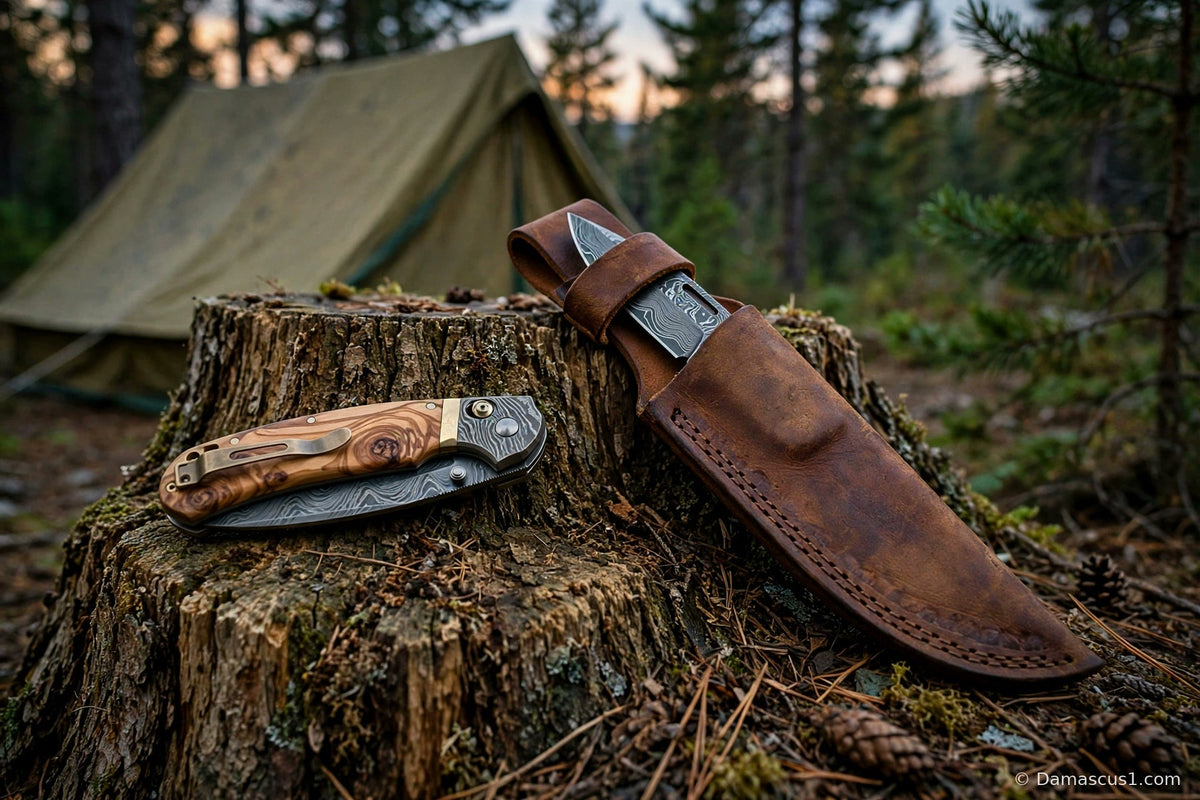
Two, matched to the two baskets, with prices verified live today and stated in US dollars exactly as the store lists them. For the folder basket — the knife most Canadian campers will use most — the recommendation is the Olive Wood Damascus Pocket Knife Set at $39.99 USD (compare-at $89.99): forge-welded 1095 and 15N20 Damascus at roughly 276 layers and 58–60 HRC, olive wood handle, 6.5 inches overall, single-edged, and — decisive for camp carry — a manual two-hand nail-nick opener with a back-lock, the low-risk-by-design mechanism the law section describes. It is expressly not stainless, and this guide has built its whole field-care section around that fact rather than around pretending otherwise. Its product page carries buyer reviews of 4.9/5, stated exactly as the page states them; the store's wider Amazon seller rating of 4.8 stars is a store-wide figure and not this knife's score, and this guide does not blur the two. Engraving is available on request, quote-based, up to 25 characters, with proof, price, and timing confirmed before work starts — a camp knife with a name on it is a gift this series' readers have made before. The same steel in other handles, the Orange Wood 6.5" Damascus Folding Pocket Knife at $39.99 USD (compare-at $99.99) and the Green Wood Damascus Folding Pocket Knife at $39.99 USD (compare-at $99.99), suits campers who rotate handles or buy for two packs. For the heavy basket, the fixed-blade entry is the Camel Bone Fixed Blade at $69.99 USD (compare-at $99.99), listed at 8.2 inches total length — stated as total length only, with no blade length invented here — a fixed blade for the kindling, shelter, and game-adjacent work a folder should not be asked to do. Back at home, the Premium Kitchen Knife Block Set (7-pc) at $169.99 USD and the VG10 Nakiri at $44.99 USD cover the kitchen the camp food was rehearsing for. The store banner as listed reads "Free Shipping & Returns above $50!"; no delivery dates, customs outcomes, or Canadian-dollar conversions are promised anywhere in this guide, because none were listed to promise.
Our companion guides carry the neighbouring ground: are pocket knives legal in Canada owns the law in full, best Damascus hunting knife owns the game-work end of the fixed-blade world, and Damascus pocket knife Canada owns choosing the folder itself. Today's sibling drafts — how to oil a pocket knife, and Damascus versus ceramic — are planned mentions only, named in words and linked nowhere until they are live pages. One more honesty note for the road: this guide recommends no knife for batoning logs, prying, or digging, whatever its construction. Those jobs belong to saws, axes, and trowels, and a guide that sells a pocket knife as a survival system is selling the fantasy list this page opened by refusing.
Frequently asked questions

What do you do with a pocketknife when camping?
The Canadian Rank-It roundup asks "What do you do with a pocketknife?" in exactly this form and answers with the hands-on list: pocket knives are handy for the constant small cutting of outdoor life and are, in its words, very useful for fans of outdoor activities like hiking and camping. This page's four baskets — food, campcraft, repairs, and the heavy work a folder should decline — are that answer with the camp detail filled in.
What is a folding knife, and is it enough for camp?
The fixed-versus-folding explainer in this search poses this as a heading and answers that a folding knife's blade folds into the handle on a pivot with a locking mechanism, making it compact and easy to carry, and that outdoor users rely on folders for light cutting jobs, food preparation, and general utility. The archaeology field guide in this search adds the working verdict: its own staff find a pocket knife perfectly adequate for their forest survey work.
What is a fixed blade knife better at?
The same explainer poses this as a heading and answers with construction: a fixed blade does not fold or move, its blade extends into the handle as one solid piece, and that solidity is why fixed blades handle the force of cutting branches, preparing firewood, processing game, and building shelter — the heavy basket a folder should not attempt.
How do you choose the right camp knife?
The Bowie holder in this search asks "How Do You Choose the Right Bowie Knife?" as a heading, and the Quebec guide answers the general question with its golden rule: the longer and more technical the outing, the heavier and bigger the knife it justifies. Audit your real tasks first — most campers' lists are food and cordage, and a folder covers them — then let the heaviest genuine task on your list decide whether a fixed blade joins the pack.
What is a camp knife used for, at the heavy end?
The Bowie holder asks "What is a Bowie Knife Used For?" in exactly this form and lists the heavy basket: field dressing and breaking down game, splitting kindling and processing firewood by batoning, clearing light brush, camp food preparation, and cutting rope, webbing, and heavy cordage. Those are fixed-blade jobs, and this guide assigns them to one — never to the folder.
Can you carry a knife to a Canadian campsite?
The Quebec outdoor guide in this search answers for its province in plain terms — it is legal to carry a knife in the forest for utilitarian purposes, keeping it in the bag during transport and in urban areas — and this page generalises cautiously: genuine camp purpose, transported packed, rules checked for the specific park or venue, and no reliance on this article as legal advice. Prohibited opening mechanisms are a separate, design-level matter: automatic, gravity, and centrifugal openers are prohibited in Canada regardless of purpose.
The last word: match the knife to the trip you actually take
The best Damascus knife for camping in Canada is not the biggest blade in the catalogue or the lightest one in the pack. It is the one whose basket matches your season: a two-hand carbon Damascus folder for the food, cord, and repairs that fill a real camp day, a fixed blade added without apology when your trips genuinely include wood, shelter, or game, and a two-minute dry-and-oil rhythm that keeps carbon steel honest in a damp country. Buy for the trips on your calendar, not the expedition in your imagination, and the knife will earn its place every single night out. Start with the folder most Canadian campers will reach for first: the Olive Wood Damascus Pocket Knife Set at $39.99 USD — a tool by design, a companion by the second trip.
The Olive Wood Damascus Pocket Knife Set — $39.99
Real Damascus steel, an olive wood handle and a genuine leather sheath included — the knife our readers ask about most.
Shop the Olive Wood Damascus Pocket Knife Set — $39.99 · Free US shipping on orders over $50.
Leave a comment: