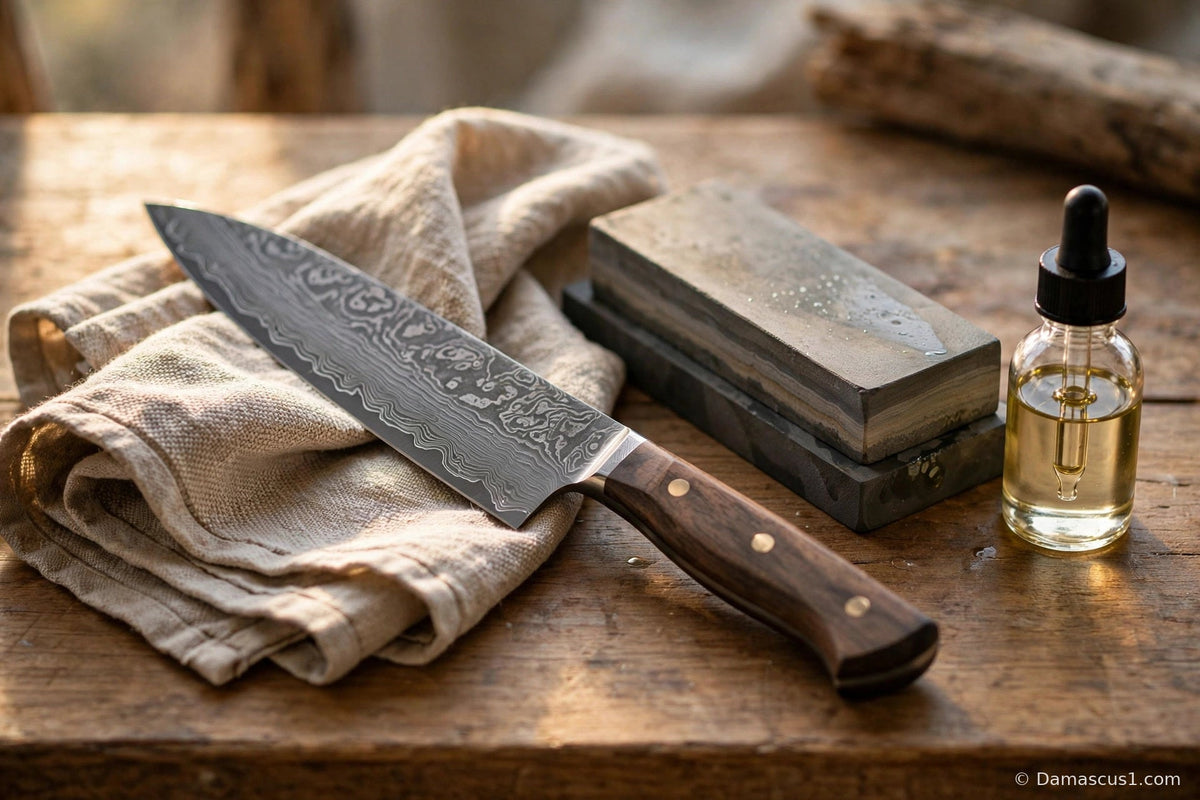
Direct answer: Care for a good kitchen knife with four habits: hand wash it in warm soapy water right after use, dry it immediately and completely with a towel, store it in a block, on a magnetic strip, or in a sheath — never loose in a drawer — and sharpen it on a whetstone, not a pull-through sharpener. Add one more for carbon-rich blades: a whisper-thin coat of food-safe oil before storage. That is the whole system. Everything else in this guide is explaining why those habits work and what happens when they slip.
Knife care has a public-relations problem: it is usually taught as fussiness. Lists of prohibitions, special products, rituals. In truth, good knives — Damascus included — are not delicate. They are intolerant of exactly three things: standing water, violent company (a dishwasher rack, a drawer full of steel), and abrasive sharpening that tears at the edge. Avoid those three and a knife will outlast the kitchen it works in. The chef's best kitchen blades collection is full of knives that will reward these habits for decades; this guide is the owner's manual the box should have included.
It also supports the deeper rust-and-care hub on this blog, can Damascus steel rust?, where the chemistry of spots, stains, and patina gets the full treatment. Read this page for the routine; read that one when something has already gone orange and you need to know whether it is a disaster or a five-minute fix. Usually, it is the five-minute fix — if you catch it early, which is what routines are for.
How should you wash a kitchen knife?

Wash a kitchen knife by hand, in warm water with a small amount of dish soap, using a soft sponge or cloth, blade facing away from your fingers. Rinse it, then dry it straight away. Never leave a good knife soaking in the sink: standing water attacks edges and handles, and a hidden blade under suds is a genuine cut hazard for the next person who reaches in.
The technique takes thirty seconds and has only two rules that matter. First, the edge never points at the hand holding the sponge — wipe from spine to edge, or lay the knife flat and wipe along the flat of the blade, so a slip slides off steel rather than into it. Second, washing and drying are one job, not two jobs separated by "in a minute." A knife washed and left wet on the draining board has completed the easy half and skipped the half that prevents rust. Carbon-rich blades can spot in the time it takes to eat dinner; stainless-leaning blades forgive more, but their handles and edges still prefer dry.
What about the dishwasher — can't a sturdy knife handle it? No, and the reasons are mechanical as much as chemical. Inside a dishwasher a knife rattles against racks and other items, and every knock lands on the edge: that is how sharp knives come out dull and occasionally chipped. The detergent is far harsher than hand soap and the heat cycle bakes it on. Handles suffer worst — wood swells and cracks across repeated cycles, and even synthetic handles age years in a season of machine washing. One cycle rarely kills a knife outright, which is exactly the trap: the damage is cumulative and deniable until the edge and handle are both tired. Hand washing is not snobbery. It is the cheapest maintenance there is.
Drying technique is worth ten seconds of thought. Use a clean, dry towel — linen or cotton, not the damp one that has been hanging all day, which merely redistributes moisture. Dry the blade on both sides, then the handle, then run the towel lightly along the spine and into the junction where blade meets handle, because that crevice is where water hides and rust starts. If the knife will be used again within the hour, this can be brisk. If it is going away until tomorrow, it should be thorough — and if it is going away for a week, the oil step below applies.
One habit separates careful kitchens from lucky ones: the knife is washed by the person who used it, immediately, as part of finishing the task — not left "for the wash-up" as a surprise in a full sink. Sinks full of hidden blades injure more home cooks than cutting ever does. Wash it, dry it, put it away: three verbs, one motion, every time.
Should you oil a kitchen knife — and with what?

Oil a kitchen knife when its blade is carbon-rich, when it will sit unused for more than a few days, or when it lives in a humid kitchen. Use a food-safe oil — plain mineral oil sold for cutting boards is the standard choice — applied as the thinnest possible film with a soft cloth or paper towel, then buffed almost dry. The goal is an invisible barrier against moist air, not a greasy blade.
Stainless-leaning knives in daily use rarely need oil; washing and drying is enough, because tomorrow's use arrives before corrosion gets started. The calculus changes with time and chemistry. A blade with meaningful carbon content trades some corrosion resistance for edge qualities its owner chose deliberately, and oil is how you pay that trade's small toll. A knife stored through a humid summer, a holiday home's knife that works one month a year, a blade put away after cutting acidic food — these are oil cases. So is any knife travelling in a leather sheath, since leather can hold moisture against steel.
Application matters more than brand. Wash and dry first — oil over a damp blade seals the water in, which is worse than no oil at all. Then a drop or two on a cloth, wiped along both flats and the edge, and buffed until the blade looks dry but feels slick. If you can see oil, there is too much; wipe it back. Before the next use on food, a quick rinse and dry clears any residue. Never use olive oil or other kitchen cooking oils for storage: they oxidise, turn sticky and rancid, and glue dust to the blade. Mineral oil stays stable, which is the entire point.
Handles have their own version of this conversation. Wooden handles — the rosewood handle on the VG10 Nakiri at $44.99 is the example in this store — benefit from being kept dry and, very occasionally, from a light coat of board oil if they begin to look parched. Synthetic handles such as G10, named in the title of the G10-handle Damascus chef knife (from $34.99) and stated on the page of the VG10-core 6-piece set, ask for nothing beyond washing and drying. Know which handle you own; the care follows from the material, not from a generic routine copied onto every knife you own.
If rust spots have already appeared, do not improvise with harsh abrasives. Start with the least aggressive fix — a paste of baking soda and water on a soft cloth, or a cork — and read the full decision tree in can Damascus steel rust? before reaching for anything stronger. Prevention is this section; cure is that page, and the order matters.
What is the best way to store kitchen knives?

The best storage keeps edges separated, dry, and off other steel: a knife block with slots that fit your blades, a wall-mounted magnetic strip, an in-drawer tray with individual slots, or individual sheaths and blade guards. The one unacceptable option is loose in a drawer, where edges collide with every opening and fingers go searching among sharp steel.
Each good option has its trade-offs, and the right choice is the one your kitchen geometry supports. A block is the classic: visible, tidy, and forgiving — but it eats counter space, its slots must actually fit your tallest blades (a nakiri's height defeats some blocks), and the slots themselves should be kept dust-free and dry. A magnetic strip frees the counter and fits any blade shape, which is why it anchors the storage advice in our chef knife vs santoku vs nakiri guide; its cautions are to place knives gently (sliding a blade sideways across the magnet scratches the flat) and to dry blades fully first, since a strip holds a wet blade against a wall for hours. An in-drawer slotted tray is the best answer where toddlers or counter famine rule strips and blocks out — it keeps separation and safety while hiding the knives entirely. Sheaths and guards are the travellers and the overflow solution: they protect single knives in drawers safely, provided the blade goes in clean and dry, because a sheath over a damp blade is a rust incubator with a handle.
Whatever you choose, match it to the set you actually bought — the piece-count logic in the kitchen knife set piece count guide includes storage in the buying decision for exactly this reason. A block set like the Premium 7-piece block set at $169.99 — described here by its verified price and listed contents only, because its own product page contradicts itself about the blade steel — arrives with its storage solved. Singles arrive naked, and the guard or strip they need is part of their true price. Care begins at checkout: buy the storage with the knife, not after the first drawer incident.
A small, unglamorous storage rule: never store a knife on the counter "just for tonight" beside the sink. Splash zones are rust zones, and a knife beside a sink gets wet a dozen times a day without ever being used. If it is not in your hand, it belongs in its storage — the habit takes two seconds and prevents the single most common care failure this guide hears about.
How often should you sharpen a kitchen knife — and how?

Sharpen a kitchen knife when it stops biting — when a tomato skin dents instead of parting, or paper resists instead of slicing — which for a home cook is typically a few times a year on a whetstone, supported by light honing in between. Use a whetstone in the 1000-grit range for routine sharpening (coarser for damage, finer for finishing), hold a consistent angle, and avoid pull-through sharpeners on good knives: their fixed carbide slots tear metal and can groove a fine edge.
Honing and sharpening are different jobs that share a reputation, so separate them. Honing — the rod in many blocks — does not remove metal; it straightens the microscopic bends a working edge accumulates, restoring the feeling of sharpness for weeks at a time. A smooth or fine-cut rod, used gently at the same angle as the edge, a few strokes per side before a big prep session, is maintenance. Sharpening actually rebuilds the edge on stone, and it is the only cure once honing stops helping. Confusing the two leads to both classic errors: grinding a knife on a stone monthly when a rod would have done, and rod-wrestling a truly dull knife for months because "it was sharpened" (honed) last week.
The whetstone method itself — soaking the stone, the angle discipline, working both sides evenly, raising and removing the burr, finishing and stropping — deserves more room than a section, and it has it: our full walkthrough is how to sharpen a Damascus knife: whetstone guide. What belongs here is the philosophy: sharpening is a skill with a learning curve of about three sessions, the stones are cheap compared to the knives, and a mediocre whetstone job by an attentive owner beats a pull-through gadget every time, because the gadget's one-size angle fits almost nobody's edge.
Boards are the silent half of edge care. A sharp edge dies by a thousand contacts, and the surface it lands on decides how many. Wood and quality plastic boards cushion the edge; glass, stone, granite worktops, and ceramic plates destroy it audibly — if you can hear a clink, you have spent sharpness. Never use the edge to scrape food off the board sideways; flip the knife and use the spine. And never cut on the plate because the board is in the dishwasher — that single laziness costs more edge than a week of dinners.
If all of this sounds like a lot, consider the alternative ledger: a pull-through-sharpened, dishwasher-washed, drawer-stored knife needs professional rescue or replacement within a couple of years. The whetstone routine is two or three pleasant sessions a year. Care is not the tax on owning a good knife; it is the subscription that keeps it good, and it is cheaper than the replacement cycle in money, not just sentiment.
What are the most common knife care mistakes?

The common mistakes are leaving a knife wet, soaking it in the sink, running it through the dishwasher, storing it loose in a drawer, cutting on glass or stone, scraping the board with the edge, and sharpening with a pull-through gadget. Every one of them is a habit, not an accident — which is good news, because habits can be replaced the day you notice them.
Two deserve extra warning because they disguise themselves as care. The first is the overnight soak, which feels like diligence ("letting it soften") and is actually corrosion time plus a hidden-blade hazard. Nothing on a kitchen knife needs soaking; thirty seconds of warm water and a sponge handles anything a meal leaves behind, and dried-on food yields to a brief lay-flat rest on a wet cloth, edge safe, while you eat — then the normal wash. The second disguise is the enthusiastic steel: honing with heavy pressure and theatrical speed, banging the rod like a fencer. The rod straightens an edge with alignment, not force; heavy pressure bends the edge the other way and can chip hard, thin edges. Slow, light, and angled beats fast and dramatic, on the rod as on the stone.
Handle mistakes round out the list. Wooden handles left soaking split and grey. Any handle used as a pry bar, a can opener, or a screwdriver risks the junction where tang meets handle — a knife is a cutting instrument with one job, and the handle is engineered for grip, not leverage. And knives do not belong in the garden, the toolbox, or the parcel-opening rotation if you care about their edges; cardboard is quietly abrasive, tape adhesive gums the flat, and one twist against a staple teaches an expensive lesson.
Finally, the meta-mistake: assuming a material name guarantees a routine. Stainless-leaning blades can still spot if abandoned wet with salt on them; carbon-rich blades can stay bright for years under a wash-dry-oil habit. The old version of this guide made the point and it remains the wisest line in it — ask for, and follow, the instructions for the actual knife in your hand. Where a product page's details conflict, as one set in this store does, ask the seller. The routine in this guide is the safe default for every kitchen knife Damascus1 sells, from the $34.99 G10-handle chef knife to the VG10-core 6-piece set at $399.99, whose page states its G10 handles and VG10 core — follow the product's own instructions where they add specifics.
What does a realistic care calendar look like?
A realistic care calendar is mostly empty, which is why it works. Daily: wash, dry, store — thirty seconds attached to cooking itself. Weekly, or before any big prep session: a few light strokes on a honing rod for the knives in heavy rotation. A few times a year: a proper whetstone session for each working knife. Once in a while: check wooden handles for dryness, check block slots and sheaths for trapped grit, and oil any blade heading into a period of disuse.
The calendar framing matters because it kills the two failure modes at once. Neglect is the obvious one — the knife that is never honed, never stoned, and slowly becomes a serrated memory of itself while its owner blames the steel. But over-care is a real failure mode too, and it wears a virtuous face: the knife ground on a coarse stone monthly loses metal it will want in year ten; the blade soaked "to be safe" corrodes in the name of cleanliness; the handle oiled weekly gets gummy. Steel keeps score in both directions. A calendar with almost nothing on it, reliably kept, beats an elaborate ritual performed in bursts.
Anchor the whetstone sessions to something that already happens — the change of seasons is the classic trick, or the deep-clean weekends before big cooking holidays, when sharp knives will be appreciated most. Put the stone where you will see it, not in the back of the plastics cupboard. And sharpen the whole working set in one sitting: your hands find the angle on the first knife and keep it for the rest, which makes a batch session genuinely better, not just more efficient. This is also the moment to inspect each edge against the light for chips and each handle for looseness or cracks — a two-minute audit per knife, four times a year, that catches small problems while they are still free to fix.
Households with several cooks need one more calendar entry, and it is social, not technical: agree the rules out loud. Most knife damage in shared kitchens is not malice; it is one person not knowing that the good knife never soaks, never rides the dishwasher, never lives in the drawer. Say it once, kindly, when the knife arrives — or tape the short version inside a cupboard door: hand wash, dry now, block or strip, no exceptions. Guests get the forgiving knives, and there is no shame in owning a couple of those on purpose. A kitchen where the rules are known is a kitchen where good knives survive.
That is the whole system, and it is deliberately unglamorous. The knives in the best Damascus kitchen knives and chef's knives pillar were not bought to be maintained; they were bought to cook with. Care is simply what keeps the cooking easy — an edge that bites, a handle that stays sound, a blade that brightens instead of spotting. Thirty seconds a day and an hour a season. Any cook can afford that, and every good knife repays it.
The Olive Wood Damascus Pocket Knife Set — $39.99
Real Damascus steel, an olive wood handle and a genuine leather sheath included — the knife our readers ask about most.
Shop the Olive Wood Damascus Pocket Knife Set — $39.99 · Free US shipping on orders over $50.
Frequently asked questions
Can Damascus knives go in the dishwasher? No. Dishwasher heat, harsh detergent, and rattling against racks dull and chip edges and damage handles — wood fastest, but no good knife benefits. Hand wash and dry immediately; it takes under a minute. The full rust picture is in our guide to whether Damascus steel can rust.
How do I know if my knife needs oil? If it will sit unused for days, if its blade is carbon-rich, if your kitchen is humid, or if it is stored in a leather sheath — oil it lightly with food-safe mineral oil. A daily-use stainless-leaning knife that is washed and dried properly rarely needs it.
Is a honing rod the same as sharpening? No. Honing straightens a bent edge without removing metal; sharpening on a whetstone rebuilds the edge. Hone lightly and often, sharpen a few times a year — or when honing stops restoring the bite. Our whetstone guide walks through the full method.
What cutting board is best for knife edges? Wood or quality plastic. Both cushion the edge. Avoid glass, stone, granite, and ceramic surfaces entirely — every cut on them costs sharpness, and the clink you hear is the edge being damaged.
My knife has a small orange spot. Is it ruined? Almost certainly not. Surface rust caught early usually lifts with gentle methods — a baking-soda paste and a soft cloth — and the spot becomes a story, not a scar. Work through the steps in our rust guide before using anything abrasive, and fix the habit that caused it: somewhere, that knife sat wet.
Can I store knives on a magnetic strip if I have children? Only mounted well out of reach, and even then many households prefer an in-drawer slotted tray. The strip itself is excellent storage for edges; the deciding factor is your household, not the knife.
The short version
Wash by hand, dry at once, store separated and dry, hone lightly, sharpen on a stone a few times a year, oil carbon-rich blades before they sit. Six habits, none of them expensive, all of them together the difference between a knife that ages into a heirloom and one that ages into a drawer of regrets. The full picture of the kitchen cluster — which knives to apply all this to — is in the best kitchen knives guide.
If your current knives have suffered the drawer-and-dishwasher years and you are starting fresh, start with a knife you will enjoy maintaining: browse the chef's best kitchen blades collection, where orders above $50 ship free as shown on the site, and buy the storage at the same time as the knife. Then wash it, dry it, and put it away properly tonight — the routine starts with the very first meal.
For the same routine expressed as a timed schedule for carbon and carbon-layered blades specifically — wash and dry after every use, oil weekly, whetstone when dullness says so — see carbon steel knife care: the complete schedule.
Care stretches the interval, but it does not abolish it: when honing stops restoring the bite, the routes, published costs and pre-handover checks for a professional reset are set out in how to choose a knife sharpening service.
A long butcher blade needs the same block-or-strip storage and whetstone care as any kitchen knife, with one extra rule — never let it meet bone; the full routine is in the butcher knife buyer's guide.
Leave a comment: