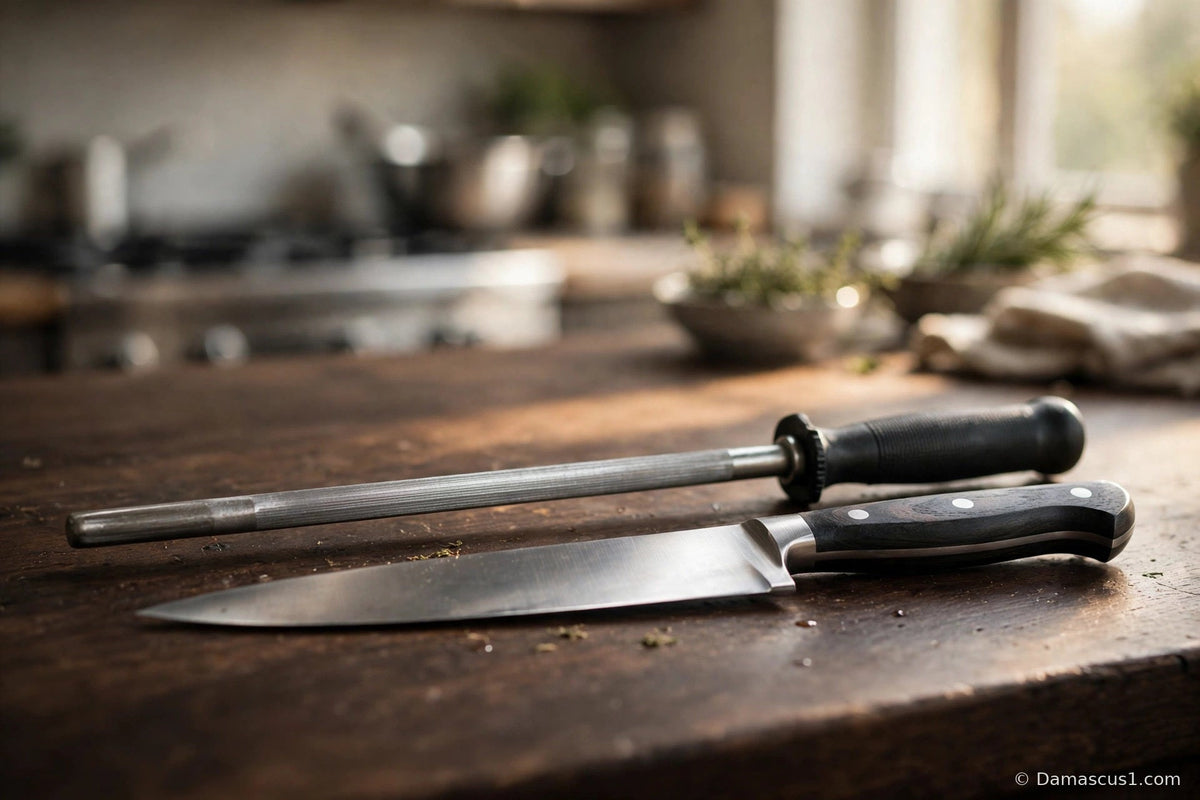
A rod and a working knife at the board — the pairing this whole guide is about. Editorial scene — the knife shown is not a specific Damascus1 product.
Direct answer: The best honing steel depends on your knife, not on the rod. For softer Western and German blades, a fine or grooved steel rod longer than your blade is the right daily tool. For hard Japanese and Damascus edges, skip the grooved steel — use a fine ceramic rod lightly, or maintain the edge on a whetstone or guided sharpener instead.
That answer will annoy the ranked lists a little, so let us be plain about why this guide is built differently — starting with the disclosure most buying guides bury and one in this category, restaurantweekhawaii.com, deserves credit for printing on its own page: nobody writing this guide handled the rods in it. Every verdict below belongs to the page-1 guide that published it, named next to the pick. And here is the second disclosure, the one no rod seller can make: Damascus1 does not sell a honing steel. We checked our full catalog — 122 products, live on November 14, 2026 — and there is no honing rod in it. Not steel, not ceramic, not diamond. We sell knives and sharpening tools. A rod is not among them.
Why write the guide, then? Because "best honing steel" is one of the most quietly misleading searches in the knife world. It assumes the answer is a product. Half the time, the answer is a diagnosis — your edge is bent, not dull — and the other half, for the growing number of cooks using hard Japanese and Damascus blades, the honest answer is that the category's default tool, the grooved steel rod hanging in every butcher's kit, is the wrong tool for your knife and can chip the edge you paid good money for. A maker with no rod to sell you can afford to lead with both of those truths. The lists cannot, or do not. So this guide runs in an order the lists will find backwards: diagnosis first, knife type second, products third — and a "skip the rod" route, honestly labelled, sitting in the main table where it belongs.
One more ground rule. Prices: exactly two competitor prices in this post are printed as numbers, because exactly two were verified with a source and a date — Dalstrong's Gladiator 10" at $69 and Shadow Black 9" at $99, from Dalstrong's own guide, prices as of November 3, 2026. Everything else says "check current price," because rod prices drift and a guide that prints ten prices to the cent while checking none of them is selling confidence, not information. Our own products, where they appear, carry live damascus1.com prices checked the same day as the teardown. Fair is fair.
Which honing steel is best for you at a glance?
Direct answer: Match the rod to the blade. Soft Western steel takes a grooved or fine steel rod happily. Hard Japanese and Damascus edges should use a fine ceramic rod with a light touch — or no rod at all. Diamond rods are light sharpeners, not daily honers. Whatever you choose, the rod must be longer than the blade it serves.
| Rod / route | Best for | Source of verdict | Price |
|---|---|---|---|
| Wüsthof 9" grooved magnetic steel | Best overall steel rod for Western knives | Ranked #1 by restaurantweekhawaii.com (spec-based; no product handled) and winner at hometosight.com | Check current price |
| J.A. Henckels International 10" steel | Best classic steel rod | Ranked #1 by bestreviews.guide | Check current price |
| ZWILLING 12" Diamond | Best diamond rod / light sharpening duty | Ranked #2 by bestreviews.guide | Check current price |
| Cutluxe 10" Artisan honing rod | Best for long blades; substantial in the hand (~1 lb, noted as heavy by bestreviews.guide) | Ranked #3 by bestreviews.guide; best for long blades per restaurantweekhawaii.com | Check current price |
| Henckels fine-edge steel | Best lower-priced fine steel | restaurantweekhawaii.com | Check current price |
| Victorinox 10" steel | Best medium grit / lightest option | restaurantweekhawaii.com | Check current price |
| Sharpeak 17.5" ceramic, 3000 grit, with angle guides | Best ceramic rod for guided, gentle honing | hometosight.com | Check current price |
| Dalstrong Ceramic 10" | Best brand ceramic option | Dalstrong's own guide | Check current price |
| Dalstrong Gladiator 10" | Best budget brand steel rod with a printed price | Dalstrong's own guide | $69 (as listed by Dalstrong, Nov 3, 2026) |
| Dalstrong Shadow Black 9" | Best short brand steel rod with a printed price | Dalstrong's own guide | $99 (as listed by Dalstrong, Nov 3, 2026) |
| LEVINCHY diamond 12", ~600 grit | Best aggressive rod — treat as a sharpener, not a honer | hometosight.com | Check current price |
| Skip the rod — the Damascus route | Best for hard Damascus and Japanese edges: whetstone or guided rolling-sharpener maintenance instead of any grooved steel | This guide's verdict, built on the hometosight.com and dalstrong.com hard-blade warnings | Damascus1 alternatives from $39.99 (live, see product cards below) |
Read the table the way it was built. Eleven rows are other makers' rods, placed there because the page-1 consensus — bestreviews.guide, restaurantweekhawaii.com, hometosight.com, Dalstrong — keeps landing on the same handful of names. When four guides agree that the Wüsthof 9" is a top steel rod and that the Cutluxe suits long blades, that agreement is the most useful data a buyer gets, and no honest guide should bury it. The last row is different in kind, and it is labelled that way on purpose. It is not a rod. It is the route this guide recommends for the readers the other eleven rows can actively harm — owners of hard, thin edges. If that is you, the table's most important line is the one that sells you no rod at all.
A word on the two Dalstrong prices, since they are the only competitor numbers here. They come from Dalstrong's own guide, dated November 3, 2026 — a brand pricing its own products in its own content, which is the most reliable kind of competitor price there is, and still worth re-checking at purchase time. Our own prices in this post get the same treatment: live when checked, dated in the checklist at the top, and always subordinate to the product page itself.
Is your edge bent or dull? The diagnosis that decides everything

Direct answer: A bent edge feels dull but is not — the metal has rolled to one side and a few light rod strokes stand it back up. A truly dull edge has lost its apex entirely and no rod will restore it; it needs abrasive sharpening. The tomato test separates them: a knife that tears tomato skin instead of biting it usually has a bent edge, not a dead one.
This is the section the ranked lists should lead with and do not. Credit where it is due: restaurantweekhawaii.com built its whole guide around the sharpest sentence in this category — a tearing tomato means a bent edge, not a dull one — and it is worth slowing down for, because nearly every disappointed honing-steel purchase in history traces back to skipping this diagnosis. Someone's knife stops cutting. They buy a rod, because rods are what knives get waved against in films. They wave. Nothing improves, or it improves for one meal and dies again. They conclude the rod is junk, or honing is a myth. Usually, neither is true. The diagnosis was wrong. The edge was dull — genuinely worn away — and they were realigning metal that was no longer there.
Here is what is actually happening at the edge, in plain terms. A knife edge is a very fine wedge, and in daily use against boards, bones, frozen anything, and the occasional plate, that fine wedge does two different kinds of failing. The first is rolling: the apex bends to one side, like the tip of a fingernail catching on something. The metal is all still there. It is just pointing the wrong way, so instead of biting into food it skates and tears. The second is wear: the apex is ground away by abrasion until the edge is a rounded wire. That metal is gone. No alignment trick brings back metal that does not exist. Honing fixes the first failure. Sharpening — abrasive, metal-removing work on a stone or a guided sharpener — is the only fix for the second. Every page-1 guide in the teardown agrees on this split; honing realigns, sharpening removes metal. The disagreement is only about how much it matters, and the honest answer is: it is the whole decision.
So run the diagnosis before you spend anything. Four checks, no equipment beyond what is already in your kitchen:
| What you observe | What it means | The correct fix |
|---|---|---|
| Knife tears or slips on tomato skin but still slices paper | Edge is bent / rolled — metal present, pointing sideways | Hone: a few light strokes on the right rod for your knife type |
| Knife slides on tomato skin and crushes paper instead of slicing it | Edge is dull / worn — apex is gone | Sharpen: whetstone or guided sharpener. A rod will not help |
| Edge catches your thumbnail in some spots, skates in others | Uneven edge — rolled in places, worn in others | Sharpen first to reset the apex, then hone to maintain |
| Visible bright line or glinting spots along the edge under light | Reflected light = flat, worn, or rolled sections (a keen edge reflects almost nothing) | Sharpen if the glint is broad; hone and re-check if it is faint |
| Tiny chips or a gritty feel against the thumbnail | Chipped edge — common after grooved-steel misuse on hard blades | Sharpen on a stone to grind past the chips; do not hone a chipped edge straight |
The tomato test: bite means the apex is alive, tearing means it has rolled. Editorial scene — the knife shown is not a specific Damascus1 product.
Work through the table top to bottom the next time a knife disappoints you. Notice what it does to your shopping: most "my knife is dull" moments are row one — a rolled edge, fixed free, in twenty seconds, with a tool you may already own. Row two is the honest purchase moment, and the purchase it points to is not a rod at all. That is why the diagnosis leads this guide. It is also, not coincidentally, the chart most likely to be worth bookmarking from this page — it will still be true when every price on it has changed. If you want the full sharpening side of the routine once the diagnosis lands on "dull," our guide to how to sharpen a Damascus knife walks the stone work step by step.
Does honing a knife actually sharpen it?
Direct answer: No — not in the way the word is normally meant. Honing straightens a rolled edge back into line; it removes little or no metal and creates no new apex. Sharpening is the abrasive work that removes metal and forms a fresh edge. A diamond rod blurs the line, because its abrasive surface does remove metal — which is exactly why it should not be your daily honer.
The confusion is understandable, because the tool is literally called a "sharpening steel" in half the shops on earth, and because a freshly honed knife feels sharper — dramatically so. It cuts like a new knife because, geometrically, it briefly is one: the apex is back where it belongs, centred over the blade, biting instead of skating. Nothing was sharpened. Something was un-bent. The distinction sounds pedantic until you watch what it predicts. It predicts that honing works brilliantly right up until the day it does not — the day the apex has worn away — and then fails completely, no matter how many strokes you add or how hard you press. Cooks who know the distinction read that failure correctly ("time for the stone") and cooks who do not read it as a defective rod, a defective knife, or a defective technique, in roughly that order.
It also predicts the category's quiet scandal: pressing harder. If honing were sharpening, pressure would help. Since honing is alignment, pressure mostly harms — it folds the edge further, fatigues the fine apex, and on hard, thin blades it is how chips are born. Every good source in the teardown lands in the same place even when their product lists differ: light strokes, few of them, and the moment honing stops restoring the bite, the rod's job is done and the sharpener's job begins. Hold that thought; it becomes a full routine further down this page.
Where does the diamond rod fit? Awkwardly, and honestly. A diamond surface — hometosight.com puts a typical diamond rod at roughly 600 grit — is an abrasive. Stroking a knife down it removes metal. That makes a diamond rod a light, portable sharpener wearing a honing rod's shape, and it explains both its fans (it genuinely revives tired edges that a plain steel cannot) and its danger (used daily, with pressure, it eats edges — and on thin, high-hardness Japanese blades hometosight.com calls it too abrasive outright). Treat a diamond rod the way you would treat a coarse stone: occasionally, deliberately, and never as the daily driver. If your routine needs daily abrasion, your routine is telling you the knife needs a proper sharpening and a look at what is dulling it.
Ceramic vs steel vs diamond honing rod: which is better?

Direct answer: None is best in the abstract — each matches a blade class. Grooved and fine steel rods suit softer Western knives and realign with little metal removal. Ceramic rods, roughly 1000–3000 grit per hometosight.com, are the gentle option and the only rod family hard Japanese and Damascus edges should meet. Diamond, around 600 grit, is an occasional light sharpener, too aggressive for daily use or thin hard blades.
Start with the classic. A steel rod — the butcher's steel, the one in every film — is a hardened rod, smooth ("fine") or cut with lengthwise grooves. restaurantweekhawaii.com's top pick shows the type at its most developed: the Wüsthof 9" is high-carbon stainless, tempered to 58 HRC, ultra-fine in its grooving, and magnetic, a small practical grace — a magnetic rod collects the fine metal dust honing frees, instead of leaving it on the board. hometosight.com describes the steel rod's action plainly: it realigns the edge with little metal removal. That is the honest summary of the whole family. Steel rods are alignment tools. Their virtues are speed, toughness, and forgiveness on the soft-to-medium Western blades they evolved with. Their limit is written into the same sentence: little metal removal means no rescue for a worn edge, and the grooved variants concentrate force along fine ridges — a detail that matters enormously two paragraphs from now.
A ceramic rod is the same silhouette in a different material, and the material changes the behaviour completely. Ceramic is hard, smooth, and mildly abrasive: hometosight.com puts ceramic honing surfaces in the region of 1000–3000 grit, and lists the Sharpeak ceramic at 3000 grit with angle guides — fine enough to polish an edge back into line while removing very little metal. That gentleness is why ceramic is the rod family that hard blades tolerate. Dalstrong's own guide — a brand that sells steel rods, remember — concedes the point in a single line worth more than most advertising: very hard Japanese blades do better on a ceramic rod or a fine whetstone than on a grooved steel. When the steel-rod seller says it, you can stop wondering whether it is true. Ceramic's costs are real, though: it is brittle. Drop a ceramic rod on tile and the guide is over. It also loads up with metal over time and needs cleaning to keep cutting evenly. Neither flaw is fatal. Both belong in an honest guide.
A diamond rod coats the silhouette in industrial abrasive, and at roughly 600 grit per hometosight.com it is playing a different sport. It does not coax an edge back into line; it grinds a new one, quickly, stroke by stroke. For a neglected soft-steel knife in a busy kitchen, that can be genuinely useful — the LEVINCHY 12" diamond in hometosight's list exists because the demand exists. But call it what it is: sharpening. Used the way honing rods are marketed — daily, casually, with a flourish — a diamond rod will thin an edge unevenly, scratch blade faces, and on a thin, hard Japanese or Damascus edge it risks the micro-chipping that turns a fine knife into a stone project. The material verdict, compressed: steel for alignment of Western blades, ceramic for gentle alignment of everything including hard blades, diamond for occasional rescue work on blades that can afford to lose metal. Any guide that ranks the three families without asking what knife you own is ranking in a vacuum.
Ceramic is the gentle end of the rod family — the only one hard, thin edges should meet. Editorial scene — the knife shown is not a specific Damascus1 product.
And our own position in this material fight, stated once more so nobody has to hunt for it: Damascus1 sells none of the three. What we sell for edge care is on the sharpening side of the line — guided rolling sharpeners that hold an angle for you — and they appear in the product cards further down, labelled as alternatives, not smuggled into this comparison as a fourth rod material. If your knife type points to a rod, buy a rod, from whoever makes the right one. The table at the top names them.
Can a honing steel damage a Japanese or Damascus knife?
Direct answer: Yes — a grooved steel rod can, and this is the most important verdict in this guide. Hard, thin Japanese and Damascus edges can micro-chip when a grooved rod's ridges strike them at a slightly wrong angle or with pressure. A fine ceramic rod used lightly is the safer honing option; many hard blades are best maintained on a whetstone or guided sharpener with no rod at all.
Here is the mechanics of it, because "can damage" claims deserve a mechanism, not a mood. A grooved steel rod is not a smooth surface. It is a file's polite cousin — a series of fine lengthwise ridges. When a blade strokes down it, the edge does not meet a plane; it meets ridge after ridge, and the contact force concentrates on those ridge lines. On a softer Western blade — the kind hardened into the mid-50s HRC, the kind the Wüsthof rod itself is tempered near at 58 HRC per restaurantweekhawaii.com's spec listing — the edge is comparatively tough and ductile. It bends rather than breaks, rides the ridges, and gets pushed back into line. That is the system working as designed, and it has worked for generations of butchers and line cooks.
A hard Japanese or Damascus edge lives at the other end of the trade-off. Hardness buys edge retention — the apex stays keen far longer — and the price is brittleness: the steel is less willing to bend and more willing to chip. Run that edge down a grooved rod with a degree or two of angle error, or a moment of sideways pressure, and the ridge does not push the apex back. It catches it, and a flake of the edge lets go. One chip is invisible. A season of them is a saw-toothed edge that tears everything and needs real stone work to grind out. hometosight.com makes the matching point about the diamond family — too abrasive for thin, high-hardness Japanese knives — and Dalstrong's guide, again, tells its own customers that very hard Japanese blades do better on ceramic or a fine whetstone than on grooved steel. Two independent page-1 sources, one of them a rod seller, pointing the same way. This guide is simply willing to put their shared warning in the headline where it belongs.
So what should a Damascus owner actually do? Three tiers, in order of preference. First, the stone or the guided sharpener. Real maintenance on hard edges is controlled abrasion at a fixed angle — a whetstone if you have the skill and the patience, a guided rolling sharpener if you want the angle held for you. Our own sharpening guide covers the stone side in depth at how to sharpen a Damascus knife, and the steel-choice background — why hardness and edge behaviour trade off the way they do — sits in our Damascus vs VG10 comparison. Second, if you hone, hone ceramic and hone light. A fine ceramic rod, a handful of feather-pressure strokes per side, edge trailing or leading with perfect consistency, and stop the moment the bite returns. Third, never these: no grooved steel, no diamond rod, no steel-on-steel flourish copied from a cooking show, and no honing a chipped edge — chips are a sharpening problem, full stop, per the diagnosis chart above.
If you are shopping for the knife itself rather than the rod, this is also the care reality to price in before you buy: a hard, beautiful edge asks for gentle maintenance, and our best Damascus chef knife set guide and the wider best chef knife guide both treat upkeep as part of the purchase, not an afterthought. A knife you maintain correctly stays thrilling for years. A knife maintained with the wrong rod becomes a chore you blame on the knife.
The Damascus route, priced honestly
These are the Damascus1 sharpening tools that carry the maintenance load for hard edges in place of a rod. They are sharpeners, not honers — labelled that way because the distinction is the entire point of this page.
Rolling Knife Sharpener with Magnetic Holder and Diamond Stone — $39.99. The guided route at the lowest price we sell: a rolling sharpener with 15° and 20° angle options (per its product name), so the angle — the variable that chips hard edges on a freehand rod — is held by the tool instead of your wrist. For a Damascus owner who will never learn a whetstone, this is the honest recommendation. See it at damascus1.com.
Stone Angle Rolling Knife Sharpener — $129.99. The step-up guided option in our range, for cooks who sharpen often enough to want the heavier-duty tool. See it at damascus1.com.
Household Kitchen Knife Sharpener — $99.99. Our household sharpener, suited to keeping a working set of kitchen knives in rotation. See it at damascus1.com.
And because most rod questions arrive attached to a knife purchase: the Premium Kitchen Knife Block Set — $169.99 is our flagship seven-piece block set, the anchor set these maintenance tools exist to serve. See it at damascus1.com. The full knife range lives in our best kitchen knives guide and the best knife set breakdown, if you are comparing before you commit.
What length honing steel do I need?
Direct answer: Longer than your longest blade — that is the whole rule. An 8-inch chef knife wants at least a 10-inch rod, and 12 inches is the comfortable default for most kitchens. A 9-inch rod suits shorter knives and smaller hands. If the rod is shorter than the blade, the tip runs off the end mid-stroke and the heel never gets honed.
The rule sounds obvious and is violated by half the gift sets ever sold, which pair a long chef knife with a short, matching, useless rod. The geometry is unforgiving: a honing stroke draws the full length of the edge along the rod, from heel to tip, in one pass. If the rod's working length is shorter than the blade, something has to give — either the stroke shortens and the heel section never gets aligned, or the tip slides off the rod's end and dings against the handle bolster. Neither is a technique flaw. It is a sizing error, baked in at purchase. hometosight.com frames its length guidance as a 9-inch versus 12-inch choice with the same underlying rule — the rod should exceed the blade length — and Dalstrong's guide lands on 10–12 inches, longer than your longest knife. Two sources, one rule, no daylight between them.
Practical translation. Measure your longest everyday knife, not your longest knife-shaped object. For most home kitchens that is an 8-inch chef knife, and a 10- or 12-inch rod covers it with room to spare — room that matters, because the spare inches are where your stroke slows down and finishes instead of running out of road. If your longest working blade is a 10-inch slicer or a long bread knife, you are in 12-inch territory minimum, and the Cutluxe 10" earns its "best for long blades" tag from restaurantweekhawaii.com partly on heft and presence — though note bestreviews.guide's counterweight detail, that at roughly a pound the Cutluxe is heavy, and a heavy rod tires the holding hand and wobbles the angle. Length first, then weight you can hold steady for ten strokes without thinking about it. A rod you dread using is a rod that stays in the drawer, and a rod in the drawer hones nothing.
Storage deserves one sentence, because it kills more rods than use does: a rod rattling loose in a utensil drawer gets its surface nicked and its ceramic — if it is ceramic — chipped. Block slot, magnetic strip, or a dedicated drawer with the rod lying still. The tool that realigns edges deserves a straighter life than the junk drawer gives it.
How do you hone a knife correctly? Angle, pressure, and stroke count

Direct answer: Hold the rod steady, set the blade at roughly 15–20 degrees to it, and draw the full edge down the rod in a smooth arc, heel to tip, with feather pressure — the weight of the knife and little more. Four to six light strokes per side is a full session. If the bite has not returned by then, the edge is dull, not bent, and more strokes will not change that.
Technique is where honing guides earn their keep, because the motion is simple and the failure modes are all in the details nobody films. Take it in order. The setup: two grips dominate. The tip-down method plants the rod's tip on a folded towel on the counter, rod vertical — the most stable option, and the one this guide recommends for anyone's first hundred sessions, because a fixed rod removes one moving variable from a two-body problem. The horizontal method holds the rod out in front of you, chef-style, and strokes the knife down its length; it is faster and it is the version that fills cooking shows, and it demands that the rod hand stay genuinely still, which is a skill disguised as a pose. Neither is wrong. Tip-down is righter for learning, because stability is what you are actually buying.
The angle is the variable that decides everything. The blade meets the rod at the same angle the edge was ground at — for most kitchen knives, somewhere in the 15–20 degree band per side — and the entire stroke's job is to not change it. Too shallow and you polish the shoulder of the bevel while the apex waves untouched above the surface. Too steep and you grind the apex itself into the rod, folding or chipping it. Consistency beats precision here: a stroke that holds 18 degrees from heel to tip does more good than a stroke that hunts between 12 and 25 looking for a perfect number it cannot feel. This, in one sentence, is also the entire case for guided sharpening tools when sharpening day comes — the tool's only real trick is refusing to let the angle wander.
Pressure is the second variable, and the rule is embarrassingly simple: almost none. The weight of the knife, guided, is the dose. Pressure is the beginner's instinct — the edge feels dull, so push — and it is exactly backwards for an alignment task. You are coaxing a bent apex upright, not sanding a board. On soft Western steel, excess pressure folds the edge to the other side and you chase it back and forth, stroke after stroke, wondering why the knife never quite bites. On hard Japanese or Damascus steel, excess pressure is the chipping mechanism itself. Feather pressure feels like doing nothing. It is doing the only thing honing can do.
Stroke count closes the loop: four to six per side, alternating, then test. A slice of paper, a tomato, anything with a skin. Bite restored? Stop — you are done, and every additional stroke from here is risk without reward. Bite not restored? Also stop, and re-read the diagnosis chart, because you have just learned something valuable: the edge was never bent. It is dull, and it has been telling you so politely. The cooks who damage knives with rods are almost never the careless ones; they are the diligent ones, adding stroke twenty, thirty, forty to a problem strokes cannot solve.
Tip-down, shallow angle, feather pressure — the boring version is the correct version. Editorial scene — the knife shown is not a specific Damascus1 product.
Two smaller details that separate clean technique from folklore. First, stroke the full edge: start at the heel, finish at the tip, every time, in one continuous arc. Short scrubbing strokes on the middle third leave the heel — the part that does your garlic and onion work — permanently rolled. Second, wipe the blade after honing, before it touches food. Honing frees microscopic metal particles; a magnetic steel rod collects some of them (the Wüsthof's quiet virtue), but a wipe is the cook's job regardless. Twenty seconds, a clean towel, done.
Which rod for which knife? The verdict chart
Direct answer: Western and German knives: grooved or fine steel, freely. Japanese and Damascus knives: fine ceramic only, lightly — or skip the rod for stone and guided maintenance. Serrated knives: no standard rod; the gullets need a tapered tool or professional service. Ceramic knives: no rod at all — they go back to the maker or to a specialist sharpener.
| Knife type | Grooved steel | Fine steel | Ceramic rod | Diamond rod | The verdict |
|---|---|---|---|---|---|
| German / Western chef knives (softer, tougher steel) | ✅ Yes — the classic pairing | ✅ Yes | ✅ Yes | Occasionally, as a light sharpener | Hone freely and often; this is the blade class rods were invented for |
| Japanese / Damascus knives (hard, thin edges) | ❌ No — chip risk | ⚠️ Only with expert lightness; ceramic preferred | ✅ Yes — fine grit, feather pressure, few strokes | ❌ No — too abrasive (hometosight.com) | Skip the rod as the default; maintain on stone or guided sharpener, ceramic rod as the only honing option |
| Serrated knives | ❌ No | ❌ No | ❌ No (standard rod cannot reach the gullets) | ❌ No | Do not hone on a rod; serrations are serviced with tapered tools or professionally |
| Ceramic knives | ❌ No | ❌ No | ❌ No | ❌ No | No rod of any material; maker or specialist sharpening only |
| Soft budget knives / everyday utility blades | ✅ Yes | ✅ Yes | ✅ Yes | ✅ Yes — its best use case | The forgiving class: any rod works; diamond earns its keep here |
Keep this chart and you can retire most of the category's marketing. Notice what drives every row: not the rod, not the brand — the hardness and thinness of the blade. Soft and tough forgives everything, including technique errors, which is why the classic butcher's-steel ritual never hurt the knives it grew up with. Hard and thin forgives nothing, and rewards the cook who swaps ritual for gentleness. If you take one idea from this entire guide to a knife shop, take that one: ask how hard the blade is before you ask which rod to buy, because the first answer decides the second. Our best kitchen knives guide sorts the knife side of that question across the main styles, if you are building a set and want the maintenance picture attached to each choice from the start.
How often should you hone a knife?

Direct answer: For a Western knife in daily use, a few light strokes every few uses is the rhythm bestreviews.guide's buying guide lands on — hone every 3–4 uses. For hard Japanese and Damascus blades, hone less often and only on ceramic, or skip routine honing entirely and maintain on the stone. Honing is maintenance between sharpenings, not a substitute scheduled instead of them.
Frequency is where knife type splits the advice in two, and any guide giving one number for every blade is averaging away the truth. The Western rhythm is the familiar one: the softer edge rolls a little with every board session, so it wants standing back up regularly — every few uses, per bestreviews.guide, and many working cooks simply give a knife two or three strokes before each session, a habit so cheap in time that scheduling it is overthinking. The edge tells you when you have overdone the interval: the tomato test starts failing mid-week, and each honing restores less than the last. That fading return is the sharpening bell. Hear it early and the stone session is short.
The hard-blade rhythm is deliberately lazier, and lazier is safer. A hard Japanese or Damascus edge does not roll the way a soft edge does — it holds its apex far longer, which is the entire reason to own one — so the daily-ritual honing that suits a German knife is mostly unnecessary exposure for a hard one. Every rod pass on a brittle edge is a small wager. Make fewer of them: ceramic only, lightly, when the bite genuinely fades — and many owners of hard blades skip routine honing altogether and go straight to a fine stone or guided sharpener at longer intervals. That is not neglect. That is the maintenance schedule the steel actually asks for, and it is the schedule this guide's "skip the rod" row exists to legitimise.
Then there is the sharpening cadence underneath both rhythms, the appointment honing can postpone but never cancel. When honing stops restoring the bite — the diagnosis chart's row two — the knife needs abrasive work: a whetstone session if you have the hands for it, or a guided tool that holds the angle while the abrasive does the work. In our own range that is the Rolling Knife Sharpener with Magnetic Holder and Diamond Stone at $39.99, with its 15° and 20° angle options, or the Stone Angle Rolling Knife Sharpener at $129.99 for heavier use. How often sharpening day arrives depends on use, board, and steel — a home cook sharpening a few times a year is normal; a knife needing it monthly is telling you something about the board or the storage, and it is worth listening.
The full station: hone for alignment, sharpen for wear, store so neither is needed early. Editorial scene — the knife shown is not a specific Damascus1 product.
Storage closes the routine, because the best honing schedule is the one bad storage does not sabotage. A knife loose in a drawer rolls its edge on every rummage — you can hone every morning and lose the fight every night. Block, magnetic strip, or blade guards: pick one. It is the cheapest edge-retention upgrade in this entire article, and it costs less than every rod in the comparison table.
What are the mistakes that chip edges and ruin rods?
Direct answer: Five, in order of damage done: honing a hard or chipped edge on a grooved steel; pressing hard; letting the angle wander mid-stroke; honing a genuinely dull knife for dozens of strokes instead of sharpening it; and using a diamond rod as a daily honer. Every one of them is a diagnosis or discipline error, not a product defect.
Mistake one: the wrong rod on the wrong blade. Covered above, repeated here because it does the most harm: grooved steel plus hard, thin edge plus ordinary human angle error equals micro-chips. If this guide changes one purchase, it is this one.
Mistake two: pressure. The flourish is the tell — the cook who attacks the rod, sparks of effort, twenty strokes a second. Speed and force feel like skill. They are how apexes fold and chip. Slow down, lighten up, count your strokes. If you are breathing hard, you are not honing, you are fighting.
Mistake three: the wandering angle. The stroke that starts at 15 degrees and finishes at 30 has honed nothing except inconsistency into the edge. This is the mistake with the kindest fix, because it is mechanical: choose the tip-down setup, shorten your stroke count, and let consistency accumulate over weeks. Nobody's wrist is born calibrated. Everybody's improves with a stable rod and honest reps.
Mistake four: honing past the diagnosis. The knife is dull — worn, apex gone — and the cook hones it daily, harder, longer, for a month, then concludes the knife is finished. The knife was never finished; it was waiting for a stone while being punished with a rod. Re-run the tomato test weekly. The moment honing stops working, believe it.
Mistake five: diamond as a lifestyle. A diamond rod used daily is a slow-motion sharpening with no angle control and no grit progression — the worst of both crafts. It has a job: occasional rescue of forgiving blades. Promote it beyond that job and it will thin your edges unevenly and, on hard blades, do the chipping work of mistake one with abrasive instead of ridges.
And a bonus mistake, small but real: honing a dirty blade, or serving on a honed-but-unwiped one. Grit on the edge grinds sideways during the stroke; metal dust on the edge afterwards belongs in the towel, not the tomato. Wash, dry, hone, wipe. The order costs nothing and the edge notices.
Can you hone a serrated knife?

Direct answer: Not on a standard honing rod — the rod rides across the serration tips and never reaches the gullets where the cutting happens, and it can round the points that make a serrated knife work. Serrated edges are maintained with a tapered rod or file that fits each gullet, or serviced professionally. The good news: serrations stay functionally sharp far longer than straight edges, so the need arises rarely.
This question earns its place because the instinct is so reasonable. The bread knife feels less grabby; the rod is right there; surely a few strokes help. They do not, and the geometry shows why in one look: a serrated edge is a row of scalloped gullets protected by pointed teeth. The points take the wear and shield the curved cutting surfaces inside the scallops — which is precisely why serrated knives seem to stay sharp for years. A flat or round rod drawn across that edge contacts only the points. At best it does nothing. At worst it dulls the points, and the points were the bodyguards. Leave the bread knife alone. When a serrated knife truly fades — years in, usually — the honest options are a tapered sharpening tool worked gullet by gullet, or a professional service, or the unglamorous truth that an inexpensive serrated knife is often replaced rather than restored. No shame in any of the three. The shame is only in the rod strokes that hurried it there.
The same restraint, doubled, applies to ceramic knives, the other "can I hone it?" regular. Ceramic blades are harder than any rod in this guide and brittle in a way steel never is. A rod cannot realign a ceramic edge, and contact risks chipping the blade or damaging the rod. Ceramic knives go back to their maker or to a specialist with diamond equipment. Every other knife you own fits somewhere in the verdict chart above; these two categories fit in the drawer marked leave it to the specialists, and a guide that tells you so is saving you a knife, not dodging a question.
When the diagnosis says dull, this is the honest destination — abrasive, angle, patience. Editorial scene — the knife shown is not a specific Damascus1 product.
The Olive Wood Damascus Pocket Knife Set — $39.99
Real Damascus steel, an olive wood handle and a genuine leather sheath included — the knife our readers ask about most.
Shop the Olive Wood Damascus Pocket Knife Set — $39.99 · Free US shipping on orders over $50.
Frequently asked questions
Does honing a knife actually sharpen it?
No. Honing realigns a rolled edge — it stands bent metal back up without removing material or forming a new apex. The knife feels sharper because the existing apex is centred again. Sharpening is the separate, abrasive process that removes metal and creates a fresh edge. A diamond rod is the exception that blurs the line: its abrasive surface does remove metal, which is why it belongs in occasional sharpening duty, not daily honing.
How often should you hone a knife?
For a Western knife in regular use, every few uses — bestreviews.guide's buying guide suggests honing every 3–4 uses, and a couple of light strokes before a session is a sound habit. Hard Japanese and Damascus blades need it far less: their edges roll less, so hone rarely, on ceramic only, or skip routine honing and maintain on a stone or guided sharpener. Whenever honing stops restoring the bite, the knife is dull, not bent — sharpen it.
Can a honing steel damage a Japanese or Damascus knife?
Yes, if it is a grooved steel. The grooves concentrate force on fine ridges, and a hard, thin edge can micro-chip instead of bending back — hometosight.com likewise warns diamond rods are too abrasive for thin high-hardness Japanese knives, and Dalstrong's guide steers very hard Japanese blades to ceramic or a fine whetstone. Use a fine ceramic rod lightly if you hone at all; stone or guided maintenance is safer still.
Ceramic vs steel vs diamond honing rod: which is better?
Better for which knife is the real question. Steel rods realign softer Western edges with little metal removal and are the classic daily tool. Ceramic rods run roughly 1000–3000 grit per hometosight.com — gentle, mildly abrasive, and the only family hard Japanese and Damascus edges should meet. Diamond sits around 600 grit: a light sharpener for occasional rescue work on forgiving blades, too aggressive for daily honing or thin hard edges.
What length honing steel do I need?
Longer than your longest blade, with room to spare. An 8-inch chef knife pairs with a 10- or 12-inch rod; a 9-inch rod suits shorter knives. hometosight.com frames the choice as 9" versus 12" under the same rule — the rod must exceed the blade — and Dalstrong's guide recommends 10–12 inches, longer than your longest knife. A rod shorter than the blade leaves the heel unhoned and runs the tip off the end mid-stroke.
Can you hone a serrated knife?
Not on a standard rod. The rod contacts only the serration points and never reaches the gullets where serrated cutting happens; it can round the very points that protect the edge. Serrated knives hold their function for years without maintenance. When one finally fades, the honest routes are a tapered tool worked gullet by gullet, professional servicing, or — for inexpensive bread knives — straightforward replacement.
The bottom line: buy the rod your knife asks for — or none
Everything on this page compresses into three sentences. Diagnose first: bent edges get honed, dull edges get sharpened, and the tomato test tells you which one you are holding. Match the rod to the blade: steel for Western knives, ceramic for hard ones, diamond almost never — and length always longer than the blade. And if you cook with hard Japanese or Damascus knives, hear the verdict plainly: the grooved steel, the category's default purchase, is the one tool your knives should never meet. Skip it without a flicker of guilt. Your edges will last longer for the skipping.
If the diagnosis sent you to the sharpening side of the line, start where the angle is held for you: the Rolling Knife Sharpener with Magnetic Holder and Diamond Stone — $39.99, or step up to the Stone Angle Rolling Knife Sharpener — $129.99. If you are building the knife collection these tools exist to protect, the Premium Kitchen Knife Block Set — $169.99 is our flagship set, and our best knife set guide lays out how it compares inside the range. Maintain them the way this page describes — diagnosed, matched, gentle — and the knives will repay you every single dinner.
Damascus1 sells no honing steel; the rods named above are other makers' products, with verdicts attributed to the guides cited. Prices for Damascus1 products were checked live on damascus1.com on November 14, 2026; competitor prices are labelled "check current price" except where a dated source is named. Confirm current prices and specifications on the product page before ordering.
Leave a comment: