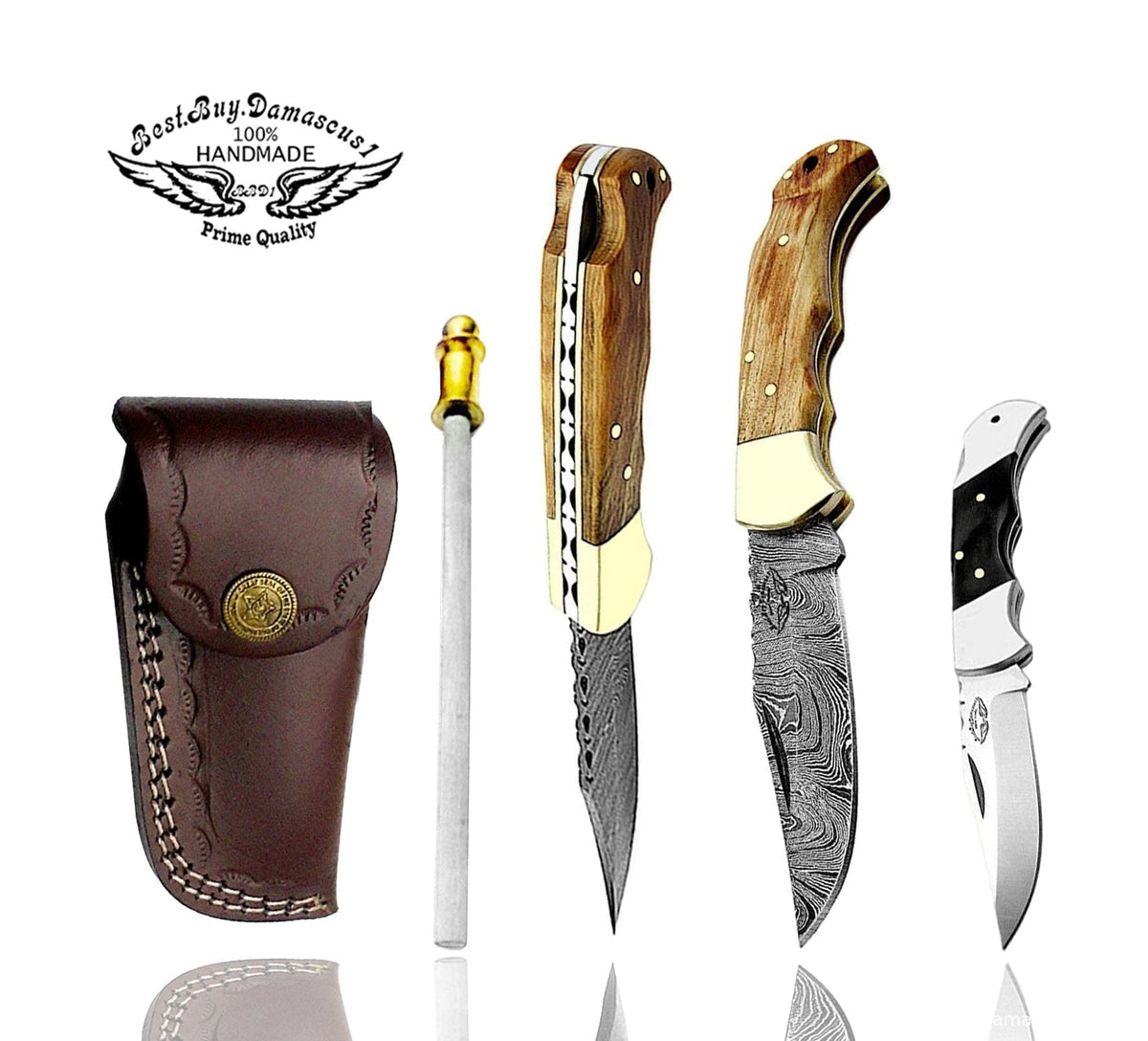
Cover: Olive Wood Damascus Pocket Knife 6.5" — $39.99 (was $89.99). Real catalog photo.
Direct answer: The best EDC knife for most people who want a traditional handmade folder is the Olive Wood Damascus Pocket Knife 6.5" at $39.99. It is compact, warm in the hand, and priced at the entry point of the range. Shop the full lineup in the Everyday EDC Pocket Knives collection and compare it with our wider guide to the best pocket knife.
That answer needs context, because "best" means something very different depending on how you actually carry. If you want the lightest possible tactical folder that disappears on a pocket clip and flicks open with one thumb, this list is not trying to be that — and it will tell you so, repeatedly, before you spend a dollar. If you want a knife you drop in a pocket, a jacket, or a truck console, one that looks like it was made by a person rather than extruded by a production line, one you would also be proud to hand someone as a gift, then keep reading. This is that list.
EDC lists online have converged into a single shape: black handles, pocket clips, thumb studs, drop-point blades in modern powder steels, weights quoted to the tenth of an ounce. There is nothing wrong with that shape. It is just not the only shape everyday carry has ever taken. For most of knife history, everyday carry meant a folding knife with a wooden, bone, or horn handle, carried loose in a pocket, opened with two hands, and used for everything from opening feed sacks to slicing an apple at lunch. That tradition never actually disappeared. It just stopped winning the search results.
This guide brings it back into the conversation — honestly. You will get real prices checked on October 19, 2026, real photos of the exact knives for sale, a clear statement of what these knives cannot do, and a framework for deciding whether traditional carry fits your life or whether you should buy a modern tactical folder instead and come back here when you want a gift or a second knife with some soul in it.
What does everyday carry knife actually mean?
An everyday carry knife — an EDC knife — is simply the folding knife you carry with you most days for ordinary tasks: opening boxes, cutting cord, trimming, food prep on the go, and small jobs around home, work, or camp. The phrase describes the habit of carrying, not a blade style, a brand, or a price point.
That definition matters because the phrase gets stretched. Search "everyday carry knife" and you will find everything from a $12 gas-station folder to a $400 titanium frame-lock presented as if they belong to the same category. In a sense they do — both are knives someone carries daily. In every practical sense they do not, because the daily experience is completely different: how it rides in your pocket, how it opens, how it feels after the fiftieth box of the month, and whether you would care if you lost it.
Think of "everyday carry knife" as three separate decisions bundled into one phrase. First, legal and social fit: can you carry it where you live, work, and travel without a problem? Second, physical fit: is it small and comfortable enough that you will actually have it on you, instead of leaving it in a drawer because it annoyed you? Third, task fit: does the blade shape and size match what you cut most often? A knife that nails all three is your EDC knife, whatever it cost and whatever it looks like.
For readers new to the vocabulary: EDC itself is shorthand for "everyday carry," a term borrowed from the broader gear world where it also covers wallets, flashlights, pens, and multitools. In knife writing, "EDC knife" and "everyday carry knife" are used interchangeably, and this guide uses both phrases to mean the same thing — the folder that lives in your pocket most days. If you are building your first carry setup, start with the knife decision here, then read our practical walkthrough on how to carry a pocket knife for pocket, belt, and bag options in detail.
One more clarification that saves disappointment later: an everyday carry knife is not a survival knife, not a dedicated hunting knife, and not a kitchen knife, even though a good one can pinch-hit in all three roles for light work. It is a generalist. Generalists win by being present, comfortable, and adequate at many things — not by being the best tool for any single heavy job. Judge every pick below by that standard.
What is the best EDC knife overall in 2026?
For traditional handmade carry, the Olive Wood Damascus Pocket Knife 6.5" at $39.99 is the best overall EDC knife in this guide. It pairs a compact closed size with a warm, grippy natural wood handle and a patterned Damascus blade, at the lowest Damascus price in the collection — an easy first carry or gift.
Why olive wood, and why this knife first? Start with the hand. Olive wood is dense, naturally oily, and warm to the touch in a way synthetic handles are not. It does not feel cold on a January morning and it does not feel slick when your hands are a little damp. The grain on each handle is genuinely individual — two knives from the same batch will not look identical — which is a large part of the appeal of handmade carry in the first place. You are not carrying a unit. You are carrying a specific object.
Size is the second reason. At 6.5 inches overall, this is a compact folder that sits in the sweet spot most people actually tolerate daily: big enough for real cutting, small enough to forget about until you need it. If you have only carried modern folders, the loose-pocket ride will feel different — there is no clip — and the size and carry sections below deal with that honestly.
Price is the third reason, and it is not a small one. At $39.99, down from a listed $89.99 at the time of checking, this is the entry point to Damascus carry on Damascus1. That matters for EDC specifically, because an everyday knife gets lost, lent, dropped on concrete, and left in jacket pockets that go through the wash. A first EDC that costs $39.99 teaches you your own carry habits without punishing every mistake. Readers shopping strictly on budget should also see our dedicated roundup of the best pocket knife under $50, where most of this list overlaps.
A necessary honesty note, here at the top rather than buried at the bottom: the Everyday EDC Pocket Knives collection also includes 420C stainless steel folders priced around $34.99 to $39.99. Stainless and Damascus are different blade materials with different looks and care needs, and a similar price does not make them the same product. Every pick in this guide is a Damascus model, and each product card below links to its exact product page. Whichever knife you choose, check the blade-material line on that exact page before you check out, so the steel you receive is the steel you meant to buy.
Lead pick — priced product card
Olive Wood Damascus Pocket Knife 6.5" — $39.99 (was $89.99) Traditional back-lock style folder in olive wood with a patterned Damascus blade. The warmest, simplest starting point in the range. View the Olive Wood Pocket Knife
How big should an EDC knife be?
Most people carry comfortably in the 6.5 to 7.6 inch overall range covered by this guide. Smaller folders disappear in a pocket and suit office or light daily tasks. Larger 7.5 to 7.6 inch folders give more handle and blade for bigger hands and heavier cutting, but ride noticeably bulkier loose in a pocket.
Size is where EDC purchases most often go wrong, because product photos lie about scale. A knife photographed alone on a white background can look compact and arrive feeling like a brick, or look substantial and arrive feeling like a toy. Overall length — the measurement used throughout this guide — is the honest starting point, but it is only the starting point. Closed length decides how it rides. Handle thickness decides how it feels against your leg through a pocket. Weight decides whether you notice it by 3 p.m.
Here is how the range in this guide maps to real life. The 6.5-inch folders — the Olive Wood and Green Wood models, both $39.99 — are the true pocket knives here. They suit front-pocket carry in jeans or work pants, a jacket pocket, or a small bag, and they are the natural choice if your daily cutting is boxes, packaging, string, tape, fruit, and light food prep. The 7.5 and 7.6-inch scrimshaw folders are a step up in presence: more handle to hold, more blade to work with, and a carry that most people will prefer in a jacket, a belt sheath where legal and practical, a truck console, or a bag rather than loose in a front pocket all day.
Hand size cuts across all of that. A 6.5-inch folder in a large hand can feel cramped on a hard cut, with your last finger hunting for somewhere to land. A 7.6-inch folder in a small hand can feel like steering a boat. If you are between sizes and buying your first one, buy the smaller knife first — an undersized EDC still gets carried, while an oversized one gets left at home, and a knife left at home is not an everyday carry knife at all.
If measurements are new to you, our pocket knife size measurement guide explains overall length, closed length, and blade length with diagrams in words, and it is worth five minutes before you order any folder from anyone. And a word on weight honesty: these are natural-material, traditionally built folders, not ultralight modern designs. Wood, bone, horn, and antler handles with metal bolsters carry real substance in the hand. Many people prefer exactly that. But if your benchmark is a featherweight synthetic tactical folder, expect these to feel heavier — that is the trade you are making for the materials and the look, and it is better to know it now than at unboxing.
Is a Damascus EDC knife practical for daily use?

Yes — a Damascus folder is practical for ordinary daily cutting like boxes, cord, packaging, and light food tasks, provided you accept simple care: wipe it dry after use and oil it occasionally. The patterned blade is the appeal, but like other non-stainless patterned steels it rewards dry storage over neglect.
Practicality deserves a longer answer than the sales version, so here it is without the gloss. The swirling pattern that makes Damascus recognizable is not a coating and it is not printed on. It comes from the layered construction of the steel itself, which is why no two blades pattern in exactly the same way and why the look reads as crafted rather than manufactured. For the cutting most EDC knives actually do — cardboard, tape, plastic packaging, twine, an apple, a sandwich, the occasional zip tie — a well-made Damascus folder does the job and looks considerably better doing it than a plain blade.
Where practicality has limits, name them. First, care: patterned Damascus blades in traditional folders are generally not the set-it-and-forget-it stainless you can toss wet into a drawer. The care section below keeps it simple — wipe, dry, oil, store dry — but if your honest routine is "rinse it, shake it, forget it for a week," stainless will serve you better and the collection's stainless folders exist for exactly that reason. Second, heavy abuse: prying paint cans, batoning wood, and using a folding knife as a screwdriver are hard on any folder, Damascus or not, and an EDC folder is the wrong tool for them regardless of steel. Third, sharpening: Damascus sharpens with the same basic approach as other knife steels, and our step-by-step guide on how to sharpen a Damascus knife covers stones, angles, and stropping without mystique.
What this guide will not do is quote you a layer count or a hardness number for these knives. Those figures get copied around the internet with great confidence and very little verification, and we are not adding to it. If a specific steel specification decides your purchase, ask before ordering and check the exact product page. What we can say plainly is what the knives are: handmade patterned Damascus folders in natural handle materials, sold at $39.99 to $59.00 in this guide, suited to light and medium daily cutting with basic care. For a deeper steel-focused comparison, see our dedicated guide to the best Damascus pocket knife.
Second pick — priced product card
Green Wood Damascus Folding Pocket Knife 6.5" — real catalog photo.
Green Wood Damascus Folding Pocket Knife 6.5" — $39.99 (was $99.99) The same compact 6.5-inch format as the lead pick, in a deep green wood handle for buyers who want color instead of classic grain. Same price, same carry footprint, different personality. View the Green Wood Pocket Knife
Between the two $39.99 folders, the decision is mostly aesthetic, and there is no wrong answer. Choose Olive Wood for the classic, warm, goes-with-everything look. Choose Green Wood if your gear already leans green, if you want the knife to be findable at a glance in a bag or toolbox, or if you are buying a gift and green is the recipient's color. Identical price and size make this the easiest head-to-head in the guide.
Back lock vs liner lock — which is better for EDC?
The folders in this guide use a traditional back lock, which places the locking bar along the spine and releases with a press at the back of the handle. Back locks feel secure and ambidextrous and suit two-hand closing. Liner locks, common on modern tactical folders, allow easier one-hand closing but are not featured here.
Lock type sounds technical. In daily life it is mostly about habit and closing. A back lock is one of the oldest and most proven folding-knife locks: a spring-loaded bar along the back of the handle engages the blade tang when open, and you press that bar down to release and fold the blade home. The stag horn model in this guide specifies a back lock explicitly on its product listing, and the traditional folders in this range follow that classic pattern. Two-hand closing is the norm, which many traditional carriers consider a feature — your fingers stay clear of the blade's path while you close it deliberately.
A liner lock works differently: a section of the inner liner springs sideways behind the blade tang, and you push it aside with your thumb to close, often one-handed. That is the lock on a large share of modern EDC folders, and its convenience is real if you close your knife fifty times a day while holding something in the other hand. Neither lock is "better" in the abstract. The back lock wins on tradition, simplicity, and keeping fingers out of the closing path. The liner lock wins on one-hand convenience. What matters is knowing which you are buying — and here, you are buying traditional back-lock carry. Our full comparison, back lock vs liner lock, walks through both mechanisms, their failure modes, and who should choose which, if you want the complete picture before deciding.
Safety habits apply to every lock ever made: no lock turns a folder into a fixed blade. Do not stab, pry, or twist with force on any folding knife, keep the pivot area reasonably clean so the lock engages fully, and if a lock ever feels loose or fails to engage with a positive click, stop using the knife until it is checked. A lock you inspect is a lock you can trust.
Which handle material is best for everyday carry?

For daily carry, wood is the most forgiving all-rounder: light, warm, and comfortable. Bone offers a smooth, classic feel with scrimshaw artwork. Horn brings dark, polished character. Antler gives the most textured natural grip. The best material is the one whose feel and care needs match how roughly you actually treat a pocket knife.
Handle material is not decoration on an EDC knife — it is the part you touch every single time, and on a traditional folder it also carries most of the knife's visual identity. Here is each material in this guide, honestly assessed.
Olive wood is the practical romantic's choice. Dense and naturally oily, it shrugs off everyday handling, feels warm in cold weather, and shows a grain that photographs beautifully without shouting. It suits a first EDC and a daily user equally. Green wood and rose wood trade on color and richness: green for a distinctive modern-traditional look, rose wood for a deep reddish warmth that reads formal — a strong combination with scrimshaw work, as the Rose Wood model below shows. Wood in general asks for one thing: do not soak it, and dry it if it gets wet. That is the whole care contract.
Camel bone is smooth, pale, and the classic canvas for scrimshaw — the engraved-and-inked artwork style that defines several models in this guide. Bone feels cool and polished in the hand and makes a knife read instantly as a gift or a keepsake rather than a utility tool, even though it cuts like one. Buffalo horn is its dark counterpart: deep tones, a polished finish, and scrimshaw that contrasts against the dark surface in a completely different way. Horn and bone both reward gentle handling — drops onto concrete are unkind to natural materials — and both repay it with character that synthetics simply do not develop.
Deer antler, or stag horn, is the most tactile option here: naturally textured, grippy even with damp hands, and the most unmistakably traditional handle of the six. No two stag handles match, because no two antlers do. If grip and old-school character top your list and the slightly larger 7.6-inch format suits your carry, the stag model is the one to look at first.
A final practical note: natural materials age. Wood deepens, bone warms in tone, antler smooths where your hand works most. Owners tend to count that as patina — evidence the knife has actually been carried. If you want a handle that looks factory-new forever, buy synthetic. If you want a handle that looks like yours, buy one of these.
Deer Antler / Stag Horn Scrimshaw folder — real catalog photo.
Do these EDC knives have pocket clips or one-hand opening?
No. These are traditional folders without pocket clips and without one-hand tactical opening. They open in the classic two-hand style and carry loose in a pocket, jacket, bag, or sheath. That is the honest trade-off against modern tactical EDC: you gain handmade character and natural materials, and give up clip carry and fast one-hand deployment.
This section exists because it is the single most important expectation to set in the entire guide, and most buying guides would bury it. Current EDC coverage from outlets like Men's Journal, GearJunkie, and OutdoorGearLab is dominated — reasonably, for their audience — by lightweight modern folders built around three features: a pocket clip, one-hand opening via thumb studs, flippers, or button locks, and slim synthetic handles. If that feature set is your definition of EDC, the knives in this guide will disappoint you, and you should know that before money moves, not after a return starts.
Traditional carry is a different rhythm. The knife rides loose in a pocket — many carriers use a small pouch or carry it in a jacket, vest, or bag — and opening it is a deliberate two-hand act: pinch the blade, swing it open until the back lock engages. It takes a second longer. For opening boxes, cutting string, slicing cheese at a trailhead table, or trimming a loose thread, that second costs nothing. For a warehouse worker cutting straps all shift with one hand occupied, it costs real time, fifty times a day. Context decides whether the trade is trivial or disqualifying, and only you know your context.
There are upsides on the traditional side of the ledger that clip-carry fans rarely mention. No clip means nothing snagging on seatbelts, furniture, or door frames, and nothing advertising that you are carrying a knife — loose carry is discreet carry. No clip also means the knife sits comfortably in either pocket and in hand without a metal clip digging into your palm during a hard cut. And two-hand opening reads as unhurried and non-tactical in offices, family gatherings, and public spaces, which — fairly or not — changes how the people around you react to the same cutting task.
Our position is simple: choose with your eyes open. Want the fastest modern deployment? Buy a modern folder; the market is full of good ones. Want a handmade knife with a patterned blade and a handle with a story, carried the way folders were carried for generations? That is exactly what is sold here, and the rest of this guide helps you pick the right one.
How much should you spend on an EDC knife?
For a first traditional EDC, $39.99 to $59.00 — the full range of this guide — is a sensible spend. The $39.99 wood-handled folders cover daily needs. The $49.99 and $59.00 scrimshaw models add hand-worked artwork and larger formats. Spending more makes sense mainly for gifts, collecting, or a handle material you specifically want.
Budget advice for EDC knives usually goes one of two wrong ways: it tells you to buy the cheapest knife that cuts, ignoring that you will hold this object every day, or it upsells you toward premium prices with diminishing returns for ordinary tasks. The range here is refreshingly narrow, so the decision is simpler than usual. Every Damascus pick in this guide sits between $39.99 and $59.00 at the prices verified on October 19, 2026. (A larger Camel Bone Scrimshaw 6.5-inch variant at $69.00, was $119.99, tops the immediate family if you want the range's ceiling — beyond that, you are into different product categories entirely.)
At $39.99, the Olive Wood and Green Wood folders are the value core: full Damascus pattern, natural wood, compact format. Nothing in their more expensive siblings cuts a box meaningfully better. What the extra $10 to $20 buys at $49.99 and $59.00 is not cutting performance — it is the scrimshaw artwork, the larger 7.5 to 7.6-inch format, and handle materials like camel bone, buffalo horn, and stag antler. That is a legitimate purchase if artwork and presence are what you want, and an unnecessary one if they are not. Know which buyer you are.
One more budget truth specific to everyday carry: factor in loss. EDC knives are among the most-lost objects in daily life — left on job sites, lent and not returned, dropped in parking lots. A knife in this price band hurts to lose for an afternoon, not for a month. That is a real, practical advantage of this range over triple-digit carries, and for many daily carriers it settles the question by itself.
Best EDC knife comparison table
| Model | Price (verified Oct 19, 2026) | Size | Handle | Best for |
|---|---|---|---|---|
| Olive Wood Damascus Pocket Knife | $39.99 (was $89.99) | 6.5" | Olive wood | Best overall — first traditional EDC, daily pocket carry |
| Green Wood Damascus Folding Pocket Knife | $39.99 (was $99.99) | 6.5" | Green wood | Best for color — same compact carry, distinctive look |
| Camel Bone Scrimshaw Damascus Folding Pocket Knife | $49.99 (was $99.99) | 7.6" | Camel bone with scrimshaw | Best scrimshaw value — artwork at the mid price |
| Buffalo Horn Scrimshaw Pocket Knife | $49.99 (was $99.99) | 7.6" | Buffalo horn with scrimshaw | Best dark handle — polished, formal, giftable |
| Deer Antler / Stag Horn Scrimshaw Damascus Pocket Knife | $59.00 (was $119.99) | 7.6" | Stag antler with scrimshaw, back lock | Best grip — textured natural handle, traditional character |
| Rose Wood Scrimshaw Damascus Pocket Knife | $59.00 (was $119.99) | 7.5" | Rose wood with scrimshaw | Best formal gift — rich wood plus hand-worked detail |
Prices are the live listed prices checked on October 19, 2026 and can change. Always confirm the price and the blade-material line on the product page before ordering.
Are scrimshaw pocket knives good for EDC or just for gifting?


Both. Scrimshaw folders are fully functional Damascus pocket knives whose handles carry engraved, inked artwork — a tradition borrowed from whalers' bone carving. They cut and carry like any traditional folder here, while the artwork makes them the strongest gifts in the range. Daily use will add honest wear to the handle over time.
Scrimshaw needs a short explanation, because the word is unfamiliar to many buyers and it does a lot of work in this product range. Scrimshaw is the practice of engraving fine lines into bone or similar natural material and rubbing pigment into the cuts so an image emerges — scenes, animals, patterns. It began with sailors carving whale bone and teeth on long voyages, and it remains a hand skill: the artwork varies slightly from piece to piece because a person, not a mold, made it.
That heritage cuts both ways for EDC, so let us be direct about both. In scrimshaw's favor for daily carry: the knife underneath the artwork is the same traditional Damascus folder platform as the plain models, the engraving is in the handle rather than on the blade so it does not interfere with cutting, and carrying something beautiful makes you more likely to keep it, maintain it, and enjoy the small tasks it does. Against scrimshaw for hard daily use: natural bone and horn handles prefer not to be dropped on concrete, the artwork will soften and wear with years of pocket friction alongside keys and coins, and if the piece's value to you is as a pristine collectible, daily carry works against that goal.
The sensible middle path many buyers take: carry the $39.99 wood folder daily, and own or gift a scrimshaw model as the jacket-pocket, weekend, and special-occasion carry. Or invert it — carry the scrimshaw daily precisely because the wear becomes part of its story. Both are defensible. What is not defensible is buying scrimshaw expecting it to stay museum-perfect in a working pocket, so choose your expectation when you choose your knife.
Scrimshaw picks — priced product cards
Camel Bone Scrimshaw folder — real catalog photo.
Camel Bone Scrimshaw Damascus Folding Pocket Knife 7.6" — $49.99 (was $99.99) Pale camel bone with scrimshaw work over a Damascus blade, in the larger 7.6-inch format. The mid-price entry into the scrimshaw line. View the Camel Bone Scrimshaw Pocket Knife
Buffalo Horn Scrimshaw folder — real catalog photo.
Buffalo Horn Scrimshaw Pocket Knife 7.6" — $49.99 (was $99.99) The dark counterpart to the camel bone model: polished buffalo horn, scrimshaw detail, same 7.6-inch format and price. The most formal-looking knife at the $49.99 tier. View the Buffalo Horn Scrimshaw Pocket Knife
Rose Wood Scrimshaw folder — real catalog photo.
Rose Wood Scrimshaw Damascus Pocket Knife 7.5" — $59.00 (was $119.99) Rich rose wood with brass double bolsters and scrimshaw work, at 7.5 inches. Warm, formal, and the strongest purely wooden gift option in the guide. View the Rose Wood Scrimshaw Pocket Knife
Deer Antler / Stag Horn Scrimshaw Damascus Pocket Knife 7.6" — $59.00 (was $119.99) Textured stag antler with brass double bolsters, scrimshaw work, and a back lock, at 7.6 inches. The grippiest, most traditional handle in the range — see its photo in the handle section above. View the Stag Horn Scrimshaw Pocket Knife
Is an EDC knife legal to carry where you live?
Often, but not everywhere and not always in the same way. Knife carry laws vary by state, city, workplace, and venue, and they can turn on blade length, opening style, and whether a knife is concealed. Check your local rules before carrying — no buying guide can clear you legally.
This is the section no responsible EDC guide skips, and it is deliberately general, because specific legal advice for your street address does not belong in a blog post. What can be said usefully: traditional folders like these — manually opened, two-hand opening, in the 6.5 to 7.6-inch overall range — are among the most widely accepted knife styles in the United States, precisely because they lack the features (automatic opening, for example) that attract the strictest rules in many places. That general acceptance is not a guarantee. Some cities regulate blade length for concealed carry. Many employers, schools, courthouses, airports, and venues prohibit knives entirely regardless of style. Rules change, and they differ across a state line you might cross on an ordinary drive.
Practical steps that keep you out of trouble: look up your state and city rules from an official source before you start carrying daily; check your employer's policy separately, because workplace rules bind you even where the law allows carry; keep the knife fully pocketed rather than displayed in sensitive settings; and when you travel, re-check — the knife that is unremarkable at home can be a problem two states away. When in doubt, leave it in the car or at home. No cutting task is worth a legal headache, and an EDC habit is a long game played over years, not a single afternoon.
How do you care for a Damascus everyday carry knife?
Keep it simple: wipe the blade clean and dry after use, especially after food or anything acidic; store it dry; work a light coat of food-safe mineral oil or camellia oil onto the blade occasionally; keep the pivot clean; and sharpen on a stone or strop before the edge gets truly dull.
Care is where Damascus ownership is won or lost, and the good news is that the routine is measured in seconds, not hours. After cutting food, tape residue, or anything wet, wipe the blade with a soft cloth until it is dry — not "mostly dry," dry — and fold it away. That single habit prevents most of the spotting and discoloration that owners later blame on the steel. Every few weeks, or before storing the knife for a stretch, put a drop of oil on a cloth and wipe a thin film over the blade. Thin is the operative word; you are protecting a surface, not marinating it.
Handles ask for the same common sense by material. Wood, bone, horn, and antler all dislike soaking and harsh detergents — wash by hand if you must, briefly, and dry immediately. A drop of mineral oil on dry-looking wood once in a while keeps it fed. Keep pocket lint out of the pivot and lock area with a blast of air or a soft brush, because a clean lock engages the way it was designed to. And sharpen little and often rather than heroically and rarely: a few passes on a strop or fine stone when the edge starts to drag restores it in minutes, while a fully dull blade is a project. The complete technique — stones, angle control, stropping, and pattern-safe practice — is in our guide on how to sharpen a Damascus knife, and it is the natural next read after this one.
What not to do, collected from the usual mistakes: no dishwasher, ever. No leaving the knife wet in a sink or a damp sheath. No prying, no screwdriver duty, no cutting on glass or stone surfaces if you care about the edge. Treat it like the handmade object it is, and the care routine stays at the wipe-dry-oil level for years.
What is the best EDC knife to give as a gift?
The scrimshaw models are the strongest gifts: the Camel Bone and Buffalo Horn folders at $49.99 for artwork at a mid price, and the Stag Horn and Rose Wood folders at $59.00 for maximum character. For a safe, classic choice anyone can use daily, gift the Olive Wood folder at $39.99.
Gift-buying flips the usual logic, and it is worth saying how. When you buy for yourself, you optimize for tasks. When you buy for someone else, you optimize for the moment of opening the box and the years of being remembered afterward — and a knife is an unusually strong gift on both counts, because it is useful, durable, and personal in a way gift cards and gadgets are not. A patterned Damascus blade and a natural handle deliver the unboxing moment without any help. Scrimshaw artwork doubles it: the recipient immediately understands that a person made this, by hand, slowly.
Match the model to the person. The outdoorsman, hunter, or traditionalist in your life: the Stag Horn Scrimshaw at $59.00, whose textured antler handle needs no explanation. The father, mentor, or colleague who appreciates formal things: the Rose Wood Scrimshaw at $59.00 or the dark Buffalo Horn at $49.99. The recipient whose taste you are less sure of: camel bone at $49.99, pale and classic, or the Olive Wood at $39.99 — the lowest-risk, highest-utility choice, and a genuinely good daily knife rather than a shelf ornament. Our full gifting guide, knife gift for men, goes deeper on occasions, presentation, and who should get which style, if you are shopping for a specific date.
On personalization, one precise point: engraving is available on a quote basis only, for up to 25 characters. It is not promised free, fast, or included in the listed prices, and timelines are confirmed when quoted. If your gift has a deadline — a birthday, a wedding, a retirement — ask about engraving early rather than assuming it can be added at the last minute, and have a non-engraved plan ready. A knife delivered on time beats a perfect inscription delivered late, every time.
A small tradition worth knowing: in many families, giving a knife comes with a coin — the recipient "pays" a penny for the knife so the gift does not "cut" the friendship. Including a shiny penny in the box with a line explaining the custom turns a good gift into a story the recipient retells. It costs you one cent and about fifteen seconds. Do it.
Frequently Asked Questions about EDC Knives
What does "everyday carry knife" mean?
It means the knife you carry with you every day — usually a folding pocket knife — for routine tasks like opening packages, cutting cord, and light food prep. "Everyday carry knife" and "EDC knife" are the same thing; EDC is just the abbreviation. The term describes the carrying habit, not a specific blade style, size, or price, which is why this guide defines picks by size, lock, and handle rather than by the label alone.
Are the knives in this guide really Damascus?
The six picks in this guide are listed as Damascus models on their product pages. However, the same EDC collection also sells 420C stainless folders around $34.99–$39.99, and stainless is not Damascus. Always check the blade-material line on the exact product page of the knife you are ordering, so you know precisely which steel you are buying.
Do these knives have pocket clips?
No. Every folder in this guide is a traditional design without a pocket clip and without one-hand tactical opening. They open with two hands and carry loose in a pocket, jacket, bag, or sheath. If clip carry and fast one-hand opening are essential to you, a modern tactical folder is the better buy — this guide says so plainly rather than letting you discover it after delivery.
Which size should a beginner choose?
Start with a 6.5-inch folder — the Olive Wood or Green Wood, both $39.99. That size rides comfortably in a front pocket, handles the cutting tasks beginners actually meet, and costs the least if you lose it while learning your carry habits. Move up to a 7.5 or 7.6-inch scrimshaw model once you know you prefer a larger handle.
How do I keep a Damascus EDC knife from spotting or rusting?
Wipe it dry after every use, store it dry, and wipe on a thin film of food-safe oil every few weeks. Most spotting on patterned blades traces back to being put away damp — after food, rain, or a wet pocket. The full sharpening and care routine is covered in our sharpening guide linked in the care section above.
Can I get an EDC knife engraved as a gift?
Yes, on a quote basis, for up to 25 characters. Engraving is not included in the listed knife prices and is never promised free or fast — pricing and timing are confirmed in the quote. Ask early if the gift is tied to a fixed date, and confirm the exact text carefully before approving it.
The bottom line: carry something worth carrying
Strip away the categories and an EDC knife decision is really this: you will reach for this object hundreds of times a year, so it should work well, carry comfortably, be legal where you live, and — if you are honest — please you a little every time it comes out of your pocket. Modern tactical folders deliver the first two with clips and one-hand speed. The traditional handmade folders in this guide deliver them with patterned Damascus blades, natural handles, and back-lock simplicity, at $39.99 to $59.00, with the clip and the flipper honestly left off the spec sheet.
If you are ready to carry the traditional way, start where this guide started: the Olive Wood Damascus Pocket Knife 6.5" at $39.99 for daily carry, or a scrimshaw model if character and gifting matter most. Browse the complete Everyday EDC Pocket Knives collection to compare every handle side by side, then keep learning with our guides to the best pocket knife and the best Damascus pocket knife.
Shop Damascus1 EDC knives now — handmade Damascus folders from $39.99, and carry a knife that looks like it was made by a person, because it was.
Leave a comment: