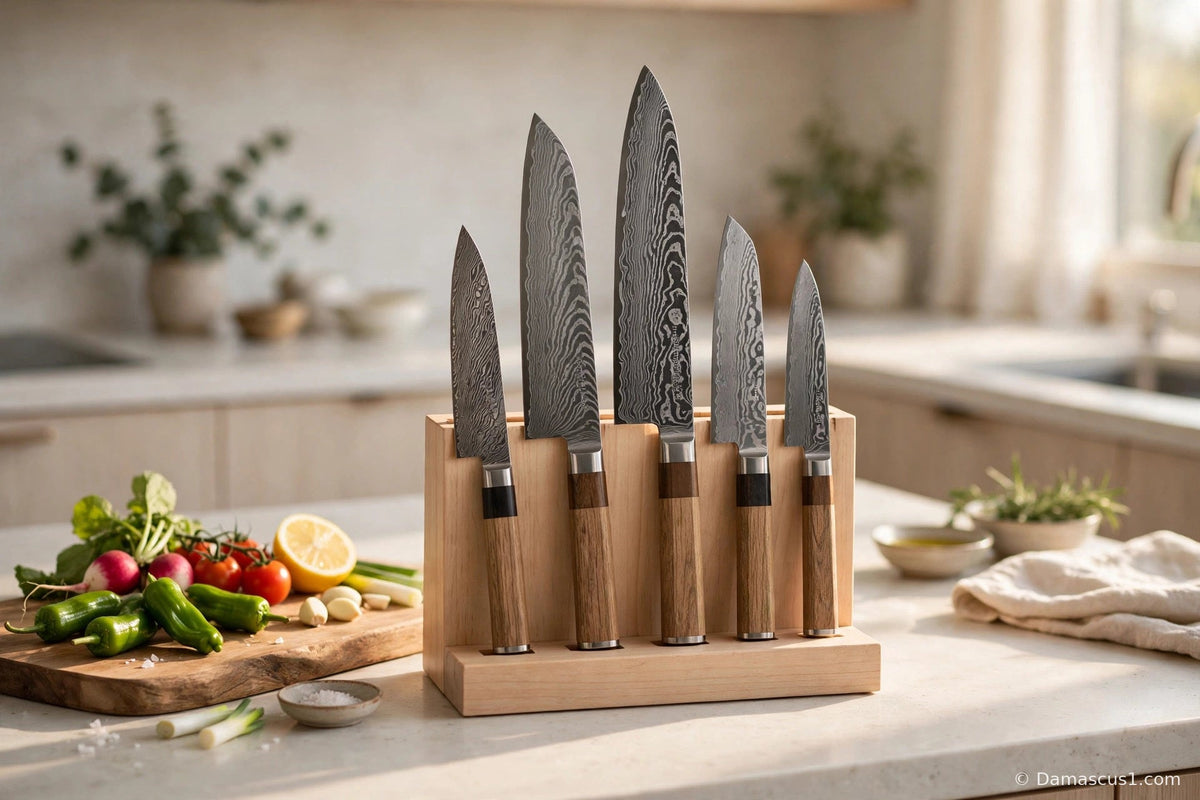
Layered blades, wooden handles, a block that earns its counter space. Editorial scene — the knives shown are not specific Damascus1 products.
Quick answer
The best Japanese knife set for most home cooks is a VG10 or AUS-10 Damascus set built around the trio you will actually use — an 8-inch chef knife in the gyuto profile, a utility knife, and a paring knife — with santoku and nakiri shapes added only if your cooking calls for them. Expect to pay $150–$400 for quality. Our own 6-piece VG10 Damascus set is $399.99, priced live, with 9-piece AUS-10 block sets from $334.
Put a Japanese knife next to a German one and the difference is visible before either touches food. The Japanese blade is thinner. The steel is harder. The edge is ground to a narrower angle, so it parts an onion instead of pushing through it, and it stays sharp longer between sharpenings — in exchange for demanding better manners: no twisting in a squash, no chicken bones, no glass boards, no dishwasher. Every serious guide ranking for this keyword opens with some version of that trade-off, because it is the true one. KnivesAdvice, the freshest editorial voice on this SERP, puts it bluntly: a Japanese set rewards cooks who use a wooden or soft plastic board, wash by hand, and keep a cheap German knife around for the rough jobs.
This guide follows that honesty all the way down — including about ourselves. Damascus1's sets are Japanese-profile Damascus sets: gyuto, santoku and nakiri shapes, VG10 and AUS-10 cores, layered Damascus cladding, sold by us at maker-direct prices. Our listings do not state a country of manufacture, so we will not claim "made in Japan" for them, here or anywhere. What we can claim, and verify, is the steel, the profiles, the prices on the page today, and the comparison against the made-in-Japan benchmarks — Shun, Tojiro, MAC, Enso — whose sets anchor this category at $480 and well beyond. If origin is your deciding factor, buy the benchmarks with our blessing and this guide's help. If steel, shape and value are, read the table.
Our shelf starts with the 6-Piece VG10 Damascus Japanese Kitchen Knife Set at $399.99, and the full range lives in our kitchen knives and chef knife sets collection.
The sets at a glance
| Set | Best for | Steel | Format | Live price (Nov 11, 2026) |
|---|---|---|---|---|
| Damascus1 6-Pc VG10 Japanese Set | Best all-round Damascus value | VG10 core, 67-layer Damascus* | 6-piece set, G10 handles* | $399.99 |
| Damascus1 9-Pc AUS-10 Block Set, Blue G10 | Most complete block under $350 | AUS-10 Damascus | 9-piece block set | $334.00 |
| Damascus1 Japanese Block Set, 9-Pc | The classic block presentation | Damascus (see product page) | 9-piece block set | $339.99 |
| Damascus1 AUS-10 Set, Gray G10, 9-Pc | Modern gray-G10 kitchen | AUS-10 Damascus | 9-piece set | $349.99 |
| Damascus1 7-Pc with Wooden Block | Largest Damascus presentation | Damascus (see product page) | 7-piece set + wooden block | $449.99 |
| Damascus1 Premium Block Set | The under-$200 route | See product page | 7-piece block set | $169.99 |
| Benchmark: Shun Classic 6-Pc Block | Made-in-Japan benchmark | VG-MAX, Damascus cladding | 6-piece block | $479.95–$499.95 (marketplace range reported by Best Japanese Products) |
| Benchmark: Tojiro DP 3-Pc | Made-in-Japan value trio | VG10 | 3-piece set | $140–$155 (same source) |
| Benchmark: Miyabi Birchwood SG2 7-Pc | The no-ceiling option | SG2, 100-layer Damascus | 7-piece block | $1,399.95 (same source) |
*Specs for our 6-piece VG10 set — 67 layers, 58–62 HRC, 11° edge, G10 handles — are as stated in our live best Damascus chef knife set guide (verified there Nov 3, 2026). Piece lists can change between production runs: the product page on the day you order is the final word on what is in the box, for our sets and for everyone else's.
Read the benchmark rows carefully, because they frame the whole decision. The made-in-Japan ladder, as Best Japanese Products priced it this fall, runs from a $140 Tojiro trio to a $1,400 Miyabi block, with Shun's classic block just under $500. Our sets sit in the rung that ladder mostly skips: full 6- to 9-piece Damascus sets between $334 and $449.99. Whether that rung is the smart buy depends on what you value — which is what the rest of this guide is for.
What actually makes a set "Japanese"?

Profile, steel and edge — in that order. The profiles are the shapes Japan refined over centuries: the gyuto, a chef knife with a flatter profile and a finer tip than its German cousin; the santoku, shorter and sheepsfoot-tipped, the three-virtues knife for meat, fish and vegetables; the nakiri, a flat rectangle that turns vegetables into confetti with straight up-and-down chops; the petty, a small utility blade; and the paring knife for in-hand work. Our chef knife vs santoku vs nakiri guide walks each shape against the jobs it suits.
The steel is harder than Western set steel — VG10 and AUS-10 cores typically live around 58–62 HRC in our range, against the softer high-50s of German sets — and the edge is ground narrower, around 11–16 degrees depending on the maker. Harder plus narrower equals sharper for longer, and more fragile while it is being sharper. That is not a defect to apologize for; it is the definition of the category. A Japanese set is a set of scalpels. Treat it like one and it will feel like magic for years. Treat it like a cleaver and it will chip like one shouldn't.
And the Damascus part: in modern sets, "Damascus" means the patterned cladding — layers of steel forge-welded around the hard core and acid-etched so the layers show as flowing lines. The core does the cutting; the cladding protects it, adds a measure of food release, and looks — there is no point pretending otherwise — beautiful on the counter and in the gift box. When the pattern is real, it runs through the blade's spine and edge, not just across the flat. Our guide to spotting the difference is linked from the best kitchen knives hub if you are comparison-shopping beyond our shelf.
The gyuto test: one draw, translucent slices. Editorial scene — the knife shown is not a specific Damascus1 product.
VG10 vs AUS-10: which core steel should you choose?
These two Japanese stainless steels anchor almost every set on this page, ours included, so the difference is worth two minutes. VG10 is the connoisseur's default: a cobalt-bearing stainless that takes a very fine edge, holds it well, and sharpens willingly on a whetstone — the steel in our 6-piece flagship set and in Tojiro's benchmark trio. AUS-10 is its close cousin, a touch more forgiving and often a touch cheaper at the same piece count, which is exactly how our shelf is arranged: the AUS-10 block sets carry more pieces for less money ($334–$349.99 for nine pieces) than the VG10 set ($399.99 for six).
In daily cooking, the honest difference is smaller than the forum wars suggest. Both out-cut and out-last the steel in a supermarket set by a wide margin. VG10 rewards the cook who sharpens on stones and notices edge quality in month six. AUS-10 rewards the cook who wants the full block on the counter this month. Our VG10 vs AUS-10 comparison goes deeper, including the third steel that appears across the category, if you want the full picture before you decide.
Above both sits the benchmark tier — Shun's VG-MAX, Miyabi's SG2 powder steel — where you pay two to four times more for increments of edge life and finish that serious knife people can feel and most home cooks, honestly, will not. That is not a dismissal. It is a budget allocation: the jump from a $60 grocery set to a $334–$399.99 Damascus set is enormous; the jump from there to $1,400 is refinement.
How many knives do you actually need?

Three, daily. The chef knife (gyuto profile) does ninety percent of board work in most kitchens. The petty or utility covers the in-between jobs — sandwiches, fruit, cheese, trimming. The paring knife handles in-hand work over the sink and the board's small print. Every serious guide on this SERP lands in the same place, which is why the benchmark winner is a three-piece Shun set and the value pick is a three-piece Tojiro.
So why buy six or nine pieces at all? Three honest reasons. The santoku genuinely suits cooks who prefer a shorter, lighter, up-and-down cutting rhythm to the gyuto's rock and draw — it is a preference, not a duplicate. The nakiri is a revelation if vegetables are half your cooking; nothing else turns a cabbage into ribbons as fast or as safely. And the block itself is storage that keeps edges separated, visible and off the drawer floor — half of edge damage happens in storage, not in use.
And what should you skip? Filler. Steak knife bundles counted as "pieces" in a chef's set. A second bread knife. Shears and a sharpener of unknown quality padding the count. When you compare sets, count knives you will cook with, divide the price by that number, and watch the rankings rearrange themselves. By that math our 9-piece AUS-10 block at $334 is roughly $37 per listed piece before the block's own value — against roughly $80 per piece in the benchmark Shun block. Pieces are not all equal, and steel and finish differ; but as a first filter against marketing arithmetic, per-knife math is ruthless and fair. If a smaller footprint serves you better, our best knife set hub compares the non-Japanese-profile options too, and the best kitchen knife set under $200 guide covers the budget end, where our Premium Block Set at $169.99 is the honest entry.
The nakiri case: straight chops, no rocking, vegetables in ribbons. Editorial scene — the knife shown is not a specific Damascus1 product.
Our sets, pick by pick

Best all-round: 6-Piece VG10 Damascus Japanese Set — $399.99. The flagship, and the set we would hand a serious home cook first: VG10 core under 67-layer Damascus, G10 handles that shrug off water and kitchen life, and a six-piece count that stays close to the useful end of the spectrum. Per our live set guide: 58–62 HRC, an 11° edge. Confirm the current piece list on the product page before ordering.
Most complete under $350: 9-Piece AUS-10 Block Set, Blue G10 — $334.00. The value play of the shelf: nine pieces, AUS-10 Damascus, blue G10 handles that give a kitchen a deliberate, modern look. If the goal is "replace everything in the drawer with one box," this is the box. Product page.
The classic block: Japanese Damascus Block Set, 9-Piece — $339.99, and its Gray G10 AUS-10 sibling — $349.99. Same nine-piece idea in two finishes; choose by your kitchen, not by a spec sheet. Both live on the collection page with the rest of the range.
The presentation set: 7-Piece Damascus Set with Wooden Block — $449.99. Our largest Japanese-profile presentation, and the gift-season pick — the one that arrives looking like an occasion. (A 7-piece forged Damascus set at $399.99 sits beside it for cooks who prefer that handle line.)
The add-on: VG10 Nakiri — $44.99. Already own a decent chef knife? The single highest-joy upgrade for a vegetable-heavy kitchen is a nakiri, and at $44.99 it costs less than the steak-knife filler in most big sets. Product page.
Real Damascus shows its layers at every angle, spine and edge included. Editorial scene.
The trade-offs nobody should hide
Chips are the tax on sharpness. Hard, thin, narrow-angled edges chip on bone, frozen food, and hard rinds if you twist. Keep one inexpensive, softer knife for the rough jobs — the benchmark guides say it, and so do we.
Hand-wash, always. Dishwasher heat, detergent and rattling are edge abuse in a box. Japanese sets are a thirty-second hand-wash and a towel dry. Our product pages give the same instruction for Damascus generally: clean, dry, and a thin coat of oil if a blade will sit — habits that take less time than loading a dishwasher rack properly.
Boards matter. Wood or soft plastic. Glass, stone and bamboo-as-hard-surfaces are edge killers under hard steel. If your board is glass, replace the board before the knives; it is the cheaper fix.
Origin, one more time, plainly. Shun, Tojiro, MAC and Miyabi sell made-in-Japan sets with generations of forge heritage, and their prices reflect it. Our sets are Japanese-profile Damascus sets with Japanese steels at maker-direct prices, and our listings do not state where they are made. Buyers who care about the forge's postcode should buy the benchmarks. Buyers who care about steel, shape and the remaining $150–$1,000 should read our product pages closely. Both are respectable decisions; only one of them is ours to sell.
Care: the ten-minute month

A Japanese set asks for one skill: whetstone sharpening. The stones do what no pull-through gadget can — preserve the narrow factory angle instead of grinding a new, worse one. Our Damascus sharpening guide covers the grit progression and the pattern-safe technique step by step. Between sharpenings: hone gently if at all (hard steel prefers a stone to a steel rod), store in the block or on a strip rather than in a drawer, and keep the blades dry. Ten minutes a month, total, is a realistic budget for a set that will out-cook two generations of cheap ones.
One last care truth, because it decides more edges than sharpening does: most Japanese knives are not ruined by use — they are ruined in the sink and the drawer. A blade left sitting in dishwater corrodes at the edge and gets knocked by everything else in the basin; a blade tossed loose in a drawer arrives at its next onion pre-dulled. Wash it, dry it, put it back in the block. That three-step habit, repeated without exception, is worth more than any steel upgrade on this page — and it is free, which no other improvement in this guide can claim.
The one skill the category asks for: ten calm minutes on a stone. Editorial scene.
How to choose: the five checks before you buy any Japanese set
Check one — the chef knife first. A set lives or dies by its largest blade, because that blade does most of the work. Everything else in the box is supporting cast. If the gyuto-profile chef knife is right for your hand — weight you can hold for a full prep session, a handle shape your grip likes — the set is probably right. If it is wrong, no quantity of bonus pieces rescues it. Read the chef knife's specs first and the piece count last.
Check two — steel you can maintain. VG10 and AUS-10 both sharpen happily on a basic two-grit whetstone, which is the maintenance reality for home cooks. Powder steels and high-carbon lines (the Blue Steel sets on the Kasumi page, the SG2 Miyabi tier) reward experts and punish beginners. There is no dishonor in the middle shelf; there is only mismatch. Buy the steel your sharpening habits can feed.
Check three — count cooking knives, not pieces. Do the division before you fall in love: price ÷ knives you will actually cook with. A block, a sharpener and shears have value, but they are not knives, and marketing departments count them precisely because buyers do not. On our shelf that is $334 across nine listed pieces for the AUS-10 block — ask the same hard question of every set in the table, benchmarks included.
Check four — storage you will actually use. A block on the counter gets used; a set in a drawer gets damaged. If your counter has no room for a block, choose a smaller set and a magnetic strip rather than a large set and a junk drawer. Edge damage happens in storage more than in service — plan for where these blades will live before you pay for how they cut.
Check five — the rough-job plan. Every Japanese set needs a designated survivor: one cheap, softer knife for bones, frozen squash, hard rinds and the jobs that chip hard edges. If your kitchen does not already own one, budget twenty dollars for it alongside the set. The benchmark guides give the same advice; it is the cheapest insurance in this entire category.
Gifting a Japanese knife set: what to know before you wrap it
Knife sets are December's favourite serious gift for a reason — they are useful daily, they last for years, and a Damascus set in a block or a presentation box looks like an event rather than an errand. Three honest notes from the seller's side. First, give the set that matches the cook, not the price you want to signal: the vegetable-heavy cook wants the nakiri in the mix, the roast-and-bread cook wants the longer chef knife and the slicer shapes. Second, traditions aside — some households observe the custom that a gifted knife should come with a coin so the blade is "bought," not given; it costs you a penny and delights traditionalists. Third, a Japanese set is a commitment gift: it asks the recipient to hand-wash and sharpen on a stone. For a cook who loves the ritual, that is the pleasure. For a cook who runs everything through the dishwasher, gift the tougher German-style set instead and be the person who actually knows them. Our presentation pick for the season is the 7-Piece Damascus Set with Wooden Block at $449.99; the value pick is the 9-Piece AUS-10 Block Set at $334 — both are in the collection, and orders over $50 ship free.
Shop Damascus kitchen knives
Prices checked November 21, 2026. The product page on the day you order is the final word.
- Japanese VG10 Damascus Chef Knife, 8.5 in.: $399.99
- Premium Kitchen Knife Block Set: $169.99
- 7-Piece Forged Damascus Kitchen Knife Set: $399.99
Damascus pocket knives for the cook who has everything
- Olive Wood Damascus Pocket Knife Set, 6.5 in.: $39.99
- Green Wood Damascus Pocket Knife Set, 6.5 in.: $39.99
- Buffalo Horn Damascus Pocket Knife Set, 6.5 in.: $39.99
- Stag Horn Damascus Folding Pocket Knife, 6.5 in.: $49.99
- Camel Bone Scrimshaw Damascus Folding Pocket Knife, 7.6 in.: $49.99
Damascus pocket knives under $50 · All handmade Damascus pocket knives
Frequently asked questions

What is the best brand of Japanese knife set?
For made-in-Japan heritage, the guides converge on Shun and Global, with Tojiro as the value name and Miyabi at the top of the price ladder. For Japanese-profile Damascus sets at maker-direct prices, Damascus1's VG10 and AUS-10 sets ($334–$449.99) are the alternative this guide exists to compare — with the origin difference stated plainly rather than blurred.
Are Japanese knife sets worth the investment?
For cooks who value precision and edge life, yes. Harder steel at a narrower angle stays sharp far longer than a German-style set, and the shapes — gyuto, santoku, nakiri — cover prep with less effort. Expect $150–$400 for quality. The worth-it condition is care: hand-washing, a proper board, whetstone maintenance. Without those, buy a tougher, cheaper set instead.
What steel is best for a Japanese knife set?
VG10 is the category's benchmark core — fine edge, good retention, willing on a whetstone. AUS-10 is its close, slightly more forgiving cousin and often the better value at larger piece counts. VG-MAX and SG2 sit above both at benchmark prices. Damascus, in modern sets, is the layered cladding around those cores, not the core itself.
How many knives do you actually need?
Three daily: a chef knife in the gyuto profile, a utility or petty, and a paring knife. Add a santoku if you prefer its rhythm, a nakiri if vegetables dominate your board, and a bread knife if crusty loaves are weekly. Count cooking knives, not box pieces, when you compare prices.
What is the difference between Japanese and German knife sets?
Japanese sets are thinner, harder (around 58–62 HRC in our range) and ground narrower, so they cut with less effort and hold an edge longer — and chip if abused. German sets are thicker, softer and tougher, tolerant of bones, twisting and dishwashers-adjacent lifestyles. Most serious kitchens end up owning both styles, each for its own jobs.
How do you care for a Damascus Japanese set?
Hand-wash and towel dry. Sharpen on a whetstone at the factory angle — never a pull-through. Store in the block or on a magnetic strip, edges separated. Use wood or soft plastic boards. Wipe a thin coat of oil on any blade that will sit unused, as our product pages advise for Damascus steel.
Gift season is the other reason sets exist: one box, a whole kitchen. Editorial scene.
The bottom line
Decide what you are actually buying. If it is heritage and a Japanese forge's name on the tang, the benchmark ladder is honest and this guide has priced it for you. If it is the cutting itself — the thin blade, the hard core, the shapes that make prep feel easy, the pattern that makes a Tuesday dinner feel like an occasion — then a Japanese-profile Damascus set at $334–$399.99 does that work for hundreds less, and we have told you exactly what it is and is not.
Start with the 6-Piece VG10 Damascus Japanese Set — $399.99 or the 9-Piece AUS-10 Block Set — $334, and browse the rest in the kitchen knives and chef knife sets collection. Orders over $50 ship free. Count the knives you will cook with, check the steel, and let the filler go.
Leave a comment: