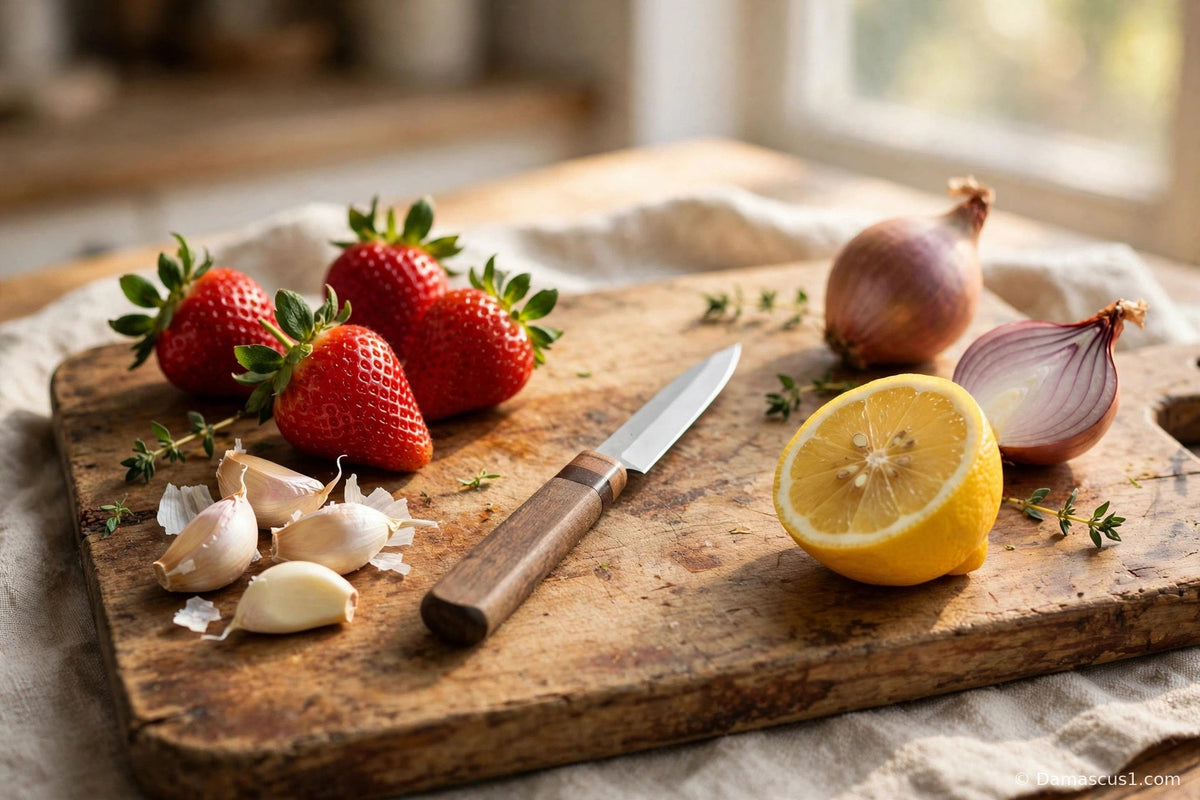
Small prep, laid out: the work a petty knife exists for. Editorial scene — the knife shown is not a specific Damascus1 product.
Quick answer
A petty knife is a 120–150mm Japanese utility knife for peeling, hulling, garlic, citrus and small-produce detail — the second knife beside your chef knife, not a replacement for it. Most cooks should buy 130–135mm. It works in-hand and on the board, which a shorter Western paring knife mostly does not.
Now the part no other page on this ranking will tell you. Damascus1 does not sell a petty knife. We checked our full catalog — 122 products, live on November 13, 2026 — and there is no standalone petty in it. Not a 120, not a 150, not one hiding inside a set under another name. We make chef knives, knife sets and a boning-profile kitchen knife. A true petty — 120 to 150 millimetres of thin Japanese blade, built to live in the space between your palm and the board — is not among them.
Why write the guide, then? Because the petty question is really a sizing question, and sizing questions get mangled by pages that only exist to rank products. Every guide on page one agrees on the bones of the answer: the size range, the sweet spot, the second-knife role. Where they go quiet is the part that actually decides whether you'll love the knife — which size wins which job, and what to do if, like our own customers, your drawer doesn't hold a petty at all. A maker with nothing to sell you in the category can afford to be blunt about both. Every pick below comes from the page-one guides that rank for this keyword — their consensus, their trade-offs, their few verified prices — and where a Damascus1 product genuinely overlaps a petty's work, we'll say exactly where that overlap ends. No further.
If you want to browse what we do make while you read, it lives in the chef's kitchen blades collection — kitchen knives, honestly labelled, none of them a petty. And if your real question is bigger than one small knife — which main blade this second knife will stand beside — start with our guide to the best chef knife, because a petty is bought second and judged against whatever it partners.
Which petty knife should you buy at a glance?
Direct answer: The best petty knife for most home cooks is a 130–135mm Japanese petty: long enough for board work on small produce, short enough for in-hand peeling and hulling, and thin enough to segment citrus cleanly. Buy 120mm for mostly in-hand work, 150mm if you mostly work on the board.
| Knife | Best for | Blade | Price |
|---|---|---|---|
| Tojiro DP 120mm | Best overall (japaneseknifelab's pick) | 120mm, Japanese | ~$83 (per japaneseknifelab, Nov 2026) |
| Tojiro DP Cobalt 135mm | Best sweet-spot value (jpnknife's listing) | 135mm, Japanese | ~$29 as listed by jpnknife (Nov 2026) — check current price |
| MAC Professional 125mm | Best thinner alternative (japaneseknifelab) | 125mm, thin profile | ~$75 (per japaneseknifelab, Nov 2026) |
| Misono Molybdenum Petty 130mm | Best overall, tested (mrkitchenadviser's pick) | 130mm | Check current price |
| Tojiro DP F-802 150mm | Best Japanese value at full length (mrkitchenadviser) | 150mm | Check current price |
| Misono UX10 150mm | Best premium (japaneseknifelab / jpnknife) | 150mm, premium line | ~$180–200 (per japaneseknifelab, Nov 2026) |
| Victorinox Fibrox | Best budget / beginner (mrkitchenadviser) | Utility length | Check current price |
| Seido 5" VG-10 Damascus petties (Kurogane / Epokishi / Shinko) | Best Damascus petty line (retailer's own range) | 5-inch, 37-layer Damascus, 60+ HRC per Seido's page | Check current price |
| Damascus1 7-Piece Set with Wooden Block | Not a petty — whole-set route whose listing includes utility and fruit knives | Set — confirm the current piece list on the product page | $449.99 (live at damascus1.com) |
| Damascus1 AUS-10 Boning-Profile Knife | Not a petty — best for meat trimming and deboning only | Stiffer, larger boning profile | $59.99 (live at damascus1.com) |
Read that table the way it was built. The first eight rows are other makers' knives, recommended because the page-one consensus — mrkitchenadviser, japaneseknifelab, seidoknives, jendeindustries, kitchnknife, jpnknife — keeps landing on the same handful of names and the same size logic. When a task-tested roundup, a spec-based lab, a sharpness-measurement site and two retailer guides all converge on Tojiro, MAC and Misono at 120–150mm, that convergence is the most useful data a buyer gets. Jende Industries adds the one hard dataset on the SERP: across ten petties measured on an Edge-On-Up tester, the Tojiro DP came out sharpest at a 107g average — their measurement, reported here as theirs, and a decent tiebreaker if out-of-box sharpness is your thing.
The last two rows are ours, and they sit in the table precisely so nobody mistakes them for the other eight. Neither is a petty. One is a set that covers small-knife work as part of a whole drawer; the other is a trimming knife that shares exactly one neighbourhood with a petty and no more. A guide that blurred that line to move product would be lying to you for the price of a small knife, and we'd rather sell you nothing here and be believed everywhere else.
One more honesty note on prices. Small-knife prices move with imports, seasons and sales, and most roundups either quote snapshots that go stale or hide behind price tiers. This post carries four benchmark prices — the three japaneseknifelab verified in its guide and the one jpnknife lists — each attributed to its source, and labels everything else "check current price." If a guide gives you ten prices to the cent, ask when they were checked. Ours were checked against the live sources on November 13, 2026, and for most of them the honest answer was: they move. Check before you buy.
What is a petty knife used for?

Direct answer: A petty knife handles the small, precise jobs a chef knife is clumsy at: peeling and hulling fruit, trimming strawberries, mincing garlic and shallots, segmenting citrus, deveining shrimp, trimming meat and finishing garnishes. It works in-hand for peeling and on the board for slicing, which is exactly the double life that defines the category.
Start with the in-hand work, because that's the petty's home turf. Hulling strawberries — popping the stem and core out with the tip without halving the berry. Peeling an apple or a kiwi in one turning ribbon. Taking the eyes out of a pineapple, the blemishes off a potato, the stem scar out of a tomato. These are cuts made against your own fingers, at a scale where an 8-inch chef knife is all liability: too much blade to track, too much weight to finesse, and a heel that serves no purpose an inch from your thumb. A petty's blade is short enough that your hand always knows where the tip is. That awareness is not a luxury. It's the safety system.
Then the board work, which is where the petty pulls away from the paring knife it gets confused with. Segmenting citrus — sliding the thin blade between membrane and flesh to free clean supremes. Mincing garlic and shallots finer than a chef knife wants to bother with. Slicing strawberries, cherry tomatoes, radishes, small mushrooms. Deveining shrimp along the back with the tip. Trimming a chicken breast, taking silverskin off a small cut, portioning cheese. On the board, length is leverage: a petty has enough edge to finish a slicing stroke on small produce without the sawing a stubby paring knife forces, and enough knuckle clearance — just enough — to work flat without rapping your fingers on every pass.
Jpnknife's guide puts a frame around all of this that page one keeps repeating: the petty is the second most-used knife in Japanese professional kitchens, behind the gyuto. That's their framing, reported as theirs — but it matches the logic of any busy home kitchen. The big knife does the big third of cooking: breaking down, chopping, slicing at volume. The petty absorbs the fiddly two-thirds that surround it — the peeling, trimming, opening, finishing and fixing that never make it into recipe instructions because they're assumed. "Prep the vegetables" is petty work. So is everything garnished, cored, seeded or segmented.
What a petty is not for matters just as much. Not for hard squash, frozen food, bones, or prying anything — the blade is thin and comparatively hard, and lateral force is how thin edges chip. Not for high-volume chopping; that's the chef knife's shift, and our chef knife vs santoku vs nakiri guide walks through which big blade owns which work. And not as your only knife. The petty is a specialist that earns its slot by making the generalist's job easier — a second knife, proudly, and never a replacement for the first.
Hulling is the petty's signature cut: tip control at fingertip scale. Editorial scene — the knife shown is not a specific Damascus1 product.
What size petty knife is best?
Direct answer: Buy 130–135mm if you only buy one petty — page one's retailer consensus sweet spot, long enough for board work, short enough for in-hand peeling. Choose 120mm if most of your work is in-hand, and 150mm if most of it happens on the board beside a chef knife. Match the size to the dominant job, not the occasional one.
This is the section we built this guide around, because it's the one the pick lists gesture at without ever laying out in one place. Here is the size-by-task chart — the shareable asset of this post, and the quickest honest buying shortcut we can give you:
| Size | Wins at (buy it for this) | Loses at (don't ask it to do this) | Who should buy it |
|---|---|---|---|
| 120mm | In-hand peeling (apples, kiwis, potatoes); hulling strawberries; taking out eyes and blemishes; garnish and detail work held in the palm | Board slicing of anything wide; knuckle clearance runs out fast; long strokes on cheese or sausage | The in-hand specialist — cooks whose small work rarely touches the board |
| 135mm | The crossover: in-hand peeling that still feels direct, plus board work on garlic, shallots, citrus segments, cherry tomatoes, small mushrooms; deveining shrimp | Very large small-produce (big onions still belong to the chef knife); marathon chopping | Almost everyone — the one-petty answer and the page-one sweet spot |
| 150mm | Board-first work: slicing small produce in longer strokes; segmenting larger citrus; trimming meat; portioning cheese; small slicing jobs a chef knife overwhelms | Delicate in-hand peeling gets wand-like — the tip sits a long way from your hand; tight hulling turns clumsy | Board-dominant cooks who already peel with a peeler and want a small slicer |
Two things to notice in that chart. First, the sizes are only 15mm apart, and they still don't substitute for each other — because at this scale, 15mm is not a rounding error, it's a tenth of the whole blade, and your hand feels it in tip distance on every in-hand cut. Second, the middle row wins by not losing: 135mm is nobody's absolute best at anything and everybody's second-best at everything, which is exactly what a second knife should be. That's why jpnknife calls 130–135mm the retailer-consensus sweet spot, and why mrkitchenadviser's tested best-overall pick lands at 130mm and japaneseknifelab's premium pick stretches to 150mm for board-heavy buyers. The consensus isn't a coincidence. It's the chart, discovered independently, one kitchen at a time.
How to choose without overthinking it: watch your own hands for one week of normal cooking. Count how many small-knife jobs you did in the air versus on the board. If the air wins — peeling, hulling, trimming over the sink or the bin — buy 120mm and don't look back. If the board wins — mincing, segmenting, slicing — buy 150mm and use a peeler for the rare in-hand job. If it's genuinely mixed, or you don't want to count, buy 135mm. That's not a cop-out; it's what the sweet spot means.
One trap to avoid: buying the 150mm "because it can do everything the smaller ones can, plus more." Length is not a superset. A 150mm petty cannot do the 120's best work — the tip control that makes hulling a strawberry feel surgical becomes guesswork when the tip drifts far from your grip. Bigger is a trade, not an upgrade. Guides are paid to rank one winner. Your hand is allowed to prefer a smaller one.
Petty knife vs paring knife: what is the difference?

Direct answer: A petty is longer, thinner and usually harder than a Western paring knife. Paring knives run roughly 80–100mm and live almost entirely in-hand; petties run 120–150mm and split their work between in-hand peeling and on-board slicing. That extra length is the whole point — it turns a peeling tool into a genuine second knife.
The paring knife is the older, narrower idea. Western kitchens built it for one posture: food in one hand, knife in the other, work done in the air — peeling, coring, deveining at palm scale. Its blade is short because the food it meets is small, and its steel is traditionally softer because a knife that works against a thumb and gets tossed in drawers benefits from toughness over edge retention. It is a good tool. It is also a one-room tool: set it on a board and ask it to slice a strawberry or mince a shallot, and the short edge forces a sawing stroke while your knuckles fight the board for space.
The petty comes from a different kitchen logic. Japanese prep splits work between a big blade and a small one, and the small one was expected to earn its keep on the board as well as in the hand — so it grew. At 120–150mm it keeps everything the paring knife does in-hand (a 120mm petty peels and hulls happily) and adds the board game the paring knife can't play: real slicing strokes, cleaner citrus segments, faster garlic and shallot work. Per jpnknife's guide, Japanese petty steel also tends to run harder — roughly 58–62 HRC as their consensus framing — against softer Western paring steel, which means a thinner edge that holds longer and asks for a whetstone instead of a honing rod. Treat those hardness numbers as the category's general shape, not a promise about any individual knife; confirm the spec of the exact knife you're buying on its product page.
So which belongs in your drawer? If your small work is ninety percent peeling and you already own a paring knife you like, the honest answer is that a petty is a want, not a need — the overlap is real, and we'll say so again in the worth-it section below. If you find yourself reaching past the paring knife for the chef knife every time small work touches the board — too big, but the paring knife is too small — that gap you're feeling is precisely petty-shaped. Buy for the gap, not the label.
There's one more difference nobody puts on a spec sheet: confidence at the tip. A paring knife's tip is a peeling tool. A petty's tip, on a longer and thinner blade, is a detail instrument — the thing that deveins the shrimp, scores the garnish, frees the citrus segment without tearing the membrane. If your cooking is getting more precise — plating, finishing, the small cuts that separate a good dish from a neat one — you'll feel the petty's tip working for you within a week.
Board detail at small scale: the work a paring knife saws at and a petty slices. Editorial scene — the knife shown is not a specific Damascus1 product.
Petty knife vs utility knife: are they the same?
Direct answer: Mostly, yes — with an accent. "Utility knife" is the Western name for a mid-length small knife, and "petty" is the Japanese version of the same idea: longer than a paring knife, shorter than a chef knife. Japanese petties tend to be thinner and harder; Western utility knives tend to be softer, thicker and sometimes serrated.
This is the most honest section in the guide, because the knife industry would prefer you not to notice how much of this category is the same idea wearing different passports. A utility knife and a petty knife answer the same brief — the in-between knife, for the jobs too small for the chef knife and too board-bound for the paring knife — and in set after set, the utility slot and the petty slot describe the same piece of steel at roughly the same length. If you already own a utility knife you like, you own most of what a petty does. Anyone who tells you otherwise is selling you a synonym.
The real differences are tendencies, not walls. Japanese petties lean thinner and harder, with flat-ish profiles that slice cleanly and edges that reward whetstone care. Western utility knives lean a little thicker and softer, shrug off drawer life and dishwasher-adjacent abuse more forgivingly, and show up serrated surprisingly often — a serrated utility is a tomato-and-bread-roll tool, genuinely handy, but it is not a petty in any functional sense: it saws where a petty slices, and it can't peel or segment with a plain edge's cleanliness. When you shop, shop the blade in front of you — its length, its thickness, its edge — and let the name tag come last.
This matters for our own shelf, so let's be exact about it. Our 7-Piece Damascus Kitchen Knife Set with Wooden Block ($449.99) — the set's listing includes utility and fruit knives among its pieces; confirm the current piece list on the product page before ordering, because listings are the final word. A utility knife arriving inside a set like that is the Western answer to the same brief the petty answers. For a cook building a whole drawer at once, that may be answer enough: set utility knives handle board work on small produce and general trimming perfectly respectably. What they don't give you is the dedicated petty's thinness and tip precision at 130–135mm — the specialist's edge. Sets are how most kitchens cover the brief; a standalone petty is how a kitchen refines it. Both are legitimate. They're just different purchases wearing similar names, and now you can tell them apart.
How do you use a petty knife in-hand without cutting yourself?

Direct answer: Hold the food, not your palm, in the line of the edge. Peel away from your body on the board when you can; when you peel in-hand, brace the food with your thumb well behind the edge's path and draw the blade with your fingers, slowly. At petty scale the claw grip still applies — fingertips curled, knuckles guiding.
The pick lists never teach this, which is strange, because a petty spends half its life working toward your own hand. So here's the technique section the rankings skip — the part that decides whether a petty feels like a scalpel or a hazard.
Peeling away vs peeling toward. The board is always the safest station: food pinned flat, edge travelling away from you, both hands out of the cut's future. Use it whenever the food allows — potatoes, carrots, anything that sits still. In-hand peeling exists for round, turning work: apples, kiwis, peaches, where the food rotates against a nearly still blade. The classic grip braces the fruit against your thumb while your fingers draw the blade in short strokes — and the rule that keeps it safe is embarrassingly simple: your thumb is a backstop, never a target. Keep it behind the plane the edge is travelling in, move the food more than the knife, and slow down. Speed is the only variable in nearly every in-hand nick. A petty rewards the cook who turns the apple, not the one who hurries the blade.
The claw grip, shrunk. On the board, the guiding hand works exactly as it does under a chef knife — fingertips curled under, knuckles forward, the blade's flat riding the knuckles — just scaled down. Two adjustments at petty size: your curled fingers sit closer to the edge's line, so curl them honestly, not approximately; and the knife is light, which tempts a fingertip grip on the spine for detail cuts. That pinch grip — thumb and forefinger on the blade flat just ahead of the handle — is legitimate for hulling and segmenting, where strokes are short and pressure is tiny. It is not a grip for force. The moment a cut needs pressure, go back to the full handle and the claw.
Small rules that prevent small cuts. Never catch a falling petty — small knives vanish from the counter edge fastest, and the grab reflex is how palms get opened. Never park it under a towel, a peel pile or a board; a hidden edge is an ambush. Wash it alone, edge facing away, and put it back in its slot immediately — petties are the knives most often left loose in drawers, where the next hand in is yours, rummaging. And keep it sharp, which sounds backwards and isn't: a dull petty makes you push, pushing makes it skate, and skating across a shallot is the classic petty injury. The sharp one obeys. The dull one improvises.
In-hand peeling done right: the food turns, the blade barely travels, the thumb stays behind the edge's path. Editorial scene — the knife shown is not a specific Damascus1 product.
What should you buy if your drawer has no petty knife?

Direct answer: Three honest routes. Buy a benchmark petty from another maker — the true tool for the job. Buy a set whose listing includes small utility and fruit knives if your whole drawer needs building. Or, for meat trimming only, use a stiffer boning-profile knife and accept its limits. What we won't do is rename something a petty that isn't.
Here is the whole commercial section of this guide, priced and placed honestly. Route one is the benchmark table at the top — Tojiro, MAC, Misono and the rest, from makers who build petties and build them well. If a dedicated petty is what you came for, buy it there with a clean conscience; this guide exists to size it, not to intercept it. Routes two and three are ours, and each comes with its limit printed on the label.
Our knives, priced and placed honestly
Route two — build the whole drawer: 7-Piece Damascus Kitchen Knife Set with Wooden Block — $449.99. The set's listing includes utility and fruit knives among the pieces — confirm the current piece list on the product page, as listings are the final word. For a reader whose petty question is really "my whole knife drawer is one dull chef knife," a set answers the bigger question first and covers small-knife board work through its utility slot. It is not a way to buy a petty. It is a way to stop needing one urgently. Product page. If sets are your route, our guide to the best knife set compares the options properly, and the best kitchen knives hub maps the whole drawer around them.
Route two, smaller first step: Premium Kitchen Knife Block Set — $169.99. The whole-kitchen route at a lower spend — a block set for readers starting from near-empty. We won't enumerate its pieces here; the product page carries the current list, and that's where to confirm it. Same honest framing as its bigger sibling: a set covers the small-knife brief broadly rather than specially. Product page.
Route three — the trimming overlap only: AUS-10-Labelled Kitchen Knife (boning profile) — $59.99. The one place our shelf and a petty's job genuinely overlap is trimming work: taking down meat, working around joints, deboning — jobs where a petty is also used, and where control matters more than thinness. Be clear about the trade, because we are: this knife is stiffer and larger than a petty. It will not hull a strawberry gracefully, it will not segment citrus with a petty's delicacy, and it isn't meant to. For the trimming third of a petty's workload, in a kitchen that also breaks down chickens and trims roasts, it's a honest tool. For the peeling and detail two-thirds, it isn't — buy the benchmark petty instead. Product page — confirm the current spec there before ordering.
Finishing work — portioning cheese, trimming, placing the last details — is where small knives earn their slot. Editorial scene — the knife shown is not a specific Damascus1 product.
Is a petty knife worth it if I already own a chef knife?

Direct answer: Yes, for most cooks who prep produce daily — the petty does the fiddly third of cooking faster and more safely than an 8-inch chef knife asked to work at fingertip scale. It is not worth it if your small work is rare, or if a paring knife you already own genuinely covers your peeling and trimming.
Think about what you actually ask your chef knife to do in a week. Somewhere in there — probably daily — you're holding it like a pencil over a garlic clove, or levering its tip around a strawberry, or mincing one lone shallot with a blade built for a cabbage. Every cook does it. It works, the way driving a nail with a wrench works, and it carries the same quiet risk: a big, heavy blade doing fingertip work is a blade whose tip you can't fully account for. The petty's worth-it case starts there. It's not that the chef knife can't do these jobs. It's that the petty does them at the scale they happen, with the control they deserve, and the accumulated difference across a year of dinners is real — faster prep, cleaner cuts, fewer held breaths.
The second-knife framing from jpnknife's guide — the petty as the second most-used knife in Japanese pro kitchens — generalises because the division of labour is natural, not cultural. Big knife: volume, force, long strokes. Small knife: precision, turning, finishing. Home cooks who add a petty in the sweet-spot size tend to describe the same discovery: they didn't buy a new capability, they stopped borrowing one. The chef knife gets sharper in their estimation too, because it stops being blamed for jobs it was never sized for. If you're still choosing that first knife, our best kitchen knives guide is the place to start; the petty conversation only makes sense standing next to a main blade you trust.
Now the honest no. A petty is not worth it if your cooking is genuinely big-batch and board-bound — soups, roasts, sheet-pan everything — with small work appearing twice a month. It is not worth it as a duplicate: if a good paring knife and a utility knife you like already split the work between them, the petty adds refinement, not coverage, and refinement can wait for a birthday. And it is never worth it as a first knife — a drawer holding only a petty is a drawer that can't chop an onion properly. Buy the hierarchy in order: main knife first, petty second, specialisation last. That ordering is the whole philosophy of this guide in one line.
Segmenting citrus: the board job a paring knife is too short for and a chef knife is too big for. Editorial scene — the knife shown is not a specific Damascus1 product.
How do you sharpen a petty knife?
Direct answer: Sharpen a petty the way you'd sharpen any thin Japanese knife: a whetstone, a low and consistent angle, light pressure, and more frequent light touch-ups rather than rare heavy grinds. The blade is small, so keep your guiding fingers on the flat of the blade and work in short sections. Follow the same routine you'd use for a Damascus chef knife.
The principles transfer from any thin Japanese blade, and our full walkthrough — how to sharpen a Damascus knife — applies here step for step: soak the stone, hold a steady low angle, work both sides evenly, finish lighter than you started. What changes at petty scale is the handling. A 135mm blade doesn't span the stone the way a chef knife does, so you sharpen in short sections — heel, middle, tip — moving the blade across the stone in small arcs, with your off-hand fingers resting flat on the blade to feel the angle instead of guessing it. The tip section is where petties get rounded off by careless sharpening; lift the handle slightly as you reach it, follow the edge's curve, and check your work with a marker line on the bevel if you're learning. Two sessions of patience beat one session of confidence.
Pressure is the second adjustment. Thin edges need less force and punish more: lean on a petty the way you'd lean on a big German blade and you'll roll the edge or carve a hollow into the middle of it. Let the stone do the work, keep strokes even, and stop the moment the edge feels uniformly keen along its whole length. Frequency beats intensity with these knives — a light touch-up every few weeks of regular use restores a petty faster than a heroic annual regrind, and removes a fraction of the steel. That matters more on a small blade: there's simply less of it to spend.
Storage finishes the job sharpening starts. A petty loose in a drawer dulls against everything it touches and endangers every hand that visits — use a block slot, a magnetic strip, or a simple edge guard, every time, no exceptions for "just tonight." Hand-wash and dry it after use; thin edges and damp drawers are enemies. Do that, and a well-bought petty holds its edge through months of daily detail work — which, given that detail work is most of cooking, makes it possibly the best cost-per-cut in your kitchen.
What else do readers ask about petty knives?
What is a petty knife used for?
Peeling, hulling, trimming and detail work: strawberries, apples, kiwis and potatoes in-hand; garlic, shallots, citrus segments, cherry tomatoes and small mushrooms on the board; plus deveining shrimp, trimming meat and finishing garnishes. It is the second knife beside your chef knife — the one that absorbs the fiddly work surrounding every recipe. If a job happens at fingertip scale, it is probably petty work, and doing it with a petty instead of a chef knife is faster, cleaner and easier to keep safe.
Petty knife vs paring knife: what is the difference?
Length, role and steel tendency. Paring knives run roughly 80–100mm and work almost entirely in-hand; petties run 120–150mm and split their work between in-hand peeling and on-board slicing. Japanese petties also tend to be thinner and harder than Western paring knives (roughly 58–62 HRC per jpnknife's consensus framing — confirm any individual knife's spec on its product page). If your paring knife frustrates you on the board, the difference you're feeling is exactly the petty's reason to exist.
What size petty knife is best?
130–135mm for most cooks — the page-one retailer-consensus sweet spot. Choose 120mm if your small work is mostly in-hand (peeling, hulling, turning fruit), and 150mm if it's mostly on the board (slicing small produce, segmenting larger citrus, trimming, portioning cheese). The full job-by-job breakdown is the size-by-task chart in the sizing section above. Match the size to the dominant job, not the occasional one, and don't assume the longest is the most capable — at this scale, length is a trade, not an upgrade.
Petty knife vs utility knife: are they the same?
Mostly — they're the Western and Japanese answers to the same brief: the in-between knife, longer than a paring knife, shorter than a chef knife. Japanese petties tend to run thinner and harder; Western utility knives a little thicker and softer, sometimes serrated (a serrated utility is a different tool — it saws rather than slices). A set's utility knife covers the brief broadly; a dedicated petty refines it. Shop the blade's length, thickness and edge, and let the name come last.
Is a petty knife worth it if I already own a chef knife?
Yes, if you prep produce most days — the petty takes over the fiddly third of cooking that a chef knife does clumsily and less safely at fingertip scale. No, if your small work is rare, or if a paring knife and utility knife you already like genuinely cover your peeling, trimming and board detail between them. And never as a first knife: the hierarchy is main knife first, petty second. It's called the second knife because that's the order it earns its place in.
How do you sharpen a petty knife?
On a whetstone, at a low, steady angle, with light pressure and section-by-section strokes — heel, middle, then the tip with a slight handle lift so you don't round it off. Prefer frequent light touch-ups over rare heavy grinds; thin blades have less steel to spend. Keep guiding fingers flat on the blade to feel the angle. The full routine in our sharpening guide applies step for step, and storing the knife in a block, on a strip or in an edge guard protects the edge you just built.
What is the bottom line on buying a petty knife?
Direct answer: Buy the size first and the brand second: a 130–135mm petty from the benchmark names on page one will out-serve a premium 150mm bought for the wrong jobs. We sell no petty, so our closing advice costs us a sale — size it to your dominant work, keep it sharp, and let it be the second knife it wants to be.
Everything in this guide reduces to three decisions. Size: 120, 135 or 150mm, chosen by whether your hands work in the air, on the board, or both — the chart in the sizing section is the whole argument, and it's free to screenshot. Source: the benchmark names page one converges on, at the four attributed prices we could verify and "check current price" honesty for the rest. And role: a second knife, bought after a main knife you trust, judged by how completely it takes over the small work — not by how it photographs.
If a petty SKU ever joins our catalog, this page gets rewritten the day it does — the honesty frame only works if it's true on the day you read it, and on November 13, 2026 the truth is that our 122-product catalog holds no petty. Until then, our contribution to your small-knife problem is a clear head and, if your drawer needs the bigger fix, a set whose listing includes utility and fruit knives — the 7-Piece Damascus Kitchen Knife Set with Wooden Block ($449.99), piece list to be confirmed on its product page — or the Premium Kitchen Knife Block Set ($169.99) as the smaller first step. Browse the full range in the chef's kitchen blades collection, read the best chef knife and best Damascus chef knife set guides to settle the main blade this petty will stand beside — and then, sized right and honestly bought, go make something small and precise for dinner.
Shop Damascus kitchen knives
Prices checked November 21, 2026. The product page on the day you order is the final word.
- Japanese VG10 Damascus Chef Knife, 8.5 in.: $399.99
- Premium Kitchen Knife Block Set: $169.99
- 7-Piece Forged Damascus Kitchen Knife Set: $399.99
Damascus pocket knives for the cook who has everything
- Olive Wood Damascus Pocket Knife Set, 6.5 in.: $39.99
- Green Wood Damascus Pocket Knife Set, 6.5 in.: $39.99
- Buffalo Horn Damascus Pocket Knife Set, 6.5 in.: $39.99
- Stag Horn Damascus Folding Pocket Knife, 6.5 in.: $49.99
- Camel Bone Scrimshaw Damascus Folding Pocket Knife, 7.6 in.: $49.99
Damascus pocket knives under $50 · All handmade Damascus pocket knives
Leave a comment: