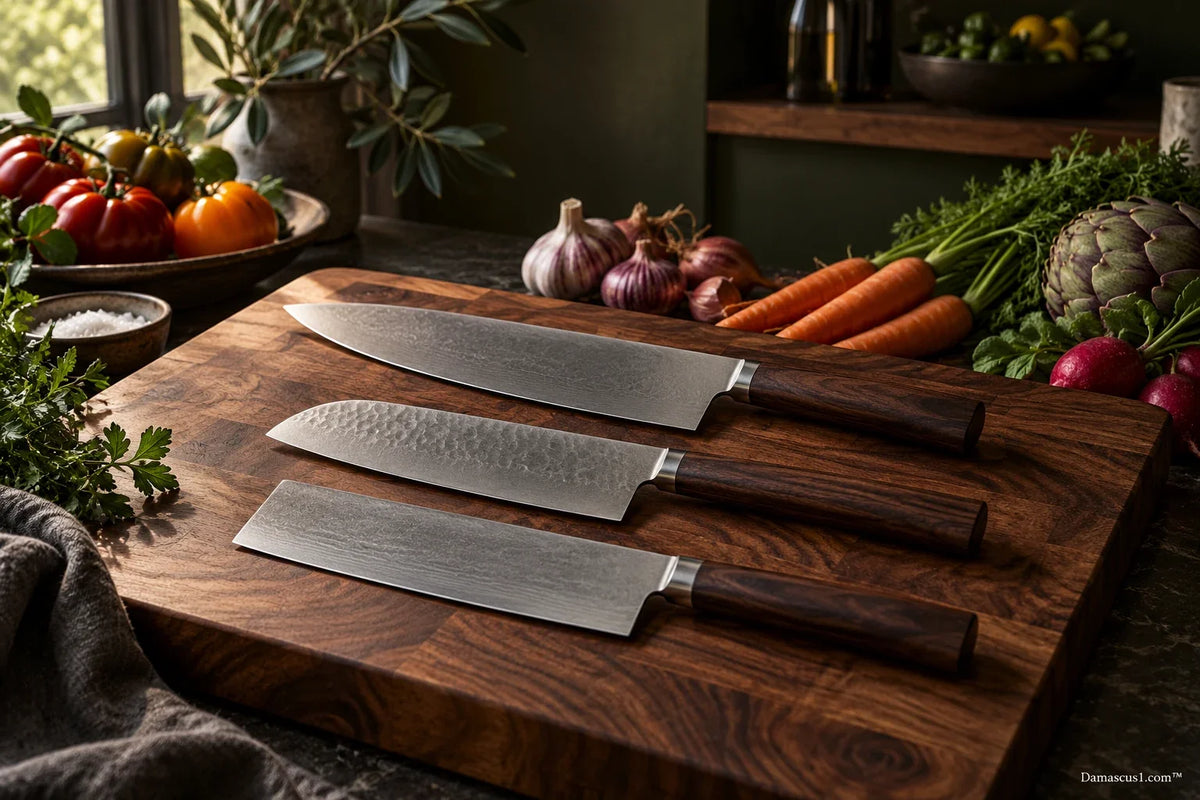
Choose a chef knife, santoku or nakiri by the meals you cook, the cutting motion you prefer and the space you have. Compare everyday preparation with vegetable-focused tasks, then check each model’s dimensions, handle, storage fit and instructions. Use the linked Damascus1 listings to build a shortlist before buying.
The cover and interior images are AI-generated editorial illustrations. Product links lead to real catalog photography and current buying details.
A photograph of three beautiful blades cannot tell you which one belongs in your kitchen. The practical answer comes from a much smaller question: what do you spend time cutting? A cook who prepares vegetable bowls every evening has a different brief from someone who mostly slices bread, trims a few ingredients and heats prepared meals. Start with your own work rather than a collection you feel expected to own.
This guide separates familiar knife shapes from the specifications of an individual product. It offers a meal-based comparison, a way to assess fit online, and questions to resolve before ordering. The linked Damascus1 products are real catalog listings; their current pages remain the place to check price, variants, availability and documented details. Editorial illustrations show generic kitchen scenes and do not establish any product's dimensions, materials or performance.
Build a three-meal brief before browsing
Write down three meals you cook regularly, not three meals you hope to attempt one day. For each, list the ingredients you actually prepare. A stir-fry might involve onions, peppers and boneless protein. A breakfast routine might involve fruit and a loaf of bread. A soup might involve several kinds of vegetables. This exercise makes the buying decision concrete and reveals whether the problem is a missing shape, an uncomfortable handle, or a knife that needs attention.
Add the knife you currently use beside every task. Mark the tasks that feel awkward, but describe the problem rather than immediately naming a replacement. Perhaps the blade feels too long on the available board, the handle becomes uncomfortable during a larger batch, or a serrated knife is missing for bread. A new nakiri will not solve every one of those problems. A good brief prevents an attractive specialist from replacing a more useful purchase.
Finally, identify your most frequent preparation session. Buying for the ordinary evening is often more useful than buying for an annual celebration. If two shapes could cover that session, compare their individual models next. Keep the brief short enough to remember while browsing: regular foods, current frustration, board space, storage position and realistic budget. You can revise it after learning more, but having a starting point reduces aimless comparisons.

What to look for in a chef knife
The familiar chef-knife category is a sensible starting point for a mixed preparation list. Many examples have a curved edge profile that accommodates a rocking motion, but the amount of curve differs between models. Look at the whole blade silhouette rather than assuming the name guarantees an identical feel. Shun's manufacturer guide describes the chef shape as an all-purpose option and explains the role of its curved belly. That is useful category context, not a specification for every knife sold elsewhere.
For your shortlist, ask whether the actual blade gives you comfortable room to work on your existing board. A longer blade can require more working space and may feel unfamiliar if you have always used a small utility knife. A shorter model may be easier to place in a compact drawer but should still suit the foods you prepare. Neither length is automatically the right choice. Record the stated blade length and overall length separately so you do not compare two different measurements.
Notice how the handle meets the blade and whether the listing offers clear side views. If you cannot assess grip comfort online, identify what you liked about your previous knife and ask for the missing measurements. A photograph provides visual information; it does not prove balance in your hand. The useful question is whether this model fits your routine and preferences, rather than whether the category is described as essential by another cook.
Where a santoku fits into the comparison
A santoku belongs in the everyday-preparation comparison rather than being reserved for a single cuisine. Its outline commonly differs from a Western-style chef knife, including a lower tip and a comparatively straighter section of edge. Actual profiles vary. The most useful comparison is a side-by-side look at the specific santoku and chef models you are considering, followed by their documented dimensions. A category name does not settle blade height, weight or how the handle will fit.
Consider this shape if you want to compare a compact everyday blade with your current preparation habits. Observe how you usually move the knife, and read the maker's instructions instead of forcing a motion based on a video of a different model. If the edge has a relatively flat section, that feature may matter more to your decision than the decorative finish. Do not assume that every knife marketed as a santoku has the same geometry or is equally suitable for every cutting technique.
Some listings describe indentations or other surface features along the blade. Treat those as features to investigate, not a promise that food will never stick. Ingredient moisture, size and preparation all affect what happens in a real kitchen. Ask what the current product actually includes and avoid transferring another brand's claims to it. If a listing combines chef and santoku terminology, obtain clarification about the pictured model before using the label as the basis for your order.

Why consider a nakiri for a vegetable routine?
The rectangular nakiri outline is strongly associated with vegetable preparation. Shun describes its nakiri as a straight-edge design used with a down-and-forward push cut rather than rocking. ZWILLING also places nakiri within its vegetable-focused knife guidance. These manufacturer descriptions help explain the category. They do not establish the thickness, edge angle, steel or suitability of a Damascus1 model, and they should not be used as a replacement for its own instructions.
A useful reason to shortlist a nakiri is that vegetables make up a large, repeated part of your prep and you want to compare a dedicated shape. Think about a week of salads, soups and stir-fries. If your existing general-purpose knife already feels comfortable for those meals, the specialist may be an optional addition. If your frustration concerns storage or grip, resolve that before treating a rectangular blade as the answer. The benefit needs to match an actual task in your kitchen.
Do not mistake a rectangular silhouette for authorization to chop bones or use the blade as a heavy cleaver. Similar outlines can conceal very different construction and intended roles. Follow the selected model's instructions and ask the seller about any demanding task you have in mind. For a vegetable-focused purchase, evaluate normal produce preparation first. A category comparison is most useful when it also makes clear which jobs require a different, specifically suitable tool.

Compare roles before comparing materials
| Your starting question | Useful shape to compare | Detail to confirm |
|---|---|---|
| One knife for a mixed meal routine | Chef knife and santoku | Actual edge profile, dimensions and grip |
| A repeated vegetable-preparation task | Nakiri alongside your current knife | Intended use and recommended motion |
| Regular whole-loaf slicing | A bread knife as a separate role | Serrated design and usable length |
| Small trimming work | A smaller suitable knife | Control and model-specific instructions |
Material descriptions should answer a different set of questions from blade shape. They can help you identify a model and its care requirements, but the name of a steel does not prove that a knife will feel comfortable or match your meals. Similarly, a patterned blade is not a universal performance rating. Keep your task brief visible while reading the specifications. A technically detailed listing still needs to describe a tool you will actually use.
Read materials as model-specific statements. If a title, description and option label disagree, flag the conflict and ask for clarification. Do not average the claims, select whichever sounds most impressive, or import the specification from a similar photo. A clear written answer tied to the current variant is more useful than a broad claim about an entire collection. This is particularly important when multiple products have similar names or different handle colors.
Check board space and storage together
Place your current cutting board where you normally work and consider the surrounding space. A knife choice affects more than the moment it touches food: you also need a stable preparation area and a safe place to put it down. If the counter is crowded, clearing that area may improve your routine before you buy anything. Choose a blade you can use comfortably within the working area rather than comparing length in isolation.
Plan storage before ordering. An existing block slot or drawer organizer may not accept the new blade's height or length. Ask for the dimensions needed by the storage maker, including the usable internal space rather than only its outside dimensions. Do not assume that a storage accessory pictured near a knife is included. A wider vegetable blade can raise a different fit question from a narrower general-purpose knife even when their advertised lengths appear similar.
For a shared kitchen, make the storage arrangement understandable to everyone who uses it. Each knife should have a protected place, and a new addition should not become a loose sharp object among other utensils. If secure storage cannot be arranged immediately, resolve that before expanding the collection. The right purchase should make the kitchen easier to manage, not create a second task that remains unfinished after the parcel arrives.

Turn an online listing into a useful comparison card
Create one card for each shortlisted product. Record the exact URL, selected option, stated blade length, overall length, handle description, care instructions, included accessories and unresolved questions. Keep unknown fields marked unknown. A blank entry is a prompt for a useful question; filling it with an estimate from a photograph only makes the comparison look more complete than it is. This method is particularly helpful when you are choosing between two similarly named products.
Add your own preferences beneath the documented facts. These might include a restrained color, an existing storage fit, or a familiar handle shape. Keeping the two kinds of information separate prevents taste from becoming an unsupported technical judgment. You can prefer a particular appearance without claiming it produces better cutting results. A good buying decision combines confirmed information with a clear understanding of what you personally enjoy and need.
If you are buying for someone else, ask about the recipient's existing kitchen setup. A specialist knife may duplicate a tool they already like, and a larger set may not fit their storage. Giving them a choice between two suitable models can be more thoughtful than maximizing the number of pieces. Leave enough time to clarify delivery and return terms, particularly if the gift depends on a specific occasion.

Three worked buying situations
A mixed weeknight cook replacing one uncomfortable knife
Imagine a cook who prepares pasta sauce, salads and boneless stir-fries using an old general-purpose knife with a handle they dislike. Their brief is not simply to buy a more elaborate blade. They should first compare chef and santoku models, look for useful grip information, check board space and decide how the replacement will be stored. A nakiri remains an optional later comparison if vegetable preparation becomes the specific task they want to improve.
A vegetable-focused cook adding a second shape
Now imagine someone who already owns a comfortable everyday knife and regularly prepares batches of vegetables. They can compare a nakiri as an addition while keeping the current knife for other work. The purchase question is whether the selected model and recommended technique fit their preparation habits. They should also check whether the broader blade needs a different storage slot. Buying a specialist makes sense when its role is clear and its storage is ready.
A small-kitchen owner starting from scratch
A compact kitchen may favor a short, carefully chosen list of tools over a large block. The owner can begin by comparing one versatile knife and identifying separate tasks, such as bread slicing, that need another suitable tool. Measure the available drawer or counter area before choosing a set. The best answer may be a modest collection whose roles are distinct, rather than three general-preparation shapes with substantial overlap.
Compare current Damascus1 listings
Begin with the kitchen knife collection to see current choices. The Nakiri Knife Japanese VG10 listing and the separately named 8-inch Japanese VG10 Nakiri listing are useful pages to inspect when comparing vegetable-knife options. Their names identify listings, not independent verification of every specification. Confirm the current variant, dimensions and instructions on the actual selling page.
The G10 Handle Chef Knife listing is another comparison page. Its existing copy also uses santoku terminology, so ask Damascus1 to clarify the exact model if that distinction matters to your choice. Do not assume all products in the kitchen collection share a steel, profile or accessory package. Read model-specific reviews on the model's page and use real product photos to assess appearance.
For a set purchase, use the kitchen knife set piece-count guide to separate knives from blocks and other tools. For ownership planning, read the kitchen knife cleaning and storage guide. These guides answer different questions: shape, package contents and daily care. Working through them in that order gives you a concise buying plan without needing to collect every blade category.
Frequently asked questions
Do I need a chef knife, santoku and nakiri?
No. Compare your regular meal preparation with the tools you already own. Chef and santoku roles can overlap, while a nakiri is a more vegetable-focused comparison. Add a tool when you can explain its role and have suitable storage. A complete kitchen is defined by the tasks it can handle comfortably, not by owning every named shape.
Is a nakiri a heavy cleaver?
Do not make that assumption from its rectangular appearance. Use the selected knife only for the tasks described in its instructions. If you need a tool for bones or another demanding task, ask about a specifically suitable model. Shape alone does not establish blade construction, edge durability or permission to use a knife beyond its intended role.
Which shape is best for a beginner?
Start by comparing a versatile knife that fits the beginner's regular meals, board space and grip preferences. Read its instructions and make sure cleaning and secure storage are straightforward. A chef knife or santoku may be worth comparing, but there is no universally correct model based only on the person's experience level. Clear documentation matters more than an impressive category label.
Can I choose by steel name alone?
No. You also need the actual shape, dimensions, handle information, intended role and care instructions. Ask about conflicts in the listing instead of treating the most impressive specification as confirmed. Steel is one part of a product description. It cannot by itself tell you how the knife will feel in your hand or fit your storage.
How should I plan delivery and returns?
Read the current shipping policy and refund policy before ordering. The return policy checked for this guide states 30 days from purchase, with unused original condition, intact tags, original packaging and proof of purchase required; shipping fees are non-refundable. Ask about an occasion deadline rather than assuming a general shipping estimate guarantees arrival.
Your next step
Choose two real product pages, complete the comparison cards and resolve the unknowns. Keep the option that fits your regular meals, working area and ownership routine. If both do, let your documented preferences decide. If neither does, refine the shortlist. The objective is a knife you understand and will use comfortably, supported by clear current selling information and an appropriate plan for its care.
Sources and scope
- Shun: blade shapes — manufacturer category explanations.
- ZWILLING: types of knife — additional category context.
- Damascus1 linked catalog pages and current store policies, checked October 3, 2026.
Editorial images are AI-generated illustrations of generic kitchen scenes. They are not product photographs or proof of specifications. This guide offers buying comparisons rather than hands-on testing of the linked products.
Leave a comment: