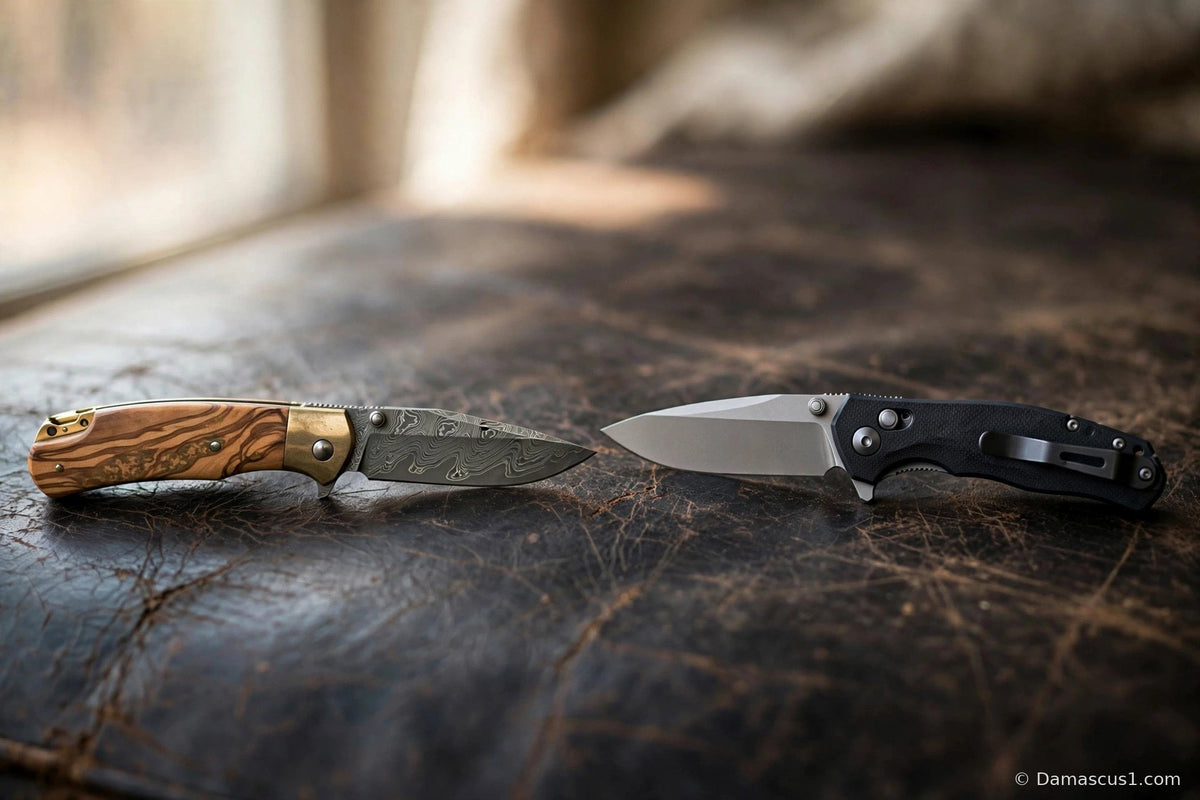
Back lock vs liner lock: what's the short answer?
A back lock and a liner lock hold an open folding blade using different mechanisms. Neither name establishes a universal strength or safety rating. A back lock uses a spring-loaded rocker engaging a notch in the blade tang; a liner lock moves a spring liner laterally against the tang. Opening features, release access, fit, condition and the maker's instructions matter as much as the category. Compare the exact knives you can buy, rather than treating one lock name as a guarantee.
Start with your actual cutting tasks and handling needs. Are you left-handed? Will you wear gloves? Can you safely set the work down before opening or closing the knife? Do you prefer sheath carry or a pocket clip? These questions help narrow a purchase, but none removes the need to keep hands away from the cutting edge and check that the blade is properly locked before use.
This is a retailer's buying guide, not a laboratory lock test or a claim to independent hands-on testing. The Damascus1 everyday carry collection contains multiple listings; check each model's stated lock and opening method. We have not verified one common mechanism for every folder in the catalogue. For the wider choice, compare size, materials, carry and package details in our pocket knife buying guide.
How does a back lock actually work?
 Editorial concept: metal parts beside a wood-handled folding blade; not a mechanism diagram. Compare current product photographs for the exact knife.
A back lock runs a solid steel lockbar along the spine of the handle, pivoting in the middle like a seesaw. When the blade swings fully open, the front end of that bar — the lock head — drops into a notch cut into the back of the blade tang, and a spring underneath holds it seated. To close the knife, you press down on the exposed rear section of the bar, the head lifts out of the notch, and the blade is free to fold.
The important distinction is where the locking parts meet, not a promise that a thicker-looking part cannot fail. Engagement geometry and manufacturing quality differ between models. A photograph showing a substantial spine or an audible click does not establish a load rating, and this guide has no comparable strength measurements for the Damascus1 models.
For closing, follow the instructions supplied with the exact knife and control the blade while keeping fingers clear of its folding path. Do not infer a safe technique from the lock name alone. Handle dimensions, release position, spring force and blade movement vary. If operation is unclear, request a model-specific demonstration before using the knife.
A closed-back handle can conceal part of the mechanism; an open-back design may make some areas easier to inspect. Neither layout makes contamination harmless. Inspect and maintain the actual knife according to its instructions.
How does a liner lock actually work?
 Editorial concept: exposed folding-knife hardware; not a verified liner-lock diagram. Compare current product photographs for the exact knife.
In a liner lock, a spring section of the handle liner moves sideways into position against the blade tang when the blade opens. Moving that liner away releases the blade. Release access and hand clearance depend on the individual handle. Some models support one-handed operation, but that is a model feature to confirm, not an instruction to improvise a closing motion.
Liner locks often appear on knives with studs, opening holes or flippers. Those opening features are separate from the lock itself. A buyer who needs one-handed access should compare the complete mechanism, grip and instructions rather than buying on the word 'liner' alone. A product demonstration should show the specific model being considered.
Which lock is stronger in real use?
There is no supported category-wide winner here. We have not tested these products on a shared rig, and there are no comparable model-specific load results in this guide. Choose a folding knife for suitable cutting tasks; do not use a lock comparison to justify prying, twisting, pounding or other abuse. Buck's published care guidance warns that impact and twisting can damage a knife and injure the user.
Strength figures need context: the precise model, condition, sample size, force direction, test method and failure definition. A single destructive video does not rate every example of a mechanism. Without that evidence, a table claiming that one lock tolerates rough use better would give a buyer more confidence than the facts support.
Do not assume a lock will provide gradual warning before failure. New blade play, incomplete engagement, sticking, unexpected movement or a change in operation warrants stopping use and contacting the seller or maker for assessment. Wear appearance alone cannot establish how much safe service remains.
Buy for the intended task and a clear support route. If a locking blade does not lock properly, stop using it. Do not perform home spine-whack or destructive tests, adjust lock faces, or try to wear a faulty lock into service.
Which lock is safer to close?
 Editorial concept: hands near an open folding knife; not a handling demonstration. Compare current product photographs for the exact knife.
Both mechanisms require attention during closing. A liner release is generally inside the handle, while a back-lock release is on the spine. That difference affects access, but does not make every back-lock close automatically fingers-clear or every liner lock unsafe. Keep all fingers outside the blade's folding path and use the maker's instructions for the model.
A demonstration should explain the release and blade control together, from a view where hand placement is visible. If you cannot keep a secure grip while keeping clear of the edge, stop and seek guidance. Wet hands, gloves, fatigue and distractions are reasons to pause and make the handling conditions suitable.
Opening and closing are separate questions. A back lock can have a one-hand opening feature, and a liner lock does not guarantee one. Check the actual opening hardware and instructions. Do not grip a sharpened edge or assume a technique shown on another model transfers to yours.
For a first knife or a gift, favour clear instructions and an appropriate user over an assumed easy mechanism. An unfamiliar recipient needs time and supervision appropriate to their circumstances. No knife should be presented as safe for untrained hands merely because its release seems simple.
Which lock opens faster — and does it matter?
Opening speed depends on the model's opening hardware, access and user control, not solely its lock. A thumb stud or opening hole may appear on different lock types. Confirm whether the exact knife is manual, assisted or automatic, and whether it is intended to open with one or two hands. Do not infer that specification from a collection heading.
For example, before ordering the olive wood folder, check its current listing and ask for confirmation of its opening method if that matters to your purchase. This guide does not verify two-handed opening for every Damascus1 folder.
If the job occupies your other hand, first consider whether you can secure the work and free both hands safely. Repeated package cutting may call for a dedicated workplace cutting tool and the employer's procedure. A fast-opening knife is not a substitute for a controlled work area.
For occasional home or gift use, the time needed to open a knife is usually less important than clear operation, comfortable control and suitable storage. Ask the seller to resolve any opening-method uncertainty before buying.
Which lock handles lint, dirt, and maintenance better?
 Editorial concept: brush and care supplies beside a folding knife. Compare current product photographs for the exact knife.
Dust, lint and residue deserve attention in either mechanism. Keep the blade, pivot and locking parts clean using the instructions and compatible materials specified for the model. Do not assume a spring will push through contamination or that hidden working parts are protected from grit.
Inspect the knife under good light before use. If debris prevents proper engagement, stop using the knife and seek suitable cleaning or service guidance. Do not scrape or modify engagement surfaces with improvised tools, force a sticky release, or treat a click as proof that contaminated parts have seated correctly.
After wet or dirty work, follow the model's cleaning, drying and lubrication guidance. Handle material and blade composition affect care choices. Our Damascus rust guide discusses care questions, but a blade pattern alone does not identify its alloy or corrosion resistance.
Screws versus pins are construction details to check separately from lock type. Visible screws do not automatically mean owner disassembly is approved. Before taking a knife apart or changing pivot tension, obtain the maker's instructions and understand the service and warranty consequences. Ask the seller for help with faults instead of altering lock geometry.
Which lock works better with cold, wet, or gloved hands?
There is no universal winner for gloved, wet or cold hands. Release size, texture, recess depth, handle grip and the glove itself vary. Do not operate a folding blade with numb hands or assume a broad release makes that safe. Pause the task until you can control the knife.
When gloves are part of normal work, ask whether the exact model is suitable and whether you can inspect a demonstration with comparable gloves. Check access without letting a glove enter the blade path. If the release requires an insecure grip, choose a more suitable tool or change the task setup.
Water, cold and movement can complicate handling regardless of mechanism. A boat, ladder or unstable work position is not the place to learn an unfamiliar release. Secure the work and use a safe position first. Marketing claims about outdoor character do not establish glove performance.
Which lock is better if you're left-handed?
A spine-mounted back-lock release can be accessible from either side. Many liner locks are oriented toward one hand, while individual designs vary. The useful purchase question is whether this exact knife's opening feature, release and carry arrangement work safely for your dominant hand.
For a left-handed buyer, request a left-hand demonstration or the maker's written guidance. Check clip position and sheath access as well as the lock. A centered release does not guarantee that the entire knife requires no grip adjustment. Avoid relying on reviews that demonstrate only right-handed handling.
Which lock lasts longer — and what does each cost to make?
Service life cannot be predicted from the lock name. Use, maintenance, materials, fit and damage all matter. This store does not have comparable longevity testing for the products linked here, and a claimed number of years would not be evidence of an individual knife's condition.
Do not dismiss blade play as patina or keep using a lock because movement appeared slowly. A change in operation calls for assessment. Keep order details and condition photographs so the seller can identify the model and advise the next step; do not attempt a home lock repair.
Price is also a model-level comparison. Handle material, finish, accessories, production and support can affect the offer. Check current product prices rather than assuming all 6.5-inch listings share one price, and compare confirmed package contents rather than attributing a price to an unverified manufacturing-cost explanation.
Back lock vs liner lock: what should you compare?
Use this table to prepare questions for the exact models on your shortlist. It describes mechanisms and purchase checks; it is not a strength ranking, safety certification or hands-on test result.
| Check | Back lock | Liner lock | Before buying |
|---|---|---|---|
| Mechanism | Spine rocker engages a tang notch | Spring liner moves against the tang | Confirm the exact model's lock |
| Opening | Separate from lock type | Separate from lock type | Verify opening hardware and instructions |
| Release | On the handle spine | Inside the handle | Check access and blade-path clearance |
| Strength | No universal rating | No universal rating | Seek comparable model-specific evidence |
| Contamination | Inspect and maintain | Inspect and maintain | Do not use with incomplete engagement |
| Gloves or left hand | Depends on complete design | Depends on complete design | Request a suitable model demonstration |
| Service | Construction varies | Construction varies | Check maker-approved care and repair |
How should you compare Damascus1 folders?
 Editorial concept: patterned folders and leather sheaths on a wood surface. Compare current product photographs for the exact knife.
Start with an exact listing and confirmed specifications. The pocket knife set comparison brings current model links together and identifies information that still needs confirmation. Choose a handle appearance you like, then check dimensions, opening method, lock, included accessories and care requirements for that model.
Natural handle appearance does not establish strength, ergonomics or mechanism quality. Review real product photographs and model-specific customer feedback. A general brand review, an illustration or feedback for a different model cannot establish how the knife you are ordering handles.
The links below are a starting shortlist, not certification that every specification or accessory is shared across the range. Read each current product page before ordering:
- Olive wood pocket knife: compare current photographs, dimensions and the stated package.
- Buffalo horn pocket knife: check this model's listing rather than assuming the olive model's details apply.
- Camel bone pocket knife: confirm availability and any specification absent from the page.
- Rose wood pocket knife: compare its current materials and accessory information.
- Scrimshaw pocket knife: check the separate model's dimensions and exact artwork rather than treating it as the same platform.
If a lock type, opening method, closed length or accessory is absent from a listing, ask for confirmation with the product URL. Do not use a neighbouring model's description to fill the gap. An answer tied to the exact model is more useful than a catalogue-wide claim.
So who should choose which lock?
Choose by the complete knife and your intended cutting task. A spine release may appeal to one buyer, while another prefers a liner release. Neither preference establishes permission for rough use or guarantees a safe closing routine. Seek clear instructions, comfortable control and a seller who can answer model-specific questions.
For a shared or gift knife, ask who will use it, whether they are familiar with folding knives and how it will be stored. Include the actual instructions with the handover. Do not assume a short explanation makes an unfamiliar blade appropriate for everyone.
For regular work, prioritise the tasks you actually repeat and the conditions in which you can use the knife safely. Compare practical fit and support rather than dramatic lock-abuse demonstrations. If a folding knife is not suitable for the task, select an appropriate tool.
Build a shortlist: compare the ram horn folder, stag horn folder and black-and-white bone folder, then ask about any missing model details. Check the shipping policy and refund policy before ordering, especially for a dated gift or engraving request.
Frequently asked questions about back locks and liner locks
Is a back lock stronger than a liner lock?
No category-wide strength result is established here. Strength depends on the exact design, fit, condition and test method. We have no comparable model-specific lock tests for these listings. Do not pry, twist or impact a folding knife to test it.
Is a liner lock safe to close with one hand?
Some liner-lock models are designed for one-handed operation. Follow the exact model's instructions and keep fingers clear of the blade path. If the motion is unfamiliar or your grip is insecure, stop and obtain guidance rather than improvising.
Can you open a back lock knife with one hand?
Some back-lock knives have one-handed opening features; others do not. The lock type alone does not answer this. Confirm the opening method on the exact product listing or ask the seller before purchase.
Which lock is better for left-handed users?
A centered back-lock release may be accessible to either hand, but opening hardware, handle shape and carry arrangement also matter. Check the complete model and request a left-handed demonstration where necessary.
Do back locks develop blade play over time?
Blade play can occur, but it should not be dismissed as harmless wear. Stop using a knife with new play, unreliable engagement or changed operation and contact the seller or maker. Do not assume failure will always provide advance warning.
Which lock is easier to keep clean?
Cleanability depends on the individual construction and instructions. Keep locking parts free of contamination on either type. Debris and incomplete engagement require attention; neither lock should be treated as lint-proof.
Before you order: delivery, returns and evidence
Shipping estimates depend on item availability and the shipping option selected, according to the current shipping policy. Do not assume a fixed delivery date from this guide. The refund policy accepts eligible unused returns within 30 days of purchase, with original condition, tags, packaging and proof of purchase; shipping fees are non-refundable. Read the full policies linked above and clarify engraving or other special-order questions before paying.
Editorial images on this page illustrate the subject. They are not mechanism diagrams, lock-test evidence or a substitute for photographs of the exact product offered. Confirm visible hardware against the current listing and seller's instructions.
Sources and scope
Mechanism descriptions were checked against Spyderco's official locking-mechanism reference. Safe-use and maintenance principles were checked against Buck's official knife-care guidance on October 16, 2026. These references explain mechanisms and general care; they are not tests, endorsements or specifications for Damascus1 products. Follow the instructions supplied for your exact knife.
laissez un commentaire: