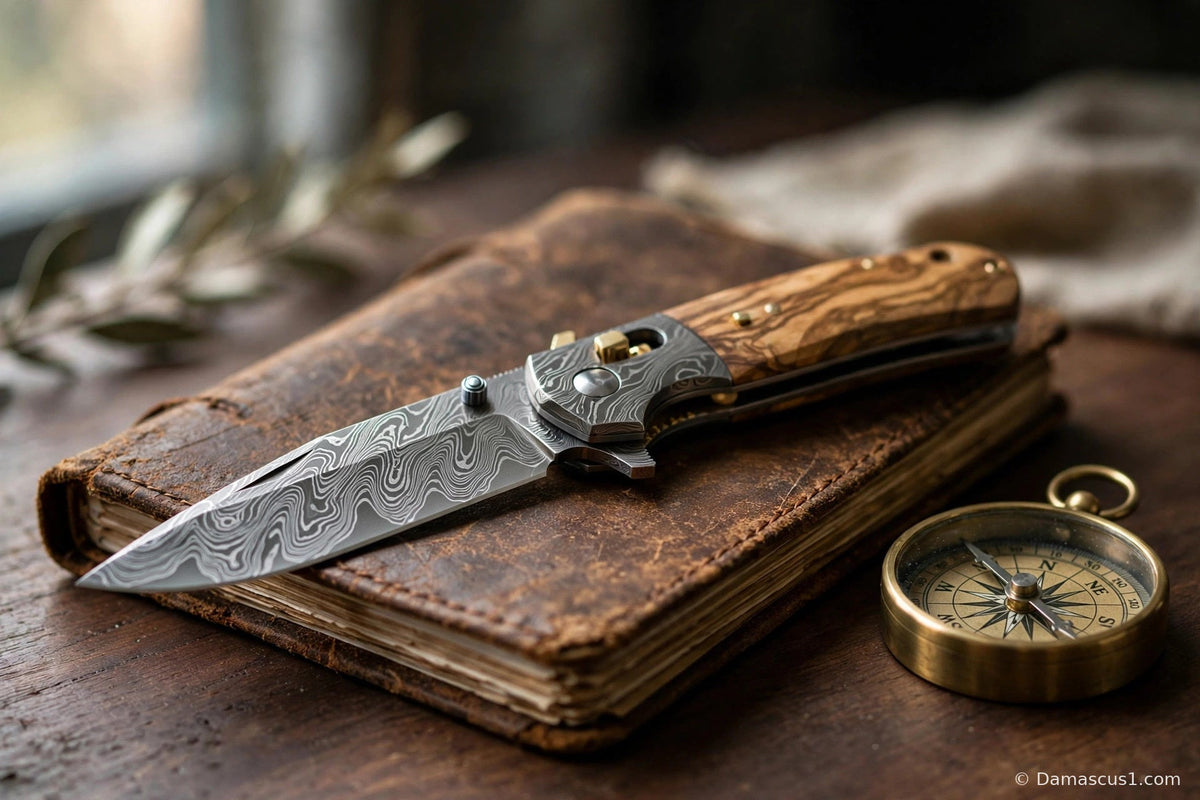
Direct answer: The best pocket knife for most people is a mid-size folding knife you will actually carry every day: comfortable in a front pocket, easy to open, and priced so you use it without ceremony. At Damascus1 today, the handmade winner under $70 is a 6.5-inch Damascus folder at $39.99 — the Olive Wood Pocket Knife for a classic look, or the Buffalo Horn or Camel Bone versions at the same price — with the Deer Antler Horn folder at $49.99 if grip matters most and the 7.6-inch scrimshaw pair at $59 if you want the statement size. One honest warning before anything else: the same collection also sells 420C stainless folders, so check the blade-material line on the exact knife you buy.
That is the short version. The longer version matters, because "best pocket knife" is one of the most crowded, most gamed phrases in the entire knife world. Type it into a search engine and you will meet laboratory roundups that weigh twenty knives to the gram, affiliate lists that crown a different winner every month, and product pages dressed up as advice. This guide takes a different route. It compares pocket knife styles by design and by the jobs they are actually good at — traditional folders, modern tactical knives, gentleman's folders, work knives, multi-tools, and the handmade Damascus folders this store sells — and it is upfront about the method: these styles are compared on construction, carry, and intended use, not on claimed hands-on testing. Nobody here pretends to have spent a month cutting rope with twelve knives. What follows is buying logic, verified prices, and the checks that keep you from paying for the wrong knife. Start by browsing the everyday EDC pocket knives collection alongside it, because that is where the handmade picks below actually live.
What is the best pocket knife for most people?
For most people, the best pocket knife is a single-blade folding knife in the mid-size class: small enough to disappear in a pocket, large enough to open packages, cut cord, slice food on the go, and handle the hundred small jobs of an ordinary week. It should open without a fight, lock or hold securely by design, and cost little enough that losing it would sting, not ruin your month. Everything else — steel fashion, handle drama, opening mechanisms — is preference layered on top of that foundation.
Why does the mid-size folder keep winning this argument, decade after decade? Because pocket knives are carried far more often than they are used hard. The knife that is in your pocket on Tuesday afternoon when the delivery box, the loose thread, the apple, and the zip tie all show up is worth more than the technically superior knife sitting in a drawer because it was too big, too heavy, or too precious to carry. Carry is the spec nobody can photograph, and it decides real-world usefulness more than any steel chart.
So judge every candidate in this guide by a simple order of operations. First, will you carry it daily without thinking about it? Second, does it suit the jobs you actually do — office and errands, workshop and yard, field and camp, or some mix? Third, do you like it enough that owning it is a small pleasure rather than a neutral fact? That third question sounds soft. It is not. A knife you like gets maintained, sharpened, and kept for years. A knife you are indifferent to gets lost in a junk drawer, and a lost knife has an edge retention of exactly zero.
Damascus1's range is built squarely on this logic: traditional folding pocket knives with natural handles and layered-steel blades, sized at 6.5 inches overall for daily carry and 7.6 inches for the larger statement models, priced from $39.99 to $59. They are not tactical knives and do not pretend to be. The sections below place them honestly against the other styles you will meet while shopping, so you can see exactly where a handmade traditional folder wins, where it draws, and where a different style is simply the right tool.
Traditional folder, tactical knife, or multi-tool: which pocket knife style fits you?

A traditional folding pocket knife fits you if your daily jobs are cutting, slicing, and opening things and you value a knife that looks like a keepsake rather than equipment. A modern tactical folder fits hard, gloved, one-handed work. A multi-tool fits people whose day involves screws, pliers, and improvisation as much as cutting. Most buyers honestly need the traditional folder, because most pocket-knife work is cutting — and a beautiful blade you enjoy carrying gets carried.
Walk the styles one at a time, because each exists for a reason. The traditional folder — the pattern this guide's picks follow — is the oldest pocket knife idea there is: a folding blade, often a slipjoint or simple lock, a handle of wood, bone, horn, or antler, and proportions meant for a pocket rather than a belt. Its strengths are comfort, looks, giftability, and a blade shape made for slicing. Its limits are equally real: opening is usually a two-handed, unhurried affair, and it is not built for prying, batoning, or gloved emergency work.
The modern tactical folder is the opposite philosophy: one-handed opening studs or flippers, pocket clips, synthetic handles, locking mechanisms engineered for speed. If you work in gloves, on ladders, or anywhere one hand is always busy holding something, that design language earns its keep. The trade-offs are a colder, more industrial look, a higher chance of raising eyebrows when you open it in polite company, and — at the budget end — a lot of anonymous black knives that feel identical because they nearly are.
The gentleman's folder is a slimmed, dressed-up cousin of the traditional knife: thinner, lighter, made to ride in a suit or dress-trouser pocket without printing through the fabric. The work or utility folder goes the other way — tougher, cheaper, often partially serrated, bought to be abused on job sites and replaced without grief. The multi-tool is not really a knife at all; it is a toolbox that happens to include a blade, and its blade is usually the weakest part of it. Buy one when your day genuinely involves pliers and drivers. Do not buy one as your main knife and then wonder why cutting feels like a compromise.
And the handmade Damascus folder — Damascus1's style — is best understood as a traditional folder with two upgrades: a layered-steel blade whose pattern makes every single knife visually unique, and natural handle materials with the same one-of-one character. It inherits the traditional folder's strengths and limits whole. What it adds is presence: it is the knife people ask about, the knife that works as a gift, the knife that turns a mundane Tuesday cut into a small moment of satisfaction. If that sentence sounds like marketing to you, buy the plain work knife instead and be happy. If it sounds like exactly why you are still reading, keep going.
How big should a pocket knife be?
A pocket knife should be big enough to fill your hand and do real cutting, and small enough that you forget it is in your pocket — for most adults, that means the class Damascus1's folders sit in: around 6.5 inches overall when open for everyday carry, stepping up to about 7.6 inches if you have larger hands, deeper pockets, or you simply want more blade and more presence. Always check whether a listed size is overall length or blade length, because sellers mix the two freely.
Size is where online knife shopping goes wrong most often, because a number with no convention behind it is just a number. One seller's "6.5-inch knife" is 6.5 inches overall, open, tip to tail. Another's is a 6.5-inch blade on an eleven-inch knife that will never ride comfortably in a jeans pocket. Damascus1's own Olive Wood product page handles this the honest way: it describes a 6.5-inch model and advises asking for the blade and closed measurements if fit matters to you. Take that advice literally, with every seller. The closed length is the one your pocket feels; the blade length is the one your cutting feels; the overall length is mostly useful for comparing knives within one store's own range.
Weight follows size, but handle material bends the rule. Dense buffalo horn feels more substantial than pale camel bone at the same dimensions; antler sits somewhere in between, with texture your fingers notice more than weight your pocket does. None of Damascus1's folders are heavy in any punishing sense — these are traditional folders, not folding pry bars — but if you wear light trousers or carry in a shirt pocket, the 6.5-inch wood-handled models are the natural pick, and the 7.6-inch scrimshaw pair belongs in jeans, jackets, and bags.
Hand size is the last variable, and the most personal. A knife handle should let your fingers wrap without crowding and without a gap you have to grip across. Small hands on a big handle lose control; big hands on a small handle lose it faster. If you are buying as a gift and cannot measure the recipient's hand, the 6.5-inch class is the safe middle of the road — it is the size this category settled on over generations precisely because it fits almost everybody.
The Damascus1 pocket knife shortlist, compared honestly

Every price below was verified on the live Damascus1 site on October 16, 2026. Prices and compare-at figures can change; the product page on the day you order is the final word. And the caveat from the top of this guide applies to every row: read the blade-material line on the individual product page. The Damascus models below are the Damascus picks — the wider EDC collection also includes 420C stainless folders such as a Rose Wood model at $39.99 and a Blue Bolster at $34.99, which are legitimate budget knives but are not Damascus and are not in this table.
| Pick | Best for | Size | Handle | Price (verified Oct 16, 2026) |
|---|---|---|---|---|
| Olive Wood Damascus Pocket Knife | Best all-round pocket knife and safest gift pick | 6.5" | Olive wood | $39.99 (was $89.99) |
| Buffalo Horn Damascus Pocket Knife | Best for a dark, dense, dramatic everyday carry | 6.5" | Buffalo horn | $39.99 (was $99.99) |
| Camel Bone 6.5" Pocket Knife | Best for the classic pale-bone traditional look | 6.5" | Camel bone | $39.99 |
| Blue Wood Damascus Pocket Knife | Best for colour — deep blue wood, modern palette | 6.5" class | Blue wood | $39.99 (was $99.99) |
| Green Wood / Multi Wood Damascus Pocket Knives | Best for the uncommon handle nobody else carries | 6.5" class | Green wood / multi wood | $39.99 |
| Deer Antler Horn Folding Pocket Knife | Best grip — textured natural antler for wet or cold hands | 6.5" class | Deer antler horn | $49.99 (was $139.99) |
| Deer Antler Scrimshaw Pocket Knife | Best larger statement knife — etched heritage detail | 7.6" | Deer antler, scrimshaw | $59 (was $119.99) |
| Blue Wood Scrimshaw Pocket Knife | Best large gift — scrimshaw detail in a modern colour | 7.6" | Blue wood, scrimshaw | $59 (was $99.99) |
Product cards — priced, linked, and framed by the job
Best all-rounder — Olive Wood Damascus Pocket Knife, 6.5" — $39.99 (was $89.99). The neutral, classic choice: warm wood grain, a size that fits nearly every hand and pocket, and the safest gift in the line when you do not know the recipient's taste perfectly. Its product page offers an engraving design quote for a name, initials, or short message up to 25 characters, with the design confirmed before any custom order is made. View the Olive Wood pocket knife.
Best dark carry — Buffalo Horn Damascus Pocket Knife, 6.5" — $39.99 (was $99.99). Dense, polished, near-black horn with natural movement no two pieces share. The pick for someone whose everyday carry runs dark and understated. View the Buffalo Horn pocket knife.
Best traditional look — Camel Bone 6.5" Pocket Knife — $39.99. The pale, classic handle that has signalled "pocket knife" for generations, paired with a patterned blade. The Camel Bone product page states its own construction details — read them there, where they belong, before you order. View the Camel Bone pocket knife.
Best grip — Deer Antler Horn Folding Pocket Knife — $49.99 (was $139.99). Antler's natural ridging gives a wet, cold, or gloved hand something real to hold. The working pick of the line, and the one to choose if this knife will live outdoors as much as in town. Find it in the EDC pocket knives collection.
Best colour — Blue Wood, Green Wood, and Multi Wood Damascus folders — $39.99 each. Same 6.5-inch class, three personalities: deep blue for a modern palette, green for the uncommon choice, multi wood for grain that refuses to repeat. Blue Wood was $99.99 before its current price. All three sit in the everyday EDC collection.
Best statement size — the 7.6" scrimshaw pair — $59 each. Deer Antler Scrimshaw (was $119.99) for etched heritage detail; Blue Wood Scrimshaw (was $99.99) for the same hand-detailed work in a cleaner modern colour. Both add size plus scrimshaw etching that pushes the knife from tool toward keepsake — the milestone-gift tier of this line.
A shipping note that affects pairing: the site currently shows free shipping & returns above $50. A single $39.99 or $49.99 knife sits just under that line; either $59 scrimshaw model clears it on its own, as do any two folders together. Confirm the offer at checkout, because offers change.
Which handle material is best for a pocket knife?
Deer antler is the best pocket knife handle for grip, because its natural ridging gives fingers — wet, cold, or gloved — real texture to hold. Wood handles such as olive, blue, green, and multi wood are the comfortable classics: warm, handsome, and smoother, so they reward a deliberate grip. Buffalo horn is dense and polished with a substantial feel, and camel bone is the smooth, pale traditionalist. There is no fragile option here; there are only different hands and different weather.
Handles deserve more thought than blades when you shop from photographs, because a photo shows colour and grain beautifully and tells you nothing about friction. Reason it through from the material itself. Antler's surface is genuinely irregular — that is anatomy, not styling — and irregularity is grip. That is why antler costs a little more in this line: $49.99 against $39.99 for the wood, horn, and bone models, with the scrimshaw antler model at $59 adding hand-etched detail on top.
Wood is the handle most people picture, and olive wood earns its place as the default: fine grain, warm colour, comfortable in a dry hand all day. The dyed woods — blue and green — trade a degree of classic restraint for individuality, and multi wood layers tones so no two handles read exactly alike. All wood handles share two habits: they get slicker when wet than antler does, and they prefer to be dried after a wet day rather than sealed damp into a pocket or bag. Bone sits at the traditional extreme: smooth, pale, dense, the handle of the knife your grandfather would recognise. Horn is the connoisseur's middle path — dark, deep, polished, with a heft that makes a 6.5-inch folder feel serious.
None of these materials wants much from you. Keep them out of prolonged soaking, dry them after wet use, and do not store them damp. A wood handle that looks pale after a hard season can be refreshed with a trace of oil on a cloth. That is the whole routine — the same respect you give a leather boot, and for the same reason: natural materials last for decades when they are dried, and deteriorate quietly when they are not.
Is Damascus steel good for a pocket knife?

Yes — Damascus steel is good for a pocket knife when the construction is genuinely layered and the owner keeps a simple care routine. A layered blade takes a keen, slicey edge suited to daily cutting, the pattern makes your knife unmistakably yours, and the maintenance — wash, dry, a light touch of oil — takes minutes. It is a poorer match for owners who will never dry a blade or touch up an edge; for them, plain stainless is the more honest tool, and there is no shame in choosing it.
Steel honesty matters in this category because pocket knife listings abuse specifications like almost no other product on the internet. Layer counts, hardness numbers, and exotic steel pairings are printed everywhere and verified almost nowhere. This guide deliberately assigns no layer count, hardness figure, or steel pairing to the individual Damascus1 folders above, because those figures were not verified per product at the time of writing. That is discipline, not a gap in the knives. Where a product page does state its construction — the Camel Bone page is the example in this line — read it there. And apply the same scepticism, doubled, to any listing anywhere that prints heroic numbers with no way to check them.
The pattern itself deserves one clear paragraph, because it is the reason most people are on this page. Real Damascus is layered steel: contrasting layers folded and forged together, then etched so the layers read as flowing lines across the blade. The result is functional and decorative at once — and it is also the most imitated look in the knife business, printed or laser-etched onto plain blades and sold at layered-steel prices. Before you buy any Damascus knife from anyone, run the five checks in how to spot a fake Damascus knife. Five minutes of reading protects the entire purchase.
What can be said generally, without inventing specifications: traditional Damascus pocket knives are commonly built from carbon-leaning layered steels, which is why the care advice for them leans toward the carbon routine — prompt drying and light oil, especially before storage. Stainless constructions forgive more neglect. Your knife's own product page tells you which family you own, and your routine should follow the page, not the category label. If the page says 420C stainless — as some folders in this very collection do — then you own a stainless knife, maintain it as one, and enjoy it for what it is.
How much should a good pocket knife cost?
A good pocket knife costs less than most people expect: at Damascus1's verified pricing, a handmade Damascus folder is $39.99 for the 6.5-inch wood, horn, and bone models, $49.99 for the deer antler folder, and $59 for the 7.6-inch scrimshaw pair. Across the wider market, honest working folders from big brands cluster in a similar band without layered steel or natural handles, while bespoke knives from individual makers run far higher. Below the honest band, check the blade-material line twice — that is where imitations concentrate.
Translate price into use and the tiers explain themselves. The $39.99 tier is the sweet spot of this entire guide: a real, carryable, handmade Damascus knife priced low enough to use without ceremony, which is a genuine virtue in an everyday tool. A knife you are afraid to use is furniture. The $49.99 antler folder buys the best grip in the line — the functional upgrade. The $59 scrimshaw pair buys size plus hand-detailed etching — the keepsake upgrade, and the tier to choose for a milestone gift or a once-in-a-decade treat for yourself.
What are you not paying for at these prices? A maker's famous name, limited-edition scarcity, or exotic modern super-steels with their own followings and price tags. If those things are what you collect, this is not your store, and a good guide should say so plainly. What you are paying for is layered steel, natural handle material, hand-finished character, and a knife that is one of one in the ways that show. Set against the mass-produced alternatives at the same money — moulded synthetic handles and plain blades rolling off a line by the thousand — the value argument is not subtle.
One more pricing habit worth stealing: distrust the gap, not the price. A $39.99 knife honestly listed as $39.99 is a better sign than a $39.99 knife "reduced" from a fantasy figure nobody ever paid. Damascus1's compare-at prices are printed on its own pages — $89.99 to $139.99 across this line — and this guide repeats them because they were verified there today, not because a discount percentage should make your decision. Buy the knife, not the markdown.
What should you check before buying a pocket knife?

Before buying any pocket knife, check five things on the product page: the stated blade material for that exact knife, the size — and whether the figure is overall length, blade length, or closed length — the handle material, what is included, since sets and accessories vary by model, and the current price. Then check your local carry rules from an official source. If the blade-material line is missing or vague on any listing, anywhere, ask the seller before you pay — silence about steel is the loudest warning in this category.
That checklist catches nearly every disappointment in pocket knives. Size confusion is the quiet giant among them, covered above: a 6.5-inch overall folder and a knife with a 6.5-inch blade are different objects living different lives. Damascus1's Olive Wood page models the right behaviour — it describes its 6.5-inch model and invites you to ask for blade and closed measurements if fit matters, and it offers an engraving design quote up to 25 characters, confirmed before a custom order, rather than taking personalisation money on a promise. Sellers who write sentences like that are telling you how to buy from them successfully. Listen to them, here and everywhere.
Included contents are the second trap. Two handle variants of what looks like the same knife can ship with different sets — sheath, box, accessories — and the difference only matters on the day the box opens, which is exactly when it is too late to fix cheaply. If you are buying as a gift, confirm the exact set contents on the product page before ordering. If anything is unclear, ask first. A thirty-second question is the cheapest accessory in this entire category.
Finally, buy for the life you live in the next twelve months, not the expedition you daydream about. The camper who also commutes needs the 6.5-inch all-rounder. The outdoorsman needs antler's grip. The collector needs the scrimshaw. The office worker who opens boxes and mail needs the knife that will not alarm the room — which, happily, is any of the traditional folders here, because a wood-handled Damascus knife reads as craftsmanship, not weaponry, in a way a black tactical folder simply does not. Match the knife to the real week and it will be carried, maintained, and trusted. Match it to a fantasy and it will live in a drawer.
How do you care for and sharpen a Damascus pocket knife?
Care for a Damascus pocket knife with a rhythm, not a project: wipe the blade after use, wash it with warm water and a little soap when it gets genuinely dirty, dry it completely — opening a folder so the pivot can dry — and add a thin film of oil if the blade is carbon-leaning or heading into storage. Sharpen little and often on a whetstone at the angle the edge was ground with, keeping abrasives on the bevel rather than the patterned flats. Stored dry, a Damascus folder asks for minutes a month.
Sharpening is the part new owners fear most, and it is mostly fear of damaging the pattern. The pattern is safe if you work the edge, not the flat: a whetstone rides the bevel, the etched sides stay untouched, and the flowing lines survive years of honest maintenance. The full pattern-safe technique — grit choice, angle control, stropping — is in how to sharpen a Damascus knife, and it applies to these folders exactly as it does to kitchen blades. Touch up early and lightly, and you will never face the heroic regrind that actually does risk the finish.
Rust is the other fear, and it deserves a straight answer: carbon-leaning layered steel can rust if it is left wet, and almost never does if it is dried. The damage story is nearly always a storage story — a damp knife sealed in a sheath, a wet pocket, a car console for a fortnight — rather than a use story. The full picture, including what early spotting looks like and how to respond, is in can Damascus steel rust?. Leather sheaths, where a model includes one, are for carry and protection in transit; long-term home storage belongs in a dry drawer or roll, with the sheath alongside rather than sealed around the blade.
Folders add one moving part to the routine: the pivot. Pocket lint, grit, and field residue collect there, so work the action open and closed a few times as the knife dries, and check the lock or joint while you are at it. Two minutes, a few times a year. Do that, and a traditional folder outlives trends, outlives its box, and usually outlives the jeans it rides in.
Are pocket knives legal to carry?
Pocket knife legality depends entirely on where you are: laws on blade length, opening mechanism, and carry method vary by country, state, city, and even by setting such as schools, government buildings, and public transport, and they change over time. This guide offers no legal advice. Before carrying any knife somewhere new, check the current rules from an official local source — a government or law-enforcement publication, not a forum summary. A confiscated knife is the most expensive outcome in this category, and it is entirely avoidable.
That paragraph is deliberately unglamorous, because the glamorous version would be a table of state-by-state rules that starts going stale the day it is published. What can be said safely and generally: traditional folding pocket knives of modest size are the most widely accepted carry format in most places that permit knife carry at all, which is one more quiet argument for the style this guide recommends. Automatic and assisted-opening mechanisms attract the most legal variation; a simple two-handed traditional folder attracts the least. But "generally" is not a permission slip — your jurisdiction's official rules are the only answer that counts, checked before you carry, not after you are asked about it.
Is a handmade pocket knife a good gift?

Yes — a handmade pocket knife is one of the strongest gifts in its price class, because it is useful daily, visibly personal, and priced at $39.99 to $59 rather than at keepsake money. A layered blade and a natural handle mean the recipient's knife is genuinely one of one, the 7.6-inch scrimshaw pair at $59 is the milestone tier, and personalisation is available carefully: the Olive Wood page offers an engraving design quote for a name, initials, or short message up to 25 characters, confirmed before any custom order. Confirm the exact set contents before ordering for a gift.
The gift logic runs deeper than the object. Most men — and most knife people of any description — already own everything they would buy for themselves under sixty dollars. What they do not own is a handmade knife with a blade pattern that exists on no other knife on earth, in a handle material with the same claim. That is the rare sub-$70 gift that does not feel like a compromise or a placeholder. It also carries well across occasions: birthdays, graduations, groomsmen, retirements, and the holidays all take a pocket knife gracefully, because a good tool never announces which holiday it was for.
Choose the handle by the person, not by your own taste. Olive wood for the classicist. Antler for the outdoorsman. Camel bone for the traditionalist. Blue wood for the one whose taste runs modern. Scrimshaw for the milestone — the promotion, the wedding, the retirement — where the knife is meant to be kept and shown, not just used. And if the knife will also work outdoors for its owner, our best Damascus hunting knife guide compares these same folders as field and camp knives, while the dedicated best Damascus pocket knife guide goes deeper on this line as pure everyday carry.
Frequently asked questions
What is the best pocket knife under $50?
The 6.5-inch Damascus folders at $39.99 — Olive Wood, Buffalo Horn, Camel Bone, Blue Wood, Green Wood, and Multi Wood — are the strongest under-$50 picks in this guide, with the Deer Antler Horn folder at $49.99 as the grip upgrade that still fits the budget. All prices verified on the live Damascus1 site on October 16, 2026. Whichever you choose, confirm the blade-material line on its product page.
What is the best pocket knife under $70?
Every pick in this guide qualifies, including the top tier: the 7.6-inch Deer Antler Scrimshaw and Blue Wood Scrimshaw folders at $59 are the best under-$70 choices when you want maximum presence and hand-detailed work. Under $70 is exactly the band where handmade Damascus beats mass-produced alternatives on character, because the whole Damascus1 folder line lives between $39.99 and $59.
Is a Damascus pocket knife good for everyday carry?
Yes, for the everyday carry most people actually live: opening, slicing, cord, food on the go, and light utility, in a size that rides unnoticed in a pocket. Traditional Damascus folders open two-handed and are not built for prying or heavy abuse, so heavy-duty job-site work belongs to a work knife. For ordinary daily life, the Damascus folder is not a compromise — it is the classic format with a better blade story.
How do I know if a Damascus pocket knife is real?
Check that the pattern flows continuously over the blade's edges and spine rather than stopping like a printed surface, that it varies subtly rather than repeating identically, and that the seller states the blade material plainly for that exact knife. Run all five checks in the fake-spotting guide linked in this post before buying from anyone. A seller who will not name the steel has answered your question already.
What size pocket knife is legal to carry?
There is no single answer: legal blade lengths and carry rules vary by jurisdiction and setting, and they change. Traditional modest-size folders are the most widely accepted format in most places that permit carry, but that general pattern is not legal advice and not a guarantee. Check the current official rules for your exact location before carrying — and check again when you travel.
Does a Damascus pocket knife need special care?
Only a little, and it is routine rather than special: wash when dirty, dry completely including the pivot, oil lightly if the blade is carbon-leaning or going into storage, and store it dry outside a sealed sheath. Sharpen on a whetstone at the original bevel angle, little and often. Minutes a month, no specialist products required — and stainless folders in the same collection need even less.
The bottom line: which pocket knife should you buy?
Buy the knife that matches your real week: a 6.5-inch Damascus folder at $39.99 for the classic all-rounder you will carry daily, the Deer Antler Horn folder at $49.99 when grip and outdoor work matter, or the 7.6-inch scrimshaw pair at $59 when the knife is also a keepsake or a milestone gift. Read the blade-material line on the exact knife you choose — remember that this collection also holds 420C stainless folders at $34.99–$39.99, fine knives that are simply not Damascus — confirm the size convention and the set contents, and keep the wash-dry-oil rhythm. Do that, and the best pocket knife stops being a search term and becomes the thing in your pocket.
Ready to choose yours? Browse the Damascus1 everyday EDC pocket knives collection, pick the handle your hand will trust, and order the handmade folder that will actually be in your pocket tomorrow.
Prices verified against the live damascus1.com collection and product pages on 2026-10-16 and subject to change. DRAFT — not yet published.
laissez un commentaire: