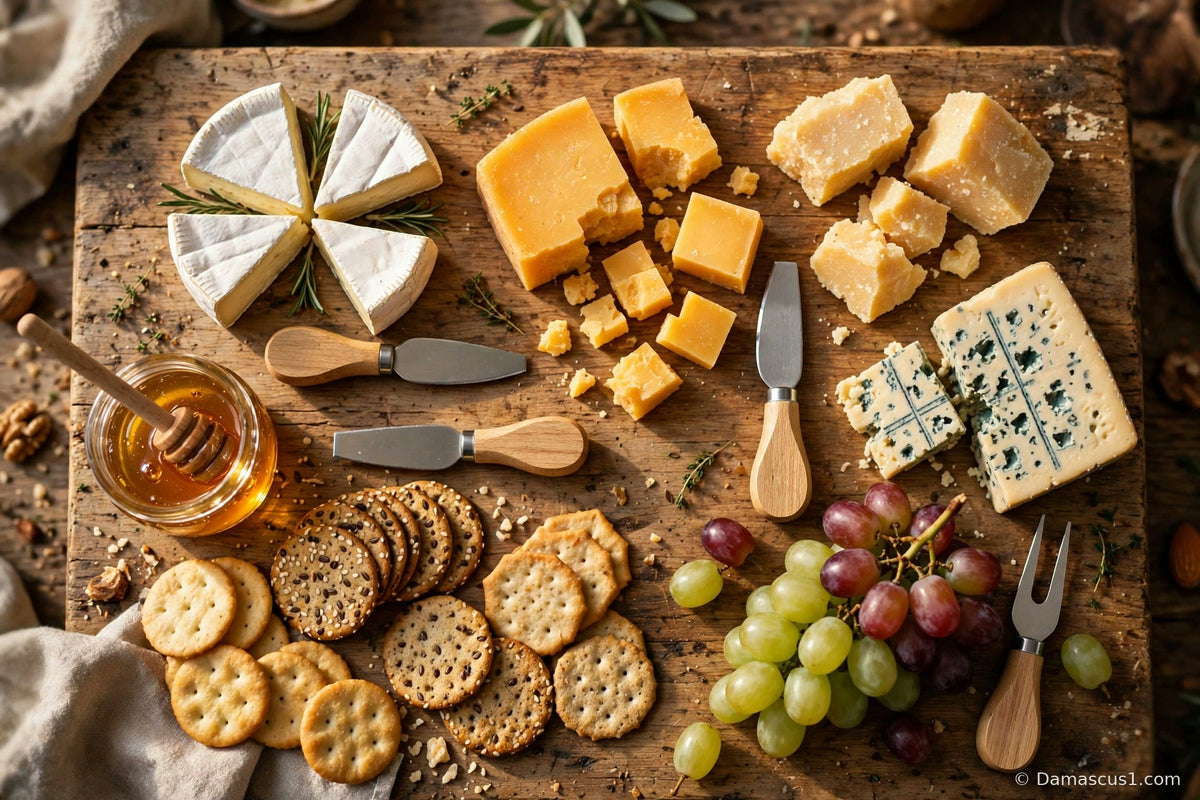
Most cheese boards fail in the same quiet way. The cheese is good. The board looks fine. Then someone drags a thick dinner knife through the brie, the centre collapses, half the slice stays welded to the blade, and the Parmesan — attacked with the same knife — either will not cut at all or shatters into dust and two sad shards. The problem was never the cheese. It was one blade asked to do four different jobs.
This guide fixes that by cheese, not by brand hype. You will get the blade shape each cheese actually wants, the specialist picks the current roundups favour, a straight answer on sets versus a single knife, and the honest limits of the ordinary kitchen knives already in your block — including ours.
The honesty part, up front. Damascus1 does not sell a dedicated cheese knife or a cheese knife set — there is no such SKU verified in our store today, and we are not going to dress a chef knife up as one. Where a Damascus1 knife genuinely helps at the board, we will say exactly how, with its real price. Where a specialist cheese knife is simply the right tool, we will say that too, and name the ones the roundups pick. A guide that will not tell you that is not a guide. It is a catalogue wearing a guide's coat.
What is the best cheese knife?
The best cheese knife is the one shaped for the cheese in front of you: a thin, perforated or etched blade for soft brie and camembert so the paste releases instead of sticking, a short stout point for breaking Parmesan, a narrow blade for semi-hard Gouda and cheddar, and a fork tip for serving what you cut.
That sounds like a dodge. It is not. Cheese is not one food. It is a family of foods that happen to share a dairy aisle — a ripe brie behaves more like butter than it behaves like a two-year-old Parmesan, and a blade that flatters one will mangle the other. Every serious roundup lands in the same place for the same reason: Kitchenist names the Wüsthof Gourmet 4.5-inch etched cheese knife its best overall, precisely because the etched blade sheds soft cheese while staying sturdy enough for firmer wedges. The Bridal Box's expert-quoted roundup splits its praise — a Boska Copenhagen Mini for effortless soft-cheese work, a Prodyne CK-300 as the multi-use versatile pick. BestReviews.guide aggregates toward sets: a Wüsthof Classic four-piece charcuterie set, a Cutco Traditional, a Boska Cheesemongers Parmesan set for the hard end of the board.
Notice what none of them does. None of them says "buy this one knife and you are done with every cheese forever" — because that knife does not exist. What does exist is a small, learnable system: four blade shapes cover essentially every cheese you will ever put on a board. Learn the shapes once and you will never squash a brie again, whoever made the knife in your hand. If you are building the rest of your knife kit at the same time, our guide to the best kitchen knives covers the everyday blades this post keeps referring back to.
Here is the whole system on one page — the table the current page-one roundups never quite give you.
The Cheese → Blade table (the original asset of this guide)
| Cheese | Blade shape you want | Why that shape wins |
|---|---|---|
| Brie / camembert | Thin blade with holes (perforated) or an etched finish | Less blade surface for the creamy paste to cling to; the slice releases instead of tearing |
| Chèvre (goat log) | Thin narrow blade, or a wire if you own one | Clean coins without dragging; a thick blade pushes the soft log apart |
| Gouda / edam | Narrow semi-hard blade or cheese plane | Slices thin, even pieces without the wedge rocking or the slice folding |
| Cheddar | Sturdy narrow blade with a proper edge, or a small cleaver shape | Firm, sometimes crumbly paste needs support and a confident, straight push |
| Manchego | Firm wedge-capable blade | Dense, oily paste cuts cleanest with a blade that will not flex sideways |
| Parmesan / pecorino | Short, stout, pointed Parmesan knife (spade/almond shape) | You do not slice these — you score, insert, and lever off rustic chunks along the grain |
| Blue (gorgonzola, Roquefort, stilton) | Thin blade, wiped between cuts | A clean, low-drag pass keeps the veins from smearing across the paste |
| Gruyère / comté | Sturdy slicing blade with some height | Firm alpine paste rewards a straight, supported slice for even portions |
Print that table in your head and the rest of this post is commentary. Now the commentary — cheese by cheese, blade by blade, with the trade-offs left in.
What knife is best for soft cheese?

A thin blade with holes in it, or an etched finish, is best for soft cheese. The holes and etching reduce the flat surface the creamy paste can stick to, so a slice of brie or camembert slides off the blade instead of collapsing around it. An offset handle, where fitted, keeps your knuckles off the board on the last cut.
Soft cheese is where the wrong knife does the most visible damage. A ripe brie at room temperature — which is how it should be served, never straight from the fridge — has almost no structure. Push a wide, polished chef knife through it and two things happen: the blade's broad face creates drag the whole way down, and the slice, once cut, refuses to leave the blade. You end up prising it off with your fingers. The wedge looks mauled. Everyone pretends not to notice.
The perforated soft-cheese knife solves this with simple physics. Less metal touching cheese means less adhesion. The slice still needs a gentle hand — no blade makes a truly ripe triple-cream cut like a cake — but it arrives intact, rind and paste in proportion, which is the whole point of cutting a wedge properly: every slice should carry the same ratio of rind to centre as the wedge itself, from tip to edge.
This is the job the roundups' soft-cheese favourites were built for. Kitchenist's best-overall pick, that etched Wüsthof Gourmet, uses acid etching to do what holes do — break the blade's grip on the paste. The Boska Copenhagen pattern, which both Kitchenist (as its value pick, at just below $40 per that page) and The Bridal Box (as its effortless pick) favour, goes the perforated, lightweight route. We are naming these as the roundups pick them; we do not sell them, and we are not going to pretend a Damascus utility knife has holes it does not have.
What can you do without a specialist? A thin utility or fruit knife — the small blades in a set — is the honest stand-in, and chilling the brie briefly firms it enough to slice more cleanly. Wipe the blade between cuts. It is slower than a perforated blade and the slices will not be as pretty. Saying otherwise would be lying to you, and the brie would expose the lie in front of your guests anyway.
Chèvre deserves its own sentence. A goat log wants thin coins, and a thin narrow blade drawn through in one motion — no sawing — gives them. Sawing tears the crumbly edge. One confident pass, wipe, repeat.
What knife cuts hard cheese like Parmesan?

A short, stout, pointed Parmesan knife — the spade or almond shape — cuts hard cheese like Parmesan by not really cutting it at all. You score the rind, push the point in, and lever gently. The cheese breaks along its natural grain into rustic, crystalline chunks. A long slicing blade is the wrong tool here and can chip or skid.
Parmesan, pecorino, very aged Gouda, aged clothbound cheddar: these cheeses are granular. Their structure is a dense mass of crystals and curd that wants to fracture, not slice. Fight that and you get crumbs, dust, and — if you are forcing a thin blade — a genuine risk of the edge skidding off the rind toward your holding hand. Work with it and the cheese does the work for you. The chunk that breaks off a Parmesan wedge along its grain tastes better than a machined slice, too: more surface, more of those crunchy crystals exposed, nothing compressed.
The specialist world agrees. Boska's Cheesemongers Parm Set Pro — surfaced by BestReviews.guide's aggregation — is a whole kit built around this single cheese family: scoring knife, breaking knife, Parmesan knives. That is how specialised the hard end gets when professionals kit it out. For a home board, one stout pointed knife covers it.
And here is where an ordinary kitchen knife honestly earns its place. A sturdy chef knife, used as a wedge — point placed, palm pressure on the spine, rocked just enough to start the fracture — can break down a Parmesan wedge respectably. It is not a Parmesan knife and the chunks will be rougher. But it will not embarrass you, and it beats a thin slicing blade every time. Our G10-Handle Chef Knife — $34.99, compare-at $59.99 is the kind of sturdy everyday blade we mean: sold as a chef knife, useful here as a wedge and board-prep partner, and never — in this post or on its product page — sold as a cheese knife. If you want the broader picture on choosing that everyday blade, see our best chef knife guide.
Why do cheese knives have holes?
Cheese knives have holes to stop soft cheese sticking to the blade. Each hole removes flat metal surface, so creamy paste has less to grip as the blade passes through. The slice releases cleanly instead of tearing or collapsing. Holes do nothing for hard cheese — they are a soft-cheese feature, and a blade full of them is a specialist, not an all-rounder.
Once you see it, you see it everywhere in good tool design: reduce contact, reduce drag. Etched blades chase the same effect with texture instead of cutouts. A narrow blade chases it with geometry — there is simply less blade there to stick to. All three approaches beat a wide polished blade on a ripe brie, and all three are compromises somewhere else. The perforated blade that glides through camembert flexes and wanders on a firm Gouda. That is not a flaw in the knife. It is the price of specialisation, and it is exactly why the set-versus-single question, coming up shortly, has no lazy answer.
A related shape worth knowing: the offset soft-cheese knife, whose handle sits higher than the blade. On a board, a straight handle runs out of knuckle room before the cut finishes. The offset buys you the last inch. Small thing. You notice it every single time once someone has pointed it out.
What about the middle of the board — Gouda, cheddar, Manchego, Gruyère?

Semi-hard and hard slicing cheeses want a narrow, sturdy blade that will not flex: a dedicated semi-hard cheese knife, a cheese plane for thin Gouda and edam slices, or a good utility knife used with a straight, supported push. These cheeses slice rather than spread or fracture, so edge and steadiness matter more than any special finish.
The middle of the board is where most boards actually live, and it is the most forgiving territory. Gouda, edam, cheddar, Manchego, Gruyère, comté — these hold their shape, take a clean slice, and do not weld themselves to the blade. This is also, honestly, where the knives you already own do their best cheese work. A sharp utility knife from a set slices cheddar and Manchego portions perfectly well. A chef knife portions a Gruyère wedge without drama. If your board is mostly these cheeses — and most weeknight boards are — you may already own everything you need, and any guide that rushes you past that fact toward a six-piece set is selling, not guiding.
Two technique points matter more than the badge on the handle. First, temperature: firm cheese slices cleanest cool but not fridge-hard; give a wedge twenty minutes out of the fridge and it will cut instead of crumbling at the edges. Second, support: slice on the board, wedge on its flattest face, fingers curled on the far side, and cut away from the rind edge in even portions so every guest gets the same paste-to-rind balance. Thin for Gouda — it eats better thin, almost translucent at the edge. Slightly thicker for aged cheddar, which crumbles if you bully it into wafers.
Blue cheese sits at the edge of this section and the soft one. Treat it gently: a thin blade, a single clean pass, and wipe the blade before the next cheese so the blue's mould and salt do not hitchhike onto the Manchego. Separate knives per cheese is the monger's rule, and on a mixed board it is worth roughly following — one for the blue, one for everything else, at minimum. Flavour purity is not snobbery here; a smeared blue really does colonise a mild cheese's cut face.
This middle territory is also where a set's small blades stop being decoration. The utility and fruit knives named in a block set's piece list are, in practice, cheese-board knives for everything between chèvre and comté. Hold that thought for the product section below.
What is a pronged cheese knife for?

A pronged cheese knife ends in two short tines. You slice with the blade, then use the forked tip to lift and serve the slice without touching it with your fingers. It is part knife, part serving fork — the shape you will see doing quiet, polite work on boards where guests serve themselves.
It is a small invention and a good one. Boards are communal. Fingers on cut cheese are the thing nobody wants to be the one to do and everybody ends up doing when the only tool is a plain blade. The prongs end that negotiation: cut, spear, lift, place on the cracker, done. Pronged tips usually ride on thin semi-soft blades, so the pairing is natural — the cheeses you slice thinnest are the ones that are fiddliest to pick up.
A spreader belongs in this paragraph too, though it barely cuts anything. For truly soft, rindless cheese — a fresh chèvre you intend to spread, a soft washed-rind at full ooze — the right tool is often not a knife at all but a small blunt spreader or even a spoon. Guides that insist every cheese meets a blade have not watched a ripe Époisses surrender. Let the softest things be scooped and spread. The board will look better and nobody will miss the slice that never held together.
Do I need a cheese knife set or just one knife?
Most households need one good soft-cheese knife plus the sturdy kitchen knives they already own — not a full set. Buy a set only if you regularly serve three or more cheese families at once and each knife will actually be used. A set whose hard-cheese knife never leaves the drawer is storage, not value.
Let us be specific, because "it depends" helps nobody. Your real board life probably looks like this: a soft cheese, a firm cheese, something in the middle, on weekends and when people come over. For that life, the highest-value single purchase in this entire category is the perforated or etched soft-cheese knife, because soft cheese is the one job your existing knives genuinely do badly. The middle cheeses, your utility knife already handles. The Parmesan, your chef knife wedges adequately. One specialist, honestly chosen, completes the kit.
The set earns its money in a different life: the household that hosts often, puts four or five cheeses out at once, and wants a knife per cheese so flavours stay separate and guests can serve themselves without a bottleneck. Sets are also, plainly, giftable in a way a single knife is not — the Boska Copenhagen mini set's value billing (just below $40, per Kitchenist) is aimed squarely at that buyer, and the larger Wüsthof and Zwilling sets in the roundups climb from there into proper present territory. Nothing wrong with any of that. Just buy the set for the life you have, not the life in the photograph.
What should a set contain, if you go that way? Four shapes cover the board: a perforated soft-cheese knife, a narrow semi-hard slicer, a stout pointed hard-cheese knife, and a pronged fork-tipped knife or a spreader. Sets padded out with duplicate slicers in different finishes are giving you handles, not capability. Count shapes, not pieces.
Can I cut cheese with a regular kitchen knife?
Yes — for most firm and semi-hard cheeses, a sharp regular kitchen knife does a perfectly good job, and for Parmesan it works as a wedge. Where a regular knife genuinely falls down is soft, ripe cheese: a wide blade drags and the slice sticks. That one weakness is the whole reason specialist soft-cheese knives exist.
This is the paragraph the specialist roundups tend to skip, so let us not skip it. A good utility or paring blade covers roughly half of a typical board: cheddar, Manchego, Gruyère, comté, firm Gouda, chèvre coins at a pinch. A chef knife covers the heavy work — portioning wedges before they go out, wedging Parmesan, trimming rinds. If your everyday knives are sharp and in decent shape, your cheese capability is already better than most boards you have been served from. Keep them that way — our guide on how to sharpen a Damascus knife walks through the process, and a dull utility knife will squash a semi-soft cheese just as surely as a thick one will.
The honest shopping order, then, for a household starting from ordinary kitchen knives: first, nothing — host a board, use what you own, notice where it actually fails. Second, a soft-cheese knife, because it will have failed there. Third, a stout Parmesan point, if hard aged cheeses are a habit. A set only after that, if hosting demands it. Any order that starts with the set is the retailer's order, not yours.
The picks, compared — with the trade-offs left in
| Pick | Best for | The honest trade-off |
|---|---|---|
| Wüsthof Gourmet 4.5" etched cheese knife (roundups' best overall, per Kitchenist) | One specialist that handles soft cheese release and firmer wedges | A single blade still cannot break Parmesan properly |
| Boska Copenhagen mini set (roundups' value pick; just below $40 per Kitchenist) | Soft cheese and a small multi-shape starter set on a budget | Mini proportions can feel slight on large firm wedges |
| Prodyne CK-300 (roundups' versatile pick) | Multi-use slicing beyond cheese — fruit and board prep | Versatility cuts both ways: not the soft-cheese release of a perforated blade |
| Boska Cheesemongers Parm Set Pro (surfaced by BestReviews.guide) | Serious Parmesan and pecorino work | A whole kit for one cheese family — only worth it if that family is a habit |
| A sharp utility / fruit knife you already own | Cheddar, Manchego, Gruyère, Gouda, chèvre — the middle of the board | No release help on ripe brie; wipe between cuts and accept plainer slices |
| A sturdy chef knife you already own | Wedging Parmesan, portioning wedges, board prep | Too wide for elegant soft-cheese work; a wedge, not a slicer, on hard cheese |
Where Damascus1 knives honestly fit at the board
We said it at the top and we will say it again in the shopping section, because it matters: none of the products below is a cheese knife, and none is sold as one. They are the kitchen knives this guide keeps referring to — the ones that cover the middle and the heavy work — plus the board itself. If your everyday kit has gaps there, these fill them. If it does not, the specialist picks above are your shopping list and this section is just us showing our work.
7-Piece Damascus Kitchen Knife Set with Wooden Block — $449.99, compare-at $599.99. The listing names utility and fruit knives among its pieces, and those small blades are the cheese-board workhorses inside a set — cheddar, Manchego, Gouda, chèvre coins, board prep — with the chef knife handling wedges and portioning. This is the "small-blade route" to a better board: not a cheese set, but the everyday set whose smallest members end up at the board most often.
Premium Kitchen Knife Block Set, 7 pcs — $169.99. The lower-priced block route. One caveat, kept deliberately: the listing does not enumerate every piece, so check the product page for the current piece list before assuming a utility knife is included. We would rather flag that than glide over it.
G10-Handle Chef Knife — $34.99, compare-at $59.99. Already introduced above as the wedge-and-prep partner: Parmesan wedging, wedge portioning, trimming. A chef knife. A good one for the board's heavy jobs. Not a cheese knife.
Serbian-Style Kitchen Knife — $59.99. The optional extra, framed honestly: its wide blade is genuinely useful for one board job that is not cutting cheese at all — lifting and transferring. Scooping cut portions, moving a pile of Parmesan chunks from board to platter, carrying sliced cheese to plates. A transfer tool. That is the claim, and it is the whole claim.
And the board itself, mentioned once as promised: the acacia end-grain chopping board — $109.99. A board, not a knife — a stable, knife-friendly surface to cut and serve on, which matters more to your edges and your slices than most people realise. Browse the wider range in our Chef's Best Kitchen Blades collection. Orders over $50 ship free in the US. If you are weighing a set purchase more broadly, our best knife set guide lays out what sets should and should not contain.
How do you care for cheese knives?

Hand-wash cheese knives in warm soapy water, dry them straight away, and store them in a block or on a strip — never loose in a drawer. Soft-cheese blades need a wipe between cuts while you work, and any knife that has cut blue cheese should be washed before it touches a mild cheese, so flavours stay where they belong.
Cheese is harder on knives than it looks. It is salty, acidic, and determined to dry onto a blade in a film that dulls edges and spots finishes if it sits. The routine is short: wash soon after the board is done, not the next morning; dry fully, especially around the handle join; store with the edge protected. Drawer-loose storage is how good edges go to die — every rattle is a tiny collision. A block, a magnetic strip, or a simple blade guard all fix it.
Boards need the same honesty. A wooden board that serves cheese should be washed, dried upright, and never soaked. Cut on the board, by all means — that is what it is for — but retire it from slicing duty if deep grooves start harbouring what washing cannot reach. And keep the knives themselves honest-sharp: a cheese blade does not need a razor's polish, but a dragging edge will tear a semi-soft cheese that a keen one would have sliced. Little and often beats the annual rescue mission.
The Olive Wood Damascus Pocket Knife Set — $39.99
Real Damascus steel, an olive wood handle and a genuine leather sheath included — the knife our readers ask about most.
Shop the Olive Wood Damascus Pocket Knife Set — $39.99 · Free US shipping on orders over $50.
Frequently asked questions
What knife is best for soft cheese?
A thin perforated or etched blade. The holes or etching cut the surface the paste can grip, so brie and camembert release cleanly. The roundups' favourites for this job are the etched Wüsthof Gourmet and the perforated Boska Copenhagen pattern.
What knife cuts hard cheese like Parmesan?
A short, stout, pointed Parmesan knife. Score the rind, insert the point, lever gently, and let the cheese fracture along its grain into chunks. Do not try to slice Parmesan thin with a long blade — it fights back, and the blade can skid.
Why do cheese knives have holes?
To stop soft cheese sticking. Less flat metal means less adhesion, so the slice comes away whole. The feature does nothing for hard cheese; a perforated blade is a soft-cheese specialist.
Do I need a cheese knife set or just one knife?
For most households: one soft-cheese knife, plus the utility and chef knives you already own. A set makes sense when you regularly serve three or more cheese families at once, or as a gift. Count shapes, not pieces.
Can I cut cheese with a regular kitchen knife?
Yes, for firm and semi-hard cheeses, and as a wedge on Parmesan. The genuine gap is ripe soft cheese, where a wide regular blade drags and sticks. That gap — and only that gap — is what a specialist soft-cheese knife fills.
What is a pronged cheese knife for?
Serving. The blade slices; the two tines at the tip lift the slice onto a plate or cracker without fingers touching the cheese. On a communal board, it is the shape that quietly does the most polite work.
The short version
The best cheese knife is not a product. It is a match — perforated thinness for the soft and ripe, a stout point for the hard and granular, a steady narrow blade for everything in between, and a fork tip for the serving. The roundups' specialists — the etched Wüsthof, the Boska Copenhagen set, the Prodyne all-rounder, the Boska Parmesan kit — each own one corner of that map, and we have told you plainly that our store sells none of them.
What we sell is the other half of the board: the sharp small blades and sturdy chef knives that portion, wedge, slice the middle cheeses, and transfer the results — the 7-Piece Damascus Kitchen Knife Set with Wooden Block at $449.99, the G10-Handle Chef Knife at $34.99, and the rest of the Chef's Best Kitchen Blades collection, with free US shipping on orders over $50. Start with the board you actually host. Buy the one specialist your current knives fail on. That is the whole secret — and now you have the table to prove it at your next gathering.
laissez un commentaire: