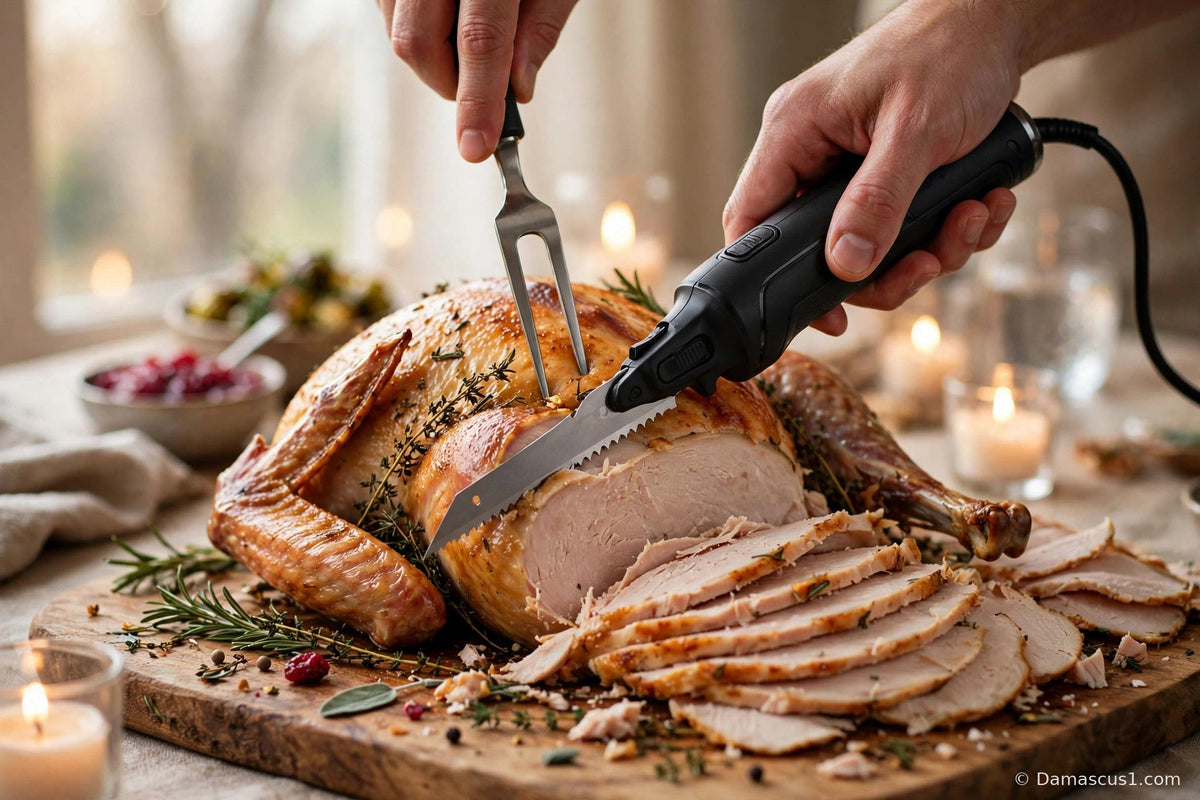
A turkey being carved at the table with an electric knife and a two-prong fork. Editorial scene — the knife shown is not a specific Damascus1 product.
Quick answer
The best electric carving knife for most homes is a corded model in the Cuisinart CEK-41 class — a micro-serrated universal blade, a published motor rating, a safety lock, and a fork in the box. Buy cordless only if you carve away from an outlet. And if you carve every week, skip electric entirely: a sharp manual slicing knife is quieter, cleaner to wash, and never needs charging.
Thanksgiving is fifteen days out. If you are the person who carves in your house, you already know how this goes. The bird comes out of the oven looking like a magazine cover, twenty people are suddenly very interested in your knife skills, and the difference between a proud platter of even slices and a shredded pile of good intentions is mostly the tool in your hand — and how tired your wrist is by slice twelve.
That is the honest case for an electric carving knife. It is not a better knife. It is a motor that makes the sawing motion for you, two thin serrated blades sliding back and forth against each other so the slicing happens with almost no downward pressure from you. For a once-or-twice-a-year carver, or anyone whose hands get tired or sore, that is a genuinely useful trade.
One disclosure before the picks, because you deserve it up front: Damascus1 does not sell an electric carving knife. We sell handmade Damascus kitchen knives. So this guide does two things. It tells you, straight, which electric knives are worth your money if electric is what you want — based on the manufacturers' own published specs and the most honest reviewers currently ranking for this keyword. And it shows you the manual alternative we do sell, with live prices, for the cooks who would be better served by it. No hands-on testing is claimed anywhere below. Where a spec comes from a maker or a reviewer, we say so.
If the manual route is the one you are weighing, start with the set most of our carving readers end up with: the Premium Kitchen Knife Block Set at $169.99, whose long slicing knife does the carving job this whole page is about. The full kitchen range lives in our kitchen knives and chef knife sets collection.
The picks at a glance
| Pick | Best for | Blade | Power | Cord | Price basis |
|---|---|---|---|---|---|
| Cuisinart CEK-41 class | Best overall electric | Universal micro-serrated | 130W (published by Cuisinart) | Corded | Check the listing — category band below |
| BLACK+DECKER EK500B | Best value electric | ~7.5 in. serrated edge, ~9 in. reach | Not published | Corded | Check the listing |
| Hamilton Beach 74250 | Holiday-only carvers | Two ~7.5 in. serrated blades | ~100W class (listing-reported) | Corded, ~5 ft | Check the listing |
| Cuisinart CEK-40 | Meat + bread households | Interchangeable carving + bread blades | Not published | Corded | Check the listing |
| Cordless class (Rapala / Bubba type) | Fish, docks, big briskets | 6–12 in. blade options | Battery | Cordless | Check the listing |
| Damascus1 Premium Block Set slicer | Best manual alternative | Long Damascus slicing knife in a 7-piece set | Your wrist | None | $169.99 live at damascus1.com |
A note on electric prices: the category typically runs about $20–$60 according to the buying guides ranking today, and prices move weekly in November. We are not going to print a precise dollar figure we cannot keep honest for a product we do not sell. Check the listing on the day you buy. The one price in this table we can stand behind to the cent is our own, checked today.
What is the best electric carving knife for turkey?
For a standard Thanksgiving turkey, the best electric carving knife is a corded model with a 7- to 8-inch micro-serrated blade, a squeeze-to-run trigger with a separate safety lock, and a carving fork in the box — the Cuisinart CEK-41 pattern. Corded power does not fade mid-bird, the blade length covers a large breast in one stroke, and the fork matters more than any spec on the box.
Here is why the details shake out that way. A turkey breast is wide. A blade much under seven inches forces a sawing, back-and-forth travel that tears the skin and raggeds the slice face; a blade in the seven-to-eight-inch range lets the reciprocating edge do a single calm pass. Micro-serrations — the fine, dense teeth on the CEK-41's universal blade — grip skin and crust without ripping, which is also why the same blade handles a crusty loaf on Saturday morning. Coarser teeth cut faster and finish uglier.
The fork is not an accessory, it is half the system. Every carving disaster starts with the bird sliding. A two-prong fork pins the breast while the blade travels, and it is the reason the sets that include one (Cuisinart's kit adds a bamboo board and storage tray; Hamilton Beach includes a fork and case) are easier to recommend than a bare handle at the same price.
Motor wattage, by contrast, is mostly marketing. Cuisinart publishes 130 watts for the CEK-41; most rivals publish nothing at all. What actually matters is whether the motor holds its speed when the blade meets a dense thigh joint. Reviewers who track owner reports — SteelSnob's guide is the clearest on this — consistently say behavior under load tells you more than the number on the handle. A knife that stutters at the joint will shred the slice no matter what its box claims.
The electric picks, honestly

Best overall: the Cuisinart CEK-41 pattern
If you want one recommendation and no homework, this is the shape of it. A published 130W motor, a universal micro-serrated blade that reviewers credit with the smoothest, most controlled slicing in the class, an ambidextrous grip (left-handed carvers, take note — many handles are not), a safety lock, and the fork, board and tray in the box. GearTestedLab, which compared it directly against the Hamilton Beach and Black+Decker from manufacturer specs and aggregated owner reviews in November 2026 — and says plainly that it did not hands-on test the units — still landed on the CEK-41 set as the best all-round choice, citing the three-year limited warranty as part of the reason.
The trade-offs are real. It is corded, so your carving station lives within a cord's reach of an outlet. It carries one universal blade rather than a swap-out pair. And it is the premium end of a cheap category, so you are paying for composure and accessories, not for a fundamentally different machine.
Best value: BLACK+DECKER EK500B
The EK500B is the quiet achiever of this category — literally. SteelSnob calls it a legitimately good knife rather than just a cheap one: secure comfort grip, safety lock, dishwasher-safe blades, and noticeably low noise and vibration, which matters more than you would think when you are carving in front of guests who are trying to hold a conversation. Know the sizing trick before you buy: the "9-inch" figure is total reach. The serrated cutting portion is closer to seven and a half inches. That is still plenty for turkey and roasts; it is only a problem if you bought it expecting a brisket-length blade.
What you give up versus the Cuisinart: no published wattage, fewer accessories, one blade type. What you keep: most of the money.
Best for the holiday-only drawer: Hamilton Beach 74250
Some knives live in a cupboard for eleven months and emerge, blinking, on the fourth Thursday of November. For that life, the Hamilton Beach Carve 'n Set formula is hard to argue with: two serrated stainless blades around seven and a half inches, a twelve-inch carving fork, a plastic storage case that keeps everything in one place, and roughly five feet of cord. It is inexpensive, it stores tidy, and it carves a turkey perfectly well.
Its known weakness, repeated across owner reports and flagged by SteelSnob, is the handle: comfortable dry, slippery once your hands are in turkey fat. If you carve twice a year and wipe your hands as you go, that is a manageable flaw. If you carve monthly, buy up.
Best for meat-and-bread households: Cuisinart CEK-40
The CEK-40 is the CEK-41's older sibling and trades a little refinement for flexibility: interchangeable blades, one for carving and one for bread, so each edge is shaped for its job instead of compromising. Owners report it carves comfortably and handles the same work well; it runs a touch louder and feels slightly less polished than the 41. If your electric knife will earn its drawer space on sourdough as much as on roasts, the two-blade system is the sensible pick.
Best cordless: know which cordless you actually need
"Cordless electric knife" is really two different tools wearing one name. The fishing pattern — Rapala's lithium-ion combo is the category standard — pairs six- and seven-and-a-half-inch reciprocating blades with runtimes around eighty minutes and two batteries, built for a cleaning station where a trailing cord is a genuine hazard. The big-roast pattern — Bubba's cordless line is the name here — runs blades up to about twelve inches, which is the one case where length is not a luxury: a whole brisket flat or a fifteen-pound ham wants a single clean pass, not a sawed trench.
What cordless costs you, whichever pattern: more money, a finite charge, and a lithium battery quietly losing capacity in a drawer year after year. SteelSnob's advice is the right filter — buy two batteries or a fast charger if you carve for a crowd, and top the battery up before it goes back in the cupboard, because storing lithium fully drained shortens its life.
Brisket is the length test: slices resting in a row after single passes. Editorial scene — the knife shown is not a specific Damascus1 product.
The manual alternative: when a slicing knife beats the motor

Here is the part no electric-knife roundup will tell you, because none of them sell what we sell. An electric knife is a specialist that is brilliant at one job, a few times a year, and ordinary the rest of the time. A long, sharp manual slicing knife does the same job — thinner slices, actually, in practiced hands — and then goes on to do every other job in your kitchen for the other 360 days.
Choose the manual route if any of these sound like you. You carve weekly, not yearly: Sunday roasts, brisket Saturdays, a ham at Easter. You already own or want one good knife set rather than a drawer of single-purpose appliances. You carve at a table with no outlet nearby and no desire to run a cord through the gravy. You hate washing around motors. Or you simply like the feel of a real knife — the weight, the quiet, the way a Damascus pattern catches the light when you set it down next to the platter. There is no wrong answer here. There is only the honest one for your kitchen.
Our priced picks for manual carving
The set route — Premium Kitchen Knife Block Set, $169.99. Our flagship seven-piece block set is the carving answer for most households: the long slicing knife in the block is the tool you reach for on Thanksgiving, and the chef knife, utility and paring knives cover the prep that comes before it. One honest caveat, stated on purpose: this listing has carried conflicting legacy copy in the past, so confirm the current packing list on the product page before you order — what is on that page today is what ships. If you are comparing sets more broadly first, our best Damascus chef knife set guide walks the whole shelf, and the best kitchen knives hub covers the single-knife route.
The single-knife route — G10-Handle Kitchen Knife, $34.99 (compare at $59.99). The budget entry, and a perfectly sensible one if the block set is more kitchen than you need. One more honesty note in the same spirit: this listing's profile wording has conflicted before (chef, santoku and bread profiles have all appeared), so check the product page and confirm the profile is the one you want. At $34.99, it is priced like the electric knives on this page and outlives all of them.
The board — Acacia Wood End-Grain Cutting Board, $109.99 (compare at $199.99). Every carving guide assumes a board and none of them sell you one. A turkey does not fit on a twelve-inch board, and a brisket does not fit on anything small. This large end-grain acacia board is the unglamorous purchase that makes the carving itself easier — room to work, a surface that is kind to edges, and enough mass that it stays put while the fork does its job. It is in the kitchen collection alongside the knives.
The manual route: one long stroke per slice, no cord, no motor to wash around. Editorial scene — the knife shown is not a specific Damascus1 product.
Corded or cordless: which should you actually get?
For most people, corded. The power is constant from the first slice to the last, the knife costs less, it weighs less in the hand because there is no battery in the handle, and there is nothing to remember to charge on the one day a year you need it. The entire top of the electric market — the Cuisinart and Hamilton Beach sets above — is corded for exactly these reasons.
Choose cordless when the cord itself is the problem. You carve at the dining table, away from an outlet, with guests on both sides. You work at a dock, a tailgate or a cleaning station. You slice big briskets and hams and want the twelve-inch blade class, which lives in the cordless fishing lines. Just go in clear-eyed about the trade: you are paying a premium for freedom, the runtime is finite (roughly seventy to eighty minutes on the models reviewers cite), and the battery is a consumable with a lifespan, not a heirloom.
One practical check nobody mentions until it bites: measure your carving station. Corded models give you about five feet of cord. If the nearest outlet is behind the refrigerator or across a walkway, corded stops being the simple option and starts being a trip hazard with a serrated edge attached. Decide where the bird will actually be carved before you decide what carves it.
What size electric carving knife do you need?
Match the blade to the widest thing you carve. Seven to eight inches of serrated edge covers turkey, chicken, roasts and bread for most households — it spans a large turkey breast in one pass with room to spare. Step up to the ten-to-twelve-inch class only if whole briskets, large hams or full salmon sides are regular work, because the long blade that glides through a brisket is clumsy on a chicken.
Ignore the headline number on the box and look for the cutting length. As the Black+Decker shows — nine inches of reach, about seven and a half of serrated edge — manufacturers count handle-adjacent tang in the total. The serrated portion is what slices. If a listing will not tell you the blade's cutting length, that silence is information too.
The same math applies in the manual world, by the way. It is why the slicing knife in a good set is the longest blade in the block, and why our best chef knife guide tells readers to judge a chef knife and a slicer as different tools rather than substitutes.
Can an electric carving knife cut through bone or frozen food?

No — and trying is how these knives die. Electric carving knives are built for cooked meat, poultry, bread and fish flesh. The reciprocating blades are thin; drive them into a turkey's thigh bone, a ham bone or anything still frozen and you will bend teeth, strain the motor, and possibly kick the knife sideways in a greasy hand. Work around joints instead: find the joint with the tip, cut through the soft tissue there, and let the bird come apart the way it was built to.
The frozen-food version of this mistake happens every November. A half-thawed bird is a knife problem before it is a cooking problem. Thaw fully, rest the bird after roasting — twenty to thirty minutes under foil is the range most carving guides converge on — and carve meat that gives. Resting is not dead time, either: it is what keeps the juices in the slices instead of pooling on your new board.
The result everything on this page is for: slices that hold together. Editorial scene.
How to carve a turkey with an electric knife, in order
The sequence matters more than the knife. Whether your blade is powered or manual, this is the order that produces a platter instead of a pile:
- Rest the bird. Twenty to thirty minutes, tented. Hot, unrested meat sheds juice and shreds under any edge.
- Set the station. Board with room around it, fork in your off hand, platter warming nearby, cord routed behind the board where it cannot cross the work.
- Legs and thighs first. Pull each leg outward, cut through the joint where it gives, and set the dark meat aside to slice off the bone.
- Take each breast off whole. Run the blade down along the breastbone, following the rib cage with long, light strokes, and lift the entire breast half free. This is the step where an electric knife earns its keep for a nervous carver — the motor does the travelling while you steer.
- Slice the breast on the board, across the grain. Even strokes, a fork or your fingertips steadying the top. Thickness is your choice; evenness is the goal.
- Slice the dark meat, arrange, and get it to the table. Skin side up where you can. Serve the carver last and accept the compliments like you meant to do it.
If you are prepping the whole meal rather than just the bird, our Thanksgiving kitchen prep plan sequences the day so the carving is the calm part.
What to look for before you buy

Blade. Micro-serrated universal blades are the best single-blade answer (meat and bread). Swap-out carving-plus-bread pairs are better if bread is half the job. Button-release blades that detach for washing are non-negotiable; anything that needs a screwdriver to clean will not be cleaned.
Motor steadiness, not wattage. A published rating (Cuisinart's 130W) is a good sign of confidence, but the real test is holding speed at a joint. If reviewers and owners do not mention bogging down, the motor is fine.
Grip with wet hands. You will hold this knife with fat on your fingers. Textured, contoured handles beat smooth plastic every time; the Hamilton Beach's slippery-when-wet grip is the cautionary tale. Squeeze-to-run triggers with a separate safety lock are the safe design — the knife stops when your hand relaxes.
Cleaning and storage. Blades dishwasher-safe, handle wipe-only, and never — ever — submerge the motor handle; water in the motor kills these knives faster than anything else owners do. A case or tray keeps loose serrated blades from hunting your fingers in a drawer.
Noise. You are carving in company. The quiet models feel like kitchen tools; the loud ones feel like power tools. It is a vanity metric right up until you are shouting over your own knife.
The manual checklist. If this section has talked you out of electric, the equivalent checks are simpler: a slicer long enough for your widest roast, an edge you can maintain on a whetstone (our Damascus sharpening guide covers the grits), and a board it fits on. That is the whole list, and it stays true for decades.
The second job: crusty bread is where micro-serrated blades prove themselves. Editorial scene — the knife shown is not a specific Damascus1 product.
The mistakes that ruin carving day

- Pressing down. The knife — powered or not — does the work. Pressure tears meat, crushes bread, and strains motors. Light guidance, long strokes.
- Carving straight off the heat. Unrested meat floods the board and shreds. The rest is part of the recipe.
- Starting with a dull manual blade. If you carve manually, sharpen the day before, not the morning of. A dull slicer saws; a sharp one glides.
- Storing blades loose. Serrated edges in a junk drawer are a cut waiting for a hand, and the teeth dull banging around. Case, tray or guard, every time.
- Letting a cordless battery sit dead all year. Top it up before storage. A battery stored empty is a battery being retired early.
- Buying for the wrong bird. A twelve-inch fishing blade for a ten-pound turkey, or a seven-inch blade for a full packer brisket. Match the tool to your actual table.
What a complete set looks like out of the box: handle, two blades, fork, case. Editorial scene.
Shop Damascus kitchen knives
Prices checked November 21, 2026. The product page on the day you order is the final word.
- Japanese VG10 Damascus Chef Knife, 8.5 in.: $399.99
- Premium Kitchen Knife Block Set: $169.99
- 7-Piece Forged Damascus Kitchen Knife Set: $399.99
Damascus pocket knives for the cook who has everything
- Olive Wood Damascus Pocket Knife Set, 6.5 in.: $39.99
- Green Wood Damascus Pocket Knife Set, 6.5 in.: $39.99
- Buffalo Horn Damascus Pocket Knife Set, 6.5 in.: $39.99
- Stag Horn Damascus Folding Pocket Knife, 6.5 in.: $49.99
- Camel Bone Scrimshaw Damascus Folding Pocket Knife, 7.6 in.: $49.99
Damascus pocket knives under $50 · All handmade Damascus pocket knives
Frequently asked questions
What is the best electric carving knife for turkey?
The Cuisinart CEK-41 pattern: a corded handle with a published 130W rating, a micro-serrated universal blade around seven to eight inches, a safety lock, and a fork, board and tray in the box. It is the pick the most honest November 2026 comparisons converge on for an all-round turkey carver.
Are electric knives worth it?
If you carve a turkey or a roast a few times a year and want even slices without the wrist work, yes — the category costs roughly $20–$60 and the good ones last for years. If you carve weekly, the money is better spent once on a sharp manual slicing knife, which also does every other job in the kitchen.
Corded or cordless, which should I get?
Corded for most people: steadier power, lower price, nothing to charge, and no battery ageing in a drawer. Cordless only earns its premium when you carve at the table away from outlets, work outdoors or at a dock, or need the long twelve-inch blades for whole briskets and hams.
What's the best electric knife for turkey and brisket?
Split the difference honestly. A seven-to-eight-inch corded knife is right for turkey and marginal on a wide brisket flat. If brisket is a regular event, the long-blade cordless class (blades up to about twelve inches) takes one clean pass instead of sawing — or use a long manual slicer and your own two hands.
Can an electric carving knife cut through bone?
No. The thin reciprocating blades are made for flesh and crust. Forcing one through bone or frozen meat bends teeth, strains the motor and risks a slip. Cut around joints, never through them, and thaw the bird completely before it meets any knife.
How do you clean an electric carving knife?
Detach the blades with the release button and wash them — many are dishwasher-safe — then wipe the motor handle with a damp cloth. Never submerge the handle. Dry the blades before they go back in the case, and store them in the case rather than loose in a drawer.
What is the manual alternative to an electric carving knife?
A long slicing knife, kept sharp. In our range that is the slicer in the Premium Kitchen Knife Block Set ($169.99), or the G10-Handle Kitchen Knife ($34.99) as a single budget blade — both priced live at damascus1.com, both quiet, both washable end to end, and neither will ever need a charge before Thanksgiving.
The bottom line
Buy the electric knife if carving is a twice-a-year performance and your wrists would like the help — corded, micro-serrated, fork in the box, and you are done shopping. Buy cordless only when the cord is genuinely in your way. And if you cook and carve all year, put the same money toward the last slicing knife you will need for a long while.
Start with the Premium Kitchen Knife Block Set — $169.99, or browse the full kitchen knives and chef knife sets collection. Orders over $50 ship free, and whichever route you choose — motor or muscle — carve rested meat, on a big board, with a fork that means it. Thanksgiving is November 26. You have time to get this right.
laissez un commentaire: