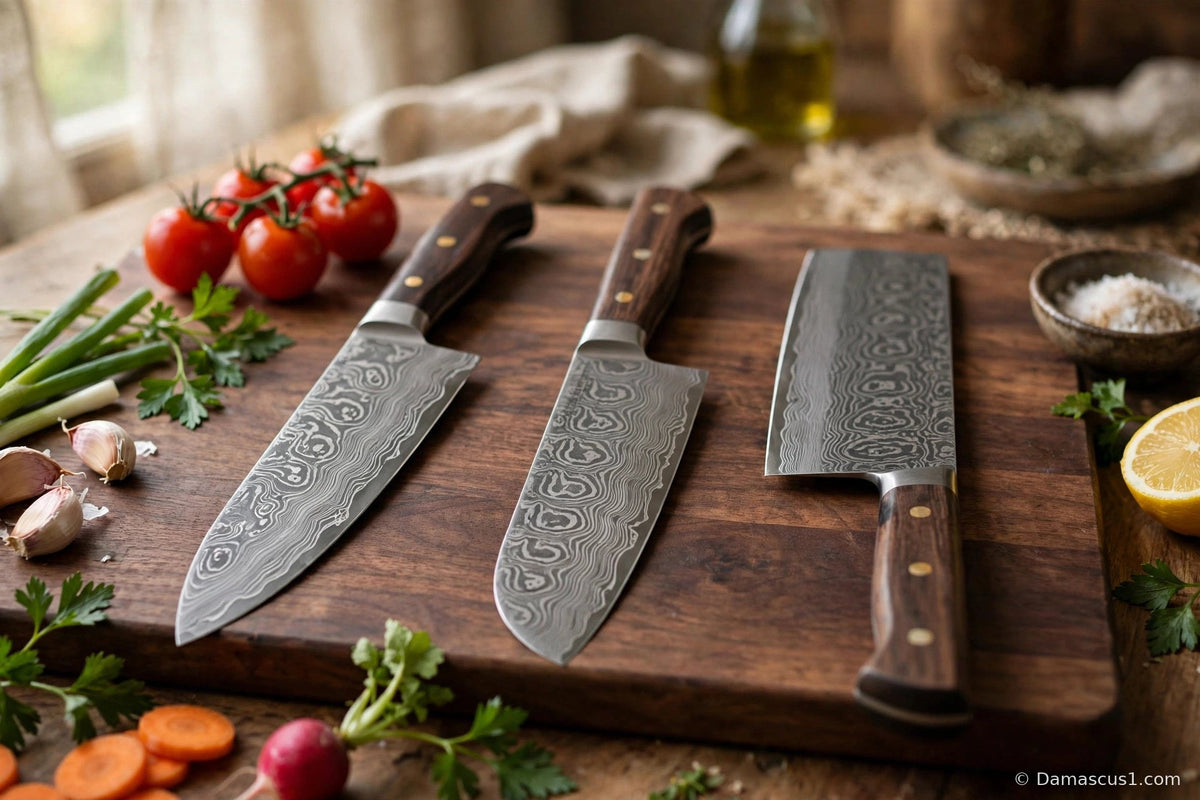
Direct answer: Buy the shape that matches the meals you already cook. A chef knife is the best first knife for mixed cooking because its curved belly rocks through herbs and handles almost everything. A santoku is the better daily driver if most of your board work is vegetables and boneless proteins cut with a straight up-and-down motion. A nakiri is a vegetable specialist — brilliant at fast, even dicing, useless as a general knife. Most home cooks need one of the first two now, and the nakiri later, if ever.
That sounds simple, and it is — once you stop shopping by silhouette. All three knives look vaguely similar in a product photo: a handle, a patterned blade, a sharp edge. The differences that matter are invisible in a thumbnail. They live in the curve of the edge, the height of the blade, and the motion your wrist makes without thinking. Get those three things right and any of these knives feels like it was made for your kitchen. Get them wrong and even a beautiful blade sits in the block while you reach for the old knife you were trying to replace.
A useful place to see the shapes together is the chef's best kitchen blades collection, which is where Damascus1's kitchen knives and sets live. Open it alongside this guide. As each shape below gets explained, the listings will make more sense — and one honest gap will become obvious: there is no standalone santoku in this store, which changes the buying advice for santoku fans, and this guide deals with that head-on rather than pretending otherwise.
What is the difference between a chef knife, a santoku, and a nakiri?

The difference is edge shape and intended motion. A chef knife has a curved belly built for rocking. A santoku has a flatter edge and a sheepsfoot tip built for straight push-cuts and up-and-down chopping. A nakiri has a completely flat, rectangular blade built only for vegetables, with no point at all. Same family, three different tools.
Start with the chef knife, because it is the reference point. Its edge curves gently from heel to tip, so when the tip stays on the board and the handle rises and falls, the blade rocks — and that rocking motion is how generations of cooks have minced garlic, herbs, and onions without lifting the knife. The point matters too: it scores, it trims, it gets into the joints of a chicken. A typical chef knife runs about 8 inches, tall enough at the heel to keep your knuckles off the board, heavy enough to help with dense vegetables without being a workout.
The santoku comes from Japanese home kitchens, and its name is usually translated as "three virtues" — slicing, dicing, and mincing. Its edge is much flatter than a chef knife's, and the tip curves down to meet the edge instead of pointing forward. That shape rewards a different motion: lift the whole blade and bring it straight down, or push forward and down in one clean stroke. Santokus usually run shorter than chef knives, around 7 inches, and the blade is often thinner behind the edge, which is why vegetables seem to fall away from it instead of wedging and splitting.
The nakiri is the easiest to recognise and the hardest to generalise. It looks like a small cleaver — a rectangle of steel with a flat edge and no point whatsoever. That is deliberate. A flat edge means the whole blade meets the board at once, so a cabbage leaf or an onion slice separates completely instead of staying connected by a thin accordion thread, which is what happens when a curved edge misses the last millimetre. The tall blade doubles as a bench scraper: chop a pile of spring onions, scoop them up on the flat of the knife, and tip them into the pan. Nothing else in the kitchen does that job as neatly.
So the honest summary is not "which is best" but "which motion do you already make." Cooks who rock will fight a nakiri. Cooks who chop straight down will find a chef knife's belly wasteful and slightly awkward. The santoku sits between the two temperaments, which is exactly why it has become the default second knife in so many kitchens — and the first knife in plenty of others.
What is a chef knife best for?

A chef knife is best for mixed, everyday cooking: rocking through herbs and onions, slicing roasts and large vegetables, trimming proteins, and handling the odd jobs — a melon, a squash, a pile of garlic — that a varied week throws at one knife. It is the safest single-knife answer and the right first purchase for most people.
Think about what "mixed" really covers across a normal week. Monday is a stir-fry: onion, peppers, garlic, ginger, a chicken breast sliced thin. Wednesday is soup: leeks, carrots, potatoes, celery, maybe a cabbage that needs wedging apart. Friday is something roasted that then needs carving at the board. A chef knife does all of that without a pause, and its weight helps on the dense work — the heel end of the edge, pushed straight down with your other hand on the spine, is how a butternut squash gets halved without drama.
Where does it compromise? Thin slicing. A chef knife can slice a cucumber perfectly well, but its curved edge asks you to finish each cut with a slight rock, and cooks chasing paper-thin, perfectly even rounds often find the santoku's flat profile more obedient. It is also a big knife for small hands and small boards. On a cramped counter with a little board, an 8-inch chef knife can feel like parking a truck — one reason shorter santokus win loyalty in small kitchens.
If you are buying one Damascus knife first, the accessible entry point in this store is the Damascus chef knife with a G10 handle, listed at $34.99 — check today's price on its page before ordering. G10, the handle material in its title, is a fibreglass laminate that shrugs off water and kitchen grime, which suits a knife that will be washed daily. And if the chef-knife-first logic appeals to you but you cook for a household, the wider shortlist in our best kitchen knives guide puts this shape in the context of a full working set.
One more chef-knife virtue rarely gets mentioned: forgiveness. The curved edge tolerates sloppy technique better than the flat profiles do. If your cuts are uneven while you learn, the belly compensates. That is not a small thing for a first good knife — the knife should make you better, not grade you.
What is a santoku best for?

A santoku is best for vegetable-heavy cooking and clean slicing: push-cutting cucumbers, peppers, and onions, slicing boneless chicken and fish neatly, and working comfortably on smaller boards. Its flatter edge and lighter, shorter blade suit cooks who chop straight down rather than rock. It is the strongest alternative to a chef knife as a daily knife.
The santoku's flat edge changes the feel of ordinary prep in ways people notice within one meal. Slicing a tomato: the blade goes down and slightly forward, and the slice separates fully — no skin tag holding it to the next slice. Dicing an onion: the vertical cuts land cleanly because the edge profile matches the motion. Scooping is easier too, because the blade is tall enough to carry a small pile of chopped scallions from board to pan without spilling half of it.
Its limits are just as real. That down-curved sheepsfoot tip is not a piercing point, so jobs that start with a point — coring a pepper from the top, trimming the eye end of a potato precisely, working around a chicken joint — feel clumsier than with a chef knife. And on a whole cabbage or a big squash, the shorter blade simply runs out of length; you saw where a chef knife glides. Neither flaw matters if your cooking rarely asks for those jobs. Both matter weekly if it does.
Now the shopping reality, stated plainly: Damascus1 does not sell a standalone santoku. Search the store and you will find chef knives, a nakiri, sets, and outdoor knives — but no single santoku listing. So if your heart is set on this shape, the route here is a Japanese set whose product page lists a 7-inch santoku among its contents. Two do. The VG10-core 6-piece Japanese set at $399.99 lists, on its own page, an 8-inch chef, a 7-inch santoku, an 8-inch bread knife, a 6-inch boning knife, a 3.5-inch utility, and a 7-inch cleaver — with its construction stated on that page as a VG10 core in 67 layers, 58–62 HRC, an 11° edge, and G10 handles. The Japanese Damascus 9-piece block set at $339.99 is the other set route, sold as a 9-piece block set; read its page for its current contents list before you buy. Buying a whole set to get one santoku only makes sense if the other pieces also earn their slots — the piece-count logic in our kitchen knife set piece count guide is the right checklist for that decision.
For readers whose kitchens are mostly vegetables, protein fillets, and noodles-and-broth cooking, the santoku-first choice is completely defensible. Plenty of experienced cooks reach for it more than their chef knife. The point of this section is not to demote it — it is to make sure you buy it knowing exactly which store shelf it lives on: the set shelf, not the singles shelf.
What is a nakiri best for?

A nakiri is best for vegetables, full stop: fast, even dicing of onions, cabbage, carrots, and greens, with a flat edge that finishes every cut and a tall blade that scoops the pile into the pan. It is not a general knife — it has no point, dislikes rocking, and should never be twisted against bones or frozen food.
The nakiri rewards rhythm. Because the edge is flat, you can work in a quick, even tempo — down, down, down — and the pieces come off uniform, which means they cook uniform. Anyone who has made a stir-fry where the carrot coins were raw in the middle while the onion dissolved knows why that matters. The tall blade also keeps your guiding knuckles safely above the edge line, which makes the claw grip feel natural instead of forced.
What should a nakiri never do? Rock — there is no curve to rock on, and forcing it just bangs the edge. Pierce — there is no point. Pry or twist — thin Japanese-style edges chip when levered against bone, squash stems, or frozen anything. Treat it as a vegetable instrument and it is a joy; treat it as a small cleaver and it will punish you. It is a specialist, and specialists demand honesty about the job description.
Unlike the santoku, the nakiri is sold on its own here: the Nakiri Knife, Japanese VG10 at $44.99, described on its own product page as a VG10-core knife with a rosewood handle. At that price it is the cheapest experiment in this whole guide — a genuine specialist you can add to a kitchen that already owns a chef knife, without committing to a set. If your week involves big vegetable prep more than twice, it earns its drawer space quickly. The pillar guide to this whole cluster, best Damascus kitchen knives and chef's knives, puts the nakiri in context alongside the other core shapes.
A fair warning about expectations: a nakiri will not make you faster on day one. The flat edge exposes uneven technique — if your down-strokes wander, the dice show it. Give it two weeks of onions and it clicks. Most people who persist describe the same small revelation: prep stops feeling like a chore they rush and starts feeling like a skill they're visibly improving.
How do the three knives compare side by side?
Side by side, the chef knife wins on versatility, the santoku wins on comfortable vegetable-and-slicing work in smaller spaces, and the nakiri wins on pure vegetable throughput. The table below scores the honest trade-offs — including how each shape is actually bought at Damascus1 today, because a comparison that hides the shopping reality helps nobody.
| Knife | Best for | Cutting motion | Weak spot | How you buy it at Damascus1 (verified Oct 16, 2026) |
|---|---|---|---|---|
| Chef knife | Best for mixed everyday cooking — the one-knife answer | Rocking, tip-down | Less obedient for paper-thin slicing; big on small boards | Single knife: G10-handle Damascus chef knife from $34.99 |
| Santoku | Best for vegetables and clean slicing on smaller boards | Straight push-cut, up-and-down chop | No real piercing point; runs out of length on big produce | No standalone SKU — via sets listing a 7" santoku: VG10-core 6-piece set $399.99; Japanese 9-piece block set $339.99 |
| Nakiri | Best for high-volume vegetable prep and even dicing | Flat up-and-down chop, no rocking | Vegetables only; no point; chip-prone if twisted | Single knife: VG10 Nakiri $44.99 |
Read the "weak spot" column as a matching exercise, not a warning label. Every knife in a working kitchen has one; the skill is choosing the weakness you will rarely meet. A cook who buys whole chickens weekly will meet the santoku's tip problem constantly and the nakiri's limits daily. A cook whose protein arrives boneless and whose vegetables arrive in bulk will meet the chef knife's compromises instead and may never notice the other two knives' flaws at all.
Price tells a story here too. The two singles — chef from $34.99, nakiri at $44.99 — let you build the classic two-knife combination (generalist plus vegetable specialist) for under $80 before shipping, and orders above $50 ship free as shown on the site. The santoku, by contrast, only arrives as part of a $339.99 or $399.99 set in this store. That is not a reason to avoid it; it is a reason to want the rest of the set as well. If you do not, a santoku from this particular store is simply the wrong purchase, and saying so plainly is worth more than a paragraph of spin.
Which one should you buy first — and what comes second?
Buy a chef knife first if your cooking is mixed, a santoku (via a set) first only if your cooking is heavily vegetable-and-slicing based and you want the set's other pieces, and a nakiri second once a chef knife or santoku already covers general work. That order protects you: the generalist always gets used, the specialist is bought with evidence from your own kitchen.
Here is the reasoning in full. The first good knife gets used for everything, including jobs it is merely okay at — because it is there, it is sharp, and the old knives feel worse by comparison. A generalist tolerates that phase gracefully. A specialist does not: buy a nakiri first and within a week you are using it on a chicken, a loaf, and a melon, hating it for jobs it never claimed to do, and concluding — unfairly — that it is a bad knife. Sequence is a form of honesty about your own habits.
The second purchase is where kitchens become personal. After a month with a chef knife, your complaints will name your second knife for you. "I wish this were shorter and flatter for vegetables" is a santoku-shaped complaint, or a nakiri-shaped one if the volume is high. "I wish I had something small for trimming" is a utility or paring complaint, which points toward a set rather than any of today's three shapes. Let the first knife teach you. It is a cheaper teacher than a return parcel.
Budget shapes the answer as well, and there is no shame in that — there is only shame in pretending it doesn't. Under $50 today buys either single knife, and both are legitimate starting points. Around $340–$400 buys a set that includes the santoku plus a chef knife, which is the two-generalists combination many households end up happiest with. What does not make sense at any budget is buying all three shapes at once before you know your own motion; the third knife would be a guess, and guesses are what blocks full of unused knives are made of.
Can one of these knives replace the other two?
One knife can cover a whole kitchen, but it cannot replace the other shapes' best work. A chef knife comes closest to doing everything. A santoku covers most daily cooking except point work and very large produce. A nakiri replaces nothing beyond the vegetable part of the day — and within that part, neither rival matches it.
This is worth dwelling on because "just tell me the one knife" is the most common version of this question, and the honest answer has two halves. Half one: yes, millions of good meals are cooked with a single chef knife, and if you want one knife, that is the one — our best kitchen knives hub makes the same argument at set level. Skill matters more than shape count; a cook who knows one knife deeply outperforms a collector with six.
Half two: the gaps are real, and you will feel them at specific moments. The chef knife user feels it slicing cucumbers for a salad platter, where the santoku user is simply faster and tidier. The santoku user feels it at the chicken. The nakiri user feels it everywhere except the vegetable board. Knowing your gap in advance is the whole game — it turns a limitation into a planned second purchase instead of a disappointment.
There is also a household dimension nobody mentions in knife guides: other people cook in your kitchen. A partner who finds an 8-inch chef knife intimidating may happily use a santoku, and a knife that gets used beats a knife that gets admired. If two people cook, two shapes is not indulgence; it is ergonomics for a shared workspace.
How should you care for whichever shape you choose?

Care for all three the same way: hand wash in warm soapy water, dry immediately and completely, store in a block, on a magnetic strip, or in a sheath — never loose in a drawer — and sharpen on a whetstone rather than a pull-through sharpener. Damascus edges are thin and hard; the dishwasher's heat, detergent, and rattling are their worst environment.
The shape-specific notes are small but real. Flat-edged knives — santoku and nakiri — show edge damage sooner because the whole edge meets the board; keep them off glass and stone boards entirely, and never scrape the board sideways with the edge to gather food (flip the knife and use the spine). The nakiri's corners deserve respect: the square heel corner is easy to bang against a pan edge, and corners chip. The chef knife's tip is its fragile point; a tip dropped on tile can bend or snap, which is an argument for the block or strip, not the drawer.
Storage is where the three shapes stop being interchangeable. A block slot sized for a chef knife may not take a tall nakiri; a magnetic strip takes all three happily, provided the wall space exists. Buy storage with the actual blades in mind, not the catalogue photo. Our full routine lives in the kitchen knife care, cleaning and storage guide, and the rust questions every Damascus owner eventually asks are answered in can Damascus steel rust? — read that one before your first orange spot panics you.
However you store them, the rule that outranks all others is boring and absolute: a knife goes back clean and dry, every time, the same day it was used. Ninety percent of "my Damascus knife stained" stories are really "it sat wet overnight, repeatedly" stories. The steel is not fragile; the habit was missing.
The Olive Wood Damascus Pocket Knife Set — $39.99
Real Damascus steel, an olive wood handle and a genuine leather sheath included — the knife our readers ask about most.
Shop the Olive Wood Damascus Pocket Knife Set — $39.99 · Free US shipping on orders over $50.
Frequently asked questions
Is a santoku better than a chef knife? Neither is better in general — they suit different motions and menus. A santoku is better for straight-down chopping and slicing in vegetable-heavy cooking and small spaces. A chef knife is better for rocking, point work, and large produce. "Better" only appears once your own week of cooking is the judge.
Do I need both a santoku and a nakiri? No. They overlap heavily on vegetables. Choose the nakiri if vegetable volume is high and you want the fastest, most even dicing; choose the santoku if you want one knife that also slices proteins and handles general work. Owning both is a luxury for people who prep vegetables daily, not a requirement.
Why doesn't Damascus1 sell a standalone santoku? Because the current catalogue simply doesn't list one — the shape is available here only inside the Japanese sets whose pages list a 7-inch santoku. This guide flags that rather than inventing a product page that doesn't exist. If a standalone santoku is non-negotiable for you, this store is not the place to buy it today.
Is a nakiri a cleaver? No, despite the family resemblance. A nakiri is a thin vegetable knife that must never be used on bones; a cleaver is built heavy for exactly that work. Using a nakiri like a cleaver is the fastest way to chip one.
Which of the three is best for a beginner? The chef knife, for most beginners — its curved edge forgives uneven technique and it covers every job while you learn. A santoku is a close second for cooks in small kitchens. A nakiri makes a poor first knife because it only does one category of work.
The short version
Chef knife for the mixed kitchen, santoku for the vegetable-and-slicing kitchen, nakiri for the vegetable marathon. Buy the generalist first, let your own complaints choose the second, and check every price and contents list on the live product page before money moves — prices above were verified on October 16, 2026, and listings change.
Start where your cooking actually starts: browse the chef's best kitchen blades collection, put the G10-handle chef knife or the $44.99 VG10 Nakiri in the cart if one of them matches your week, and remember orders above $50 ship free as shown on the site. The right knife is the one your hand reaches for without thinking — this guide's whole job was to make sure that's the knife you actually buy.
laissez un commentaire: