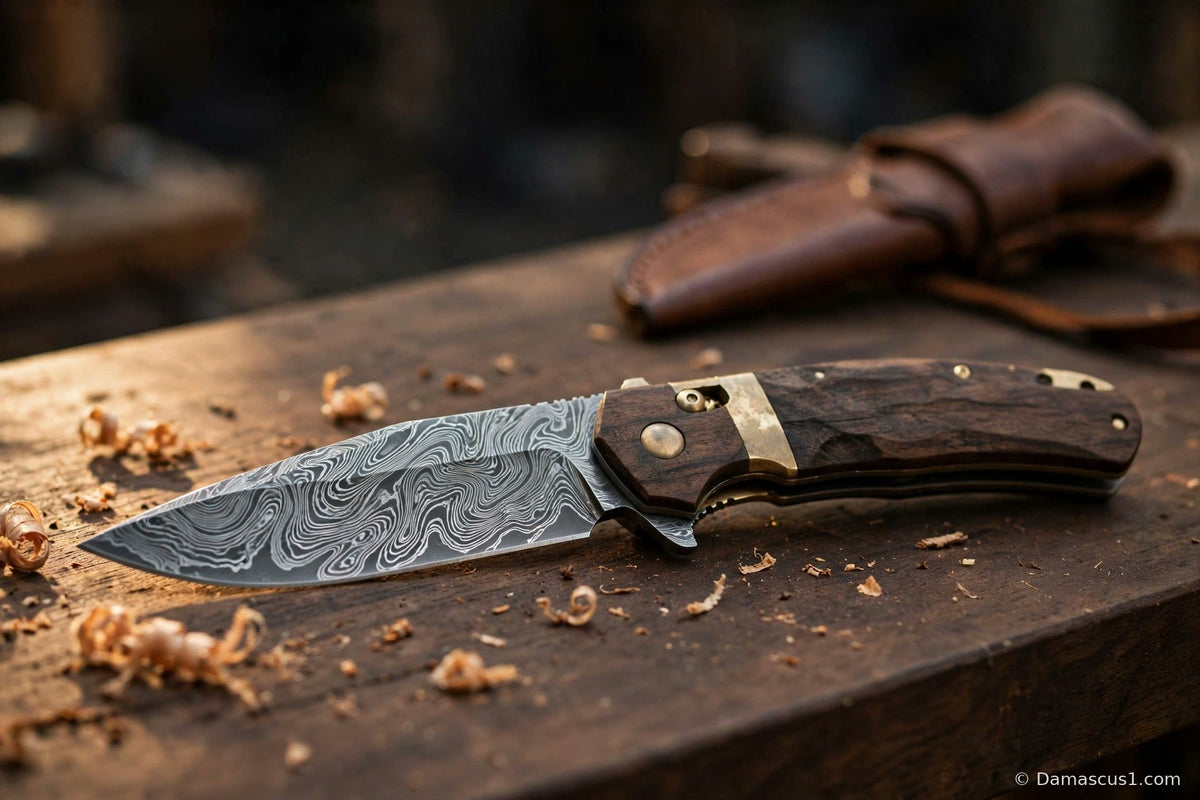
The short answer: A Damascus pattern is the figure you see when two different steels, forge-welded together in layers, are etched with acid — one steel darkens, the other stays bright, and every layer boundary shows as a line. Twist, ladder and raindrop are just three ways of shaping those layers before the etch. On a pocket knife, the honest buying rule is simple: pick the pattern you can actually see at arm's length, because the layer count tells you how fine the figure is, not how well the knife cuts. A bold twist or ladder reads across a room; a fine raindrop needs a closer look. And if it is a gift, that one test — can he see it without a magnifier? — matters more than anything the listing says about layers.
That is the whole guide in one paragraph, but the reason it needs a guide at all is that almost everything written about Damascus patterns is written for kitchen knives, by people selling kitchen knives, and it answers the wrong question. It tells you how a pattern is made. It never tells you which one to buy. A buyer looking at a pocket knife does not need nineteen patterns named. He needs to know whether the thing in the photograph will still look like something when it arrives, in his hand, at normal distance, on Christmas morning. That is what this guide does.
The knife running through the examples is the Olive Wood Damascus Pocket Knife at $39.99 USD — a handmade folder with a real pattern-welded blade in 1095 and 15N20 steels, about 276 layers, heat-treated to 58–60 HRC, with an olive wood handle. It is the right example precisely because it sits at the price where the pattern question gets asked most sharply: cheap enough that a buyer wonders whether the pattern can possibly be real, and honest enough about its steels that the answer can be checked.
What is a Damascus pattern, really?
Strip away the romance and a Damascus pattern is a cross-section made visible. A bladesmith takes two steels — in the classic combination, a high-carbon steel and a nickel-bearing steel — cleans them, stacks them, heats the stack to welding temperature and hammers it into a single solid billet. Then he draws it out, folds it, and folds it again. Each fold doubles the layers. Fifteen layers becomes thirty, then sixty, then a hundred and twenty, then two hundred and forty. When the blade is ground and dipped in acid, the two steels react differently: the high-carbon steel darkens, the nickel steel stays bright, and every boundary between layers appears as a line. The pattern is not painted on. It is not printed. It is the steel itself, all the way through the blade, edge included.
That last point is the whole test of whether a Damascus knife is real, and it is worth holding onto through the rest of this guide. On a genuine pattern-welded blade, the layers run through the whole thickness — over the spine, down the bevel, into the edge. On a fake, the pattern sits on the surface and the spine is blank. The UK maker Savernake Knives puts it bluntly in their own explainer: if the pattern is genuinely through the blade, it is real pattern-welded Damascus; if it is a shallow etch or laser mark on a single piece of steel, it is a fake — "a plain blade with a photocopied pattern, sold at a premium for the look." They are a kitchen-knife maker who does not build their knives around Damascus at all, which makes their bluntness worth more, not less. They have nothing to sell you here.
There is also a historical wrinkle that every honest guide has to mention, because the name itself is borrowed. The legendary Damascus of old was wootz, a crucible steel whose watered pattern came from the structure of the steel itself, not from layering. That knowledge largely fell out of use by around 1900 and has since been reconstructed by metallurgists. Modern Damascus is pattern-welded — a different process that produces a similar look with far more control over the design. It borrows the famous name and the look. It is a different thing, and a good deal more ordinary than the marketing suggests. None of that makes a modern pattern-welded blade a fraud. It makes it a craft with a borrowed name, and the honest sellers say so.
How is a Damascus pattern made?
The process has six steps, and the pattern is decided in exactly one of them — step four. Knowing which step does what is what stops a buyer being impressed by the wrong numbers.
- Stacking. Bars of two steels are cleaned and stacked, often 7 to 15 layers to start. In our hero knife the pair is 1095 high-carbon steel and 15N20 nickel steel — the 15N20 forms the brighter layers, the 1095 darkens during etching, and that contrast is the whole visual.
- Forge welding. The stack is heated to welding temperature and hammered into one solid billet. A bad weld here is the hidden defect no photograph can show: voids or a weak bond between layers that only reveals itself when the edge is sharpened and crumbles. This is why the maker's name matters more than the layer count.
- Drawing out and folding. The billet is stretched, cut, restacked and welded again. Each fold doubles the layer count — and produces the number on the listing, which tells you least about the knife.
- Pattern formation. This is where the design is created: twisting the bar, grinding grooves across it, punching dimples into it, splitting it and re-welding it. Twist, ladder and raindrop are all made here, from the same starting billet. The pattern is a choice, not a quality grade.
- Forging to shape and heat treatment. The billet is forged into a blade, normalised, hardened and tempered. The heat treatment — not the pattern — decides whether the edge holds. Our hero is heat-treated to about 58–60 HRC, the figure that actually matters to performance.
- Grinding and etching. After grinding, the blade is dipped in acid. The etch makes the pattern visible. It is also shallow — microns deep — which is why aggressive cleaning can soften it, and why a light re-etch can bring it back.
Hold that sequence in mind when a listing leads with a big layer number. The number comes from step three. The beauty comes from step four. The performance comes from step five. They are three different things, and a listing that lets you confuse them is doing you no favours.
Twist vs ladder vs raindrop — which one reads on a pocket knife?


Here is the question the encyclopaedia guides never answer, because they are written about chef's knives with eight inches of blade to show off in. A pocket knife gives a pattern about three inches of steel to work with, and at that size the patterns behave very differently. The Cooking Guild's guide — the strongest incumbent on this search, updated in September 2026 — names nineteen patterns and explains how each is forged. It never once asks which of them you can see on a small folder. So here is the chooser, built for the size that actually matters.
Twist. A square or round bar is heated and twisted along its length, then ground flat. The deeper you grind, the tighter the stars and swirls. Several twisted rods welded side by side make the mirrored "W" figures you see on many Japanese-style blades. On a pocket knife, twist is the loudest pattern there is: big, bold, swirling figures that read from across a room. It is also the most forgiving — a twist pattern never looks faint, because the figure is large relative to the blade. If you want the pattern to be unmistakable in a photograph, in a hand, across a table, twist is the safe pick.
Ladder. Parallel grooves are ground or forged across the flat billet, then the bar is forged flat again. The grooves push the layers into evenly spaced arcs that look like ladder rungs. Ladder blades commonly carry 200 to 300 layers — our hero's roughly 276 layers sit squarely in that band. On a pocket knife, ladder is the most architectural pattern: regular, rhythmic, obviously deliberate. It reads clearly at arm's length because the rungs are evenly spaced and high-contrast, and it photographs beautifully — which is why so many product photos you see are ladder. It is the pattern that looks most like someone designed it, because someone did.
Raindrop. Instead of grooves, the billet is dimpled with a ball-end punch or drill before being forged flat. Each dimple becomes a set of concentric rings, so the finished blade looks like rain hitting water. Raindrop is the prettiest pattern in a macro photograph and the quietest in real life. On a wide chef's knife it is gorgeous. On a three-inch folder, the rings are small, the figure is fine, and at arm's length it can read as a soft, almost smoky texture rather than a pattern at all. It rewards the person who holds the knife close and looks. It does not reward the person across the room.
That is the trade-off in one line: bold patterns read, fine patterns reward. Neither is better. They are better for different buyers, and the buyer who gets it wrong is the one who chose on a zoomed-in product photo and never asked what it looks like at normal distance.
| Pattern | How it is made | Reads at arm's length? | Best for | Gift score |
|---|---|---|---|---|
| Twist | Bar twisted along its length, ground flat | Yes — the boldest of the three | A first Damascus knife; anyone who wants the pattern to be unmistakable | ★★★★★ |
| Ladder | Grooves ground across the billet, forged flat | Yes — regular, high-contrast rungs | The buyer who wants it to look designed; photographs brilliantly | ★★★★★ |
| Raindrop | Billet dimpled, forged flat into concentric rings | Partly — fine rings soften at distance | The collector who looks closely; a second Damascus knife | ★★★★☆ |
| Feather | Stack split lengthwise, opened like a book, re-welded | Yes — dramatic fan from a centre line | A showpiece; usually the dearest of the four | ★★★★★ |
| Random / wave | Flat layers forged and drawn out | Yes — flowing, one of a kind | The buyer who wants "no two alike" as the story | ★★★★☆ |
| Chevron / herringbone | Two twisted bars, opposite directions, welded side by side | Yes — arrows run the length of the blade | A striking, symmetrical look | ★★★★☆ |
Feather deserves a word, because it is the pattern buyers ask about after they have seen one. A tall stack of layers is split lengthwise, the two halves are opened like a book and forge-welded back together, and the layers fan out from the centre line like the barbs of a feather. It is one of the hardest patterns to weld cleanly, which is why it is usually reserved for premium blades — and why, if you see a feather pattern at a low price, you should check the spine before you believe it.
What does the layer count actually tell you?
Less than the listing wants you to think, and the people who know most about steel agree on this more completely than they agree on almost anything else in knives.
The Cooking Guild puts it plainly: because every fold doubles the count, the jump from 100-layer to 200-layer Damascus is a single extra fold, and the jump to 1,000-layer is three or four more. What changes is the fineness of the figure — low layer counts give bold, wide bands, and high counts give a tight, almost smoky grain. What the layer count does not tell you is how well the knife cuts. On a clad kitchen knife the layers are cladding wrapped around a single hardened core, so cutting performance comes from that core's alloy, hardness and geometry. A 1,000-layer blade over a soft core will lose to a 67-layer blade over a properly heat-treated one every time.
Savernake, the UK maker, goes further, citing independent CATRA testing by the metallurgist Larrin Thomas: Damascus construction gives no edge-retention advantage over the same steel left plain, and the number of layers makes no difference to how the knife cuts. Sixty-seven layers or three hundred, it is all cosmetic. Their conclusion is blunt — "there is a reason no aeroplane wing or Formula 1 component is made from Damascus. It is not a performance material. It is a decorative one."
That sounds like an attack on Damascus, and in a sense it is. But it is also the most useful thing anyone on this search says, because it frees the buyer from the one mistake that costs money: paying more for layers. Here is the honest version, stated as plainly as we can:
- Layer count = fineness of the figure. More layers, finer lines. Fewer layers, bolder bands. That is all it is.
- Layer count ≠ sharpness. Sharpness comes from the edge geometry and the heat treatment.
- Layer count ≠ strength. Strength comes from the steels, the welds and the heat treatment.
- Layer count ≠ quality. A badly welded 300-layer billet is worse than a well welded 60-layer one, and you cannot tell which you have from the number.
- Our hero's ~276 layers mean its figure is fine and detailed rather than broad and bold — one extra fold past ~138, three extra folds past ~34. It is a description of the look, not a claim about the cut, and any listing that presents it as a performance figure is overselling.
So what should you judge a Damascus folder by? The steels, named — 1095 and 15N20 on our hero, not "Damascus steel" with no further detail. The hardness, stated — 58–60 HRC. The maker, identifiable. And the pattern, judged by whether you can see it. Everything else is decoration, and decoration is fine, as long as it is priced as decoration.
Which pattern should you choose if it is a gift?

This is where the guide earns its keep, because the gift buyer is the person the pattern matters most to — and the person the encyclopaedia guides help least. A gift is unwrapped once, in front of people, at a distance. The pattern has about three seconds to do its work, and it does that work from two or three feet away, in ordinary room light, in the hands of someone who has never held this knife before. So judge it the way the room will judge it.
The arm's-length test. Hold the knife out at arm's length — your arm, not a camera zoom — and look at the blade. If you can see the pattern clearly, it passes. If it softens into a grey texture, it fails the gift test, whatever it looks like in a macro photograph. Twist and ladder pass this test on a pocket knife almost every time. Raindrop often does not, and feather usually does. That is not a criticism of raindrop. It is a fact about scale, and the giver who knows it will not be disappointed on the day.
The photograph test. Look at the product photo the way a buyer looks at it: small, on a phone, while scrolling. If the pattern is still visible at thumbnail size, it will be visible in the hand. If it only appears when you pinch to zoom, it will only appear when the recipient holds the knife up to his face — which he will do once, politely, and then never again.
The recipient test. Who is it for? For a first Damascus knife — a dad, a grandad, a groomsman who has never owned one — pick the boldest pattern you can find, because the whole point of the gift is the moment he sees it. Twist or ladder, in that order. For a collector who already owns Damascus, pick the pattern he does not have: raindrop, feather, chevron — something his existing knives do not already show. For a groomsman set, where four or five knives are opened at once, pick one pattern for all of them, because a matched set reads as a set and a mixed set reads as leftovers. The recipient-by-recipient thinking is covered in full in our gift guides: Damascus knife gift for men UK and Best pocket knife gift under £40 UK — the hero folder is $39.99 USD, checkout in USD, no sterling price invented.
If the gift is for two people — two groomsmen, a father and a son — the hero pairs with its warmer-toned stablemate, the Orange Wood 6.5" Hunting Pocket Knife at $39.99 USD, so two gifts come to $79.98 combined, each with its own pattern and its own handle. Both prices verified live 2026-11-09, checkout in USD.
The handle test. Do not forget the other half of the knife. The pattern is the first thing seen; the handle is the first thing felt. On our hero the handle is olive wood, and no two olive wood handles are ever alike — the grain is wavy, irregular, cream and ochre against dark brown, and it deepens in colour with handling. So the gift is genuinely one of a kind in two ways at once. If you are choosing between two knives with similar patterns, choose the one whose handle you would want to hold.
One more gift consideration, and it is the one nobody mentions until it is too late: the pattern is the thing that makes a Damascus knife feel personal, and the engraving is the thing that makes it actually personal. The hero knife can be engraved on request — a name, initials or a short message up to 25 characters, quote-based, with proof, price and timing confirmed before any custom work starts. A pattern says "this is beautiful". An engraving says "this is yours". If the gift is a milestone — a fiftieth, a retirement, a wedding — the engraving is worth the extra step. Our engraved gift guide covers the wording and the timing: Engraved pocket knife gift UK — note that this is a Day-4 draft, linked here as PLANNED until it is live; do not treat it as a published page.
How do you tell real pattern-welding from a fake?
This is the section that saves money, and it is short on purpose, because the checks are simple and they work. Our full fake-spotting guide goes deeper, with photographs: How to spot a fake Damascus knife. Here are the four checks that matter most for patterns.
Check the spine. On real pattern-welded steel the layers continue over the spine and through the bevel, because the layers run through the whole blade. On a fake, the spine is blank — a single piece of plain steel with a design printed on the flat. This is the single most reliable check there is, and it is the one the fakes fail every time. If a listing shows you the flat of the blade in six photographs and never once shows the spine, ask why.
Check for repetition. Printed patterns repeat exactly; forged patterns never do. Look at two knives from the same listing. If the pattern is identical — the same swirl in the same place — it was printed. If it is similar but never the same, it was forged. The same applies within one blade: a real twist pattern shifts and changes along the length; a printed one tiles.
Feel it. A properly etched blade has a faint texture between the light and dark layers — you can feel the difference with a fingertip if you know what you are feeling for. A printed pattern is glass-smooth, and it will polish off with abrasive. This is a check for when the knife is in your hand, not for buying online, but it is worth knowing for the moment it arrives.
Check the steels are named. A real maker names the steels. 1095 and 15N20. VG10. AUS-10. A listing that says "Damascus steel" and nothing else is asking you to trust a word instead of a specification. Our hero names its steels on the product page — forge-welded 1095 and 15N20 — and that is the minimum a buyer should accept from anyone. If the seller will not name the steels, the pattern is the only thing they are selling, and you should price it accordingly.
There is one more honest point, and it cuts against us as much as anyone: a low price is not proof of a fake. The incumbents on this search will tell you, in various ways, that real Damascus costs £150 or more, and that anything under $50 must be printed. That was a reasonable rule when Damascus came only from small Western makers selling through specialist shops. It is not a law of nature. A maker-direct folder at $39.99 USD with named steels, a stated hardness and a visible spine is checkable in exactly the ways above — and the checks are the same whether the knife costs $39.99 or $399. Judge the blade, not the price tag. Our UK buyer's guide makes the same argument at length: Damascus pocket knife UK.
Does the pattern change how a knife cuts?

No. And it is worth saying that plainly, in a guide written by a shop that sells Damascus knives, because the temptation to imply otherwise is exactly how buyers get misled.
Cutting comes from geometry, heat treatment and the edge — the same as any other knife. The pattern does no work. Savernake says it outright: "None of it makes a knife cut better. We do not build our knives around it." The Cooking Guild says the same thing from the kitchen side: on a well-made kitchen knife, what decides performance is the core steel, its hardness and the edge geometry, not whether the cladding is ladder or raindrop. The CATRA testing Larrin Thomas ran found no edge-retention advantage for Damascus construction over the same steel left plain.
There is a subtlety worth keeping: on a pattern-welded blade like our hero, where the layers run through the whole blade and form the edge itself, the edge is a laminate of two steels — the high-carbon 1095 layers take a keen edge, the nickel-bearing 15N20 layers add toughness. That combination is real. But it is not an advantage over a good plain steel at the same hardness — it is a different way of arriving at a similar place, with a beautiful side effect. The pattern is the side effect. The edge is the work.
So buy Damascus for the craft and the look, with your eyes open, and enjoy it. That is Savernake's own advice, from a maker who does not sell Damascus, and it is the right advice. Just do not buy it believing the pattern will cut better, because it will not — and, frankly, most of the time it will cut slightly worse and sharpen slightly less well than a plain blade of the same steel, because the etched surface and the layered edge demand a little more care at the stone. Our sharpening guide covers that care: How to sharpen a Damascus knife.
Will the pattern fade?

It can soften, and the reason is simple: the etch is only microns deep. Heavy use, abrasive cleaning and aggressive polishing all wear at it, and over years the contrast can lighten. The layers themselves do not disappear — they run through the whole blade — but the visible contrast can dull. Three things matter here.
First, what fades it. Abrasive pads, steel wool, metal polish, a dishwasher, a pull-through sharpener used carelessly. Metal polish is the worst of these, because it is designed to remove surface material, and the etched surface is exactly surface material. Knife Collectors' care guide warns that metal polish removes the Damascus coating, and they are right. If you would not use it on a photograph, do not use it on a pattern.
Second, what does not fade it. Normal use. Washing by hand with mild soap. Drying immediately. A light coat of food-safe mineral oil. Sharpening on a whetstone, done properly, with the edge held at a steady angle. None of these harms the pattern, because none of them removes the etched surface faster than it should be removed.
Third, what restores it. If the pattern does dull after years of use, a light re-etch brings it back — a diluted ferric chloride etch, or the gentler home method Jayger describes, a strong instant-coffee etch with the blade immersed and the handle kept out of the solution. This is not a first-week job, and if you are unsure, ask the maker before attempting it. But it is worth knowing that a faded pattern is not a dead knife. The pattern is still there, under the surface, waiting for the etch to reveal it again. Our folding-knife care guide covers the routine that keeps it from fading in the first place: Damascus folding knife care.
There is one more thing that changes the pattern, and it is the thing new owners notice first and worry about most: rust. A Damascus blade in 1095 carbon steel is not stainless, and a few orange spots on the flat are not a disaster — they are the steel telling you it got wet. How to deal with them, and how to tell the difference between a patina you should leave alone and rust you should remove, is the subject of our companion guide — How to remove rust from a Damascus knife UK — a Day-6 draft, linked here as PLANNED until it is live.
The UK law note — the part every UK pattern guide has to carry
A word on the law, because a guide that helps you choose a knife without telling you where you stand with it is only doing half the job. The hero knife in this guide locks — its back-lock holds the blade open while it is used. That means it is legal to own and collect at home, and legal to carry in public only with a good reason: a camping or fishing trip in progress, work, transport to and from a legitimate use. It is not a knife you can carry without needing a reason, and this guide never describes it as "UK legal carry", because that phrase belongs to a different kind of knife — a non-locking folder with a cutting edge of 3 inches or less.
Buying one online is legal for adults: sales to under-18s are banned, and online sales require age verification with delivery into the hands of an adult aged 18 or over. Our full explainers go deeper: UK legal pocket knife, Are locking knives legal in the UK, and Can you buy knives online in the UK. General information, not legal advice — and if you are ever unsure, the law as written is the only source that counts.
The Olive Wood Damascus Pocket Knife Set — $39.99
Real Damascus steel, an olive wood handle and a genuine leather sheath included — the knife our readers ask about most.
Shop the Olive Wood Damascus Pocket Knife Set — $39.99 · Free US shipping on orders over $50.
Frequently asked questions
How many Damascus patterns are there?
There is no fixed number. The Cooking Guild names nineteen that cover almost everything you will see on a kitchen knife — ladder, raindrop, feather, twist, chevron and the rest — but mosaic and canister techniques allow effectively unlimited custom designs. On a pocket knife you will mostly meet five: twist, ladder, raindrop, feather and random wave. Learn those five and you have covered the market.
Is 1,000-layer Damascus better than 67-layer?
Not for cutting. Extra folds refine the look of the figure, not the edge. On a clad knife the core does the cutting, so judge the blade by its core steel and hardness and choose the layer count purely on the appearance you prefer. On a pattern-welded folder like our hero, ~276 layers means a fine, detailed figure; 67 layers would mean bolder, wider bands. Neither cuts better.
Does a Damascus pattern fade?
It can soften slightly with heavy use and abrasive cleaning, because the etch is only microns deep — but the layers themselves run through the whole blade, so re-etching restores it fully. Normal hand washing, immediate drying and a light coat of oil do not fade it. Metal polish, steel wool and dishwashers do.
Which Damascus pattern is best for a pocket knife?
The one you can see at arm's length. For most buyers that means twist or ladder — bold, high-contrast figures that read across a room and make the best gifts. Raindrop and feather reward close looking and suit a collector who already owns Damascus. There is no best pattern in the abstract; there is only the best pattern for the distance it will be seen from.
Why does Damascus steel have patterns?
Because two different steels are forge-welded together in layers and then etched with acid. The acid darkens one steel and leaves the other bright, so every layer boundary shows as a line. The shape of those lines — twist, ladder, raindrop — comes from how the smith shapes the billet before grinding: twisting it, grooving it, or dimpling it.
What is the difference between Damascus and San Mai?
On a real Damascus blade the pattern runs through the whole blade and forms the edge. On a San Mai blade, a hard core steel does the cutting and patterned steel is jacketed around it as cladding — the Damascus part is a coat, not the knife. San Mai is a legitimate construction with real reasons behind it, but it is not the same thing, and a seller should say which one you are buying.
Can you tell if Damascus is real from a photo?
Partly. Check the spine — on a real blade the layers continue over it; on a fake it is blank. Check for repetition — printed patterns repeat exactly, forged ones never do. And check whether the seller names the steels. But the only certain test is in the hand: the spine, the feel of the etch, and the way the pattern changes along the blade. Our full guide is How to spot a fake Damascus knife.
Is Damascus steel good for a pocket knife?
Yes, for what a pocket knife actually is: a small, useful, beautiful tool. The pattern-welded construction in 1095 and 15N20, heat-treated to 58–60 HRC, holds a good edge and looks like nothing else. It is not stainless, so it needs drying and a light oiling — the price of the carbon steel that makes the pattern possible. If you want zero maintenance, buy stainless. If you want a knife that looks like it was made by a person, buy Damascus and look after it.
The honest close: A Damascus pattern is decoration, and decoration is a legitimate reason to buy a knife — as long as it is priced as decoration and judged as decoration. Pick the pattern you can see at arm's length, check the spine before you believe the listing, judge the knife by its named steels and its heat treatment rather than its layer count, and buy the handle you want to hold. Do that, and the knife you give at Christmas will still be the knife he reaches for in five years — pattern, handle, edge and all. DRAFT — awaiting Faisal's word before anything is published.
laissez un commentaire: