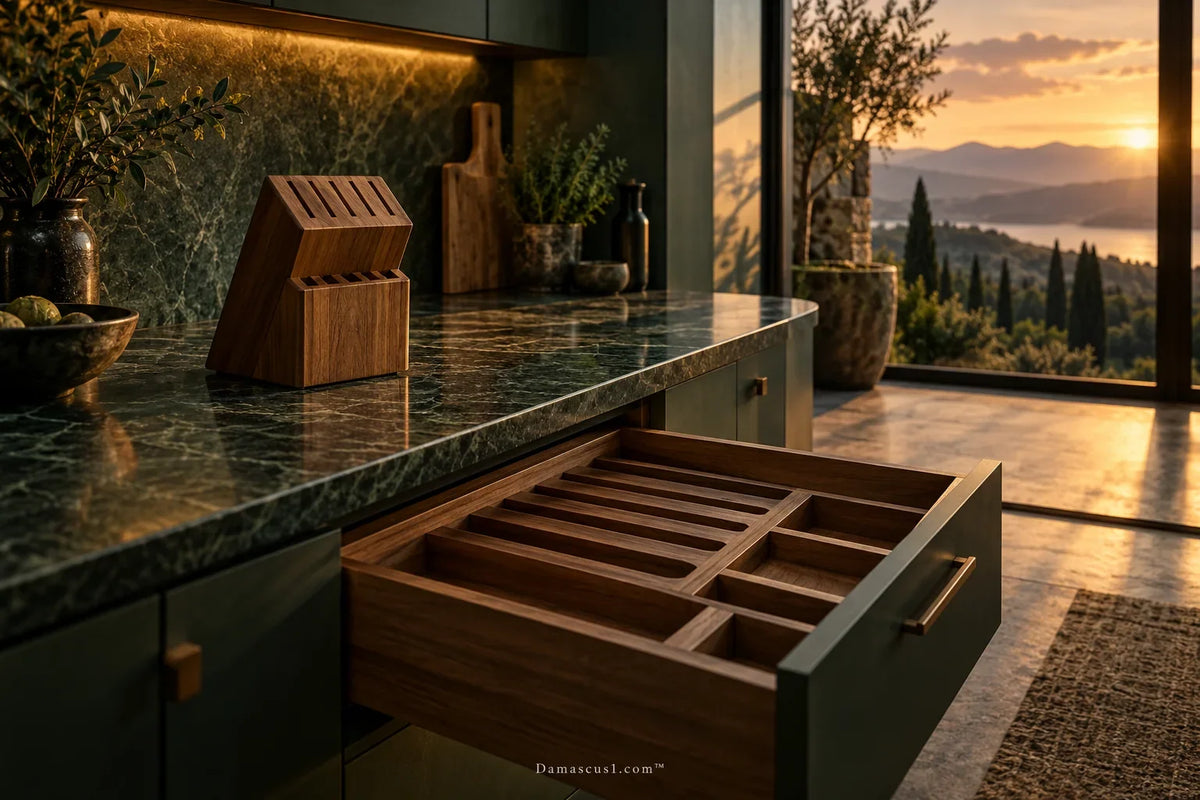
Choose knife storage by measuring the knives, the storage interior and the space needed to remove each knife. A block that fits on a counter can still sit too close to an overhead cabinet. A drawer organizer that fits the drawer can still be unsuitable for the knives you want it to hold. Those are separate checks.
This guide compares a countertop block with a drawer organizer through a practical measurement worksheet. It does not name a universal winner or claim that one format is automatically safer, more hygienic or better for every edge. Product design, correct fit, access, cleaning instructions and the people using the kitchen all matter.
The cover and five interior images are AI-generated editorial illustrations of planning spaces. They are not product photographs, dimension drawings or evidence that a particular Damascus1 knife or accessory fits a pictured block or drawer.
Start with the storage problem you actually have
Write down why the present arrangement needs to change. Perhaps loose tools make the drawer difficult to use, an existing block occupies your preparation space, a newly purchased knife has no suitable protection, or a large set is tempting you to buy storage before you know its contents. Naming the problem prevents an attractive accessory from becoming a second problem.
List the knives you intend to keep, including any specialist tool used only occasionally. Keep kitchen knives, folding knives and display pieces separate in the plan. A closed folding knife has different dimensions and access requirements from a fixed kitchen blade. A presentation box is not automatically appropriate for daily kitchen storage, and a kitchen block is not automatically suitable for an unrelated folding knife.
Identify who needs access. A storage location convenient for one adult may be accessible to a child or awkward for someone with limited reach. Consider visitors, shared kitchens and the possibility that somebody will open a drawer without knowing what is inside. This worksheet helps organize questions; it does not certify a child-resistant installation or replace the storage maker's safety instructions.
Finally, decide whether you need a permanent daily location, transport storage, or occasional protected storage. Do not ask one accessory to perform all three jobs unless the manufacturer explicitly supports those uses. A block, drawer insert, roll, case, sheath and blade guard are different products with different compatibility questions.

Make a knife inventory before measuring furniture
For each knife, record the exact model and any dimensions confirmed by the seller or manufacturer. Important fields can include blade length, overall length, blade height, blade thickness and the handle dimensions relevant to the intended storage design. Record the units and how the dimensions were defined. “Eight inches” alone is not enough if you do not know which part was measured.
Do not handle an exposed edge merely to fill in the worksheet. Use confirmed product information first and request missing dimensions. If a storage maker needs a specific measurement, ask how to provide it safely for a protected item. Keep an unfamiliar folding knife closed and obtain model-specific instructions rather than opening it to imitate a kitchen-knife diagram.
Include accessories in separate rows. A sharpening tool, scissors or sheath may be counted as a piece in a set but require a different storage space. A protective guard increases the dimensions of the object that must fit. Record the dimensions of the complete protected arrangement when that is how the storage product is designed to be used.
Use the inventory to identify missing evidence before buying. If a listing has conflicting contents or material claims, storage compatibility remains unresolved too. A historical URL containing a piece count does not establish the current pack list. Open the listing and ask for a confirmed configuration instead of measuring an imagined set.
Your knife inventory worksheet
| Field | What to record | Source |
|---|---|---|
| Identity | Exact product, model and selected option | Order or manufacturer record |
| Dimensions | Relevant blade, handle and overall measurements with units | Confirmed model information |
| Protection | Required guard or sheath and its outside dimensions | Accessory maker |
| Storage limits | Permitted orientation and compatibility restrictions | Storage maker's instructions |
| Questions | Missing dimensions or contradictory contents | Written enquiry needed |
Measure a drawer as a working space
Measure usable internal width, depth and closed height, following the furniture maker's guidance where relevant. The outside width of a drawer front is not its usable interior. Rails, curved corners, stops, liners, an internal divider and a sloping back can reduce the area available to an organizer. Check the proposed location throughout the drawer's normal movement.
A removable organizer has external dimensions of its own. Its outer footprint must fit the drawer, while its knife channels must suit the intended knives. These are two different compatibility checks. Product photographs and the number of channels do not establish channel depth, handle clearance or whether the design accepts the knife's blade height.
Check what happens when the drawer closes. A handle that fits in an open drawer may sit too high beneath the cabinet frame. A tall guard may change the required height. Do not force a loaded drawer shut to discover a problem. Resolve the organizer's dimensions and loaded clearance before placing knives into it.
Consider movement during ordinary opening and closing. Ask the organizer manufacturer about intended placement and any anti-movement provision. Do not improvise fastening through cabinetry, alter the insert or add an adhesive that could affect cleaning or fit without suitable guidance. A layout that works only when opened unusually slowly may be a poor daily choice.

Check the hand path as well as the footprint
Where will your hand go when reaching for a handle? Will adjacent utensils, the countertop edge or another handle obstruct that movement? Can the intended user see and identify the correct handle before reaching? Leave these as explicit questions in the plan instead of assuming a stated capacity makes the arrangement comfortable.
Do not put unrelated loose utensils around protected knives merely because there is spare space. Follow the organizer's layout and protection instructions. If the proposed configuration creates an uncertain reach, redesign the arrangement before loading it. A drawer's available floor area is not an invitation to fill every remaining gap.
Measure a block in its actual counter location
For a countertop block, record external width, depth and height, including any protruding base or angled support. Then measure the usable counter area where it will stand. Account for the backsplash, nearby appliances and normal preparation work. A block may fit physically while leaving too little practical space for tasks performed beside it.
Next, check the path used to remove the longest compatible knife. An overhead cabinet, shelf or microwave can interfere even if the block sits below it. The required path depends on the block's angle, the knife and the manufacturer's design. Do not invent a universal clearance allowance or assume that block height plus blade length is a reliable formula.
Ask the block maker which slot dimensions and knife forms it accepts. Number of slots, a wide-looking opening and a lifestyle photograph cannot prove compatibility. Blade height, thickness, handle shape and orientation can matter. A block supplied as part of a set should still be identified as the correct block for that option's confirmed contents.
Do not force a knife into a tight slot or use a block as a test fixture. Avoid placing sharp tools into an empty block just to judge its balance. If fit is unclear, obtain the maker's answer before use. Altering slots or adding makeshift dividers can introduce new problems and may change return eligibility.
Account for the kitchen around the block
Consider ordinary splashes, nearby cooking, cleaning access and the route people take through the kitchen. Follow material-specific placement guidance. Do not assume a wood, polymer or metal block tolerates every source of moisture or heat. Moving a block away from a crowded edge may matter more than choosing a more expensive model.
Check whether the block can be cleaned and dried as instructed in the proposed location. If its instructions require a process you cannot conveniently perform, reconsider the purchase. Attractive counter storage is useful only when it fits your daily routine as well as the available space.

Compare the two formats with evidence
| Decision | Countertop block | Drawer organizer |
|---|---|---|
| Space | Counter footprint plus supported withdrawal path | Usable drawer interior plus loaded closing clearance |
| Compatibility | Supported slot and knife dimensions | Supported channel and knife dimensions |
| Access | Reach, overhead obstruction and placement | Visibility, handle access and normal drawer movement |
| Care | How the block is cleaned, dried and positioned | How the insert and drawer are cleaned and dried |
| Cost | Included with confirmed set or separate? | Included with confirmed purchase or separate? |
Use this table to record your constraints rather than assigning a universal score. A small kitchen with a suitable deep drawer may favor one arrangement; shallow drawers and clear counter access may favor another. Neither example establishes what works for a different household or an unmeasured product.
WÜSTHOF's storage guidance discusses options for its knives, including protective accessories. It is a primary example of storage as part of a care system. Follow instructions for your own knife and storage products rather than transferring compatibility claims across brands.
Use a blank fit record
Create one page for each candidate storage product. Write its exact name and source URL at the top, followed by the date checked. Record external dimensions, internal knife accommodation, restrictions and included accessories separately. Mark a missing answer “unconfirmed.” Do not replace that word with an estimate from a photograph.
Add your kitchen measurements. Keep actual measurements and hypothetical planning examples separate. A purely hypothetical drawer measuring 40 cm internally and a hypothetical organizer measuring 38 cm externally leave an arithmetic difference of 2 cm. That subtraction does not prove loaded fit, adequate height, suitable channels or safe access. It is not a specification for anything sold here.
List unanswered questions beneath the numbers. Does quoted drawer height include the liner? Are organizer handles included in its outer width? Does a block measurement include its base? Does storage accept the protected knife or only the uncovered form specified by its maker? A precise question is a better buying tool than a confident guess.
Before purchase, ask the seller to confirm remaining compatibility details in writing. If the maker cannot confirm fit for your exact knife, retain that uncertainty in your decision. Avoid buying an unconfirmed accessory merely to create an experiment that may be expensive or difficult to return.

Save a useful compatibility enquiry
Identify both sides of the proposed fit: “I am considering this organizer for this exact knife model, stored in the configuration your instructions support. My drawer's usable internal measurements are these stated dimensions. Please confirm the organizer's external footprint, required loaded height and supported knife dimensions.” Replace general fields with verified measurements or explicitly mark them unknown.
For a block, ask about the exact slot or supported knife range and removal path in your location. Include relevant counter and overhead constraints. An answer about outer size alone does not answer a question about withdrawing a long knife beneath a cabinet. Keep that distinction in your follow-up.
Retain the answer with the product name and date. If you later change the knife, add protection or move storage, revisit compatibility rather than treating the old answer as universal. This record helps when replacing an item months later and prevents a second accessory purchase based on the wrong dimensions.
Check complete cost and purchase terms
Compare storage cost as part of the whole purchase. A set with included storage and individually selected knives with a separate organizer are different configurations. Count only confirmed included items. Keep storage, protective accessories, shipping and applicable taxes separate so the comparison remains understandable.
The Premium Kitchen Knife Block Set and Kitchen Knife Block Set — German-Labelled Listing contain clarification notes about historical conflicts. Do not infer exact contents, block dimensions, steel grade or handle material from their URLs. Use the set comparison page and ask about your intended option.
As checked on October 23, 2026, the refund policy requires unused original condition, original packaging, intact tags and proof of purchase, describes 30 days from purchase, and says shipping fees are non-refundable. Do not assume trying knives in an incompatible block preserves return eligibility. Ask about your planned inspection before using an uncertain purchase.
The shipping policy makes estimates dependent on availability and selected options and describes destination restrictions and many weight-based rates. Check your checkout and order details. This guide does not promise included storage, free delivery or a particular arrival date.
Plan cleaning without hygiene promises
Storage needs to work with care instructions for both the knives and the accessory. Ask how to clean storage, how it should dry and whether parts are removable. Do not assume a drawer insert or block is dishwasher safe. Material and construction differences can change the correct process.
Do not assume one format eliminates moisture problems or microbial risk. This guide makes no comparative hygiene claim. The practical question is whether you can follow relevant cleaning and drying directions consistently and keep stored tools protected in the supported configuration.
Our kitchen knife care guide collects questions to resolve before choosing maintenance methods. When an order arrives, follow the inspection checklist before use or discarding packaging. A storage decision begins with a correctly identified knife.
Review the arrangement after a kitchen change
A new countertop appliance, drawer liner or cabinet shelf can change the space you measured. Recheck the record when the kitchen changes, and keep the storage in a location supported by its instructions. Do not assume a layout remains suitable simply because the same knives are still present. Photograph an empty planning layout, if helpful, so you can compare the intended clear spaces without handling blades.
For shared kitchens, explain the chosen location and keep the same identification system for infrequently used tools. People should not need to search through unrelated items to discover where a knife belongs. A short household handover about placement and care can be more useful than buying an accessory with a higher stated capacity.

Frequently asked questions
Is a block always better than drawer storage?
No. Compare compatibility, usable space, access and care for the exact products and household. A format name cannot establish suitability. Measure the location and obtain the maker's compatibility guidance.
Do I measure the outside or inside of a drawer?
Use usable internal dimensions and check available closed height for the intended loaded configuration. Outside drawer-front width does not describe storage space. Rails, liners, stops and framing can reduce clearance.
How much space should I leave above a block?
Use the maker's instructions and withdrawal path for the longest compatible knife. Angle, knife dimensions and cabinet placement vary, so there is no universal allowance in this worksheet. Confirm the path before loading.
Can I put a knife into a slot to see whether it fits?
Obtain compatibility information first and never force a knife into a slot. An improvised fit test can create handling risks or change unused condition. Ask about exact dimensions and supported orientation.
Does a seven-piece set mean seven knives need storage?
Not necessarily. Counts can include a block, scissors or accessories. Ask for the exact pack list and record knives separately from storage and maintenance items. Do not infer contents from a historical handle.
Can a drawer organizer hold a closed folding knife?
Only if the maker supports that product and configuration. Kitchen channels are not automatically suitable for folders. Use closed dimensions, appropriate protection and the knife's instructions; keep it separate in your inventory.
Will a guard change the required dimensions?
Protection can change the object's outside size. Record the protected arrangement if that is the intended use and confirm compatibility. Do not assume a channel designed for an uncovered blade accepts a guard.
What if a Damascus1 listing lacks block dimensions?
Use Contact Us to request the exact option's footprint, supported knife dimensions and contents. Keep fit unresolved until answers are available. Do not estimate specifications from an editorial illustration.
Editorial review: October 23, 2026. A planning worksheet, not a dimension certificate or installation safety assessment.
laissez un commentaire: