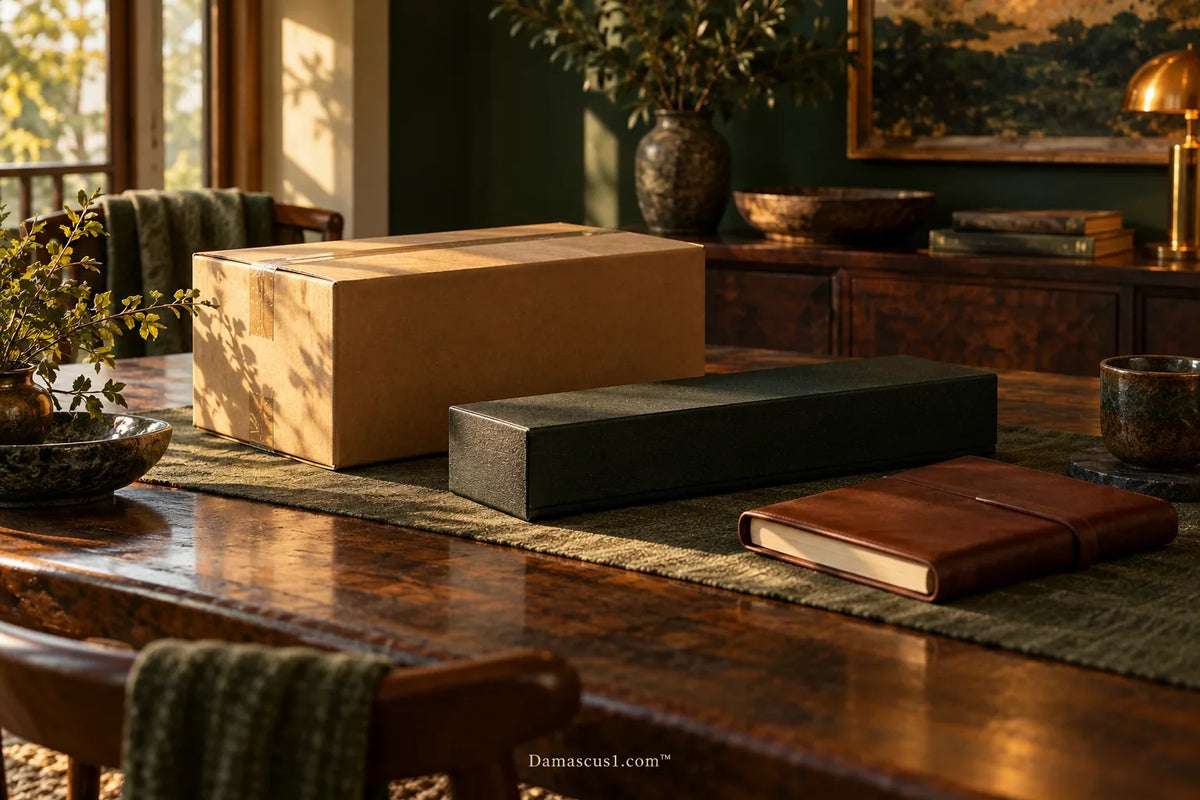
Before you use a newly delivered knife, compare the order with what arrived, retain its packaging, and resolve uncertainty about the model, contents or condition. A quiet inspection is more useful than an improvised cutting test. It creates a clear record while the purchase is still unused and helps you ask the store a specific question.
This checklist covers kitchen knives, knife sets and folding-knife gifts. It is a visual and paperwork check, not a certification of steel, sharpness, locking strength or safety. Do not handle an exposed edge, force a mechanism, dismantle a handle or remove protective components just to complete a checklist. If something looks damaged or unfamiliar, stop and ask for instructions.
All six accompanying images are AI-generated editorial illustrations. They depict a conceptual receiving and planning process, not the packaging, accessories or condition of a particular product sold by Damascus1.com.
Start with the order record
Open your order confirmation and the actual product listing. Save the product title, selected option, quantity, purchase date and order number in one place. A collection photograph, advertisement or saved social post may show a different configuration. The option recorded on the order is a better starting point for discussing what you expected.
Keep a dated copy of the listing information that matters to your choice. Useful details include the stated item count, whether storage is included, the named model, dimensions if provided, and any explicit accessory list. A lifestyle image does not establish that every object in the scene is included. If text and photographs disagree, record the disagreement rather than choosing whichever version looks more favorable.
Also record what you cannot verify. A blank measurement field is more honest than a number taken from another retailer's similar-looking knife. Different models can share a handle color or blade pattern. Do not transfer a steel grade, origin, hardness value or warranty from a visually similar product. Those questions need confirmation for the precise item and option purchased.
A compact order worksheet
- Order number, purchase date and contact email used.
- Product title, product URL and selected variant or option.
- Quantity ordered and separately purchased accessories.
- Explicitly promised contents, with a saved source.
- Dimensions or materials confirmed for that exact option.
- Questions left unresolved before delivery.
- Parcel arrival date and any date you contacted the store.
Keep payment numbers, passwords and unrelated personal information out of photos or messages. An order number and concise description are usually more useful than a screenshot of an entire account page. Use the store's current contact route rather than replying to an unfamiliar message that claims to represent your order.

Photograph the parcel before unpacking further
Set the parcel on a stable, uncluttered surface with good light and keep children and pets away. Before opening it, note visible crushing, moisture, tears or an already-open seam. Photograph the exterior and any relevant damage without exposing your address publicly. An exterior problem does not prove the item inside is damaged, but the record may help explain a later concern.
If the package appears to have an exposed sharp object or unsafe damage, do not continue handling it for the sake of a photograph. Contact the seller or carrier for appropriate next steps. Do not reach blindly into packing material. Avoid using the newly purchased knife to open its own shipping carton; that adds unnecessary handling before you have identified the contents.
As you unpack, keep original inserts, sleeves, tags and boxes together. Photograph the arrangement before moving items if you can do so without exposing an edge or disturbing a protective cover. Do not discard an insert because it looks like spare cardboard: it may explain how the item can be repacked or protect a component during a return.
A short sequence is enough: unopened parcel, visible packaging arrangement, item labels, and the specific issue if one is apparent. You do not need a dramatic unboxing video. Clear context and an ordinary close view communicate more than many near-identical images. Preserve the originals privately so you can provide a better view if the store requests one.
Count the supplied contents carefully
Lay out only the safely accessible, covered components. Compare them with the explicit contents promised for your selected option. Count knives separately from a block, sharpener, scissors, sheath, case or presentation box. A set's advertised piece count may include non-knife accessories, so the total alone cannot establish which cutting tools should be present.
Do not infer a missing knife from an empty block slot without checking the confirmed pack list. Storage products can be designed for more than one configuration. Conversely, a plausible-looking full tray does not prove the correct model arrived. Compare labels and written contents instead of relying on how complete the arrangement appears.
Use three categories: confirmed present, confirmed missing, and uncertain. Put an item in the missing category only when the order or confirmed pack list says it should be included. Put unclear accessories or ambiguous piece counts in the uncertain category and ask the seller. This keeps a useful enquiry precise and easy to answer.
For buying comparisons, the kitchen knife set comparison separates listing questions from verified details. The Premium Kitchen Knife Block Set and Kitchen Knife Block Set — German-Labelled Listing have clarification notes. Read those notes and ask for an exact contents list before treating historical URL wording as a specification.

Check identity and visible condition without performance tests
Look at labels, packaging identifiers and readily visible surfaces while keeping protection in place. Is the received item the option you ordered? Is there obvious transit damage, a damaged case, a visibly displaced component or something that prevents safe identification? Record what you see in ordinary language. “The outer box is crushed on one corner” is more useful than diagnosing an internal manufacturing fault from a distant photograph.
Do not run a finger along an edge to judge sharpness. Do not shave hair, cut paper, strike a hard object, bend the blade, pry with the tip or make a food-preparation trial while deciding whether to keep the item. These actions are unnecessary for an initial order check and can change the condition of a purchase you may want to return.
A pattern on a blade is not proof of a particular steel composition or construction method. A marking cannot by itself confirm heat treatment, hardness, country of manufacture or suitability of an unknown coating. Ask for model-specific documentation where those facts matter to the buying decision. This checklist does not offer an at-home authenticity test.
If you see a possible crack, loose-looking part, damaged edge or unstable component, set the item aside safely and contact the store before use. You do not need to reproduce the suspected problem. Do not tighten, sand, polish, sharpen, oil or repair it while waiting for instructions unless appropriate directions have been supplied for that exact issue.
Extra caution with folding knives
A folding knife may have a mechanism different from one you own. Do not force it open, repeatedly cycle it, defeat a lock or test it against a surface. Identify the model and obtain its instructions first. Keep fingers out of the blade path. If the mechanism seems unfamiliar or abnormal, stop; an order checklist cannot replace operating guidance.
For an unopened gift, you may prefer to leave the knife protected and verify external model identifiers and promised contents with the store. Explain that choice in your enquiry. Do not claim a complete condition assessment when you have deliberately not exposed the item. Preserve the distinction between an unopened gift check and a full model-specific inspection.
Use measurements only when they can be obtained safely
Measurements can clarify a storage question, but they should not turn a receiving check into unnecessary blade handling. Start with confirmed dimensions from the seller. Ask whether a stated length refers to the blade, the full fixed-blade knife, the open folder or the closed folder. A number without its measurement convention may not solve the fit problem.
If the seller requests a measurement or photograph, ask how to provide it while retaining protection. Do not place a ruler across an exposed edge or manipulate an unfamiliar mechanism to satisfy a form. You can often photograph a label, closed case or packaging identifier first and let the seller identify the correct specification.
Record units explicitly and keep external packaging dimensions separate from product dimensions. A long presentation box does not tell you blade length. A block's outside height does not tell you slot depth. If buying storage, wait for required product dimensions and the storage maker's compatibility guidance before assuming the two purchases will fit together.

Read the actual return terms before use
As checked on October 23, 2026, the store's refund policy describes a 30-day period from purchase and requires unused items in original condition, with tags intact, original packaging and proof of purchase. It states that shipping fees are non-refundable. Read the complete current policy and ask about the process for your order; do not assume delivery starts a new 30-day period.
Those conditions make the decision point important. If unsure whether the item matches the listing, ask before trying it in the kitchen or altering its finish. Do not treat “I only used it once” as equivalent to unused condition. This guide cannot approve a return, extend a deadline or promise the result of an individual claim.
Keep the policy wording distinct from a general banner or third-party description. A broad shipping message is not a complete statement of return eligibility or return costs. If two statements appear inconsistent, send the store a specific question and keep its written response with your order record before relying on an assumption.
The shipping policy links estimates to item availability and selected shipping options, describes destination restrictions, and notes weight-based rates in many cases. It does not establish a universal arrival date. Keep shipping questions tied to your destination, order and selected method rather than another customer's experience.
Send one useful enquiry
Use Contact Us and identify the order, exact product and selected option. Explain the observation, the source of your expectation, and the answer you need. Attach a small number of relevant photographs if requested or supported. Retain your message and date sent. Avoid including unnecessary financial or identity information.
For example: “My order lists this product and option. The saved listing describes these included items, but I can identify only these covered components in the parcel. I have not used the purchase and have kept its packaging. Please confirm the intended pack list and advise the next step.” Replace every general field with facts from your order.
When a listing uses conflicting material names, ask a narrow question: “Which blade material and handle material apply to the option on my order?” For a fit question, ask for blade length, overall length and the relevant maximum dimensions in stated units. For accessories, ask whether the named sheath, case or block is included.
A written clarification is useful only if it answers the question. If a response describes another model or repeats an ambiguous count, restate the missing detail. Ask whether the response applies to your selected variant. Keep a screenshot or copy of the answer so the order record stays understandable if someone else handles a follow-up.

Plan care after the keep-or-return decision
Once the order is identified and you have decided to keep it, use the care instructions supplied for the exact product. Confirm cleaning, drying and storage requirements rather than assuming all patterned blades, handles, sheaths or blocks tolerate the same treatment. Keep proof of purchase and the instructions where you can find them later.
WÜSTHOF's own guidance, for its products, emphasizes gentle hand cleaning and prompt drying and describes protective storage options. That provides context for asking care questions, but cannot replace instructions for an unrelated model. See its cleaning guidance and storage guidance for the original scope.
Our kitchen knife care guide provides questions to resolve before choosing maintenance tools. For storage, use the block versus drawer worksheet. Neither a generic care guide nor an attractive storage photograph confirms compatibility with a particular knife.
Keep a useful record for a gift recipient
If this is a gift, pass on the exact model information, confirmed contents and instructions without exposing payment details. Tell the recipient whether you left the product unopened or completed only an external check. Include the relevant contact route and the purchase date so a question can be raised promptly. Do not promise a longer return window or warranty than the store has actually confirmed.
For a gift sent directly to another address, agree who will keep the packaging and contact the seller if something is unclear. The purchaser may need to provide the order details. A simple handover prevents the recipient from discarding useful paperwork while the purchaser assumes it is still available. Keep personal addresses private when sharing parcel photographs.
A final seven-point receiving checklist
- Save the order, selected option and relevant listing details.
- Record arrival and visible exterior condition without unsafe handling.
- Retain original packaging, protective parts, tags and proof of purchase.
- Compare covered components with the confirmed pack list.
- Separate observations from unverified material or performance claims.
- Read current return terms and ask about uncertainty before use.
- After deciding to keep the item, confirm its operating, care and storage instructions.
The goal is a confident next step: keep a correctly identified purchase with suitable instructions, or obtain help while the order remains in its original condition. A checklist cannot make a seller's decision or certify a knife. It can make your observations precise and your enquiry easier to answer.

Frequently asked questions
Should I cut something before deciding whether to keep a new knife?
Use a visual and order-record inspection first. Cutting changes an unused purchase into a used one and is unnecessary for checking the model, promised contents or visible shipping damage. If concerns remain, ask the store for instructions before use.
Does an empty block slot prove a knife is missing?
No. Compare supplied components with the confirmed pack list for your option. A block may accommodate several configurations. Record an uncertain slot as a question until the seller confirms which items should be included.
Can I identify steel grade from the Damascus pattern?
No. A visible pattern does not independently establish composition, hardness, heat treatment or manufacturing origin. Request documentation for the exact model if those facts determine whether the purchase meets your needs.
Should I discard packaging once the parcel looks fine?
Keep it while checking the order and deciding whether to keep the purchase. The current return policy requires original packaging and unused original condition. Packaging also preserves context for missing-item or transit-damage questions.
Does the store's 30-day return period start on delivery?
The policy checked on October 23, 2026 says 30 days from purchase. Read its current complete wording and contact the store promptly about your order. Do not assume a later start date or extension.
What if the title and description disagree?
Save both and ask which specification applies to your option. Do not borrow details from another listing. Keep the purchase unused while a material, contents or return-eligibility question is clarified.
Can a review tell me what my parcel should contain?
A genuine model-specific review describes one customer's experience. It does not replace your order's confirmed contents or current terms. Check the date, product and selected option before treating a review as relevant context.
Where should I start before ordering?
Use the kitchen set comparison for sets or the pocket knife gift finder for gifts. Open the product page, resolve uncertain specifications and check current policies before placing an order.
Editorial review: October 23, 2026. Current policy wording and order-specific instructions govern individual enquiries.
laissez un commentaire: