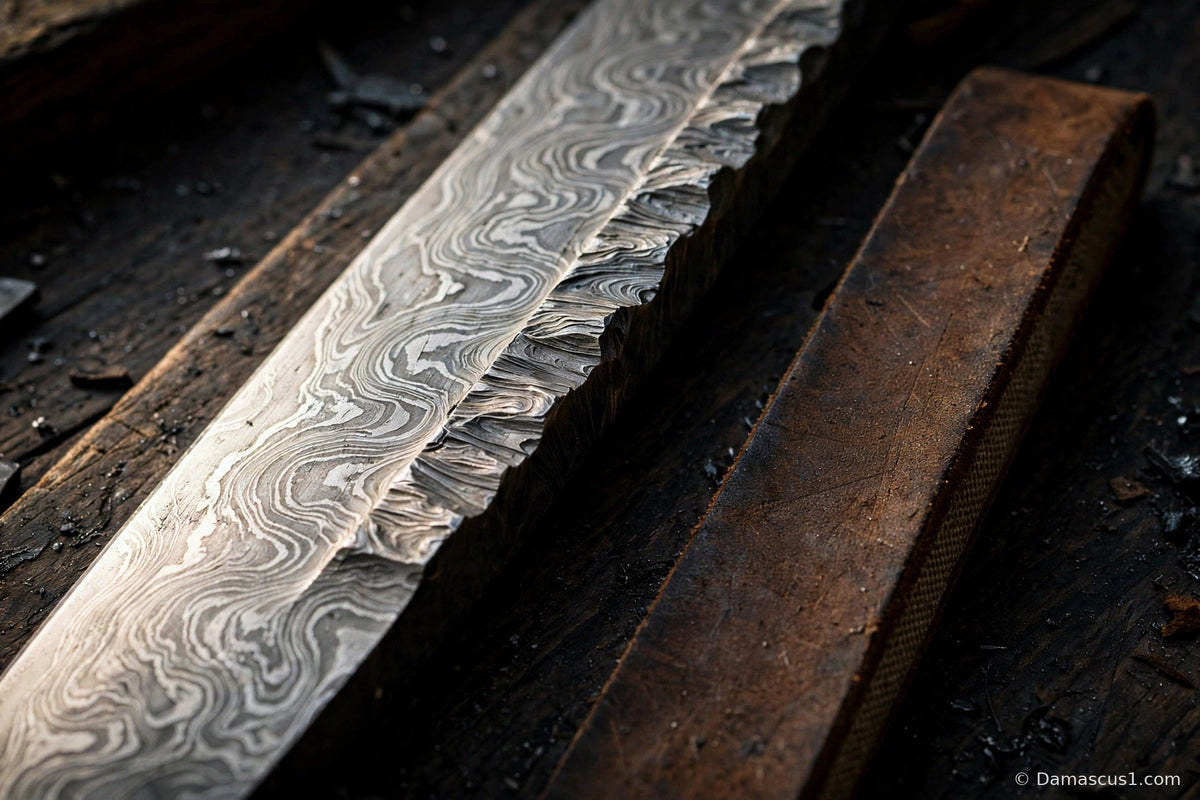
The short answer: Real Damascus is pattern-welded steel — layers forge-welded together, so the figure runs over the spine, down to the edge, and survives a lifetime of sharpening. Fake Damascus is a surface pattern printed or etched onto plain steel: it stops at the edge, repeats like wallpaper, and wears away. The tests below separate them — none is magic alone; together, they're decisive.
Every Canadian who has shopped for a Damascus knife has met the same fog. A $27 listing with swirls that photograph beautifully. A $169 premium blade with swirls that photograph beautifully. A forum thread saying everything under a hundred dollars is fake, full stop. Another saying price proves nothing. Both can't be the whole story — and the reason the argument never settles is that "Damascus" describes two completely different physical things wearing the same photograph.
The first is a structure. Pattern-welded steel: a stack of two different steels, forge-welded into one billet, folded and drawn out again and again until the billet holds hundreds of layers, then ground into a blade. The pattern you see is the cut edges of those layers, revealed when acid etches the two steels at different rates. The figure is not on the blade. The figure is the blade, all the way through.
The second is a finish. Plain, ordinary steel — sometimes decent steel, sometimes not — with a pattern applied to the surface: laser-etched, printed, or acid-drawn through a mask. It can be handsome. It photographs identically at thumbnail size. And it ends exactly where the surface ends, because there is nothing underneath it.
This guide is the Canadian edition of the test-by-test separation: what to look at (spine, edge, choil), what to do (sharpen, polish, re-etch — in principle), what to ask a seller, and what to make of the price argument, including the loudest version of it — the claim, published by a major knife retailer, that a Damascus folder under $50 is "almost certainly fake." That claim deserves an honest answer, not a defensive one, and it gets one below — from cost structure, with our own knife's steels, layers and hardness stated in the open where they can be checked. No test in this guide is presented as foolproof, and no named seller is accused of anything. Bring the tests; judge every knife — ours included — by what they show.
What is real Damascus steel, physically?
Two steels, welded into one piece of metal, folded until the layers number in the hundreds. The classic pairing — and the pairing in the knife this guide uses as its worked example — is 1095 and 15N20. 1095 is a hard, high-carbon steel that etches dark. 15N20 contains nickel, resists the etch, and stays bright. Forge-weld them, fold the billet, draw it out, fold again, and the finished blade is a laminate: hundreds of alternating microscopic strata of a dark-etching steel and a bright one. Grind the blade, polish it, dip it in etchant, and the strata reveal themselves as the flowing figure — dark rivers where the 1095 surfaces, bright banks where the 15N20 does. The contrast is not decoration applied to the steel. The contrast is the two steels, side by side, through the full thickness of the blade.
Three consequences fall out of that structure, and every test in this guide is one of them wearing work clothes. First, continuity: because the layers run through the whole billet, the pattern appears everywhere the surface cuts across them — the flat, the spine, the edge bevel, the choil. It changes character with the angle of the cut, the way wood grain does, but it never simply stops. Second, irregularity: a folded billet stretches and compresses as it is worked, so the figure flows, tightens, widens — and never repeats exactly, on one blade or between two blades from the same billet. Third, permanence: sharpen the blade and you expose fresh layer edges; polish and re-etch and the figure returns, because etching reveals the structure — it does not create it. A real Damascus blade carries its pattern the way a tree carries grain. You can sand the surface; the grain is still in the wood.
Our worked example, stated for the record and open to every test below: the Olive Wood Damascus Pocket Knife Set at $39.99 USD (compare-at $89.99) is forge-welded 1095 and 15N20 at roughly 276 layers, hardened to 58–60 HRC, with an olive wood handle and a manual two-hand nail-nick opening with a back-lock. Named steels, a named layer count, a named hardness range. A seller who will not name the steels is asking you to buy the photograph instead of the blade — remember that when the asking section arrives.
What is fake Damascus, physically?

A surface, with nothing under it. The methods vary — laser etching that burns a pattern into the top microns of the steel, printing processes, acid etching through a patterned mask — but they share one physical fact: the figure lives only where it was applied, on the flat of the blade, at surface depth. The spine is plain because nobody applied anything to the spine. The edge bevel is plain because grinding and sharpening would remove the finish, so the finish politely stops before it. And the figure repeats — the same swirl, the same spacing, knife after knife — because a mask or a laser file has no reason to improvise.
None of that makes a surface-patterned knife useless. It will cut parcels and tape. The offence is not the knife; it is the word. A buyer who pays for pattern-welded steel and receives printed steel has been sold a photograph — and in Canada the fog is thicker than most places, because so much of the market here is cross-border and marketplace listings where the blade arrives after the money leaves. That is why this guide is organised as tests: things you can check in photographs before you pay, and things you can check on the bench after it arrives, in the order a Canadian buyer actually meets them.
Test 1 — Does the pattern continue over the spine and down to the edge?
This is the single most useful check, and the one every serious guide — from steel specialists to master knifemakers' own explainers — puts first. Turn the blade over in your mind: forget the flat, which is the billboard, and look at the spine (the thick back of the blade) and the edge bevel (the ground slope that ends at the cutting edge). On pattern-welded steel, the layers run through the whole billet, so the figure must appear there too — compressed on the spine, stretched on the bevel, but present and flowing. On a surface fake, the pattern was applied to the flats, and the spine and edge are where the application stops: plain steel, a hard line, the decoration ending like paint at a skirting board.
Seller photographs will try to keep you on the flat. Ask — or look — for the angles they avoid: a spine shot, an edge shot, the choil where the pattern should dive into the unsharpened notch. A seller of the real thing photographs the spine proudly, because the spine is the proof. In this guide's own cover image the pattern is shot along the spine for exactly that reason. One honest caution, because this guide makes it everywhere: a determined faker can etch a spine too, and a heavily polished real blade can photograph faintly. No single test is a verdict. The spine test is the strongest first filter the buyer has — and fakes fail it constantly, because most surface patterns were never applied where buyers forget to look.
Test 2 — Does the pattern repeat like wallpaper?
Real folded steel cannot repeat itself. The billet was stretched by hand and hammer; the layers wave, pinch and wander; two blades ground from neighbouring sections of the same billet are cousins, not twins. So lay two photographs of the same model's blade side by side — marketplaces make this easy, since they show you ten listings of the identical knife. If the same swirl sits in the same place at the same size on knife after knife, you are not looking at folded steel. You are looking at a file — a laser program or a printed mask, stamping the identical figure onto blade after blade.
The subtler version lives on a single blade: a printed pattern often tiles within the flat, the same motif recurring at regular intervals like wallpaper in a hallway. Layered steel has rhythm, but it is the rhythm of a river, not a tiled floor — motifs stretch and compress as the metal moved. When in doubt, compare the blade against its own spine: the spine's compressed figure should rhyme with the flat's flowing one, because they are the same layers cut at different angles. A flat that tiles and a spine that is blank are two failures telling the same story.
Test 3 — What happens at the edge when the knife is sharpened?

Sharpening is the fake's deadline. Every sharpening removes steel at the edge and exposes the metal beneath the surface — and beneath a surface pattern there is no pattern. The figure near the edge fades, scratches thin, or simply ends where the stone has been, because the decoration was only ever skin-deep and the skin is gone. This is why owner forums fill with the same sad photograph: a "Damascus" blade, six months old, whose pattern stops a centimetre above an edge that sharpening has quietly stripped bare.
Real layered steel behaves the opposite way. The layers are the edge — 1095 and 15N20 alternating at microscopic scale, which is incidentally why pattern-welded edges have their admirers: the two steels wear at slightly different rates and some users swear by the faint micro-texture that gives. Sharpen a real blade for a decade and the figure is still there at the edge, because you cannot sharpen your way out of a structure that goes all the way through. The practical buyer translation: ask the seller, in writing, what sharpening does to their pattern. The honest answer for real Damascus is "nothing — it sharpens like steel, because it is steel, all the way down." Evasion on this question is information. Our own sharpening walk-through — grits, angles, and how to work a whetstone without sanding the flat's figure — lives in how to sharpen a Damascus knife, and the care rules that keep layered steel bright live beside it in the Damascus folding knife care guide.
Test 4 — Polish and re-etch: does the pattern come back?
The connoisseur's test, and the one that explains the whole physics in a single gesture. On real Damascus, the figure is contrast between two steels — so if you polish the blade bright, until the pattern nearly vanishes, and then re-etch it, the figure returns: the acid bites the 1095 darker and leaves the nickel-bearing 15N20 bright, and the layers announce themselves again, because they never went anywhere. Etching reveals structure; it does not create it. Specialist FAQs describe exactly this — sand past the etch, re-etch, and a real blade re-draws its own map.
On a fake, the same sequence is a one-way door. Polish off a laser or printed pattern and there is nothing underneath to reveal; re-etching plain steel gives you plain darkened steel. This is not a test to run casually on a knife you love — polishing and etching are workshop operations, and this guide describes the principle rather than inviting you to experiment on a gift. But as a question it is devastating and fair: "If the pattern were polished off, would re-etching bring it back?" A maker of real pattern-welded steel answers yes without blinking, because the answer is the definition of what they sell.
Test 5 — Can you feel it, and what does the seller actually claim?

Run a fingertip — carefully, across the flat, never along the edge — over a real etched blade and many people can feel the faintest topography: the two steels etch to microscopically different depths, so the figure has a whisper of relief, like grain in wood you can sense under varnish. A printed or lasered surface is dead flat by comparison. Treat this as the weakest test in the set — finishes vary, coatings interfere, and fingertips disagree — but as one signal among five it points the way the others do. Master-maker guides list continuity, variation and this feel together, alongside the last and most human test: scepticism about the story. Does the seller name the steels? State a layer count? Give a hardness? Describe the process in words that could be wrong — or only in adjectives that can't? "Genuine Damascus style" is a phrase built to survive a complaint. "Forge-welded 1095 and 15N20, roughly 276 layers, 58–60 HRC" is a claim built to be checked. Sellers of the real thing make checkable claims because checkability is their whole advantage. Our full-length companion — how to spot a fake Damascus knife — goes deeper on the listing-photography tells, and whether layered steel can rust (it can, and the honest care answer) is covered in can Damascus steel rust.
The real-vs-fake checklist: every test on one card
This is the original asset this guide exists to leave behind — the five tests, what real steel shows, what a fake shows, and where a Canadian buyer can run each one. Screenshot it; it works in a listing, in a store, and on your own bench.
| Test | Real pattern-welded Damascus | Surface-pattern fake | Where you run it |
|---|---|---|---|
| 1. Spine & edge continuity | Figure flows over the spine and down the bevel; present at the choil | Pattern stops at the flat; spine and edge plain | Listing photos — demand spine/edge angles; in hand on arrival |
| 2. Repetition | Motifs stretch, compress, never repeat exactly — blade to blade or within one flat | Same swirl tiles across blades and often within one flat | Compare multiple listings of the same model |
| 3. Sharpening survival | Pattern persists at the edge for the blade's life; layers are the edge | Figure fades/strips near the edge as the stone removes the surface | Ask the seller in writing; your own whetstone over time |
| 4. Polish + re-etch | Polished bright, then re-etched, the figure returns — etch reveals structure | Polished off is gone; re-etching plain steel reveals nothing | A question to the maker (a workshop test, not a kitchen one) |
| 5. Feel + seller's claims | Faint etched topography; seller names steels, layers, hardness | Dead flat; seller offers adjectives — "Damascus style," no steels named | In hand; and in the listing's own words, before you pay |
No single row is a courtroom. Five rows pointing the same way are as close to certainty as a buyer gets without a laboratory — and any knife that passes all five, at any price, has earned the word on its listing.
"A Damascus folder under $50 is almost certainly fake" — is that true?

Now the loud claim, taken seriously. A major knife retailer's guide argues that genuine pattern-welding is labour-intensive — which is true — and concludes that a Damascus folder under $50 is almost certainly fake. The first half is physics and forge time, and this guide agrees with it completely. The conclusion, though, smuggles in an assumption: that every knife's price is built the same way. It isn't. Price is process plus structure — and structure is where the money actually goes.
Walk a retail knife's price up its staircase. The maker's cost is the ground floor. Then an importer takes a margin, a distributor takes a margin, a retailer takes a margin, and the shelf in a high-street store takes its rent out of the same blade. The $150 retail Damascus folder is not $150 of forge work; it is perhaps a third forge and materials, and two-thirds staircase. Now remove the staircase: a maker-direct store, selling its own knives from its own site, in USD, with no importer, no distributor and no shelf. The same forge hours cost the same — but the buyer is no longer renting three businesses on the way to them. That is the entire arithmetic behind our hero: the Olive Wood Damascus Pocket Knife Set at $39.99 USD (compare-at $89.99) — forge-welded 1095 + 15N20, ~276 layers, 58–60 HRC, a simple traditional design (one blade, a back-lock, a nail nick, a wooden handle) with no bearing engineering, no machined exotic materials, and no distribution staircase inside the price.
State the honesty limits as loudly as the answer, because they are part of it. This is a cost-structure argument, not a quality-equivalence claim: a $39.99 USD maker-direct folder is not thereby the equal of a $169 premium folder in fit, finish or engineering, and this guide claims no such thing. Price alone proves nothing in either direction — a fake can be sold expensively and real steel sold directly — which is precisely why this guide is built on tests, not price tags. Run the five tests on our knife. Run them on the $169 one. Run them on the $27 one. The tests are the argument; the price is just a number that cost structure can explain.
What should a Canadian actually buy — and what does the rest of the shelf look like?
| Pick | Price (verified / at-check) | Best for |
|---|---|---|
| Olive Wood Damascus Pocket Knife Set — forge-welded 1095/15N20, ~276 layers, 58–60 HRC, olive wood, two-hand nail-nick, back-lock | $39.99 USD (compare-at $89.99) | Best testable value — named steels and layer count, a spine that carries the figure, and a maker-direct price explained in the open |
| Orange Wood 6.5″ Hunting Pocket Knife | $39.99 USD | Best variation — the same handmade folder idea in a warmer orange wood handle, for the buyer who wants the pattern with a different grain story |
| VG10-Labelled Nakiri Knife | $44.99 USD | Best for the kitchen test-bench — layered Damascus in cook's form; run the spine and edge tests on a blade shape where the flat is huge and the proof is easy |
| Premium Kitchen Knife Block Set (7-pc) | $169.99 USD | Best step-up — seven blades to test instead of one; the figure should survive every whetstone session across the set |
| Marketplace "Damascus" deal class | $26–$29 at check (Day-1 teardown) | Best disposable pick — buy it as a patterned tool if you like it; don't pay for a structure the tests would need to prove |
Two companions keep this guide honest about scope. The authenticity question sits inside the bigger Canadian buying question — routes, border mechanism risk, whole cross-border cost — which the Day-1 hub, Damascus pocket knife in Canada, covers in full; and if the knife you're testing is a gift candidate, Damascus knife gifts for men in Canada walks the occasions. One more sibling is planned from today's set — the Canadian knife-law guide — and its link joins this page when it is live. [PLANNED link — not a live URL yet.] The wider category, for readers who want it, is in best Damascus pocket knife.
How do the tests change by buying route in Canada?
The five tests are physics, but when you can run them depends on how you buy — and in Canada that timing is the whole game, because so many purchases conclude before the blade is ever in your hand.
In a Canadian store, in person: you are in the strongest position and should act like it. Spine and edge inspection takes ten seconds with the knife in your hands; the feel test is free; a good retailer will talk steels and sharpening without changing the subject, and will often have a stone in the building. If a brick-and-mortar seller balks at a spine look, that balk is the test result. Ordering from a maker's own store online (the route of this guide's worked example): your tests move upstream into questions and photographs. Demand the spine, bevel and choil shots; get the steels, layers and hardness in writing on the product page — ours are printed on it: 1095 and 15N20, ~276 layers, 58–60 HRC, $39.99 USD — and run tests 1, 2 and 5 the day the parcel lands, while the purchase is fresh. Marketplaces and bulk imports: the weakest position, and the one where test 2 (repetition across listings) was invented. Ten identical listings of the identical knife is a gift of information: compare the swirls across them. If they tile, you have your answer before money moves — which is fortunate, because after money moves across a border, your leverage largely has too.
There is a fairness point worth making while routes are on the table. "Damascus-style" honestly labelled — a surface pattern sold as a surface pattern, at a surface-pattern price — is not a scam; it is a finish, and some buyers want exactly that: the look, on a tool they'll abuse. The offence this guide polices is narrower and specific: structural language ("layered," "folded," "pattern-welded," layer counts) attached to a knife that fails structural tests. Read listings for that distinction and the market gets much less foggy, at every price, in every country.
What about kitchen Damascus — do the same tests apply?

Yes, with one adjustment of emphasis. A kitchen blade's flat is enormous, which tempts buyers to judge by the billboard — resist it twice as hard. The spine of a chef's knife or nakiri is thick and unmistakable, and layered figure should march across it from handle to tip; the edge bevel on a thin kitchen grind is where surface patterns most obviously give up, because kitchen sharpening is frequent and the stone tells the truth early. Canadian kitchen buyers meet the same fog through different doors — VG10-labelled blades whose "Damascus" cladding is a genuine layered jacket over a core steel (a legitimate, traditional construction when described as what it is: layered cladding, named core) versus printed lookalikes borrowing the same vocabulary. The question that separates them is the same one as everywhere in this guide: does the seller name the construction precisely enough to be wrong? "67-layer cladding over a VG10 core" can be checked. "Real Damascus blade" with no structure named cannot. Our own kitchen example is listed with its construction in its name — the VG10-Labelled Nakiri Knife at $44.99 USD — and for a working set, the Premium Kitchen Knife Block Set (7-pc) at $169.99 USD gives you seven blades to run the card on. Precision in language is the tell, in the kitchen as at the campsite: the real thing is always described more specifically, not less, because specificity is what the real thing has to sell.
The Olive Wood Damascus Pocket Knife Set — $39.99
Real Damascus steel, an olive wood handle and a genuine leather sheath included — the knife our readers ask about most.
Shop the Olive Wood Damascus Pocket Knife Set — $39.99 · Free US shipping on orders over $50.
Frequently asked questions
How can you tell if Damascus steel is real or fake?
Run the five checks together: the pattern continues over the spine and down to the edge on real layered steel, but stops at the flat on a fake; real figure never repeats exactly, while printed patterns tile; a real pattern survives sharpening for the blade's life, while a surface pattern strips near the edge; polished off and re-etched, real contrast returns because etching reveals structure; and a real seller names the steels, the layer count and the hardness. No single test is foolproof — the five together are decisive.
Does real Damascus pattern go all the way through the blade?
Yes — that is the definition of pattern-welded steel. Layers of two steels are forge-welded into one billet and folded, so the layers run through the full thickness. That is why the figure appears on the spine, the bevel and the choil, and why it survives sharpening: every fresh surface the stone exposes is layered steel too.
What steels are real Damascus made from?
Commonly a high-carbon steel paired with a nickel-bearing one, because the nickel steel resists etching and stays bright — the contrast is the two steels reacting differently. The knife used as this guide's worked example is forge-welded 1095 (hard, dark-etching) with 15N20 (nickel-bearing, bright), at roughly 276 layers and 58–60 HRC. A seller who cannot or will not name the steels is giving you the most useful answer of all.
Is a cheap Damascus knife always fake?
No — and an expensive one is not automatically real. Price is process plus distribution structure. A maker-direct store removes the importer-distributor-retailer staircase, so real pattern-welded steel can honestly reach a $39.99 USD price in a simple traditional design — without that claiming equivalence to premium folders' engineering or finish. Judge by the tests, not the tag: spine continuity, repetition, sharpening survival, re-etch logic, and whether the seller names checkable facts.
Can you restore a faded Damascus pattern?
On real layered steel, yes, in principle: careful polishing followed by re-etching reveals the layer contrast again, because the structure is in the metal. It is a workshop job, not a kitchen-table one, and this guide recommends learning it on something expendable first. On a surface-pattern fake there is nothing to restore — once the applied figure is worn or polished away, the plain steel underneath has no pattern to reveal.
Does fake Damascus still cut?
Usually, yes — plain steel with a surface pattern can be a serviceable blade for parcels and tape. The problem is not usefulness; it is the description. Paying pattern-welded prices for printed steel is the harm, which is why the tests matter at the moment of choosing, not after. Buy a patterned tool knowingly at a tool price if you like it — just don't let a listing sell you a structure that isn't there.
How do you test a Damascus knife before buying online?
Ask for the photographs the listing avoids: the spine, the edge bevel, the choil. Compare the blade against other listings of the same model for tiled repetition. Ask in writing what sharpening does to the pattern, and what steels, layer count and hardness the blade is. Sellers of real layered steel answer with specifics and spine photos; evasion is itself a test result.
Is Damascus steel better than stainless steel?
Different, not simply better. Pattern-welded carbon steels like 1095 + 15N20 take a keen edge and carry the layered figure, but they ask for care — washed, dried, oiled for storage — where stainless shrugs off neglect. The full honest comparison, including rust behaviour, lives in our care and rust guides linked from this page; the short version is that Damascus rewards an owner who maintains tools, and stainless forgives one who doesn't.
The last word: test the steel, not the story
Every fake in this market is sold the same way: with a photograph of a flat, a famous word, and a price that asks no questions. Every real blade can be sold the opposite way: with a spine photograph, named steels, a layer count, a hardness range, and an invitation to sharpen it for ten years and watch the figure stay. That asymmetry — who invites the tests and who avoids them — is the whole market in one sentence. The Olive Wood Damascus Pocket Knife Set at $39.99 USD is offered here on exactly those terms: 1095 and 15N20, ~276 layers, 58–60 HRC, a figure that runs over the spine and down to the edge — and a standing instruction to run every test in this guide on it, and on anything else you're considering, before the money moves. Real steel has nothing to fear from a checklist. That is rather the point of one.
laissez un commentaire: