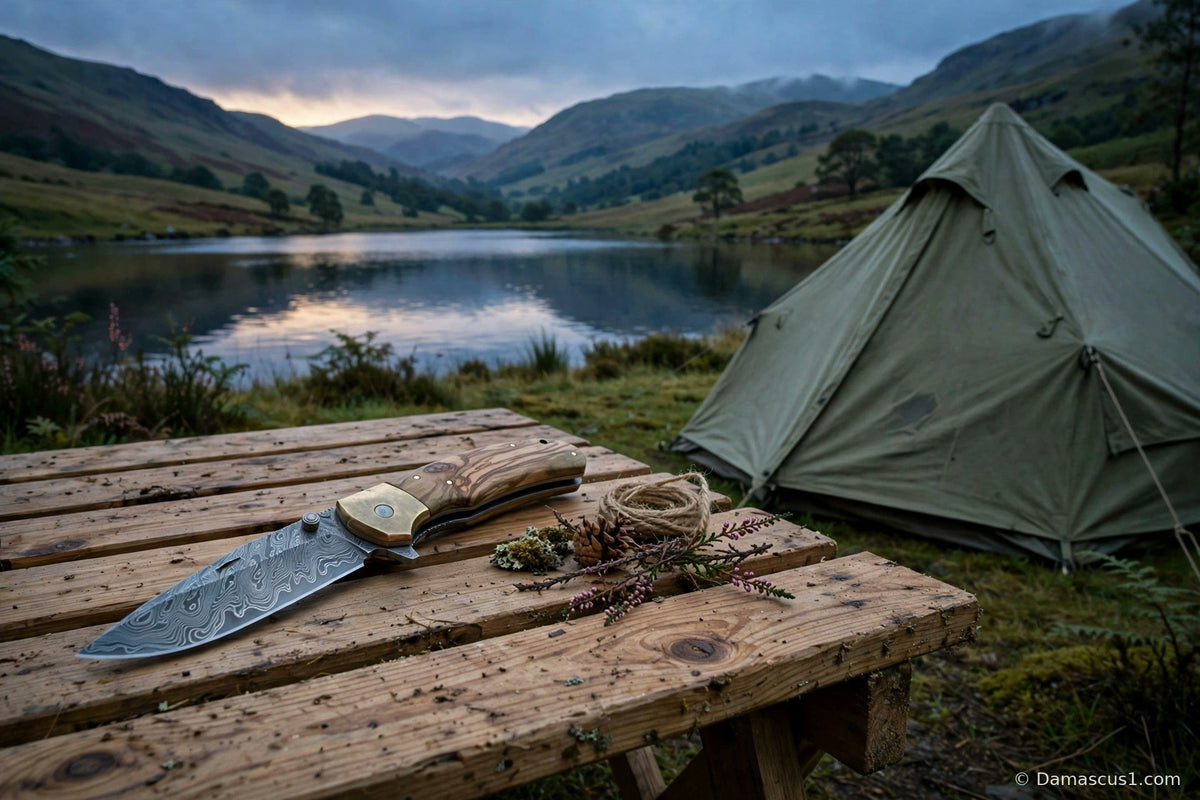
The short answer: For most UK campers, the best Damascus knife for camping is a mid-size folding knife you carry packed with your camp kit and reach for all weekend — cutting cord, prepping food, trimming stakes and shaving feather sticks — backed, if your trips involve serious fire and kitchen work, by a fixed blade for the heavy jobs. In the Damascus1 range that means the Olive Wood Damascus Pocket Knife at $39.99 USD as the camp folder, with the Camel Bone Fixed Blade at $69.99 USD as its heavier partner.
"Camping knife" is one of those phrases that conceals an argument. To a bushcraft instructor it means a fixed blade of a particular Scandinavian pattern. To a family camper it means whatever opens the sausage packet and cuts the guy rope that came too long. To a collector it might mean the beautiful folder that comes on trips because trips are where beautiful tools earn their keep. The round-ups read for this page mostly dodge the argument by listing products; the UK outdoor holders in this teardown — Perkin Knives' UK outdoor list among them — at least organise their picks by camp job, and Damascus1's own live camping guide, which sits on page one for this very search, makes the honest structural point this page builds on: a folder does most camp jobs brilliantly, has real limits, and pairs with a fixed blade rather than pretending to be one. This guide is the UK edition of that argument, written for British campsites, British weather and British law. It works through what a camping knife actually does all weekend, where a Damascus folder beats everything else in the rucksack, where a fixed blade takes over, what carbon Damascus asks of you in a wet field, and — threaded through every section rather than bolted on at the end, because in the UK it shapes every decision — the good-reason framing that makes carrying either knife lawful: genuine camp use, happening now, with the knife packed away in your kit whenever it is not in your hand. Nothing on this page is legal advice; it is general information, and the law holders cited were read in full.
What jobs does a camping knife actually do all weekend?

Fewer dramatic ones than the marketing suggests, and more small ones than anyone counts until the knife is missing. Walk a real British camping weekend in order. Arrival: cutting the cable ties and tags off new kit, trimming a groundsheet, slicing the tape on the box the stove came in. Pitching: cutting guy line to length, trimming a tent peg's burr, shaving a wooden stake to fit a loop. Cooking, twice or three times a day: opening packaging, slicing onions, peppers, cheese, sausage and bread, spreading, stirring-adjacent scraping, cutting butcher's string, portioning cooked meat. Fire: shaving feather sticks, trimming kindling to size, cutting cord for a pot hanger — light wood work, done with the grain, at modest force. Around camp: opening a blister pack of plasters, cutting tape for a repair, trimming a frayed strap, whittling something pointless and pleasant while the kettle boils. Departure: cutting down the tangled guy lines that will not untie, opening bin liners, freeing the peg that only a blade under its head will shift. Not one job on that list requires a survival knife. Every one of them is done better by a sharp, handy, mid-size blade than by a heavy one — and the list itself is the first buying guide: choose the knife that does the ninety per cent beautifully, and be honest about the ten per cent it should not attempt.
That honesty has a hard edge, and the holders state it without flinching. A folding knife should never be asked to pry with its tip, hammer its spine through hardwood, or take sideways force at the pivot. Batoning — splitting wood by striking the spine of a blade laid across a log — is a fixed-blade job, full stop: a folder's pivot and lock are not built for it, and a lock stressed sideways is a lock learning to fail. The camping question is therefore never "folder or fixed?" in the abstract. It is "which of my camp jobs are heavy jobs?" For the tent-and-car camper whose fire comes from a bag of kiln-dried logs and whose cooking is a two-burner stove, the answer may be none, and a folder alone is a complete and rational kit. For the woodland camper processing found wood and cooking over flame, the heavy jobs are real, and the fixed blade earns its weight. The citable checklist below scores the weekend's jobs against both formats.
| Camp job | Damascus folder | Fixed blade | Notes |
|---|---|---|---|
| Opening packaging, cutting cord and guy line | Excellent | Good | The folder lives in the kitchen box, always to hand |
| Food prep — vegetables, cheese, bread, cooked meat | Excellent | Good | Folder's fine edge and light weight win over a long weekend |
| Feather sticks and light kindling trimming | Good | Excellent | With the grain, modest force; the fixed blade is faster |
| Splitting wood / batoning | Never | Excellent | A folder's pivot and lock are not built for it |
| Heavy camp kitchen work (jointing, long sessions) | Fair | Excellent | Fixed blade's full handle and no pivot to tire |
| Whittling and small craft | Excellent | Good | Folder's control and fine point suit small work |
| Repairs — tape, straps, blister packs | Excellent | Fair | Small blade, precise tip; the folder is the handier tool |
| Carrying packed in kit | Excellent | Good | Folder folds away flat; fixed blade needs its sheath |
| Field care in wet weather | Fair | Fair | Both are carbon Damascus here: dry and oil, either way |
Why does a Damascus folder suit most British camping so well?

Because most British camping is exactly the light-work weekend described above, done in changeable weather from a tent, a campervan or a bothy — and a folder matches it point for point. It packs flat and safe, blade folded inside its own handle, in the kitchen box or a rucksack pocket, which matters for transport as much as for tidiness. It is light enough to be forgotten until needed, which is the defining virtue of camp kit. Its edge — and here the Damascus specifics earn their place — is a fine one: the Olive Wood Damascus Pocket Knife is forge-welded 1095 and 15N20 carbon steel, around 276 layers, hardened to 58–60 HRC, and an edge at that hardness, kept touched up, slices food and cord with the ease that makes camp cooking a pleasure rather than a chore. The olive wood handle is warm and grippy in the hand on a cold morning in a way synthetic scales are not, and the back-lock gives a firm, trustworthy open blade for work at the board. Its opening is a manual two-hand nail-nick — unhurried, deliberate, and entirely in keeping with a tool that is taken out for a job and put away after it. The pattern, finally, is not a trivial benefit at camp: a beautiful knife gets looked after, kept track of and brought home, and any camper who has left a dull black utility knife in the grass at strike-camp knows that visibility and affection are practical virtues.
The same folder in different dress covers different tastes without changing the working answer: the Orange Wood 6.5-inch Damascus Folding Pocket Knife at $39.99 USD (compare-at $99.99) and the Green Wood Damascus Folding Pocket Knife at $39.99 USD (compare-at $99.99) are the same carbon-steel camp tool in different woods. The hero's price is $39.99 USD, compare-at $89.99, charged in USD — no sterling price is invented, because the store lists none — and its product page carries 4.9/5 buyer reviews for that product, distinct from the store's wider Amazon seller rating of 4.8 stars. The store banner reads "Free Shipping & Returns above $50!" as listed, which a folder-plus-fixed-blade pairing crosses comfortably. Engraving is available on request, up to 25 characters, with proof, price and timing confirmed before work starts — a camp knife engraved with a name is a gift with a long life ahead of it, and Engraved pocket knife gift explores that route.
When does a fixed blade take over at camp?
When the work stops being slicing and starts being force. The fixed blade's advantages are structural: no pivot to stress, no lock to load, a handle built for a full grip sustained over time, and a spine that can be struck with a baton to split kindling. If your camping involves processing wood for a fire you depend on — rather than a fire you admire — or long camp-kitchen sessions, or the heavier end of bushcraft, the fixed blade is not an indulgence; it is the correct tool, and the folder becomes its companion rather than its rival. In this range the partner piece is the Camel Bone Fixed Blade at $69.99 USD (compare-at $99.99), 8.2 inches in total length — stated as total length only, as its page lists it — in the same carbon Damascus tradition, which means the same field care described below. It travels in its sheath, packed in the kit, and comes out for the heavy half-hour of the day. The two-knife arrangement mirrors how experienced campers actually organise themselves: the folder in the kitchen box for the hundred small jobs, the fixed blade with the fire kit for the dozen big ones. Perkin's UK outdoor list, read for this page, structures its own Damascus recommendations the same way — a folding knife first for general camp utility, fixed and larger blades for the heavier outdoor work — and the wider round-ups agree in practice even when their lists are less honest about why.
One caution belongs here, because camping marketing blurs it: bigger is not better at camp. A very large blade is worse at the food board, worse at small craft, heavier in the pack, and — in the UK context the next sections cover — harder to present as proportionate to the jobs a campsite actually sets. The fixed blade that suits British camping is a modest, working size, chosen for the fire and kitchen work of a real pitch, not a survival fantasy. The same proportionality logic applies to the folder: a 6.5-inch folder is a camp tool of exactly the right scale, which is part of why the good-reason conversation below is a calm one for campers who pack and behave sensibly.
What does carbon Damascus ask of you in a wet British field?

A dry cloth, a trace of oil, and the discipline to use both every evening — because a British camping trip is a moisture event. Tent condensation drips. Grass is wet until midday. A knife used at the board goes back into a kitchen box that lives in a damp porch, and carbon steel — the hero folder is not stainless, and neither is its fixed-blade partner — answers standing moisture with rust, sometimes within a day or two in the wrong conditions. The field routine that prevents it is short enough to do by lantern light. Wipe the blade clean and dry after the last job of the day, paying attention to the pivot and the seam where blade meets handle, where water hides. Work a trace of food-safe mineral oil over the blade — a small bottle lives in the kitchen box beside the knife — and buff it almost dry. Store the knife dry: the folder closed in a cloth or its pouch inside the kitchen box, the fixed blade in its sheath only for the journey, and out of the sheath, aired, whenever the trip pauses at home. Never put either knife away wet "until morning", never leave them in a wet tent's porch overnight if a drier box exists, and never store them long-term in leather, which holds damp against the flats of the blade. At home after the trip, both knives get the full version: washed if they need it, dried completely, oiled, inspected under good light for the first orange freckles — which lift easily at that stage with oil and a soft cloth — and only then put away.
There is a compensating pleasure, and campers who carry carbon steel know it: the blade records the trips. A carbon Damascus edge develops patina — the smooth grey-blue darkening that comes from use, food and handling — and the pattern deepens in character season by season. Patina is not damage; it is mildly protective and it is the visible diary of every weekend the knife has worked. The camper's choice is simply the outdoors version of the choice every carbon-steel owner makes: a knife that asks for two minutes an evening and ages beautifully, or a stainless knife that asks for nothing and stays exactly as it arrived. This page's range is the first kind, stated plainly. A buyer who knows they will not wipe a blade dry at a wet campsite should buy stainless and enjoy their trips; a buyer who will, gets the finer edge and the living pattern. For the kitchen end of camp cooking taken seriously, the Premium Kitchen Knife Block Set (7-piece) at $169.99 USD is a home-base rather than a rucksack answer, but campervan and basecamp cooks do exactly this, and its page carries its own steel and care notes.
What is the legal position for carrying a camping knife in the UK?

Plainly stated, with the caution it deserves: this is general information, not legal advice, and anyone unsure of their position should check the current official guidance on gov.uk. The framework, as the UK law holders read for this page set it out, is section 139 of the Criminal Justice Act 1988: having a bladed article in a public place is an offence unless it falls within the one narrow exception or the carrier has a good reason or lawful authority, which they must be able to show. The exception is small and specific — a folding pocketknife that does not lock, with a cutting edge of 3 inches or less, needs no reason. Everything else does. The Damascus1 folder locks, so it is not within the exception and is not a "UK legal carry" knife in the no-reason sense — that phrase is used on this page only to say so. A lock knife of any length, and any fixed blade, needs a good reason in a public place. Owning either at home is legal; buying either is legal for adults, with sales to under-18s banned and online delivery age-verified, as Can you buy knives online in the UK? explains; and Are locking knives legal in the UK? covers the lock question in full.
Camping is where the good-reason defence does its most recognised work. Camp Gear Experts' camping-law guide, opened and read in full for this page, puts the position carefully: camping is not written into the Act, but police guidance treats a backpacker preparing meals as the kind of reason that counts — the West Yorkshire Police FAQ it cites gives "someone back packing across the Lake District" preparing meals as its genuine example. The Camping Sites in Britain guide for campers and hikers says the same in its own terms: preparing and cooking food at camp, bushcraft tasks such as carving and preparing kindling, and general utility such as cutting cord are recognised camping good reasons, with the knife proportionate to the task and stored in the pack, out of reach and out of sight, when not in use. Greenman Bushcraft's and Crib Gogh Outdoor's law guides agree on the structure: outdoor activity is the classic good-reason territory, each case is judged on its facts, and the burden of showing the reason sits with the carrier. Nothing in any holder's account amounts to a guarantee, and this page offers none: a good reason is a defence assessed on the circumstances, not a licence carried in the rucksack.
How do you carry and pack a camping knife so the reason stays obvious?

By making the knife's story tell itself. The holders' practical guidance converges on the same handful of habits, and they are worth listing as the working rules of this page. Pack the knife with the kit it serves: the folder in the kitchen box with the stove and food, the fixed blade sheathed deep in the rucksack with the fire kit — a knife found among camping equipment, on a camping trip, explains itself in a way a knife on a belt in a town centre never does. Carry it only for the trip: travel directly, use it at camp, and take it out of the car and the rucksack when you get home, because a tool left in the boot for a fortnight after the trip has no live purpose left, and forgetting it was there is not a defence — Camp Gear Experts' guide makes that point with a worked example, and it is the most common way honest campers weaken their own position. Keep it packed away in public places and in transit, out of hand and out of sight, and in hand only at camp, for the job in front of you. Choose the proportionate tool: the smaller knife that does the job is always the easier reason, which is another practical argument for the folder-first arrangement this guide recommends. And keep the whole arrangement boring: a family or a walker, a tent, a stove, a kitchen box and a knife inside it is the least remarkable sight in British outdoor life, and unremarkable is exactly what a camper wants to be. Damascus pocket knife UK and UK legal pocket knife give the wider ownership picture, and Best Damascus hunting knife covers the fixed blade's other great outdoor role. Before buying, How to spot a fake Damascus knife is the essential check that the layered steel is real — a printed pattern will neither hold a camp edge nor age like one. Planned companions in today's set — a full pocket knife maintenance schedule and a Damascus-versus-ceramic comparison — cover the home care and the kitchen comparison for the same steel, and are mentioned here as drafts only.
Frequently asked questions
The questions below are the FAQ questions published in Camp Gear Experts' "Carrying a Knife Camping in the UK: What the Law Allows", opened and read in full for this page on 2026-11-21; each answer is given here in this guide's terms. No separate People Also Ask block was returned by the search tool for this keyword, so no PAA questions are claimed.
Is it legal to carry a knife when camping in the UK? (Camp Gear Experts FAQ)
A folding knife with no lock and a cutting edge of 3 inches (7.62 cm) or less needs no reason. Any other knife — including the locking Damascus folder at the centre of this guide — needs a good reason in England, Wales and Northern Ireland, or a reasonable excuse in Scotland, and you must be able to show it. Police guidance gives a backpacker preparing meals as a genuine example, which is why a packed camp knife on a real trip sits in the strongest good-reason territory there is. General information, not legal advice.
Can I take a fixed blade knife camping in the UK? (Camp Gear Experts FAQ)
Yes, if you have a good reason and can show it — carrying one in public without a reason is an offence. Pack it sheathed within your camping kit, carry it only for the trip, and take it out of the car afterwards. The fixed blade's camp jobs — fire work and heavy kitchen tasks — are exactly the jobs the good-reason examples describe.
Is a lock knife legal to carry in the UK? (Camp Gear Experts FAQ)
Not without a good reason, whatever the blade length: the prosecution guidance treats a lock knife as outside the folding-pocketknife exception because it is not immediately foldable at all times. A camping trip can be that reason, judged on the facts — which is why this guide never calls the locking hero folder a no-reason carry, and always frames it as packed camp kit.
How is a knife blade measured under UK law? (Camp Gear Experts FAQ)
By the cutting edge, which police guidance says is the whole length of the side of the blade, not just the sharpened part — measured along the sharp side from the handle to the tip. Three inches is 76.2 mm, and a measurement within a millimetre or two of it should be treated as over. The Damascus1 folder's 6.5-inch figure is its overall model size, not a cutting-edge measurement, and this page makes no cutting-edge claim for it.
Can you carry a knife when wild camping in Scotland? (Camp Gear Experts FAQ)
The same folding-knife rule applies, and anything else needs a reasonable excuse that you must show. Scotland defines a public place broadly — anywhere other than a home, a school or a prison — so a wild camp counts, and the same packed-with-the-kit, genuine-trip habits are what make the excuse believable there.
Is a multi-tool legal to carry in the UK? (Camp Gear Experts FAQ)
It depends on its blade, judged as a knife in its own right: if the blade locks, or its cutting edge is over 3 inches, you need a good reason, even though the instrument carries other tools. A camper carrying a locking multi-tool is in the same position as the camper with the locking folder — packed, purposeful and able to explain it.
The honest close: The best Damascus knife for camping in the UK is the one matched to your real weekend: a fine-edged folder for the hundred small jobs, packed in the kitchen box and cared for each evening; a fixed blade alongside it if your fire and your cooking genuinely ask for force; both carried for a trip that is happening, for reasons the kit around them makes obvious. Chosen that way, the Olive Wood Damascus Pocket Knife at $39.99 USD — with the Camel Bone Fixed Blade at $69.99 USD behind it — is not just a beautiful object to take outdoors. It is the right tool, in the right place, for the right reasons. DRAFT — awaiting Faisal's word before anything is published.
The Olive Wood Damascus Pocket Knife Set — $39.99
Real Damascus steel, an olive wood handle and a genuine leather sheath included — the knife our readers ask about most.
Shop the Olive Wood Damascus Pocket Knife Set — $39.99 · Free US shipping on orders over $50.
laissez un commentaire: