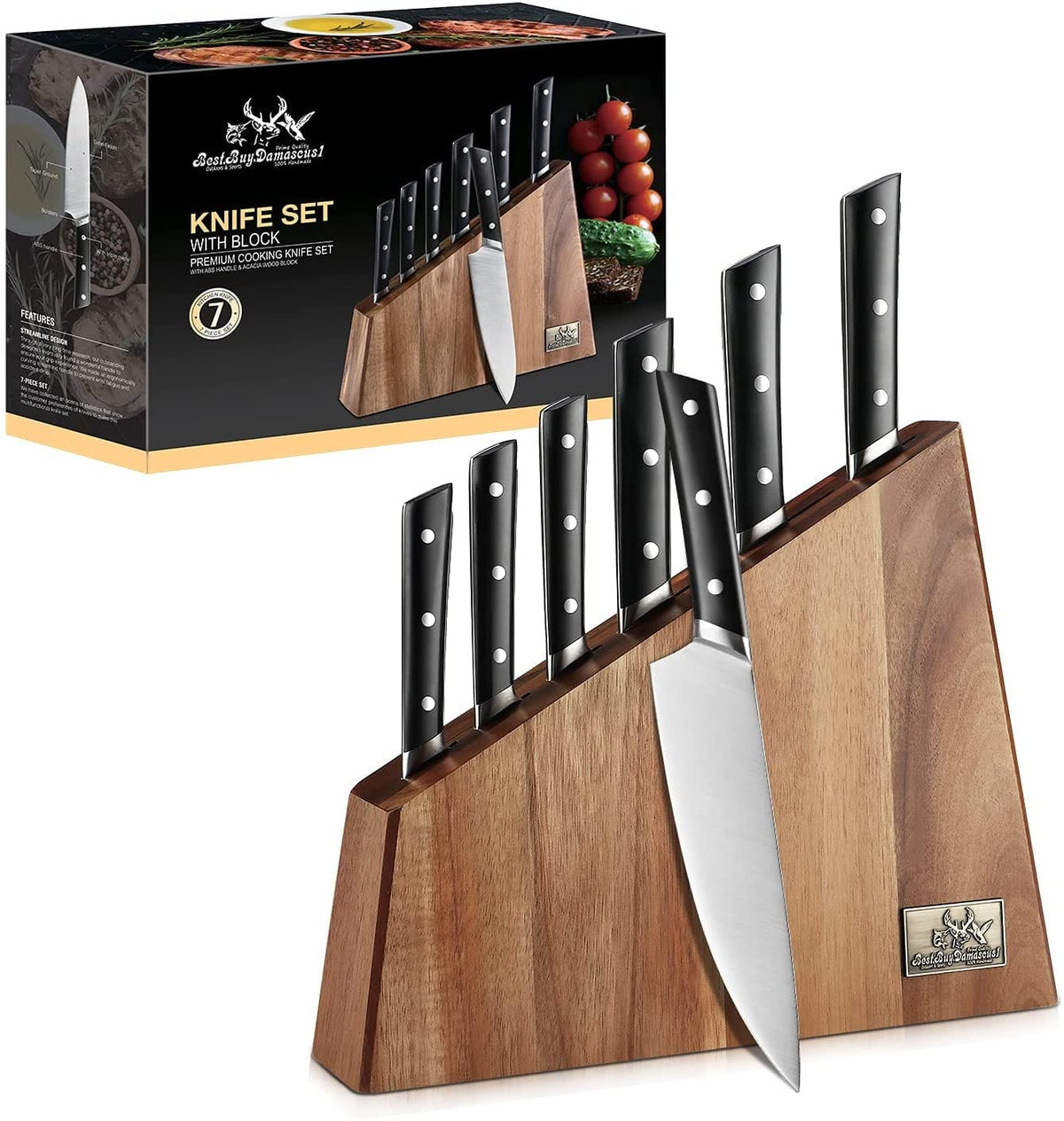
Direct answer: The best kitchen knife set under $200 for most home cooks is the Premium Knife Block Set 7 Pcs at $169.99 — a real set, under the cap, with the core knives a kitchen actually uses daily. Everything else in this guide is an honest comparison: a German-steel set at $189.99, and a build-your-own trio for $139.97.
That short answer hides a messy category. Search "best kitchen knife set under $200" today and the results are dominated by very large sets — 15, 18, sometimes 20-plus pieces — sold mostly on piece count. More pieces reads like more value. Often it is the opposite. Steak knives you did not ask for, kitchen shears, a sharpener rod, and the block itself all get counted as "pieces," which inflates the number while the knives that matter — the chef knife, the utility knife, the paring knife — stay ordinary.
This guide takes the other approach. Fewer, better, honestly described. It names one Damascus1 set that actually comes in under $200, compares it plainly with the other under-cap option on the site, shows the math on building your own set from three singles for even less, and is upfront about what you do not get at this price. If you want the wider picture first, our best kitchen knives hub covers the category beyond a single budget cap.
What is the best kitchen knife set under $200 for most home cooks?
The best kitchen knife set under $200 for most home cooks is the Premium Knife Block Set 7 Pcs at $169.99. It covers the core jobs — chef work, smaller prep, and block storage — in one buy, under the cap, without paying for filler pieces. The German-steel set at $189.99 is the alternative if you prefer that steel tradition.
Start with why a cap matters at all. Two hundred dollars is a real psychological line in kitchen gear. Below it, a set is a considered purchase. Above it, most households hesitate, compare for weeks, and often end up buying nothing — cooking on with the same dull drawer of knives they already dislike. A good set under the cap breaks that stalemate. It is expensive enough to be a genuine upgrade, cheap enough to actually happen.
The Premium set earns the lead recommendation here on arithmetic as much as on anything else. At $169.99 for a seven-piece block set, you are paying roughly twenty-four dollars a piece across a set that includes storage. No single quality knife purchase touches that per-piece figure, and storage is not a trivial extra — a block keeps edges off drawer walls and off each other, which is where a surprising amount of home knife damage actually happens.
There is a second, quieter reason to lead with a set for most cooks. Most people do not know yet which knife they will love. They know their current knives are frustrating. A season cooking with a complete set teaches you your own habits — which blade you reach for, which one never leaves the block, where your cooking actually lives. That knowledge is what makes a later, more expensive single-knife purchase smart instead of speculative. Our best knife set guide makes the same case from the set side, and it is worth reading alongside this one if you are still deciding between a set and a single.
None of that means the Premium set is perfect, or that it is right for everyone. The sections below put it next to its real alternatives, name what to skip in sets generally, and show where spending the same money differently might suit you better. Honest comparison is the whole point of this page.
Why do so many under-$200 sets look like better deals than they are?

Many under-$200 sets look generous because piece count is easy to inflate. Steak knives, shears, a honing rod, and even the block get counted as pieces, so a 19-piece set may contain only five or six knives you will use weekly. Judge a set by its core knives first, and treat every extra piece as a bonus, not the bargain.
Piece-count inflation is not illegal, and it is not even hidden. It is printed right there in the listings, if you read slowly. The problem is that shoppers do not read slowly at the comparison stage — they sort by the biggest number under their budget and move on. Sellers know that. So the headline number grows while the working core of the set stays the same size it was in a modest seven-piece set a decade ago.
Do the test yourself on any large set that catches your eye. Cover the headline number. Now count only this: a chef knife, a smaller all-purpose knife, a paring knife, and something for bread or slicing if you bake or roast often. That is the set you are actually buying for daily cooking. Everything else — the six matching steak knives, the shears, the rod, the block — is supporting cast. Supporting cast has value, especially steak knives if you serve steak weekly. But it should never be why you chose one set over another.
Price-per-real-knife is the corrective math. A $179 set with six working knives costs about thirty dollars per working knife. The $169.99 Premium set, counted conservatively the same way, lands in the same honest territory without needing a padded headline. When two sets cost similar money, compare the core, the handles, the storage, and the care each one asks of you. Let the steak knives be a tie-breaker, never the headline.
There is also a quality-spreading problem. A fixed budget spread across nineteen pieces has to come out of somewhere, and it usually comes out of the steel, the finish, and the quality control on the knives themselves. The same budget spread across seven pieces can go further on each one. That is not a guarantee — a small set can still be poor, and a large set can still be decent — but as a starting assumption for shopping under $200, fewer-better beats more-thinner almost every time.
Which Damascus1 sets and singles should you compare first?

Compare three routes first. Route one: the Premium 7-Piece Block Set at $169.99, the complete under-cap set. Route two: the German-steel set at $189.99, also under the cap, for cooks who prefer that tradition. Route three: build your own from singles — a chef knife, a nakiri, and a Japanese chef knife for $139.97 total.
Every price in the table below was verified on October 19, 2026, against the live Damascus1 catalog. Prices can change, and the product page on the day you order is always the final word. One caution belongs in plain sight: for the German-steel set, the listing's handle and title do not agree on piece count, so this guide deliberately does not state one. Check that product page for its current listed contents before you buy, and hold any seller — including this one — to what the page says on your order day.
| Pick | Best for | Route | Price (verified Oct 19, 2026) |
|---|---|---|---|
| Premium Knife Block Set 7 Pcs | Best for most home cooks wanting one complete set under $200 | Complete block set | $169.99 |
| German 1.4116 HC set | Best for cooks who prefer German-style steel | Complete set, piece count per product page | $189.99 (was $249.99) |
| G10 Handle Chef Knife + Nakiri VG10 + Japanese AUS-10 Chefs Knife | Best for building your own set and skipping pieces you will not use | Three singles, no block included | $139.97 combined |
| Blue G10 9-pc set / 9-Pieces Japanese set | Best for stepping above the cap deliberately | Upgrade tier — over $200, stated plainly | $334.00 (was $499.99) / $339.99 |
Priced product cards — what each dollar actually buys
Lead pick — Premium Knife Block Set 7 Pcs — $169.99. The only recommendation in this guide that is both a complete set and comfortably under the cap, with $30.01 of headroom left for a whetstone or a better board. That headroom matters more than it sounds: a set plus sharpening gear will out-cook a slightly fancier set with no way to maintain it, every week of the year. Seven pieces, block storage included in the proposition as listed — read the product page for the current piece-by-piece contents before ordering. View the Premium 7-Piece Block Set.
The other under-cap set — the German-steel set — $189.99 (was $249.99). Built around German 1.4116 high-carbon steel, a steel family German-tradition knives are known for: tougher, more forgiving edges that sharpen readily. It comes in just under the cap at $189.99, leaving almost no headroom — $10.01 — which is its main practical drawback next to the Premium set. If your cooking is heavy, dense, and hard on edges, this tradition may suit you better anyway. Describe it, compare it, decide on the page's current details. View the German-steel set.
Build-your-own starter — G10 Handle Chef Knife — $34.99 (was $59.99). The single chef knife at the heart of the DIY route. G10 is a hard-wearing, moisture-resistant handle material — a practical choice for a knife washed and dried daily. At this price it is a working tool, not a trophy, and that is exactly the right spirit for a first serious chef knife. View the G10 Handle Chef Knife.
Vegetable specialist — Nakiri Knife Japanese VG10 — $44.99. A flat-profiled vegetable knife: the edge meets the board along its full length, so cabbage, onions, and cucumbers slice cleanly instead of staying connected in accordion folds. For vegetable-heavy weeknight cooking, this is often the second most-used knife in the kitchen. View the Nakiri Knife Japanese VG10.
Second chef-profile option — Japanese AUS-10 Chefs Knife — $59.99. The third single in the DIY trio, adding a second chef-style profile so two cooks — or a cook who likes a spare while one knife is in the wash — are covered. Read its product page for its own stated construction and dimensions. View the Japanese AUS-10 Chefs Knife.
Over the cap, on purpose — $334.00 and $339.99 sets. The Blue G10 9-pc set at $334.00 (was $499.99) and the 9-Pieces Japanese set at $339.99 sit in a different budget conversation entirely. They are named here only so you can see the step up clearly. They are not under-$200 picks, and this guide will not pretend otherwise to make a table look fuller.
What should 7 pieces actually mean in a knife set?
Seven pieces should mean a small set built around the knives you use daily: a chef knife for most prep, a smaller utility or santoku-style knife for mid-size jobs, a paring knife for in-hand work, plus supporting blades and storage. Count the working knives first. If the core is sound, seven honest pieces beat nineteen padded ones.
Think about a normal week of cooking and the knives it truly calls for. The chef knife does the bulk: onions, carrots, potatoes, chicken, herbs, garlic, most of dinner, most nights. The smaller all-purpose knife handles sandwiches, fruit, cheese, trimming, and the quick jobs where a full chef knife feels clumsy. The paring knife works in the hand — hulling, peeling, coring, taking eyes out of potatoes. Those three profiles cover the overwhelming majority of home prep, which is why any honest set is built around them.
Around that core, useful additions earn their place by frequency, not by novelty. A bread or slicing profile earns its slot if you bake, buy unsliced loaves, or carve roasts more than a few times a month. A boning-style profile earns its slot if you break down whole chickens or trim larger cuts regularly. If neither sounds like your kitchen, those slots are not wasted — they are occasional tools you will still be glad to own twice a year — but they should not be the reason you buy.
Storage counts, but count it honestly. A block is furniture for your knives: it protects edges, keeps blades separated, and puts the set within reach of the board. That is real value. It is not a knife. When you compare a seven-piece set against a competitor's larger count, ask what the count includes on both sides before you let the bigger number impress you.
Finally, handles and consistency matter in a set in a way they do not with singles. A set gives you the same handle shape and similar balance across profiles, so switching knives mid-recipe feels natural instead of jarring. For new cooks especially, that consistency shortens the learning curve. Your hands learn one grip family, and every knife in the block benefits from it.
Which pieces are filler you can safely skip?

The safest pieces to skip are the ones sellers use to inflate the count: a full run of matching steak knives when you rarely serve steak, kitchen shears you already own, a second sharpener, and novelty profiles with no job in your cooking. Skip them on paper first — price the set by its core knives, then decide if the extras are worth anything to you.
Steak knives deserve a fair hearing before dismissal. If steak, chops, or roasts land on your table weekly, a matching set of steak knives is not filler at all — it is tableware you will use constantly, and serrated or fine-edged table knives dull and disappear in real households. The filler problem is situational. Six steak knives in the home of a mostly vegetarian cook are not value. They are storage with handles.
Kitchen shears are the classic padding piece because almost every kitchen already owns a pair, and shears are not really a knife-set purchase. The same goes for a basic honing rod bundled to raise the count when a whetstone — the tool that actually restores an edge — is what a new set owner genuinely needs. If a bundle includes a rod, fine. Just do not let it substitute, in your budget thinking, for real sharpening gear.
Novelty profiles are the subtlest filler. A knife shaped for a task you perform twice a year can still be fun to own. Fun is allowed. What is not allowed, in an honest comparison, is letting two novelty profiles outweigh a better chef knife in the competing set. Your chef knife touches almost every meal you cook. A novelty blade touches almost none. Weight your money accordingly, and sets suddenly sort themselves very clearly: core first, extras last, headline number ignored.
A useful exercise before you buy anything: write down the last ten dinners you cooked and the knife work each one needed. It takes three minutes. That list — not a product page — tells you whether you need a bread knife, whether steak knives matter, and whether a vegetable specialist would change your week. Shop from that list, and filler stops being tempting, because you can see your own kitchen instead of a marketer's version of it.
How does the Premium 7-piece block set compare with the German-steel set?

The Premium set at $169.99 wins on headroom and simplicity: one clearly priced block set, $30.01 under the cap. The German-steel set at $189.99 wins if you value the German steel tradition — tougher, forgiving edges that sharpen easily — and accept almost no budget left over. Neither is a bad buy; they suit different cooks and different habits.
Price is the cleanest difference, so start there. Twenty dollars is not much in absolute terms, but under a hard cap it is the difference between buying a set and buying a set plus its maintenance. The Premium set's $169.99 leaves room for a whetstone, which this guide will keep insisting is part of the real cost of owning good knives. The German-steel set at $189.99 consumes the budget almost completely. If you already own sharpening gear, that objection disappears, and the comparison becomes purely about the knives.
Steel tradition is the second difference, and it is a genuine fork, not a marketing one. German-style steels such as the 1.4116 family are traditionally valued for toughness: an edge that tends to roll rather than chip under rough treatment, that tolerates dense produce, squash, and the occasional careless twist, and that comes back quickly with basic sharpening. Japanese-leaning and Damascus-patterned constructions put more emphasis on a keen, fine edge and the pattern and core that carry it. Neither tradition is superior in the abstract. Your board decides. Hard on knives, lots of dense root vegetables, shared kitchen with other cooks of varying care? The forgiving tradition has real appeal. Careful cook, precise cutting, happy to hand-wash and dry? The keener tradition rewards you.
The third difference is clarity, and honesty requires naming it. The Premium set's listing presents a clean proposition: a named seven-piece block set at a single price. The German-steel set's listing, as checked on October 19, 2026, carries a piece count in its handle that does not match the piece count in its title. That does not make it a bad set. It does mean you should open its product page, read the current contents list carefully, and buy based on that — not based on a number in this guide, because this guide refuses to guess. That habit, applied everywhere, will protect you far beyond this one purchase.
If you are torn, the tie-breaker is your sharpening reality. The cook who will actually maintain a keen edge should buy the set whose edge style excites them. The cook who knows, honestly, that sharpening will be rare and rough should buy forgiveness. There is no shame in either answer. There is only waste in buying against your own habits.
Can you build a better kitchen set under $200 by buying singles?
Yes — for some cooks, building your own is the smarter under-$200 route. A G10 Handle Chef Knife at $34.99, a VG10 Nakiri at $44.99, and a Japanese AUS-10 Chefs Knife at $59.99 total $139.97, leaving $60.03 for storage and a whetstone. You give up a matched block and matching handles, and you gain exactly the profiles you chose.
Check the math, because this is the kind of claim that should always be checked: $34.99 plus $44.99 is $79.98. Add $59.99 and you get $139.97. That is thirty dollars less than the Premium block set, for three purpose-chosen knives instead of a curated seven pieces. Whether that is better depends entirely on what your cooking needs and what you already own.
The case for building your own is control. No steak knives if you do not eat steak. No bread knife if you buy sliced bread. A nakiri — a specialist many sets never include at all — if vegetables are the center of your cooking. Two chef-profile knives if two people cook together, or if your prep sessions are long and a fresh, clean blade mid-session is worth real money to you. Singles also let you stagger the spend: buy the chef knife this month, learn it, then add the specialist your cooking actually asks for next month.
The case against is everything a set quietly solves. No block is included in that $139.97, so storage is on you — a magnetic strip, blade guards, or an in-drawer tray, each a real extra cost that eats into the apparent saving. Handles will not match. Profiles were chosen by you, which means mistakes are also chosen by you: a new cook may not yet know that a nakiri is what their cooking was missing, and a curated set would have put a balanced range in their hands without requiring that knowledge in advance.
A hybrid path suits a lot of households, and our best chef knife guide explores the single-knife side of it in depth. Buy the set if your kitchen is bare. Buy singles if your kitchen has a foundation and specific gaps. Buy the set now and singles later if you want the fastest honest route to a kitchen that is both complete and personal. The $200 cap does not force a single answer — it just forces you to be deliberate, which is a healthy thing for any purchase to do.
What steel and handles should you expect under $200 — and what should you not expect?
Under $200, expect competent, working steel and practical handles — and expect to maintain the edge yourself. German-style steel brings toughness and easy sharpening; VG10 and AUS-10 are Japanese core steels associated with keen edges; G10 handles bring moisture resistance and durability. Do not expect any listing's most heroic claims to be self-proving: check the product page for each model's own stated specs.
Steel, without the fog. A knife steel has to balance three wants that pull against each other: taking a keen edge, keeping that edge through real food, and being forgiving — of sharpening, of dense produce, of the occasional bad angle. Harder, keener edges can be less forgiving. Tougher edges can need attention more often. Every steel in this guide sits somewhere sensible in that triangle, and none of them escapes it. When a listing anywhere claims a knife wins on all three at once, your skepticism should rise in direct proportion to the claim.
That is also why this guide assigns no layer counts and no hardness figures to individual Damascus1 models. Those numbers, where a product page states them, belong to that page, and you should read them there — in context, next to the price and the current listing details. Copying impressive-sounding figures into a roundup, detached from the page that has to stand behind them, is exactly how knife marketing got so cloudy in the first place. The honest sentence is shorter: check the product page for the model's own stated specs, and weigh how a seller handles questions as part of what you are buying.
Handles are the under-discussed half of the under-$200 decision, partly because they photograph badly and spec poorly. A handle decides whether a knife is pleasant in minute forty of prep, whether it stays secure when your hands are wet, and whether it survives years of washing and drying. G10, which appears across the singles in this guide, is a fiberglass-based laminate valued for being hard-wearing and moisture-resistant — unglamorous virtues that matter daily. Whatever material a set uses, the real tests are fit and finish: no sharp seams, no wobble, a shape that fills your hand without forcing it. If a set arrives and the handle feels wrong, that is not a nitpick. It is a reason to use the returns terms you read before ordering.
And temper your expectations in one more place, fairly: fit, finish, and refinement at $169.99 will not match a $339.99 set, and should not be expected to. What under $200 should deliver — and what the picks here are chosen to deliver — is honest steel, sound construction, comfortable handles, and edges that reward basic care. Refinement is what the upgrade tier sells. Cutting was already solved at this price, and cutting is the job.
Is a set under $200 enough for serious home cooking?

Yes. A set under $200 is enough for serious home cooking, because serious home cooking is limited by sharpness, board skills, and heat control far more than by knife price. A maintained $169.99 set will out-cook a neglected expensive set. Spend the saved money on a whetstone, a decent board, and ingredients worth cutting.
Consider what "serious" actually involves at home. Breaking down chickens. Turning out fine dice at a reasonable pace. Slicing roasts cleanly for guests. Working through a pile of onions without tears turning into ragged cuts halfway through. None of those tasks asks for a pedigree. All of them ask for a sharp edge, a knife whose profile suits the task, and a cook who has practiced. A seven-piece set covers the profiles. Practice and maintenance are yours to supply — and they are free, which is the best deal in this entire guide.
Where a modest set can show its limits is at the extremes, and it is fair to name them. Very hard, dense work, day after day, will ask more of an edge than occasional weeknight cooking does. Extremely fine, presentation-level work rewards the keenest edges and the most practiced hands together. If your cooking lives at those extremes — you are feeding twenty every weekend, or training seriously — you already know it, and the upgrade conversation in the next section is genuinely for you. For the vast middle of ambitious home cooking, under $200 is not a compromise. It is the sensible tier.
There is also a psychological benefit nobody lists in a spec table. A knife you can afford is a knife you will use without ceremony — daily, on everything, building the thousands of cuts that turn into skill. An expensive knife that feels too precious for a Tuesday onion teaches you nothing and often ends up admired more than used. Skill compounds with use. Buy the tier you will use hardest.
Our best Damascus chef knife set guide is the companion read if you are weighing this budget against the patterned-steel upgrade path, and it applies the same honesty checks to the higher tier.
How do you care for a knife set so the edges actually last?
Care for a knife set by hand-washing and drying each knife after use, storing blades in the block, on a strip, or in guards — never loose in a drawer — and sharpening on a whetstone before edges go fully dull. Skip the dishwasher entirely. Five calm minutes of care a week protects the whole $200 far better than any upgrade would.
The dishwasher rule deserves its one clear explanation. Detergent is abrasive, jets knock edges against racks and other metal, and hot moisture is unkind to handles and patterned blades alike. Thirty seconds at the sink — wash, dry, put it away — is the entire ongoing price of keeping a set for years. People who say they have no time for that somehow find time to replace knives. The arithmetic only runs one way.
Storage is the second silent edge-killer. A drawer full of loose knives is a drawer full of edges colliding with metal every time it opens. The block included with a set solves this by default, which is part of its real value. If you built your own set from singles, solve it deliberately: a magnetic strip if you have the wall, individual guards or an in-drawer tray if you do not. Never let "I will sort storage later" be the plan — later is measured in chipped edges.
Sharpening is the third habit, and the one that decides everything else. Honing and sharpening are different jobs: a rod can straighten a tired edge for a while, but only abrasive stone work actually restores one. Learn the basics once and a set stays keen for years with minutes of work at a time. Our step-by-step how to sharpen a Damascus knife guide walks through the whetstone process in order, and it pairs with any set in this price range, Damascus-patterned or not. Sharpen a little, before the knife is truly dull, and the job stays small and satisfying instead of becoming a rescue mission.
One more care note, on personalization, because gift buyers ask about it constantly. Engraving options, where offered, are quote-based — pricing depends on what you ask for — for text up to 25 characters. It is never promised here as free, fast, or included with a set. If a personalized knife is the gift you have in mind, start that conversation early, get the quote in writing, and treat the plain, unengraved set as your fallback if the timing does not work.
Should you pay more than $200 instead?
Pay more than $200 only when you know exactly what the extra money buys you — refinement, specification, gift presence — and your habits will actually use it. The Blue G10 9-pc set at $334.00 and the 9-Pieces Japanese set at $339.99 are honest upgrade tiers. If you cannot name what you gain, the under-$200 picks serve you better.
There are three legitimate reasons to step over the cap. The first is refinement you can feel: finer finish, more considered handles, a set that is a pleasure to handle every single day for a decade. Pleasure is a real feature in a tool you touch daily — just buy it knowingly, as pleasure, not as cutting performance you were missing. The second is gifting at a level where presentation carries meaning — a milestone wedding gift, a serious thank-you — where the object has to say something beyond "this works well." The third is a specific, proven need: you cooked with a good set for a year, you know your profiles and your steel preference cold, and a higher tier matches that proven preference precisely.
Notice what is not on the list. Fear — the worry that under $200 must secretly be inadequate — is not a reason. It is the feeling the piece-count arms race is designed to produce, monetized at a higher tier. Neither is a sale strikethrough, on its own: a $339.99 set was not worth $500-plus to you yesterday just because a listing frames it that way today. Judge the knife in front of you at the price in front of you, against the cooking in front of you. That sentence, applied consistently, is worth more than any single recommendation on this page.
If you do step up, step up once, deliberately, after the under-$200 tier has taught you your habits. That sequence — good set first, proven preferences second, upgrade last — is the cheapest route to a kitchen you love, even counting both purchases. Most cooks who follow it discover something else, too: the upgrade becomes optional. The modest set, maintained and familiar, turns out to have been the destination all along.
What else should you ask before buying a knife set under $200?
Most under-$200 questions come down to count, care, and confidence: how many pieces you really need, how much work the set asks of you, and whether the price means compromise. The short answers below cover the ones buyers ask most, and each one points back to the section of this guide that works through it in full.
Is a 7-piece knife set enough for a home kitchen?
For most home kitchens, yes. Seven pieces built around a chef knife, a smaller all-purpose knife, and a paring knife cover the overwhelming majority of daily prep, with supporting profiles and storage around that core. Add singles later only when a recipe or habit repeatedly asks for a profile the set does not include.
What is the difference between the $169.99 set and the $189.99 German-steel set?
Twenty dollars and a steel tradition. The Premium set at $169.99 leaves budget headroom for sharpening gear and presents a clearly counted seven-piece proposition. The German-steel set at $189.99 leans into a tougher, more forgiving steel tradition and leaves almost no headroom. Read its product page for its current listed contents before buying.
Can I really build a good set for $139.97?
You can build a good three-knife foundation for $139.97 — a G10 chef knife at $34.99, a VG10 nakiri at $44.99, and a Japanese AUS-10 chefs knife at $59.99. It is not a complete set: storage and a whetstone are extra, and handles will not match. As a foundation for vegetable-heavy or two-cook kitchens, it is a genuinely smart route.
Do knives under $200 need special care?
They need normal good-knife care, which is simple and non-negotiable: hand-wash, dry immediately, store them protected, and sharpen on a whetstone before they go fully dull. Never the dishwasher. That routine, followed consistently, matters more to your daily cutting than the difference between a $170 set and a $340 set.
Is engraving included if I buy a set as a gift?
No promise of that is made here. Engraving, where offered, is quote-based, for text up to 25 characters, and is not presented as free, fast, or included. Ask for a quote before you rely on a personalized knife for a dated occasion, and keep the unengraved set as your backup plan.
When does it make sense to spend over $200 on a knife set?
When you can name the gain: finer finish you will feel daily, gift presentation that carries real meaning, or a specification that matches habits a year of cooking has already proven. The $334.00 and $339.99 sets in the Damascus1 range are that tier. If you cannot name the gain, stay under the cap without regret.
The bottom line: buy fewer, better, and keep them sharp
Under $200, the winning move is not the biggest box. It is the honest one.
Start with the lead pick: the Premium Knife Block Set 7 Pcs at $169.99 — a complete set, a real block, and enough budget left over to maintain it properly. Choose the German-steel set at $189.99 instead if the forgiving German steel tradition matches how you actually cook and treat your edges. Or build your own foundation for $139.97 from the G10 Handle Chef Knife, the VG10 Nakiri, and the Japanese AUS-10 Chefs Knife — and spend the $60.03 you saved on storage and a whetstone.
Whichever route you take, verify the price and the contents on the product page on the day you order, read the returns terms before the box arrives, and commit to the five minutes of weekly care that makes any of these picks perform like they cost twice as much. Then cook. A sharp, honest set under $200, used daily, is not a stepping stone to a real kitchen. For most of us, it is the real kitchen.
Ready to choose? View the Premium 7-Piece Block Set at $169.99, compare the German-steel set at $189.99, or start building your own trio — all at Damascus1.com, and explore the wider best kitchen knives hub when you are ready to go deeper.
laissez un commentaire: