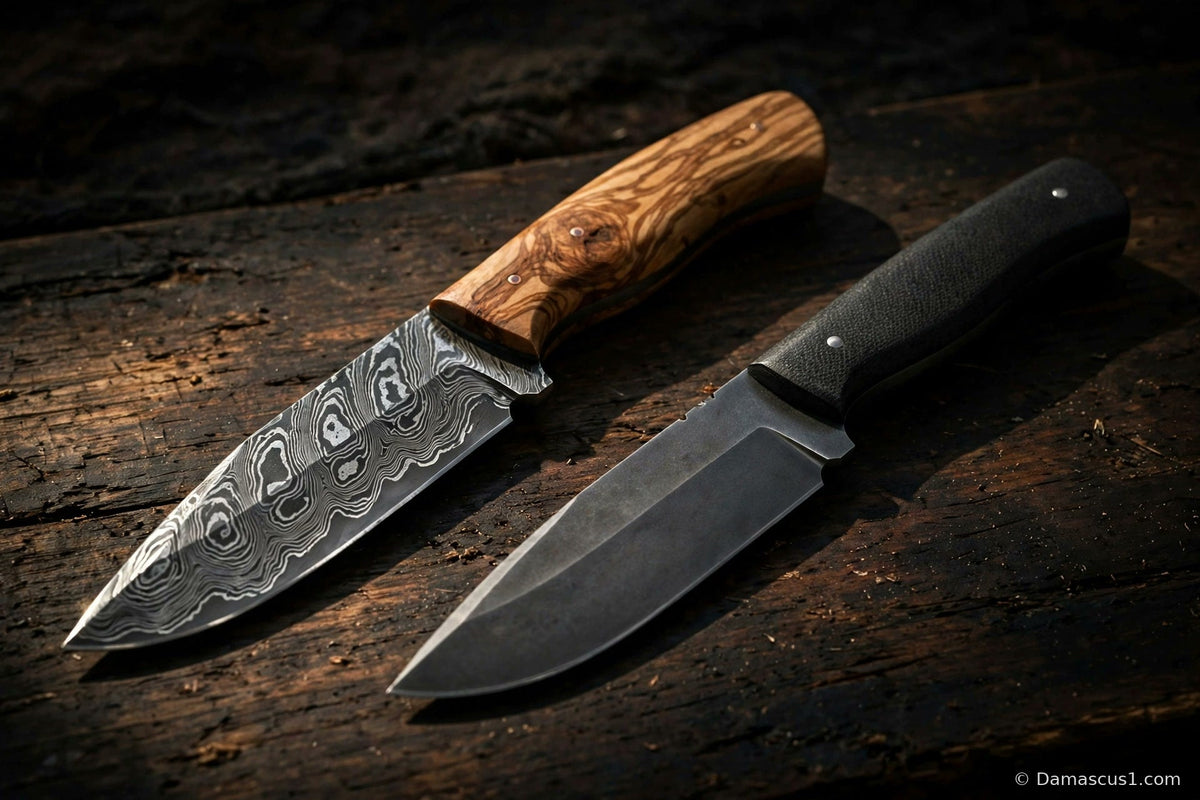
The short answer: Damascus and carbon steel are not two rival materials — Damascus is a construction (steels forge-welded in layers, then etched to show the pattern) and carbon steel is a material family, and carbon steels are usually inside the Damascus. Plain carbon steel is keener-per-dollar and easier to sharpen; Damascus adds the unique pattern and the forging story. Rust care depends on which Damascus: stainless-clad Damascus shrugs off moisture, while carbon Damascus — 1095/15N20, like the folder in this guide — needs exactly the same wash, dry, and oil discipline as plain carbon steel.
This comparison exists because the Canada series already answered the neighbouring question — Damascus against stainless — and readers kept asking the harder one. It is harder because page one disagrees with itself. The strongest comparison holder, Damascen Knives, opens with the correct frame — you are comparing a technique to a material — and then describes a Damascus that is nothing like the knife most Canadian folder buyers are holding: theirs is a stainless-core kitchen construction that resists rust and stays shiny with a standard wash and dry. The long-standing HDMD comparison says carbon steel is easier to maintain in its text, then prints a table saying Damascus requires very much care and carbon is very easy to care for, without ever saying which Damascus it means. The most honest holder, a Medium guide published this month, states the thing plainly: modern pattern-welded Damascus often contains carbon steel alloys, the pattern itself does not automatically make a blade stronger or sharper, and performance depends on composition, heat treatment, and geometry. The World of Blades care guide says it in one line: Damascus steel is a form of high-carbon steel — layered and patterned, but chemically the same family. This Canada edition builds on those two honest holders, splits "Damascus" into the two constructions the market actually sells, and then does what none of them does: it applies the comparison at pocket-knife size, in Canadian conditions, to knives you can actually buy, with their steels named and their prices stated exactly as listed.
One honesty note before the verdicts, carried through this whole series: the photographs in this post are editorial scenes made for this guide — two blades on a table, a forge, a whetstone, a picnic table — not photographs of the specific knives sold further down the page. Those knives are described exactly as the store describes them, at the store's own listed prices in US dollars, with nothing converted into Canadian dollars.
Are Damascus and carbon steel even opposites?


No — and understanding why is worth more than any verdict in this post, because it dissolves most of the confusion the other comparisons trade on. Carbon steel is a material category: iron alloyed with carbon, with limited other elements, where the carbon is what lets the steel harden enough to take and hold a fine edge. A plain carbon steel knife is one piece of that material, ground to shape. Damascus, in the modern market, is pattern-welded construction: a billet built by forge-welding different steels together — very often two carbon steels chosen to contrast — then folding, drawing out, and manipulating that billet until it holds dozens or hundreds of layers, grinding the blade, and etching it so the layers read as flowing water across the surface. The forge image in this post is that billet moment: tongs, heat, and a stack of steels becoming one piece of metal.
So the two terms answer different questions. "Carbon steel" tells you what a blade is made of. "Damascus" tells you how a blade was built — and, once you ask the follow-up question that actually matters, what it was built from. That follow-up splits the market in two. Stainless Damascus wraps or sandwiches stainless alloys — a VG-10 or similar core under stainless patterned cladding is the common kitchen version — and inherits stainless behaviour: good corrosion resistance, a wash-and-dry life. Carbon Damascus forge-welds carbon steels together — the classic pairing is 1095, a hard high-carbon steel, with 15N20, a nickel-bearing carbon steel that etches bright and gives the pattern its contrast — and inherits carbon behaviour in full: reactive, patina-forming, rust-prone if neglected, and superb at the edge. The Damascus1 folder at the centre of this series is carbon Damascus, stated on its product page and repeated in this guide every time it matters: 1095 and 15N20, roughly 276 layers, 58–60 HRC, not stainless. Any comparison that tells you "Damascus resists rust, carbon steel rusts" is comparing stainless Damascus against carbon steel and quietly hoping you will generalize. Do not generalize. Ask which Damascus.
The history deserves one honest paragraph, because the Damascus name carries legend that sellers lean on. The original Damascus blades of the Middle East were made from a crucible steel whose pattern formed in the ingot itself; that process was lost, and no modern maker sells it. What the modern market sells — every holder in this teardown agrees — is pattern-welded steel that reproduces the look and much of the working character by lamination. That is not a lesser thing; it is a different thing, made by hand at a forge, and it is exactly why our Canada guide to real versus fake Damascus steel insists on the tells that separate forge-welded layers from a pattern printed or laser-etched onto plain steel, and why the checks in how to spot a fake Damascus knife start with the steels being named. A seller who will not name the steels is asking you to buy the legend. A seller who names them — 1095, 15N20, a layer count, a hardness — is selling you a knife.
Which takes the keener edge — and which keeps it longer?
At the level of the steels themselves, this round is closer than either camp admits, and the Medium holder's discipline is the right one: sharpness and edge retention depend on the cutting-edge steel, its hardness, and the edge geometry — not on whether a pattern is visible. Plain carbon steel's reputation is earned. Its fine grain structure lets it be ground to a very keen edge, the Damascen holder concedes it usually wins pure sharpness "by a hair," and generations of cooks and hunters have prized how readily it sharpens and how cleanly it cuts. Hardened into the high fifties on the Rockwell scale, a good carbon blade holds that edge through serious work and then — this is its quiet superpower — gives it back quickly on a stone when it finally dulls.
Carbon Damascus plays the same game with the same pieces. The edge of a 1095/15N20 blade is, at the bevel, high-carbon steel at 58–60 HRC — squarely in the working range where carbon folders live — so its sharpness story is a carbon story: keen, durable through camp and kitchen work, and restored on a whetstone without drama. What the layers add is not magic at the edge; it is character behind it. The HDMD holder credits the alternating hard and softer layers with absorbing shock, and the Damascen holder makes the same sandwich argument for its stainless construction: hard where it cuts, more forgiving where it flexes. Treat those claims at the modest value the honest holders give them — a well-made blade of either kind, properly heat-treated, will out-cut a poorly made blade of the other kind every time — and the round resolves to a tie with different flavours. Plain carbon: the keenest edge per dollar, the fastest resharpen. Carbon Damascus: the same carbon edge behaviour, carried in a blade whose pattern makes you want to pick it up — which, over years, is its own performance feature, because the knife that gets used and maintained is the knife that stays sharp.
One folder-specific note belongs in this round, because pocket-knife edges live harder lives than kitchen edges. A folder cuts cord, packaging, camp food, fishing line, and the occasional regrettable zip tie; its edge meets grit and staples, not just tomatoes. At 58–60 HRC the hero's edge is hard enough to hold through that work and soft enough to survive it without the chipping that very hard, brittle edges suffer — the failure both the Damascen and HDMD holders flag for hard carbon steel dropped or forced through bone and frozen food. Hardness is a dial, not a score, and for a working folder the high-fifties setting is the honest sweet spot both materials share.
Which rusts faster — and what does care actually look like?
Here is the round the stainless-Damascus marketing wants you to misread, so here it is with the constructions separated. Plain carbon steel is reactive — full stop. Cut a lemon and walk away for five minutes, the Damascen holder warns, and the blade begins to turn; leave it wet and orange rust follows. Over honest use it builds a patina, the even grey-to-blue darkening the patina image in this post shows on the plain blade, and many owners prize that earned surface — it is stable, it modestly protects, and it records the knife's life. Carbon Damascus behaves the same way, because it is the same family: the 1095 layers patina and can rust, the 15N20 layers etch bright and resist a little differently, and the pattern — this is the HDMD holder's one maintenance insight worth keeping — visually hides light staining better than a plain blade shows it, which is a cosmetic mercy, not corrosion resistance. The folder in this guide needs the full carbon routine: hand-wash, dry completely at once, a thin film of food-safe mineral or camellia oil before it sits, dry storage out of a leather sheath for the long term. A planned sibling guide in this series — the Canada routine-cleaning guide for Damascus — walks that routine step by step for kitchen and folder alike; until it publishes it is a draft, not a live page, and this post does not link to it as one.
Stainless Damascus, to complete the split fairly, genuinely is easier: wash, dry, put it away, oil rarely. If the whole of your interest in Damascus is a kitchen knife you never want to think about, that construction is the honest recommendation — and it is not what this store's folder is, which is precisely why this guide refuses to borrow its reputation. Canadian conditions sharpen the point. A carbon blade of either construction, carried in a pocket through a humid Ontario summer or stored at a coastal cottage, lives in condensing damp and needs its oil film renewed with use. The same blade in a furnace-dry Prairie winter home can sit for weeks after one good cleaning. Plain carbon and carbon Damascus ask the same discipline; the only owners who get surprised are the ones who bought carbon Damascus believing the stainless version's brochure.
The sharpening half of care splits the other way, slightly in plain carbon's favour. Both materials sharpen on a whetstone — the sharpening image in this post, one of each waiting its turn on the stone, is the honest picture — and both resent pull-through sharpeners and power tools that strip metal and can scar the Damascus pattern near the edge. Plain carbon's fine, uniform structure makes it the most forgiving steel a beginner will ever learn on: the bevel is the same steel all the way through, feedback on the stone is immediate, and mistakes polish out. Carbon Damascus asks one extra care — keep the stone's work on the bevel and the slurry off the etched faces, so the pattern's contrast survives the edge's maintenance. It is a small discipline, learned in one session, and it is the entire practical difference between caring for the two.
What does the side-by-side actually look like?
This table is the citable asset of this post — the comparison with the constructions separated, which is how page one should have printed it.
| Question | Plain carbon steel | Carbon Damascus (1095/15N20) | Stainless Damascus (for contrast) |
|---|---|---|---|
| What it is | One material: iron + carbon, limited alloys | A construction: carbon steels forge-welded in layers (~276 in the hero), etched for pattern | A construction: stainless alloys laminated around a stainless core |
| Edge | Very keen, fine grain, quick to resharpen | Same carbon edge behaviour at 58–60 HRC; edge lives at the bevel | Keen; core-dependent (VG-10 class cores run 60–62 HRC) |
| Rust & patina | Reactive: patina forms, rust if left wet | Equally reactive: patina + pattern; light staining hides in the pattern | Resists rust; wash-and-dry care |
| Cleaning routine | Wash, dry at once, oil before storage | Wash, dry at once, thin oil film — the full carbon routine | Wash, dry, store dry; oil rarely |
| Sharpening | Whetstone; most forgiving to learn on | Whetstone; keep slurry/work off the etched faces | Whetstone; maker guidance on the core |
| Looks | Plain, utilitarian; patina is the decoration | Unique flowing pattern, no two alike | Unique pattern, stays bright |
| Price shape | Keenest edge per dollar; wide range | More than plain carbon for the forging work; the hero is $39.99 USD | Kitchen versions commonly $150+ at retail holders |
| Best for | The purist: maximum edge, minimum fuss about looks | The owner who wants carbon performance he can see — gift, camp, everyday folder | The cook who wants the pattern without the routine |
Read the middle column against the first and the verdict of this whole comparison falls out: carbon Damascus is not an alternative to carbon steel's compromises — it is carbon steel, with its compromises intact and its character made visible. You choose it for the pattern, the making, and the gift of a knife no one else's pocket holds the twin of. You choose plain carbon when every dollar should go to the edge and the patina's plainness is a virtue. You choose stainless Damascus when the pattern tempts you but the routine does not. All three are respectable answers. The only disreputable move in the market is selling the first column's care burden under the third column's promises.
Which should a Canadian actually buy — folder, kitchen, or camp?
Decide by the job, because the two materials divide Canadian work cleanly once the constructions are separated. For the everyday folder — the knife that lives in a pocket or a truck console, opens parcels, cuts cord at the cottage, and slices steak at camp — carbon Damascus earns its premium in the hand: the edge behaviour is carbon's, the pocket presence is unlike anything plain steel offers, and the two-hand manual design of the folder in this guide keeps it on the low-risk side of Canadian mechanism law, the subject our Canada hub on whether pocket knives are legal in Canada covers in full. The folder-fixed image in this post — patterned folder beside a plain fixed blade on a picnic table — is that division of labour in one frame: each knife dressed for its own work. For heavy kitchen volume, the honest answer runs through the store's kitchen route below, where the labelled construction of each knife tells you which routine it wants. For the buyer who sharpens for pleasure and counts patina as a diary, plain carbon remains the connoisseur's economy — nothing in this post argues him out of a knife he already loves correctly.
Gift-giving flips the calculation, and Canada is a gift market for this category — the folder is the Christmas, Father's Day, groomsmen, and retirement object this whole series keeps circling. A plain carbon knife is a superb tool and a flat gift: it arrives looking like every other plain blade, and its virtues announce themselves only in use, to an owner who already knows. A carbon Damascus folder announces itself the second the box opens — one-of-one pattern, olive wood, a making story with named steels — and then behaves, in use, exactly like the carbon knife the purist respects. Our guide to the engraved pocket knife gift covers the personalized version, and a planned sibling guide in this series takes the same folder into Canadian deer camp, moose country, and duck camp, splitting its camp role honestly from the fixed blade's field role. Until that guide publishes it is a draft, not a live page. The US edition of that hunting guide is already live as best Damascus hunting knife for readers who want the general picture now.
What does each option cost at Damascus1 — stated exactly?
The comparison, priced. The Olive Wood Damascus Pocket Knife Set is $39.99 USD (compare-at $89.99): carbon Damascus of 1095 and 15N20 at roughly 276 layers, 58–60 HRC, olive wood handle, 6.5 inches overall, a manual two-hand nail-nick opener with a back-lock, single-edged, not stainless — and it carries buyer reviews of 4.9/5 on its product page, cited as the page's own figure. Its siblings carry the same construction in different dress: the Orange Wood 6.5" Damascus Folding Pocket Knife at $39.99 USD (compare-at $99.99) and the Green Wood Damascus Folding Pocket Knife at $39.99 USD (compare-at $99.99). Any two at $39.99 come to $79.98 USD, crossing the store's "Free Shipping & Returns above $50!" banner as the store lists it. For the fixed-blade side of the family, the Camel Bone Damascus Fixed Blade Hunting Knife at $69.99 USD (compare-at $99.99) is the 8.2-inch field route. In the kitchen, the VG10-Labelled Nakiri Knife at $44.99 USD and the Premium Kitchen Knife Block Set at $169.99 USD are the store's routes — described exactly as the store labels them. Engraving on the folders is available on request, quote-based, up to 25 characters, with proof, price, and timing confirmed before custom work starts. The standard cross-border picture applies to a US order into Canada: prices in USD exactly as listed, possible GST/HST and a carrier handling or brokerage fee on arrival, and no delivery date promised anywhere in this post. Against the market holders describe — plain carbon folders at commodity prices, stainless kitchen Damascus at $150 and well beyond — a named-steel carbon Damascus folder at $39.99 USD is the value end of honest Damascus, and this guide's claim for it is deliberately narrow: carbon performance, visible making, nothing about rust borrowed from a different construction.
Shop handmade Damascus pocket knives
Prices checked November 21, 2026. Prices are in US dollars. The product page on the day you order is the final word.
- Olive Wood Damascus Pocket Knife Set, 6.5 in.: $39.99
- Green Wood Damascus Pocket Knife Set, 6.5 in.: $39.99
- Buffalo Horn Damascus Pocket Knife Set, 6.5 in.: $39.99
- Stag Horn Damascus Folding Pocket Knife, 6.5 in.: $49.99
- Camel Bone Scrimshaw Damascus Folding Pocket Knife, 7.6 in.: $49.99
- Ram Horn Scrimshaw Damascus Pocket Knife, 7.6 in.: $59.99
Damascus pocket knives under $50 · All handmade Damascus pocket knives
Frequently asked questions
Is Damascus steel good for kitchen knives?
Yes — the Damascen holder's answer is an unqualified absolutely, and this guide agrees with the construction caveat attached. A quality Damascus kitchen knife balances a hard cutting core against more forgiving layers, holds a fine edge, and turns prep into a pleasure. Which routine it needs depends on whether its construction is stainless or carbon — ask for the steels before you decide how you will care for it.
What are the disadvantages of Damascus steel knives?
The Damascen FAQ names cost first: the forging process makes Damascus significantly more expensive than standard stamped knives, and it requires hand-washing to preserve the finish. This guide adds the disadvantage the stainless-led holders understate: carbon Damascus also needs the full carbon routine — immediate drying and a light oil film — and its pattern can be flattened by abrasive cleaning or careless sharpening. None of these is hidden in this store's listings; all of them belong in the decision.
Are Damascus knives worth the money?
If you cook or carry regularly, the holders say yes — you are paying for edge retention, balance, and a blade built to last — and this guide narrows the claim to where it is provable. A Damascus knife is worth its premium when the seller names the steels and the construction suits your care habits: the pattern is one-of-one, the making is real forge work, and a carbon Damascus folder at $39.99 USD delivers both at the price of a plain production folder. It is not worth a premium paid for an unnamed "Damascus-style" print on mystery steel.
What is so special about a Damascus knife?
The Damascen answer — the marriage of art and engineering in the layered construction — survives this guide's stricter framing, with one correction the honest holders insist on: the pattern itself does not make a blade stronger or sharper. What is special is the combination a good one offers: carbon-class edge behaviour, a surface that is literally unlike any other knife's, and a making process you can verify by the named steels. Special is a property of specific knives, not of the word.
Which is better: a Damascus or carbon steel knife?
HDMD's closing question, and its own answer is the honest starting point: in most kitchens the two behave much the same, both are strong and reliable for years, and the choice is personal preference fitted to lifestyle. This guide sharpens it to a rule: if the Damascus is carbon Damascus, you are not choosing between performances — you are choosing whether the carbon knife you want should also carry the pattern, the story, and the gift presence. Choose plain carbon for the keenest edge per dollar. Choose carbon Damascus for the same edge, made visible.
What type of kitchen knife is best?
For most home chefs, the Damascen holder recommends a stainless Damascus chef's knife as the all-rounder — carbon-class cutting without the rust risk — and the tomato image in this post shows what that class of edge does to a ripe tomato. Households that enjoy the carbon routine can take the same performance from carbon constructions at lower prices. The best type is the one whose care routine matches the household that will actually perform it; a neglected premium knife loses to a maintained ordinary one every season of the year.
The last word: buy the construction, not the legend
Every confusion in this comparison dissolves the moment a buyer learns to ask one question — what steels, built how? Plain carbon steel answers it with a shrug: one honest material, a keen edge, a patina for a diary, and the lowest price for the performance. Carbon Damascus answers it with a billet: 1095 and 15N20, folded to roughly 276 layers, hardened to 58–60 HRC, etched so the work shows — the same edge discipline, the same rust honesty, and a blade that could only ever be the one in your hand. Stainless Damascus answers it a third way, trading the routine for a higher price and a brighter surface. Canada does not change the metallurgy; it changes the air the blade sleeps in and the law the folder opens under, and both of those favour the buyer who chose knowingly. If your answer is the visible one — carbon performance with its making on display — the Olive Wood Damascus Pocket Knife Set at $39.99 USD is where this series plants its flag: named steels, honest care, and a pattern that is nobody else's.
laissez un commentaire: