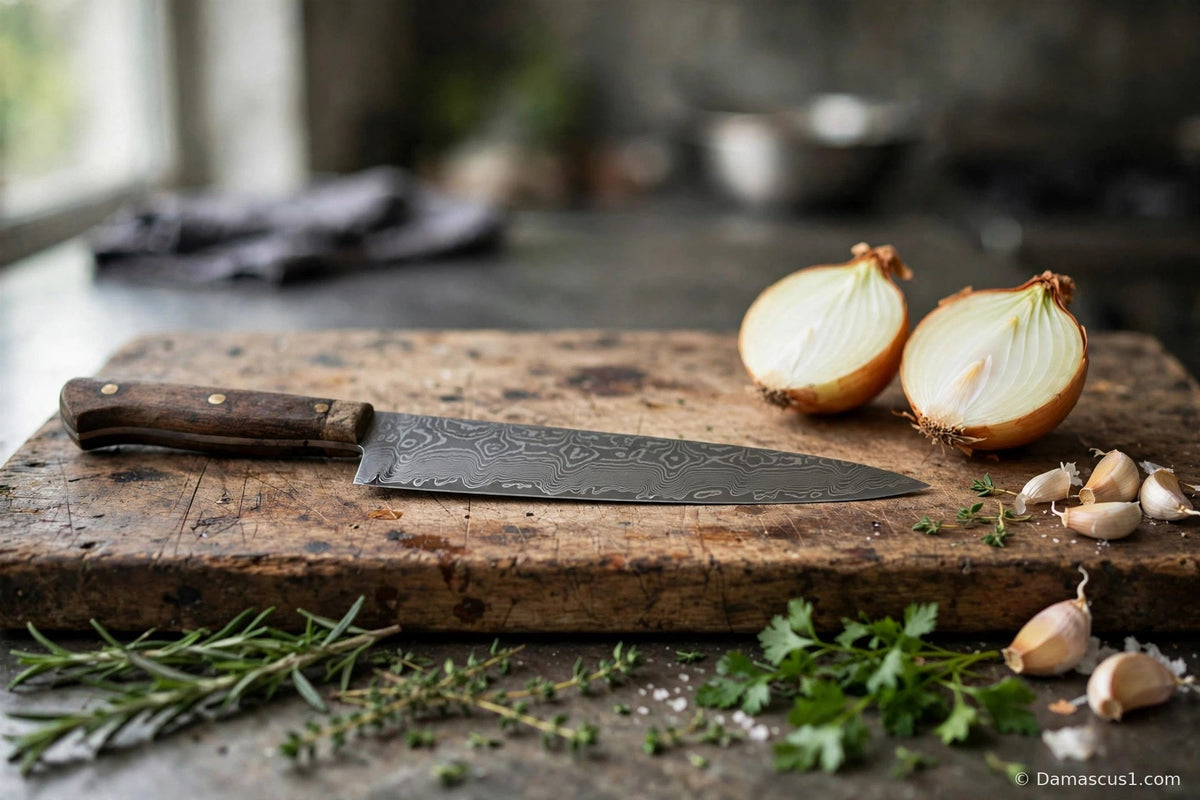
Direct answer: The best knives for chefs are a small working lineup, not a large set: an 8-inch chef knife that does most of the prep, a 3- to 4-inch paring knife for detail work, and a serrated bread knife, with a boning or utility knife added when meat work is regular. Chefs choose that core by cutting style first — German weight and curve for rocking cuts, Japanese thinness for push cuts — then by balance and handle comfort, because the knife that gets used for hours has to fit the hand that holds it.
That answer is almost the opposite of what this page used to say. The old version listed four large sets made by other companies, praised them in words nobody could check, and — strangest of all — described "Damascus" as a man who designs knives. Damascus is not a person and not a brand. It is pattern-welded steel: contrasting steels forge-welded into one billet so the layers show as a flowing pattern. Getting that one fact right is a fair summary of this rewrite. What follows is the chef's lineup explained job by job, the German-versus-Japanese decision made by cutting style rather than by flag, the honest account of what Damascus steel does and does not do, and the knives this store actually sells for the work, priced from the live catalogue this morning.
If you are building a working kit rather than reading about one, start with the kitchen knives and chef knife sets collection open beside this guide — every pick below lives there, and the prices in this guide were checked against it today.
What knives do professional chefs actually use?
Professional chefs use a short lineup of knives that each do one job well: a chef knife for the bulk of prep, a paring knife for work in the hand, a serrated knife for crusts and skins, and then specialists — a boning knife, a slicer, a nakiri — only where the menu demands them. The pattern across every serious guide to what chefs carry is the same: fewer knives, used constantly, chosen for comfort and edge retention rather than for how complete the block looks. A working kit is a tool roll, not a showroom.
The chef knife is the centre of it, and it earns that place by range. It slices, dices, minces and chops; it handles vegetables, boneless meat and fish, herbs and fruit; its curved belly rocks through a pile of onions and its flat section push-cuts a tray of mushrooms. Guides that track what professionals reach for put the chef knife at the large majority of all cutting in a kitchen, and the reason is simple geometry: one blade shape that is good enough at almost everything beats five blades that are perfect at one thing each and wrong for the rest of the board. That is why the chef knife decision — size, style, steel, handle — takes most of this guide. Get it right and the rest of the kit is cheap and easy. Get it wrong and every service starts with a small, constant irritation in the hand.
The supporting knives exist because the chef knife has real limits, and naming them is more useful than any brand list. It is too big for work in the hand — peeling, hulling, trimming eyes from potatoes — which is the paring knife's whole job. Its smooth edge crushes a crusty loaf instead of biting it, which is the serrated knife's job. It is too wide and too stiff to follow a bone or a fish's backbone, which is the boning and fillet knives' job. And it is too short to slice a large roast in one clean draw, which is the slicer's job. A chef's kit is just those five answers, bought in the order the jobs show up. The best kitchen knives guide covers the home-kitchen version of the same lineup in full, and the butcher knives uses guide covers the meat specialists — fillet, boning and steak — blade by blade.
One more habit separates a working kit from a bought one: chefs carry their knives. The roll or case that travels between kitchens holds the lineup above and little else, because weight and space punish every passenger. A home cook does not face that discipline, which is exactly why home blocks fill up with knives that are never used. The test in this guide is the traveller's test — would this knife earn its place in the roll? — and it is a better filter than any piece count printed on a box.
How many knives does a chef actually need?

Most chefs need three knives daily and five in total: an 8-inch chef knife, a paring knife and a serrated bread knife cover the great majority of prep, and a boning knife plus a long slicer complete the working kit for kitchens that break down meat or carve roasts. Everything beyond those five is menu-specific — a nakiri for vegetable-heavy cooking, a cleaver for bone work, a fillet knife for whole fish — and should be bought when the job becomes weekly, not before. Piece counts above five are mostly packaging.
| Job | Knife | Typical size | Why this one |
|---|---|---|---|
| General prep: vegetables, boneless meat, herbs | Chef knife / gyuto | 8 in (200–210 mm) | Curved belly rocks, flat section push-cuts; the one blade that does most of the board |
| Detail work in the hand: peeling, hulling, trimming | Paring / petty knife | 3–4 in (petty 5–6 in) | Short blade turns in the hand where a chef knife is clumsy |
| Crusty bread, tomatoes, roasted skins | Serrated bread knife | 9–10 in | Teeth bite surfaces a smooth edge skates across |
| Trimming, deboning, silverskin | Boning knife | 5–7 in | Narrow blade works close to bone without wasting meat |
| Slicing roasts, loins, cooked brisket | Slicer / sujihiki | 9–12 in | Length covers the cut in one draw instead of sawing |
| Vegetable volume: cabbage, squash, root veg | Nakiri | ~6.5–7 in | Straight edge meets the board along its full length; no rocking needed |
| Whole fish | Fillet knife | 6–11 in | Thin, flexible blade follows the backbone and peels skin |
| Joints and bone | Cleaver | 6–8 in, heavy | The only common knife built for bone |
Read the table as a buying order, not a shopping list. The first row is the purchase that matters and the one worth spending on. Rows two and three are inexpensive and last for years. Rows four and five arrive with the cooking that needs them — the first whole chicken broken down at home, the first brisket sliced for a crowd. The last three rows are specialists: genuinely useful, genuinely narrow, and the wrong place to start. A cook who buys the table top-down ends with a kit that matches their kitchen. A cook who buys a 21-piece block buys the table bottom-up, plus steak knives, scissors and a block — and still has to check whether the chef knife at its centre is any good.
That last point is the one the old version of this page got backwards. It presented piece counts — 7, 9, 21, 26 pieces — as if the count were the quality. It is not. In a large set, the money is spread across every piece in the box, which means the chef knife inside a big set is built to a fraction of the set's price. A smaller set, or a single knife at the same money, concentrates the budget on the blade that does the work. The best Damascus chef knife set guide makes the set side of that argument in full; this guide's position is the working one: judge any set by its chef knife first, and count the rest as a bonus.
German or Japanese chef knife: which fits your cutting style?

Choose German if you rock-chop, prep in volume and want a heavier, tougher knife that forgives rough treatment and hones quickly; choose Japanese if you push-cut, slice precisely and want a thinner, harder blade that holds a finer edge longer in exchange for gentler handling. Neither school is better. They are answers to two different ways of moving a knife: the German profile is built around a curved belly and a rocking motion, the Japanese gyuto around a flatter profile and a forward push. Match the knife to the motion you actually use and the choice makes itself.
| German style | Japanese style (gyuto) | |
|---|---|---|
| Blade profile | Pronounced curved belly | Flatter, lower tip |
| Cutting motion | Rocking chop — tip stays on the board | Push cut and draw slice |
| Steel character | Softer, tougher; resists chipping | Harder; holds a finer edge longer |
| Typical edge angle | ~15–25° per side | ~12–15° per side |
| Weight and feel | Heavier, momentum helps the cut | Lighter, the hand does the guiding |
| Forgiveness | High — bones, frozen spots and twisting hurt it less | Lower — hard, thin edges chip on bone and hard rinds |
| Maintenance | Hones back quickly; sharpening is easy | Needs a stone and a steadier hand; honing rods used gently or not at all |
The honest complication is that the boundary is blurring, and the guides ranking for this search say so themselves: the MAC MTH-80 that tops several spec rankings is a Japanese blade in a Western profile, and plenty of German makers now grind thinner than they used to. So treat the table as a description of tendencies, not tribes. What does not blur is the physics underneath it. A thinner, harder blade cuts with less wedging and keeps its fine edge longer, and pays for it by chipping where a softer blade would roll. A heavier, softer blade shrugs off the chip, dulls sooner, and comes back with a few passes on a steel. A chef working a fast line with mixed prep often wants the forgiving knife; a cook whose prep is fish and vegetables all day wants the precise one. Both are professional answers.
Damascus versions exist on both sides of this table, because Damascus describes how the steel is layered, not which school ground it. A Damascus gyuto behaves like a gyuto and a Damascus German-profile chef knife behaves like a German knife — the pattern changes how the blade looks, not how it should be chosen. The chef knife vs santoku vs nakiri guide sorts the Japanese shapes against each other; the section on Damascus below covers what the pattern itself adds.
What size chef knife do professionals use?
Most professionals use an 8-inch (200–210 mm) chef knife as their main blade, because it is long enough to clear a large onion or a cabbage in one cut and short enough to control at speed for hours. Cooks with smaller hands or tight boards often prefer a 7-inch; large-handed cooks and high-volume prep cooks move up to 10 inches for the extra board coverage. Size is a fit question before it is a performance one: the right length is the longest blade you can guide accurately without the tip wandering.
The test is practical. With a pinch grip — thumb and forefinger pinching the blade just ahead of the handle — the knife should feel like an extension of the forearm, not a weight hanging off it. Rock through an imaginary pile of herbs: if the tip lifts cleanly and lands where you aimed, the length suits you. If the tip drifts, or the heel digs in before the tip lands, go shorter. A 10-inch knife in hands it does not fit is slower and less safe than an 8-inch, whatever its steel. The same logic runs the other way for the board: a blade longer than the board's diagonal cannot be used in a full draw cut, so measure the board before coveting the longer knife.
Height matters as much as length, and it is the spec buyers most often skip. A tall blade — more knuckle clearance between the edge and the handle line — keeps knuckles off the board through a long prep session and gives the guide hand a flat face to rest against. A narrow blade feels nimble and turns easily in a cut, but brings the knuckles closer to the board. Chefs who prep in volume tend to choose height; cooks who do fine, tip-led work tend to choose narrow. Neither preference is wrong, and neither is visible in a product title — it is in the blade's measurements, which is why those measurements are worth reading before the marketing around them.
What makes a chef knife good?
A good chef knife is decided by five things, in this order: steel that holds an edge and can be sharpened back, a full tang or a handle joint you can trust, balance near the pinch grip so the blade does not drag the hand forward or back, a handle that stays gripped when wet, and an edge geometry matched to how you cut. Sharpness out of the box is not on the list, deliberately: every knife is sharp once. What a chef is buying is the edge the knife can be returned to, hundreds of times, over years.
Steel first, with the honesty the spec sheets sometimes lack. A steel's job is a three-way trade: hardness holds an edge, toughness resists chipping, and corrosion resistance decides how much drying discipline the knife demands. Push one corner and the others move. That is why "best steel" questions have no clean answer — VG-10, AUS-10, high-carbon stainless and plain carbon are all defensible choices that weight the triangle differently — and why this guide assigns no hardness figure or layer count to any knife it has not verified per product. Each Damascus1 product page states its own details; read them there, and be suspicious of any listing, anywhere, that promises all three corners of the triangle at once.
The tang is the second check, and the simplest. A full tang means the blade's steel runs the full length of the handle, visible as a spine of metal between the handle scales. It is not magic — a well-made partial tang lasts decades — but it is the easiest construction quality to verify with your own eyes, and it anchors the balance chefs feel at the pinch point. Balance itself is the third check: hold the knife at the pinch grip and it should sit near neutral, neither tip-heavy nor handle-heavy, so a long session does not become wrist work. The fourth, the handle, is personal in a way no review can settle: rounded handles suit a relaxed grip, angular handles index the blade's orientation without looking, and every handle should be judged wet, because kitchen hands are wet more often than they are dry.
Edge geometry, the fifth check, is where the German-Japanese table above becomes a buying rule. A thin blade behind the edge wedges less in dense vegetables — a carrot parts instead of cracking — and a thicker one tolerates the twist of a rushed cut. There is no free choice here either. The working answer most chefs land on is a moderately thin blade, kept genuinely sharp, on a wooden board — because board material quietly decides edge life more than most steel choices do. Glass and stone boards punish any edge; plastic is serviceable; wood, especially end grain, is kindest. The kitchen knife care guide covers boards, washing and storage as one routine.
What does Damascus steel do for a chef knife?

Damascus steel gives a chef knife its pattern — the flowing, watered figure that comes from forge-welding contrasting steels into one layered billet — and that pattern is character, not a performance promise. How the knife actually cuts, holds an edge and resists chipping depends on the steels in the layers and the heat treatment they received, exactly as it does for a plain blade. Two Damascus knives with similar patterns can perform quite differently, and a plain knife with better heat treatment can out-cut a prettier one. Buy Damascus for the object as well as the edge, with open eyes about which part the pattern is.
That honesty matters in a chef's guide more than anywhere, because a working knife is judged daily and any gap between the story and the steel shows up fast. What a well-made Damascus chef knife genuinely offers a professional or a serious home cook is this: a blade built by a slower, more deliberate process, no two of which look alike; a surface that shows wear and care visibly, which encourages the drying habit that keeps any fine edge alive; and — when the core steel is a good one, stated on the product page — an edge that behaves exactly as that steel should. What it does not offer is automatic sharpness, automatic toughness, or an excuse to skip sharpening. The old version of this page claimed Damascus knives would not need constant sharpening as if the pattern did the work. Patterns do no work. Edges do, and edges are maintained, not inherited.
There is also an imitation to know about before spending chef money. Some blades sold as Damascus are plain steel with the pattern etched or printed on the surface; the figure is skin-deep and wears away with use and sharpening. Real pattern-welded steel shows its layers through the blade — in the grind, at the edge, and after a sharpening session brings fresh steel up. The guide to spotting a fake Damascus knife walks through the checks, and the guide to the best Damascus kitchen knives and chef's knives compares the store's kitchen range shape by shape. The short version: ask whether the pattern runs through the steel, and be wary of a "Damascus" chef knife priced like a plain stamped one — real forge-welding costs more to make, and the price usually knows it.
Set or single knives: which should a chef buy?
Buy single knives if you already own a working chef knife and are upgrading piece by piece; buy a set if you are starting from an empty block and the set's chef knife is genuinely good, because a set prices its blades below their single-knife cost per piece. The deciding question is never the piece count — it is whether the chef knife at the centre of the set is the knife you would have bought alone. If it is, the matching paring, utility and slicing blades around it are good value. If it is not, the set is a discount on the wrong knife.
The market context helps calibrate the money. The spec-led guides ranking for this search put their top single chef knives — the MAC MTH-80, the Tojiro DP gyuto, the Wüsthof and Zwilling flagships — roughly between $75 and $250 for one knife, with premium Japanese pieces above that. A working chef building the essential three one knife at a time should expect the chef knife to take most of the budget and the paring and serrated knives to be comparatively cheap. Against that background, a complete set priced like a single mid-range chef knife is worth a hard look — provided its centre holds up, which is a question about the set's chef knife, not its count.
Here is what Damascus1 sells for this work, with every price verified live on November 11, 2026. The store's range is Damascus-led, so the picks below are presented for what they are: a handmade patterned-steel kit at maker-direct prices, not a claim that they out-tested the ranked factory knives above.
- Premium Kitchen Knife Block Set — $169.99. The flagship 7-piece set and the closest thing in the range to a chef's roll in a block: the working core — chef knife, utility and detail blades — in one purchase, at a price the spec guides' single top pick retails near. For a kitchen starting from empty, this is the buy. Premium Kitchen Knife Block Set
- Japanese VG10 Damascus Chef Knife, 8.5 in. — $399.99 (was $499.00). The premium single: an 8.5-inch VG10 Damascus chef knife for the cook upgrading the centre of the kit and keeping everything else. This is the singles route at its clearest — the whole budget on the blade that does most of the work. Japanese VG10 Damascus Chef Knife, 8.5 in.
- Kitchen Knife Set 9 Pcs Japanese AUS-10 — $349.99 (was $499.99). The large set, for fitting out a kitchen in one purchase: nine pieces with a block, spanning chef knife to utility. Judge it by the rule above — its chef knife first — and it is the range's full-kitchen answer. Kitchen Knife Set 9 Pcs Japanese AUS-10
- AUS-10-Labelled Kitchen Knife — $59.99. A general AUS-10 kitchen knife at the price of the guides' budget singles. One plain note: the listing's own description mixes references to a boning knife and a chef knife, so buy it as a versatile kitchen knife for general and trimming work, and read the product page for its own stated details. AUS-10-Labelled Kitchen Knife
- VG10-Labelled Nakiri Knife — $44.99. The vegetable specialist from the kit table, for the cook whose board is cabbage, squash and root vegetables most days. A nakiri is not a chef knife substitute; it is the row of the table where the straight edge beats the curved one. VG10-Labelled Nakiri Knife
- Kitchen Knife — G10-Labelled Listing — $34.99 (was $59.99). The budget entry point: a general kitchen knife for a first upgrade from a supermarket blade. At $34.99 on its own it does not clear the store's $50 free-shipping threshold, so pair it with a second item or expect the shipping charge. Kitchen Knife — G10-Labelled Listing
For the meat side of a chef's week — the boning, breaking and carving rows of the kit table — the best butcher knife buying guide covers the dedicated blades and their prices, and says plainly which of them this store does and does not currently list.
How do chefs keep their knives sharp?

Chefs keep knives sharp by separating two jobs most home cooks merge: honing, which realigns a folded edge and is done often — in busy kitchens, daily or more — and sharpening, which removes metal on a stone to cut a fresh edge and is done only when honing stops bringing the edge back. A honing steel does not sharpen, and a stone is not a daily tool. Keeping that distinction straight is most of professional edge care; the rest is angle discipline and a board that does not fight the blade.
The angles follow the school. A German-profile edge is typically honed and sharpened around 15–20 degrees per side in home practice, a Japanese edge finer, around 12–15 degrees — the ranges the professional guides cite — and the exact figure matters less than holding one angle consistently through the stroke. On the stone, that means starting coarse only when the edge is damaged or truly dull, finishing fine, and working until a burr forms on one side before switching. The full technique, with grit progressions and pattern-safe practice for Damascus blades, is in the whetstone sharpening guide.
Two habits protect all of that work. The first is the board: wood first, plastic acceptably, never glass or stone, because a hard board undoes a sharpening session in a week of dinners. The second is washing: by hand, dried immediately, never through a dishwasher, whose heat, detergent and rattling dull edges and spot patterned steel. A Damascus blade asks for the same routine with the volume turned up slightly — dry it the moment it is washed, every time — because the pattern that makes it beautiful also makes every water mark visible. Whether a given blade wants a light film of oil depends on the steels in its layers; the can Damascus steel rust guide works through that decision steel by steel.
How do you store a working knife kit?

Store a working kit so edges touch nothing hard and blades are never loose together: a leather roll for knives that travel, a block with edges facing up or a magnetic strip for knives that stay home, and a sheath on any blade that must live in a drawer. The rule underneath every option is the same — an edge that knocks against steel, ceramic or other blades dulls and chips, and a loose blade in a drawer is also how hands get cut reaching for something else. Storage is edge care that happens while the knife is doing nothing.
The roll deserves its reputation among chefs for a practical reason beyond romance: it enforces the lineup. Five pockets hold five knives, each separated by leather, and anything that does not earn a pocket stays behind. At home the equivalent discipline is the block or strip audited once a year — the knives on it should be the knives in the table at the top of this guide, and a blade that has not been touched in a year is a candidate for the drawer-with-a-sheath, not the prime counter space. Working kits stay working by being edited.
The Olive Wood Damascus Pocket Knife Set — $39.99
Real Damascus steel, an olive wood handle and a genuine leather sheath included — the knife our readers ask about most.
Shop the Olive Wood Damascus Pocket Knife Set — $39.99 · Free US shipping on orders over $50.
Frequently asked questions
What knife is most used by professional chefs?
The 8-inch chef knife is the most used knife in professional kitchens. Its curved belly and flat section let it rock-chop herbs, push-cut vegetables, slice boneless meat and portion fish, so it covers the large majority of prep on its own. Chefs build the rest of the kit — paring, serrated, boning, slicer — around the jobs the chef knife does badly, in the order those jobs appear in their cooking.
How many knives does a chef actually need?
Three daily and five in total cover most professional work: an 8-inch chef knife, a paring knife and a serrated bread knife for everyday prep, plus a boning knife and a long slicer where meat work and carving are regular. Specialists such as a nakiri, a fillet knife or a cleaver are bought when their job becomes weekly. Large piece counts mostly add steak knives and duplicates, not capability.
German or Japanese chef knife: which is better?
Neither is better overall; they suit different cutting styles. German knives are heavier, with a curved belly for rocking cuts, softer and tougher steel, and edges around 15–25 degrees that forgive rough treatment and hone back quickly. Japanese knives are thinner and harder, with finer edges around 12–15 degrees that push-cut precisely and hold sharpness longer, but chip more easily on bone and hard rinds. Choose by the motion you use.
What is the difference between a nakiri, a santoku and a chef knife?
A nakiri has a straight, square blade for chopping vegetables. A santoku is a shorter all-purpose Japanese knife for slicing, dicing and mincing. A chef knife is longer with a curved edge for rocking cuts and the widest range of tasks.
Can Damascus kitchen knives go in the dishwasher?
No. Hand-wash and dry Damascus kitchen knives right after use. Dishwashers can rust the steel, dull the edge and damage the handle.
Is Damascus better than stainless steel?
Neither is better for everyone. Damascus is pattern-welded layered steel — it can be built on stainless or carbon steels — and it takes the edge and care character of the steels in its layers, with a unique pattern as its visible difference. Plain stainless resists rust and needs less care. Pick by how much care you want to give, and check the specific steels on the product page rather than trusting the name alone.
Do professional chefs use knife sets or single knives?
Both, for different reasons. Chefs starting out or working a station often carry a small personally chosen set of singles in a roll, bought one at a time as the budget allows. A set makes sense when starting from nothing, provided the chef knife at its centre is one you would buy alone — the rest of the set is priced as a bundle around it, so the centre decides whether the bundle is good value.
How often should a chef knife be sharpened?
Hone often and sharpen rarely. A honing steel realigns the edge and can be used daily in a busy kitchen; it removes no metal. Sharpening on a stone removes metal to cut a fresh edge and is needed only when honing stops restoring performance — for most home cooks that is a few times a year, for heavy professional use more often. Sharpening on a schedule instead of on need grinds away blade life.
The short version
The best knives for chefs are not a brand or a piece count. They are a short lineup — an 8-inch chef knife chosen by cutting style, a paring knife, a serrated knife, and the specialists your cooking actually calls for — kept sharp by honing often and sharpening rarely, stored so the edges touch nothing hard, and judged by balance and handle fit rather than by claims. Damascus earns its place in that lineup honestly: the pattern is the visible character of layered steel, and the performance is the steels and heat treatment underneath it, stated per product and priced live. Start with the centre of the kit, spend the budget there, and let the rest of the roll fill in as the jobs arrive.
Build the working kit: browse the kitchen knives and chef knife sets collection, compare the Premium Kitchen Knife Block Set — $169.99 against the Japanese VG10 Damascus Chef Knife, 8.5 in. — $399.99 as your centre, and add the specialists as your cooking calls for them. Prices verified live on November 11, 2026.
Leave a comment: