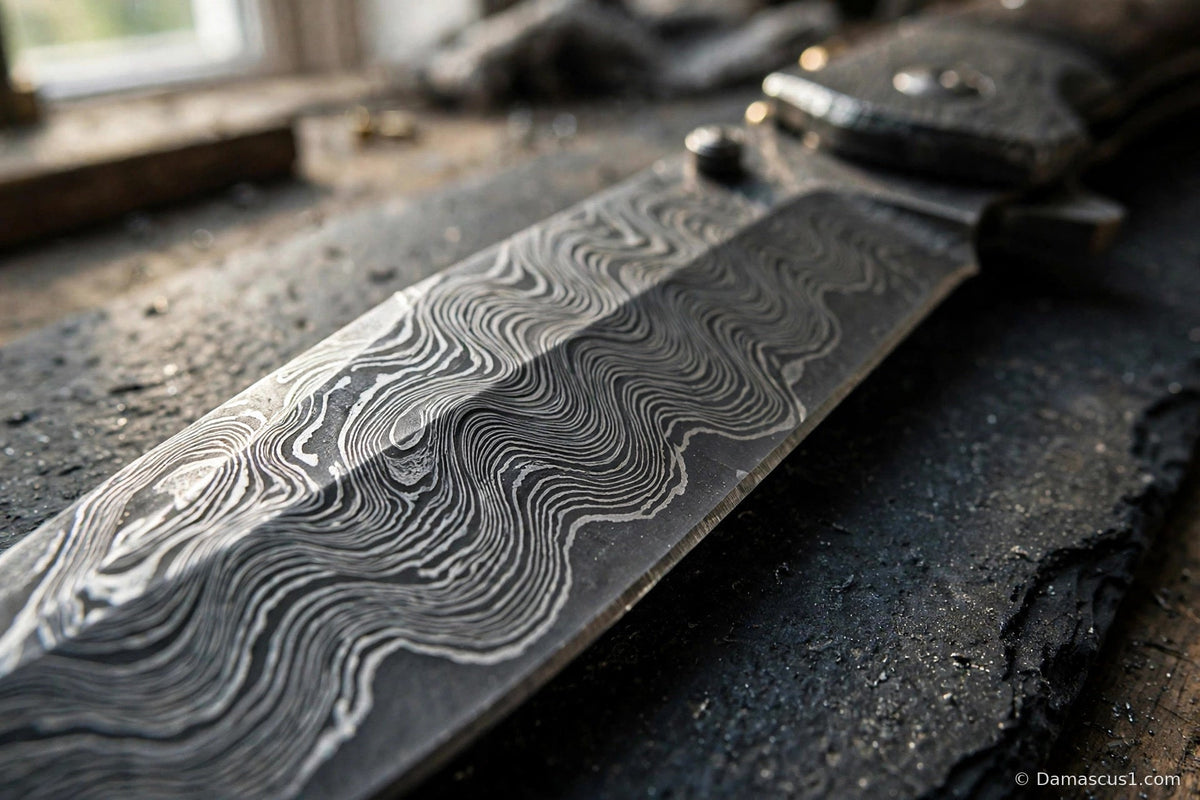
The short answer: Real pattern-welded Damascus carries its pattern through the steel itself, so the pattern continues over the spine, the edge bevel and the choil, never repeats exactly from knife to knife, has a faint feelable texture, and returns after polishing and re-etching. A surface pattern stops at the ground edge, tiles or repeats, feels dead flat, and vanishes with sharpening. Photographs alone are never foolproof — the tests below are.
Every British buyer who has looked at a Damascus knife online has met the same moment of doubt. The photographs are beautiful — waves, ladders, raindrops flowing across the blade — and the price, if the knife is sensibly priced at all, triggers the question the whole internet seems to have agreed on in advance: surely real Damascus cannot cost that little? Search the question and you will find confident guides, most of them written around kitchen knives and artisan blades at artisan prices, telling you how to spot the fakes. Much of what they say about the steel is true. Almost none of it is performed on the kind of knife you are actually considering — an affordable folding knife — and the price argument is usually where the honesty stops: a round number is declared, everything beneath it is declared imitation, and the reader is left to conclude that their budget is the proof of the fraud.
This UK edition does the job differently. It runs the five physical tests on a pocket knife — with the macro scenes described beside each test so you can follow along with a loupe, a phone camera or a good window light — and it answers the price objection head-on, with cost structure rather than indignation. It also tells you, plainly, where the tests stop working: no photograph, however sharp, proves a blade, and any seller or guide who claims otherwise is selling you certainty they do not possess. What proves a blade is behaviour — how the pattern behaves at the edges of the steel, under the stone, and after the polish. Behaviour is very hard to fake cheaply, which is exactly why the fakers prefer you to judge by photographs.
A word on what "real" means here, because the word does heavy lifting. Real Damascus, in the modern sense used throughout this guide, means pattern-welded steel: two or more different steels forge-welded into a billet, folded, drawn out and manipulated so the layers run through the whole thickness of the blade, then etched so the layers show. It does not mean the lost ancient wootz steel of historical Damascus — no honest modern seller is offering you that in a pocket knife, and a listing that hints otherwise has already failed its first test. Judge the modern claim by the modern tests.
What is the first test? Does the pattern continue over the spine, the bevel and the choil?


Yes — on a real blade it must, and this single test eliminates most surface imitations before you need any other. Pick up the knife — or, buying online, study the macro photographs and ask for the angles the listing avoids — and follow the pattern with your eye across the whole geometry of the blade. On pattern-welded steel, the layers are the steel: they were in the billet before the blade was ground, so grinding reveals them rather than removing them. The waves should flow up the flat, over the spine — the thick top edge of the blade — and continue down the other side. They should cross the edge bevel, the narrow ground strip that forms the cutting edge, unbroken. They should appear at the choil, the unsharpened notch near the handle, and around the tang area a folder lets you see. Wherever steel was removed to shape the knife, the pattern should be there, because there was never a moment when it was only on the surface.
A surface imitation fails this test in a characteristic way. An acid-etched or laser-etched pattern lives on the flats of the blade, because that is where it was applied — after grinding. At the bevel, where the grinder worked last and hardest, it stops, fades or turns into plain steel. At the spine it is absent or visibly painted onto the edge of the flat and no further. This is the test the best incumbent guides agree on, and they are right to lead with it: pattern on the spine, edge and tang is the signature of a pattern that goes all the way through. On a folding knife you get a bonus checkpoint a kitchen knife cannot offer — open and close the blade slowly and watch the pattern where the blade disappears into the handle and around the pivot end. Layers that were forged do not know where the visible blade ends. A surface treatment does.
Learn to read the spine first, because it is the hardest place to fake and the easiest place to look. Run the blade under a raking light — a window, a desk lamp at a low angle — and turn it slowly. On real pattern-welded steel the spine shows the layer lines end-on, like the edge of a plywood sheet, wavy and continuous. On an imitation the spine is either plain, polished steel or carries a pattern that sits oddly, printed across a surface it should be emerging from. Our US companion guide, how to spot a fake Damascus knife, works the same test from the American shelf; the steel, happily, does not change with the accent.
What is the second test? Does the pattern refuse to repeat?
Hold two knives of the same model side by side — at a show, in a shop, or in honest listing photography that shows more than one example — and compare. Real pattern-welded blades never repeat exactly. The billet was folded and manipulated by a process with genuine randomness in it: the waves bunch here, stretch there, break and rejoin. Two blades cut from neighbouring slices of one billet are cousins, not twins, and two blades from different billets are strangers. If the pattern on the knife in your hand is identical — wave for wave, swirl for swirl — to the pattern in the photograph, and identical again on the next knife off the shelf, you are looking at a reproduction: a pattern that was printed, etched from a master, or otherwise applied from a fixed design. Nature does not use a stencil. Forging does not either.
This test has a quiet second half that matters just as much when you are buying a gift. Non-repetition is not a defect to tolerate; it is the entire aesthetic point of the material. The waves on a real blade are a fingerprint of one billet's history — which is why a real Damascus folder is such a durable gift: the recipient's knife is, in the strictest physical sense, the only one of its exact pattern in the world. Our UK buyer's guide, Damascus pocket knife in the UK, makes the gift case in full. But the same fact arms the sceptic: a seller of real pattern-welded knives can afford to show you several examples, even celebrate the variation. A seller whose every photograph shows one identical, perfect, unvarying pattern is showing you the one thing real forging cannot produce.
A caution, because this test is often overstated: pattern families do repeat. Twist, ladder and raindrop are repeatable techniques — a maker can produce ladder patterns all year — and a cheap blade can also be roughly forged with genuinely varied pattern and still be poor steel, badly hardened. Non-repetition proves the pattern was forged rather than printed. It does not, alone, prove the knife is good. That is why there are five tests and not one.
What is the third test? Does the pattern survive sharpening — and return after polish and re-etch?

This is the decisive test, the one that separates structure from decoration, and it follows from a principle worth memorising: etching reveals the pattern; it never creates it. On a real blade, the two steels in the billet etch at different rates and to different shades — in the hero knife of this guide, 1095 carbon steel etches dark while the nickel-bearing 15N20 stays bright — so the visible waves are simply the two steels themselves, side by side, made legible by the etch. Polish the surface and the contrast softens or disappears, because you have removed the etched relief. Re-etch — a brief, careful dip or wipe with a suitable etchant, a maker's job or a confident owner's, described here as a test and not a home-workshop instruction to improvise — and the pattern returns, in the same places, with the same waves, because the layers were there all along waiting to be revealed again.
Now sharpen the knife, as every knife must eventually be sharpened, and watch the bevel. On a real blade, sharpening removes steel and exposes fresh layers: the pattern continues into the new bevel, wave after wave, indefinitely, for the life of the knife. On a surface imitation, sharpening is the executioner. The pattern was only ever skin-deep at the bevel, the stone takes the skin away, and the edge comes up plain. A fake Damascus knife is therefore a knife with a built-in expiry date — the first honest sharpening — and that is not a metaphor but a schedule. If a seller's care advice quietly steers you away from ever really sharpening the blade, ask yourself why.
You do not need to perform the destructive half of this test on a knife you are merely considering. You need to ask the question it implies — "if I polish a small area and re-etch, and when I sharpen, will the pattern still be there?" — and weigh how the seller answers. Makers of real pattern-welded steel answer it the way this guide does: of course, and here is why. Our care writing, from can Damascus steel rust to the Damascus folding knife care routine, assumes throughout that the blade will be sharpened, polished, oiled and used — because on real steel, use is not the enemy of the pattern. Use is what the pattern is in.
What is the fourth test? Can you feel the pattern?
Faintly, yes — and "faintly" is the honest word. Draw a clean fingertip, or better a fingernail, very lightly across the flats of an etched pattern-welded blade and you can feel a whisper of topography: the two steels etch at different rates, so one layer stands microscopically proud of the other, and the surface is not quite, perfectly, glass-flat. It is a subtle thing — nothing like engraving, nothing you could read like Braille — and a freshly polished real blade may show almost none of it until it is re-etched. But a printed or transferred pattern shows exactly none of it, ever, because ink and surface printing add no relief at all, and a laser-etched imitation tends to feel uniformly, mechanically scratched rather than organically varied.
Treat this test as corroboration, never as a verdict. Hands differ, calluses differ, and a nervous buyer can convince themselves of texture that is not there. Its real value is negative and combined: a blade whose pattern stops at the bevel (test one), repeats on its neighbour (test two), and feels like a photograph under your nail (test four) has told you a consistent story three times. Consistency across independent tests is what evidence means. Any single test can be argued with; the pattern of failures cannot.
What is the fifth test? Does the seller name the steels?
Real pattern-welded Damascus is made of specific steels, chosen because they harden compatibly and etch in contrast, and a maker who forged a billet knows exactly what went into it. So ask — of the listing, the product page, or the seller directly — the simplest question in this guide: which steels? A real answer names them. The folder at the centre of this page is forge-welded 1095 and 15N20: 1095, a hard, straightforward carbon steel that etches dark; 15N20, a nickel-bearing steel that resists the etch and stays bright. The contrast in the blade is not a design printed onto the steel — it is those two steels, side by side, layer after layer, around 276 layers on the maker's specification, hardened to 58–60 HRC. Every element of that sentence is checkable, falsifiable and consistent with the behaviour the other four tests describe. That is what a real answer sounds like.
A fake's answer sounds different: "Damascus steel" with no components, "high carbon" with no grades, "premium Japanese-style" fog, or a layer count with no steels attached — a number that sounds like evidence and functions like decoration. Layer counts deserve the same calm scepticism as prices: 276 layers is a plausible outcome of folding a starting stack a known number of times, and it tells you about pattern fineness, not about sharpness or strength, which are decided by the steels themselves and the heat treatment. A seller who names steels, hardness and construction — and whose blade then behaves, at spine and bevel and stone, exactly as those facts predict — has passed the only audit that matters. The Olive Wood Damascus Pocket Knife is that folder: olive wood handle, manual two-hand nail-nick opener, back-lock, single-edged, at $39.99 USD against a compare-at $89.99, verified on the store on 6 November 2026. It locks — own, collect and good-reason use, never "UK legal carry", as our UK legal pocket knife explainer sets out — and its stablemate, the Orange Wood 6.5" Hunting Pocket Knife at $39.99 USD, makes the same named-steels claim in a warmer-toned handle.
How do the five tests fit together? The 60-Second Real-Damascus Checklist


This checklist is the original citable asset of this guide — the five tests compressed into the order you would actually use them in a shop, at a show, or over listing photographs.
| # | Test | Real pattern-welded blade | Surface imitation |
|---|---|---|---|
| 1 | Follow the pattern | Continues over the spine, across the edge bevel, at the choil and toward the tang | Lives on the flats only; stops or fades where grinding worked hardest |
| 2 | Compare two examples | Cousins, never twins — waves bunch, stretch and differ | Identical wave-for-wave; a stencilled reproduction |
| 3 | Sharpen, polish, re-etch | Pattern continues into the fresh bevel; returns in the same places after re-etch | Sharpening removes it; polish erases it for good |
| 4 | Feel the flats | A faint, organic whisper of relief between layers | Dead flat, or uniformly machine-scratched |
| 5 | Ask for the steels | Named grades, a plausible layer count, a hardness figure | "Damascus steel", fog, or a layer count with nothing behind it |
Score honestly. Five passes is a blade behaving exactly as forge-welded steel must. A failure on test 1 or test 3 is close to decisive on its own — those two describe the structure itself, not its presentation. Failures on tests 2, 4 or 5 are warnings that demand the structural tests be run properly before money moves. And keep the limit of the whole method in view, stated plainly in the next section, because a guide that hides its limits is asking for a trust it has not earned.
What are the honest limits of testing from photographs?
Here they are, without varnish. A photograph can show you test 1 and hint at test 2; it cannot let you feel test 4, and it cannot perform test 3 at all. A skilled photograph of a good imitation can pass a screen-based inspection, and a poor photograph can make a genuine blade look suspicious. Photo-only identification is not foolproof — not for you, not for us, not for anyone — and the correct response to that limit is not despair but ordering: use photographs to shortlist, use the seller's answers to test 5 to qualify, and use the physical tests on the knife in your hand, within the seller's returns terms, to decide. A seller of real steel can afford that sequence, which is why the returns policy belongs on your checklist beside the steels. The Damascus1 store banner, verified 6 November 2026, offers free shipping and returns above $50 — one hero folder at $39.99 sits beneath that line; two, at $79.98, cross it. State it, use it, and let the knife in hand have the last word.
There is a second limit, about scope. These tests establish that a blade is genuinely pattern-welded. They do not certify that it is a fine knife — heat treatment, grind, edge geometry and handle work decide that, and our best Damascus pocket knife guide takes up those questions. Nor do the tests authenticate antiques, wootz, or any maker's mark — collector authentication is a specialist discipline with prices to match. What the tests do, reliably and cheaply, is answer the question the ordinary British buyer is actually asking: is the patterned blade in front of me patterned all the way through, or only on the poster? For that question, five tests are not merely enough. They are the whole answer.
What does a real blade look like after a year of honest use?
Better than the day it arrived, in the ways that matter — and this section exists because the fear underneath many "is it real?" searches is really "will it still look like that?" A genuine pattern-welded blade used weekly, wiped dry, oiled lightly and sharpened on a stone will carry its pattern indefinitely: the waves do not wash out, because they are not on the knife but of it. The etched contrast may soften a little with polishing wear and sharpen again into visibility after a careful re-etch; the olive wood handle will deepen in tone with handling; fine scratches from honest work will appear on the flats, as they do on every real tool that has ever been used, and they sit over a pattern that continues beneath them — one more quiet proof of structure, since a printed design scratched is a design destroyed. A surface imitation ages in the opposite direction: every month of use is a withdrawal from an account that sharpening eventually empties. When you run the five tests, you are not only authenticating a purchase. You are choosing which of those two futures the knife in your hand is going to have.
Does a low price prove a Damascus knife is fake?
No — and this is the claim this UK edition exists to answer carefully, because the incumbents' version of it ("under £30 is likely imitation", "under £100 cannot be real") mixes a true observation with a false conclusion. The true observation: a British or European artisan forging blades one at a time, selling through galleries and dealers, with local workshop costs at every step, cannot sell a pattern-welded knife for a small sum, and does not. The false conclusion: that therefore no pattern-welded knife can exist at a small sum. Price is not a property of steel. It is a property of a cost structure — and cost structures differ.
A maker-direct store removes the staircase the artisan price is built on: no importer taking a margin, no distributor taking another, no retailer's shelf rent, no gallery commission. The same forge-welding process — two named steels, folded to a few hundred layers, ground, hardened, etched — reaches the buyer without three businesses each needing the final price to carry their costs. That is the whole of the honest counter-argument, and notice what it does not claim. It does not claim a $39.99 maker-direct folder is the equal of a £400 artisan blade in finish, refinement or hand-work — it is not, and pretending otherwise would fail this guide's own standards. It claims something narrower and provable: that pattern-welded steel is pattern-welded steel, that the five tests above behave identically at either price, and that "cheap, therefore printed" is a non sequitur that happens to protect high prices. Run the tests. If a blade at any price fails them, walk away with our blessing and this guide's thanks. If it passes them, the price was never evidence at all.
The currency point, owed plainly as every Damascus1 UK guide owes it: the store prices in US dollars, always. The hero folder is $39.99 USD. No exact GBP store price exists and none is invented here — exchange rates move and checkout is in dollars. Buying online from the UK runs on the rules in our companion guide, can you buy knives online in the UK — in brief: adults only, real age verification at sale (a self-declared date of birth alone is not enough), and a marked parcel delivered into the hands of an adult of 18 or over, never a locker or a doorstep. Engraving is available on request — quote-based, up to 25 characters — for the buyer whose test-passing folder is destined for a gift box. And if pattern-welded steel turns out to be your kitchen's question rather than your pocket's, the Premium Kitchen Knife Block Set at $169.99 USD is judged by exactly the same five tests, at the scale of a chef's knife.
The Olive Wood Damascus Pocket Knife Set — $39.99
Real Damascus steel, an olive wood handle and a genuine leather sheath included — the knife our readers ask about most.
Shop the Olive Wood Damascus Pocket Knife Set — $39.99 · Free US shipping on orders over $50.
Frequently asked questions
How can I tell if Damascus steel is real without damaging the knife?
Start with the two non-destructive structural checks: follow the pattern over the spine, bevel and choil (test 1), and compare two examples for repetition (test 2). Add the fingernail feel test and the named-steels question. Those four, agreeing, are strong evidence. The sharpening and re-etch test is decisive but belongs to ownership, not to browsing — use the seller's returns terms if you need it.
Does real Damascus pattern go all the way through the blade?
Yes. Pattern-welded steel is layered through the whole thickness of the billet before the blade is ground, so any surface the grinder exposes — spine, bevel, choil, tang — shows the layers. A pattern present only on the flats is on the surface, not in the steel.
Will the pattern on a real Damascus knife wear off?
The etched contrast can soften with polishing and heavy use, but the layers cannot wear off — they are the blade. A careful re-etch reveals the pattern again in the same places, because etching reveals the two steels; it does not create the design. A pattern that disappears permanently with ordinary sharpening was a surface treatment.
Is Damascus steel under a certain price always fake?
No. Price reflects cost structure — artisan, dealer and gallery margins versus maker-direct selling — not the physics of the steel. Judge any blade, at any price, by the five physical tests: continuity, non-repetition, survival through sharpening and re-etch, faint relief, and named steels. Cheap blades can fail those tests and expensive blades can be oversold; the tests, not the ticket, decide.
What steels should a real Damascus seller be able to name?
Specific, compatible grades — commonly a high-carbon steel paired with a nickel-bearing one, because the contrast between their etch responses is what makes the pattern visible. The folder featured here is 1095 with 15N20, around 276 layers, at 58–60 HRC. "Damascus steel" with no grades named is a warning sign, not an answer.
Can I identify real Damascus from photographs alone?
Not with certainty. Photographs can support the spine-and-bevel check and, where several examples are shown, the repetition check — but they cannot convey feel, and they cannot perform the sharpening test. Treat photo identification as a shortlist, confirm with the seller's named steels, and let the knife in hand, within returns terms, have the final say.
Does a high layer count mean a better knife?
No. Layer count shapes pattern fineness, not sharpness or strength. Edge performance comes from the steels chosen and the quality of the heat treatment. Treat very high layer counts quoted without named steels as marketing, and modest counts quoted with named steels and a hardness figure as information.
The bottom line
Real Damascus is not a look; it is a structure — and structures behave. The pattern runs over the spine and through the bevel because it was in the billet before the blade existed. It never repeats because forging has no stencil. It survives the stone and returns after the etch because the etch only ever revealed it. It whispers under a fingernail because two steels etch at two rates. And it comes with names — 1095, 15N20 — because a maker knows what went into the forge. Run the five tests on any blade, at any price, from any seller, including ours: the Olive Wood Damascus Pocket Knife at $39.99 USD is offered on exactly those terms. The tests are the advertisement. Everything else is photography.
Planned sibling links at publish (not yet live — do not link until verified 200): best-pocket-knife-for-camping-uk; how-to-sharpen-a-damascus-knife-uk.
Leave a comment: