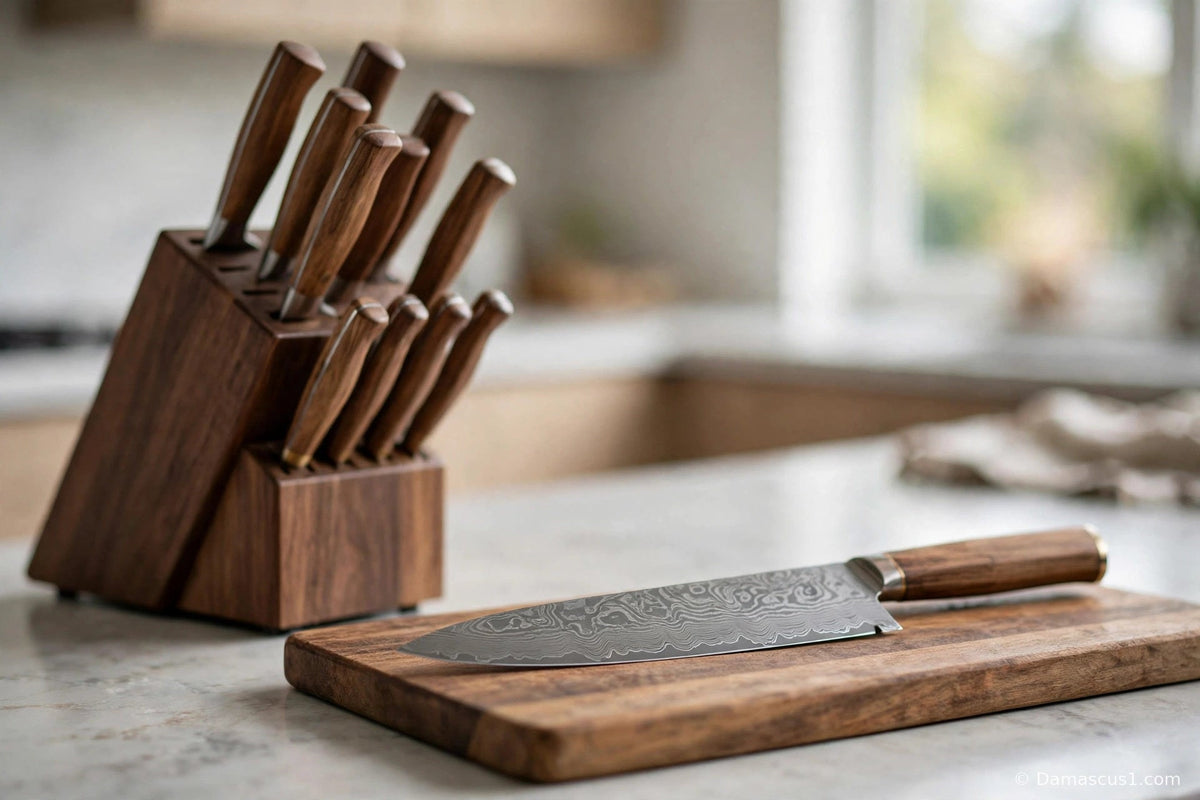
The best knife set for most kitchens is the smallest honest one: an 8-inch chef's knife, a serrated bread knife, a paring knife, kitchen shears and a block or strip to store them in — in named steel, with a stated tang, at a price that survives a second look. Under $200 that formula is absolutely buyable; the trap is not the budget, it is the piece count. Sets compete on the number printed on the box, and the cheapest way to raise that number is to add pieces nobody reaches for. This guide works through what a good set actually includes, what the filler looks like, how to judge the steel before the pattern, and the point at which spending $350 or more stops being indulgence and starts being arithmetic. Every price quoted for a Damascus1 set was checked live on the product page on November 23, 2026 — and the product page on the day you order is always the final word.
What is the best knife set for most home kitchens?
The best knife set for most home kitchens covers the five jobs that make up nearly all home cooking — chopping, slicing bread and tomatoes, small in-hand work, poultry and packaging with shears, and safe storage — with nothing else in the box. Buy the set whose chef's knife you would happily use alone, because statistically that is what will happen: in a typical week, one knife does the overwhelming majority of the cutting, a second handles bread and delicate skins, and the rest wait. A set built around a strong chef's knife, honest steel and real storage beats a sprawling set built around a number, at any budget.
That is why the under-$200 pick on this page is a block set rather than a count play. The Premium Kitchen Knife Block Set is $169.99, live-checked today, and it is the reference point for everything that follows: a compact block format, a price under the $200 line with room to spare, and a piece list short enough that each item has to justify itself. Whether you buy that set or another maker's entirely, judge every candidate against the same five-job test — if a set cannot tell you plainly which pieces do those five jobs, the rest of the box is decoration.

Which knife sets are worth comparing? The honest price ladder
Five sets span the realistic Damascus1 range, and the useful comparison is not which is "best" in the abstract — it is which rung of the ladder matches how you actually cook. Prices below were verified live on November 23, 2026.
| Set | Live price | Best for | The honest trade-off |
|---|---|---|---|
| Premium Kitchen Knife Block Set | $169.99 | Most kitchens; the under-$200 answer | Compact format — confirm the exact packing list on the product page before ordering |
| 9-Piece Chef Knife Block Set (German-labelled listing) | $189.99 (compare $249.99) | Buyers who want more pieces still under $200 | More pieces is not automatically more useful — check which blades the extra count buys |
| 9-Piece AUS-10 Damascus Blue G10 Block Set | $349.99 (compare $499.99) | The step-up: named AUS-10 Damascus steel and G10 handles | Above the budget line — worth it for daily cooks, wasted on occasional ones |
| 7-Piece Forged Damascus Kitchen Knife Set | $399.99 | Forged construction and a classic seven-piece shape | Top-of-range price; hand-wash care is part of the deal |
| 6-Piece Handmade Japanese Damascus Kitchen Knife Set | $399.99 (compare $549.99) | Japanese profiles and handmade finishing in a smaller count | Six pieces, deliberately — specialists will love it, steak-for-six households should count first |
Two things about this table are worth saying out loud. First, the two under-$200 rows are not consolation prizes — a set at $169.99 that covers the five core jobs will out-cook a $400 set whose owner only ever uses the chef's knife anyway; the extra money buys steel, finishing and profile choices, not extra dinners. Second, compare-at prices are the store's own list comparisons, shown because the product pages show them — treat them as context, not as a valuation. The number that matters is the live price and what is in the box for it.
For the wider field — how these sets sit against the best kitchen knives generally — the hub guide to the best kitchen knives works through the category, and the dedicated best Damascus chef knife set guide goes deeper on the chef-set end of the range.
How many knives do you actually need?
Most home cooks need three knives daily — a chef's knife, a paring knife and a serrated bread knife — plus shears, and everything beyond that is either a genuine specialist (a santoku for vegetable-heavy cooking, a nakiri, a boning knife for people who break down whole birds) or a duplicate wearing a costume. The honest count for a first serious set is five to seven pieces including storage. When a box advertises fifteen, twenty or more pieces, the extras are almost always steak knives counted one by one, a block counted as a piece, scissors counted as a piece, and sometimes the box itself counted as a piece.
That arithmetic matters because money is finite inside a fixed price. A $170 budget spread across seven real pieces buys meaningfully better steel, grinding and handles than the same $170 spread across twenty. This is not snobbery about minimalism; it is division. The piece-count question has its own full treatment in the kitchen knife set piece-count buying guide, which walks the count piece by piece — read it before any purchase where the headline number is doing the persuading.
The exception proves the rule: households that genuinely seat six for steak every Friday are not being fooled by a set of six steak knives — they will use them weekly. The test is never the count itself; it is whether each counted piece maps to a meal you actually cook. Run your last two weeks of dinners against the packing list. Any piece that matches nothing you cooked is filler, whatever it costs.

What knives should be in a basic knife set?
A basic set should contain an 8-inch chef's knife for the bulk of board work, a serrated bread knife that doubles on tomatoes and citrus, a 3.5-inch paring knife for in-hand work, and kitchen shears — stored in a block, on a magnetic strip or in an in-drawer tray. Add a santoku if vegetables dominate your cooking, and a honing rod if you will actually use it weekly. That is the whole skeleton. Everything else is an elective, and electives should be bought one at a time, when a recipe exposes the gap, rather than pre-bought in a box on a guess.
Why the chef's knife carries the set: it rocks through herbs, breaks down onions by the bag, portions squash, slices cooked meats and flattens garlic — it is the only knife in the box that earns its keep three times a day. The bread knife is the quiet second: its serrations saw crusts without crushing, grip tomato skins that slide a straight edge, and portion cakes and melons cleanly. The paring knife does what board knives cannot — hulling, segmenting, trimming, deveining — in the hand, where control matters more than size. Shears snip herbs, open packaging, spatchcock poultry and portion pizza in a pinch; a set without them sends you to a drawer for the household scissors, which is where good intentions go to dull.
Notice what is missing from the skeleton: a second chef's knife in a different length, a "utility" knife that duplicates the paring knife at awkward scale, and matched sets of anything you use one of. Duplication inside a set is the manufacturer spending your money twice on the same job.
Is forged or stamped better for a knife set?
Forged is generally better for a set you intend to keep: a forged blade starts as a single billet worked into shape, which typically means a bolster, better balance, more heft at the handle and a spine that tolerates years of sharpening. Stamped blades are cut from sheet steel and ground — lighter, cheaper to produce, and often perfectly sharp out of the box, but thinner through the spine and quicker to feel tired. Under $200, a well-finished stamped or precision-ground blade can still be the right buy; the deciding questions are whether the maker names the steel, states the tang, and finishes the handle like it matters.
The reason this question shows up in every serious roundup is that it is really a question about where the money went. Forging costs more per blade, so a forged set at a budget price has either economised somewhere else — handles, storage, finishing — or the price is not telling the truth. Neither is automatically disqualifying; both are worth knowing before you pay. Handle the trade-off consciously: a slightly plainer block in exchange for forged blades is a trade most cooks should take, because the block sits on the counter while the blades do the work, every single day.
Full tang deserves its own sentence, because it is the spec most often faked by implication. A full tang runs the length of the handle and is usually visible as steel along its spine and butt; a partial or rat-tail tang hides inside the handle. For chef's knives doing daily work, full tang is the durable, balanced choice and the one worth paying for. If a listing will not say, that silence is itself information.
How do you tell real Damascus steel from a printed pattern?
Real Damascus shows its pattern through the steel, not on it: hold the blade to the light and the waves shift with the angle, the pattern continues over the spine and into the edge bevel, and a fingertip drawn lightly across the flat can feel the faintest texture where the layers were etched. A printed or laser-etched imitation sits flat and uniform — the "pattern" looks identical from every angle, stops dead at the spine, and feels like any other polished blade, because it is one. The spine check is the fastest honest test: layered steel cannot hide its layers where the blade was cut to thickness.
This matters in a set purchase because Damascus is doing two jobs at once — it is a construction (layers of steel forge-welded around a hard core, which is what gives the edge its character) and it is the look that sells the box. A seller trading on the look alone can print it onto ordinary steel for pennies. Nothing in this guide asks you to take a pattern on faith: the checks above take ten seconds with the knife in hand, they work in a shop or on an unboxing video, and any honest maker should welcome them. The deeper authentication walkthrough lives in the guide to spotting a fake Damascus knife, linked from the care section below — the short version is: spine, light, fingertip, and a maker who names the core steel.

One more honesty note, because it decides real purchases: the pattern itself does not cut anything. What cuts is the core steel at the edge, its hardness, its grind and its sharpening. Buy Damascus for the construction and keep it for the beauty — but judge the chef's knife in a set by the same standards as any other chef's knife, because dinner will.
Is a knife block bad for knives?
A knife block is not bad for knives when the slots fit and the knives go in clean and dry — the damage attributed to blocks is usually done by wet blades sealed into wooden slots, by slots so tight they scrape the edge on every draw, or by the loose drawer the block replaced. A magnetic strip is the gentlest common option: no slot friction, no trapped moisture, and every blade visible at a glance. An in-drawer tray suits households with children or no counter space. The worst storage, by a distance, is the unsorted drawer, where edges collide with everything you own.
Two habits decide more than the furniture does. First, dry before you store — Damascus in particular should never sit wet, because the layered steels in the blade can spot where plain stainless would shrug; thirty seconds with a towel is the entire maintenance secret behind most "my Damascus rusted" stories, and the full routine is laid out in the kitchen knife care, cleaning and storage guide. Second, store the edge away from traffic: on a strip, blades sit flat against the wall; in a block, they should slide without forcing. If a slot fights you, the slot is wrong, not the knife.
Counter space is the real cost of a block, and it is worth pricing honestly. A block set's footprint is roughly a dinner plate's worth of your best workspace, forever. Kitchens short on counters should weigh a strip-mounted or drawer solution before the box arrives — which is one more reason the packing list, storage included, deserves reading before the order, not after.

What is the difference between honing and sharpening?
Honing realigns an edge that has folded microscopically in use — it straightens, it does not remove steel — while sharpening grinds a fresh edge on a stone, removing a small amount of metal to restore a blade that honing can no longer rescue. A honing rod used weekly keeps a good chef's knife cutting for months between sharpenings; a whetstone session two or three times a year does the deep work. Confusing the two leads to the two classic errors: grinding a merely folded edge down on a stone it never needed, or honing a genuinely dull blade forever and concluding the knife is finished.
For a new set, the practical sequence is simple. Hone lightly before big prep sessions, with the rod vertical on a towel and the blade drawn down at a shallow, consistent angle. Sharpen when honing stops restoring the bite — the tomato test is the honest gauge: when a knife that used to glide through skin starts skating on it even after honing, the stone comes out. Damascus edges respond beautifully to whetstones precisely because the core steel is hard and the layers give feedback as you work; a 1000/6000 combination stone covers a home set's whole life. Pull-through gadgets and electric grinders remove metal fast and unevenly, and they are the one care purchase this guide will talk you out of at any price.

When is a $350 or $400 knife set actually worth it?
A $350–$400 set is worth it when three things are true at once: you cook most days, the extra money buys named steel and construction you can verify — an AUS-10 Damascus core, forged blanks, full tangs, handles in a material like G10 that shrugs off water — and you will keep the set for years rather than seasons. Spread across a decade of daily cooking, the difference between $170 and $400 is a few cents a meal; paid for a kitchen that cooks twice a week, the same difference buys nothing you will ever feel. Frequency, verifiability and horizon — the upgrade pays exactly when all three line up.
That is the honest frame for the top rows of the table. The 9-Piece AUS-10 Damascus Blue G10 Block Set at $349.99 (compare $499.99) names its steel and its handle material, which is what the step-up money is for. The 7-Piece Forged Damascus set and the 6-Piece Handmade Japanese set, both $399.99 live today, buy forged construction and Japanese profiles respectively — choices a daily cook feels in the hand and a twice-a-month cook simply does not encounter often enough to value. There is no virtue in the higher rung; there is only fit.
And the reverse honesty: if your honest self-assessment is "I cook three nights a week and I want it to stop feeling like a chore," the under-$200 rung is not a compromise — it is the correct purchase, and the remaining budget is better spent on a decent board and a combination whetstone than on steel you will not exercise. The best Damascus kitchen knives and chef's knives guide covers the single-knife alternative for readers who would rather build slowly around one great chef's knife.

What should you check before buying any knife set? Five checks
Run these five checks on any set, from any maker, at any price — they take ten minutes and they catch nearly every way a set purchase goes wrong.
- The packing list, piece by piece. Every counted piece named, with the block, shears and rod declared as pieces if they are counted. If the count cannot be reconstructed from the list, the count is marketing.
- The chef's knife, judged alone. Named steel, stated tang, a blade length that suits your hands (8 inches is the default for a reason). If you would not buy this knife by itself, the set around it cannot save it.
- The pattern test, for Damascus. Pattern over the spine, shifting in the light, a maker who names the core steel. Printed patterns fail all three, cheaply and obviously.
- The storage, measured. Block footprint against your counter, or a strip/drawer plan if space is tight. Storage decided after delivery is how knives end up in the drawer of doom.
- The care terms, accepted in advance. Hand wash, dry immediately, hone weekly, stone a few times a year, never the dishwasher. If that routine sounds like a burden rather than a ritual, a lower-maintenance steel is the honest buy — a set you resent caring for is a set going dull.
Are knife sets worth it, or should you buy knives separately?
A set is worth it when its core pieces match the skeleton above and its per-piece price beats buying the same quality one by one — which, for a first serious kitchen, it usually does, because sets price the bundle below the sum of comparable singles. Buying separately wins for the second kitchen and the specialist: once you know you want a particular santoku profile or a longer chef's knife, no bundle should talk you out of it. The standard advice — buy a small set, then grow it one deliberate knife at a time — is standard because it is right; the set handles the foundation, and your own cooking tells you what the foundation is missing.
The profile question is where separate buying earns its keep earliest. A cook who discovers, three months in, that vegetable prep dominates their week will get more from one excellent santoku or nakiri than from any set upgrade — the chef knife vs santoku vs nakiri guide works through exactly that fork in the road. Sets are the foundation, never the ceiling.
Shop Damascus kitchen knives
Prices checked November 21, 2026. The product page on the day you order is the final word.
- Japanese VG10 Damascus Chef Knife, 8.5 in.: $399.99
- Premium Kitchen Knife Block Set: $169.99
- 7-Piece Forged Damascus Kitchen Knife Set: $399.99
Damascus pocket knives for the cook who has everything
- Olive Wood Damascus Pocket Knife Set, 6.5 in.: $39.99
- Green Wood Damascus Pocket Knife Set, 6.5 in.: $39.99
- Buffalo Horn Damascus Pocket Knife Set, 6.5 in.: $39.99
- Stag Horn Damascus Folding Pocket Knife, 6.5 in.: $49.99
- Camel Bone Scrimshaw Damascus Folding Pocket Knife, 7.6 in.: $49.99
Damascus pocket knives under $50 · All handmade Damascus pocket knives
Frequently asked questions
Are knife sets worth it?
Yes, when the set is small, honest and built around a chef's knife you would buy alone — the bundle price then beats comparable singles and every piece earns its place. Sets stop being worth it when the piece count is inflated with duplicates and steak-knife arithmetic, because the money spreads across pieces you will never use instead of concentrating in the two or three knives that do the work.
How many pieces should a knife set have?
Five to seven pieces, including storage, covers a home kitchen completely: chef's knife, bread knife, paring knife, shears, a honing rod and the block or strip. Larger counts are not more capability — they are the same capability divided by more objects, with steak knives counted individually doing most of the inflating. Judge the packing list, never the number on the box.
What is the number one kitchen knife set?
There is no single number one set for every kitchen — there is a best fit per budget and cooking style, which is why this guide ranks by rung instead of crowning one box. Under $200, the reference point here is the Premium Kitchen Knife Block Set at $169.99 live-checked; at $350–$400, the named-steel AUS-10 and forged sets earn their rung for daily cooks. Any ranking that ignores how often you cook is selling, not advising.
Is a knife block bad for knives?
No — a block with slots that fit, used with clean dry knives, is safe, common storage. The real edge-killers are wet blades sealed into slots, slots tight enough to scrape, and the loose cutlery drawer. A magnetic strip avoids slot friction entirely and keeps blades visible; an in-drawer tray is the right answer where children or counter space rule a block out.
What is better, Wüsthof or Henckels?
They are two German traditions with different lines at different prices — Wüsthof's forged lines and Zwilling's Henckels lines both make honest knives, and the better buy depends on the specific line, steel and price in front of you rather than the badge. The useful lesson for set buyers is the shared one: judge the individual set's steel, tang and packing list, whoever makes it — the five checks above apply to famous names exactly as they apply to this page.
Can Damascus knife sets go in the dishwasher?
No. Dishwasher heat, detergent and rattling against racks and other cutlery will dull the edge, stress the handle and invite spotting on layered steel — and the same advice holds for any quality knife, Damascus or not. Hand wash in warm soapy water, dry immediately with a towel, and store dry; the whole routine takes under a minute and is the difference between a set that ages and a set that declines.
How often does a knife set need sharpening?
With weekly honing, most home sets need a true whetstone sharpening two or three times a year. The trigger is the tomato test: when a honed blade starts skating on tomato skin instead of biting, honing has done all it can and the stone comes out. Hard Damascus core steels hold an edge longer between sessions, which is one of the quiet ways better steel repays a daily cook.
Do Damascus knives rust?
Layered Damascus can spot or patina if it is stored wet, because the blade combines steels that react differently to moisture — which is a care instruction, not a defect. Washed, dried and stored dry, a Damascus set stays bright for years; left wet in a block or a sink, it will mark faster than plain stainless. The towel is the whole secret, and it costs thirty seconds.
What is the best knife set to give as a gift?
The set the recipient's cooking actually matches — for most households that is the same small honest set this guide recommends for buying yourself, in the under-$200 range, presented in its block. Damascus has a genuine gift advantage: the pattern makes the object feel singular rather than appliance-like, and a handmade set at $169.99 reads far above its price. Add a card noting the care basics, and the gift arrives with its instructions built in.
The short answer, and where to start
Start with the smallest honest set that covers the five core jobs, in named steel, with storage you have measured for. For most kitchens that is the under-$200 rung: the Premium Kitchen Knife Block Set at $169.99, live-checked on November 23, 2026, is the reference point this whole guide was built around. Cook daily, verify the steel by name, and plan to keep the set for a decade — then the $349.99–$399.99 rungs stop being a splurge and become the arithmetic they actually are. Either way, run the five checks, read the packing list like a contract, and let your last two weeks of dinners — not a number on a box — decide what belongs in your kitchen. Start using the set the day it arrives; a knife's first tomato is worth more than a month of deliberation.
Leave a comment: