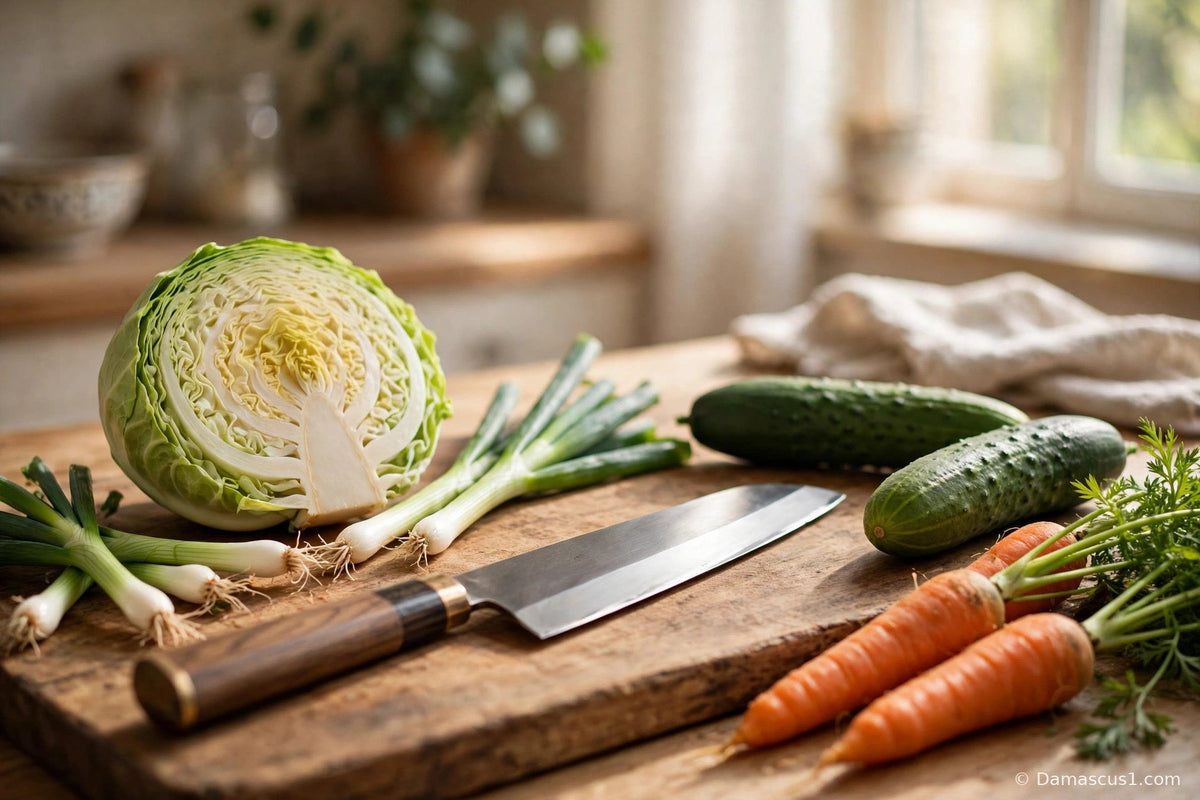
Vegetable prep is the whole job here — a tall blade, a full board, and produce waiting its turn. Editorial scene — the knife shown is not a specific Damascus1 product.
Quick answer
The best nakiri knife for most home cooks is a thin 165mm (6.5-inch) blade with a flat edge that meets the board along its full length. Thinness behind the edge matters more than the steel stamp. Damascus1's VG10-labelled nakiris cost $44.99 and $49.99 — below the Tojiro benchmark's roughly $65–$75 band — so start there if budget leads.
Here is why this guide is built the way it is. Most "best nakiri" pages are pick lists. Useful, up to a point — but a list cannot tell you why one thin rectangular blade glides through a cabbage while another, same shape, same pretty pattern, wedges halfway and splits it. The pages that rank for this keyword in November 2026 actually agree on the answer, and the agreement is more valuable than any single verdict: thinness decides, the flat profile is the point, and the Tojiro is the benchmark everybody measures against. We have built this guide on that consensus, attributed pick by pick, and then added the two things the lists leave out — a chart that matches the blade to the vegetable in front of you, and an honest account of the board technique that makes the shape work.
And the prices. This is the part where we should declare our interest plainly, because we have one: Damascus1 sells nakiris. Two of them, both VG10-labelled, both live in our catalog today — the Nakiri Knife at $44.99 and the Nakiri Kitchen Knife at $49.99. Both sit below the benchmark band the other guides set. That does not make them the best nakiris on this page by default, and this guide will not pretend otherwise — the Tojiro earned its benchmark status across independent guides, and we say so below. What our prices do give you is a checkable fact instead of a vibe: a live store price, dated, one click from the product page. The full range lives in our best nakiri knife collection. Judge the picks first. Then judge the prices.
One more ground rule before the table. We run no test kitchen and we claim no hands-on testing anywhere in this post — the same disclosure Bevel and Bone make on their guide, and the right one. Every competitor verdict below belongs to the guide that published it, named in the table and the text. Every Damascus1 price is a live catalog price checked on November 13, 2026. Anything we could not verify is labelled "check current price," because a guide that prints ten prices to the cent and checked none of them is selling you confidence, not information.
Which nakiri knife is best for you at a glance?
Direct answer: Start with the job, not the brand. If you shred cabbage, dice onions and slice cucumbers daily, a thin 165mm nakiri in the $45–$75 band covers you. Damascus1's two VG10-labelled options sit at $44.99 and $49.99; the cross-guide benchmark, Tojiro, sits around $65–$75. Pay more only for fit, finish or handle feel you can name.
| Knife | Best for | Price |
|---|---|---|
| Tojiro F-502 / DP | Best overall benchmark — the cross-guide standard (Dalstrong citing Serious Eats' 2026 testing; Steel Snob; knife-depot blog) | ~$65–75 (as reported by the knife-depot blog guide) |
| Mac JU-65 6.5" | Best top pick (Bevel and Bone) | $97.95 (as listed by Bevel and Bone) |
| Shun Classic 6.5" | Best fit and finish (Steel Snob) | ~$130–190 (as reported by the knife-depot blog guide) |
| Dalstrong Shogun 6" | Best premium brand pick (Dalstrong's own guide) | $159 (as listed in Dalstrong's guide, Nov 3, 2026) |
| Mercer Genesis 7" | Best value (Bevel and Bone) / best budget (Steel Snob) | $45.00 (as listed by Bevel and Bone) |
| Shun Premier 5.5" | Best overall (Knives Advice) | Check current price |
| Yoshihiro VG10 hammered | Best wa-handle (Knives Advice) / mid-priced pick (Dalstrong citing Serious Eats) | Check current price |
| Global 7" | Best beginner option (Dalstrong citing Serious Eats' 2026 testing) | Check current price |
| Damascus1 VG10-Labelled Nakiri Knife | Best for a Damascus-look nakiri priced under the benchmark | $44.99 (live at damascus1.com) |
| Damascus1 VG10-Labelled Nakiri Kitchen Knife | Best for stepping up inside the Damascus1 range | $49.99 (live at damascus1.com) |
Read the table the way it was built. Eight rows are other makers' knives, placed there because the page-one consensus — Dalstrong, Knives Advice, Bevel and Bone, the knife-depot blog, Steel Snob — keeps landing on the same handful of names. When five independent guides agree that Tojiro is the benchmark and thinness is the deciding quality, that agreement is the most useful data a buyer gets, and no honest guide should bury it under its own product. The last two rows are ours. They are in the table at their real prices, next to the benchmarks, so you can see exactly where they sit: under the Tojiro band, level with the Mercer Genesis value slot, and a long way under the Shun and Dalstrong tier. Whether that position wins your money depends on what you value — pattern and presence on the board, or the benchmark's track record. Both answers are respectable. Our job is to make the choice a clear one, not a pushed one.
A note on the two prices without a Damascus1 label that look oddly precise. The $97.95 Mac and the $45.00 Mercer are Amazon snapshots captured by Bevel and Bone in the teardown; Amazon prices move, sometimes daily. Treat them as "about there, on that day," and check before you buy — the same advice applies, in fairness, to our own $44.99 and $49.99 if you are reading this weeks later. Live prices live on product pages. Guides, including this one, are dated the moment they are published.
What is a nakiri knife used for?

Direct answer: A nakiri is a Japanese vegetable knife built for straight, full-contact cuts: shredding cabbage, dicing onions, slicing cucumbers and breaking down squash without rocking. Its tall, flat, rectangular blade pushes straight down, leaves no accordion-connected slices, and scoops what you cut. It is not a meat, bone or frozen-food knife — keep it on produce.
The name gives the job away: nakiri translates roughly as "leaf cutter," and leaves are still its home turf. But the modern home-kitchen version of that job is bigger than leaves. It is the weeknight mountain of produce — the onion and carrot base under everything, the cabbage for slaw, the cucumber for the salad, the zucchini that needs to become coins, the herbs that need to become a pile rather than a bruised smear. A nakiri exists because that work is repetitive, and repetitive work rewards a specialised shape. A general-purpose knife can do all of it. A nakiri does all of it with less thinking, and after the two-hundredth onion, less thinking is a real feature.
The shape explains itself once you watch it work. The blade is tall — much taller than a chef knife — so your knuckles clear the board and the flat of the blade becomes a bench scraper you never have to put down. The edge is flat, or nearly flat, along most of its length, so when the blade comes down, the whole edge arrives at the board at once. Nothing hides in the middle of the cut. Nothing stays connected by a thread of onion skin because the curved belly of a Western blade lifted at the wrong moment. That "accordion" failure — slices joined at the bottom like a paper chain — is the single most common annoyance in vegetable prep, and the nakiri's flat profile is the mechanical fix for it. Not a skill fix. A shape fix. That distinction matters, and we will come back to it in the technique section.
What a nakiri is not for deserves equal time, because thin edges punish misuse honestly and immediately. Not bones, ever — not chicken joints, not squash stems forced sideways, not frozen anything. Not hard rinds levered open with a twist; twisting a thin, hard edge is how chips happen. Not the tip work — coring a pepper, trimming an eye from a potato — because there is barely a tip to work with. And not meat, as a rule: raw protein wants a blade that slices and separates, and while a nakiri will portion a boneless, skinless something in a pinch, it is a guest in that job, not a resident. Our chef knife vs santoku vs nakiri guide draws the three-way line in full; the short version is that the nakiri is the specialist, and specialists earn their drawer space by being brilliant at one thing, not adequate at six.
Cabbage is the flat profile's home game: full-length cuts, no connected shreds left behind. Editorial scene — the knife shown is not a specific Damascus1 product.
Why does thinness behind the edge matter more than anything else?
Direct answer: Thinness behind the edge is how fine the blade is just above the cutting edge, and it decides whether a nakiri glides through an onion or wedges it apart. Page-one guides agree it separates great nakiri from pretty ones. A thin blade needs less force, tears less cell wall, and keeps slices even. Check it before steel, handle or price.
Bevel and Bone built their whole guide on this sentence, and they are right to: thinness behind the edge separates great nakiri from the rest. It is worth unpacking, because it is the least visible spec in the category and the most decisive one. Every blade is a wedge. The edge itself does the first parting, but immediately behind the edge the blade thickens into its full spine thickness — and it is that thickening, the wedge angle your food actually experiences, that decides whether a cut feels like gliding or like splitting firewood. A blade that is fine just behind the edge slips through an onion with the onion barely noticing. A blade that thickens quickly pushes the two halves apart as it descends. The halves resist. The cut wanders, the slice comes out wedge-shaped, and with something dense — a sweet potato, a wedge of squash — the resistance wins outright and the vegetable cracks apart ahead of the edge instead of being cut by it.
You can feel this in one cabbage. A thin-behind-the-edge nakiri drops through a halved cabbage in a smooth, quiet stroke, and the shreds fall away in ribbons. A thick one makes a sound — a creak, then a pop — and the ribbons come out bruised and uneven. Same shape. Same length. Same cook. The difference is a fraction of a millimetre in a place most listings never mention, which is exactly why the guides that rank for this keyword keep returning to it. Steel Snob's steel-first readership lands in the same place from the other direction: edge geometry first, alloy second.
So how do you check a spec nobody lists? Three honest ways. First, look at the choil — the unsharpened heel end of the blade — if a listing shows one; the taper from spine to edge is visible there, and a graceful, continuous taper is the thin blade's signature. Second, read the guides that talk about wedging by name, as Bevel and Bone do, over listings that talk about layer counts. Third, be suspicious of weight: a nakiri that brags about heft is bragging about the wrong thing for this category. None of this requires a lab. It requires reading for geometry instead of mythology — a habit worth keeping for every knife claim you will ever meet, ours included. On our own two nakiris we state the verified facts — VG10-labelled, live prices, product pages linked — and leave the geometry verdict to the check above rather than inventing measurements we have not published. Confirm the current spec on the product page before ordering; the listing is the final word.
Where does steel fit, then? In its proper place: second. The knife-depot blog guide calls VG10 at 60–61 HRC the sweet spot for this category — their claim, attributed to them, and a reasonable summary of where the mainstream sits. A mainstream, well-treated steel at a sensible hardness will take the thin edge a nakiri needs and hold it through board work. An exotic steel ground thick will still wedge your cabbage. Buy the geometry first. Let the steel be the tie-breaker it deserves to be, not the headline it is marketed as.
Nakiri vs santoku: which is better for vegetables?
Direct answer: For vegetables alone, the nakiri wins: its flat edge finishes every slice with full board contact, while a santoku's slight curve can leave pieces connected. For mixed boards — vegetables plus protein, one knife for everything — the santoku is the safer single-knife buy. Own the nakiri when produce is most of your prep; own the santoku when it is not.
This is the comparison most buyers are actually making, because the santoku is the Japanese knife most home cooks already own or have been told to buy. The two look like cousins — both shorter and lighter than a Western chef knife, both at home over produce — and the difference is a matter of degrees that turn into a matter of results. The santoku carries a gentle curve along its edge and a proper, useful tip. That curve lets it rock, a little, and the tip lets it score, trim and pierce. It is a generalist with a vegetable lean. The nakiri removes both compromises: the edge goes flat, the tip squares off, and the blade gets taller. Every concession to general work is traded for board contact and clearance.
Run the same three vegetables through both and the trade shows itself. Onion dice: the nakiri's flat edge finishes the horizontal cuts cleanly to the board; the santoku leaves the occasional connected strip where its curve lifted. Cabbage shred: the nakiri, again — full-length strokes, nothing to re-cut. Herb pile: closer than you would expect, because the santoku can rock gently through parsley while the nakiri must chop straight up and down; fast choppers split the difference, and honest cooks admit the santoku feels quicker here. Protein trim on the same board — the chicken going into the stir-fry after the vegetables: santoku, comfortably, and the nakiri should stay out of it. Score it two-one with an asterisk, which is another way of saying the verdict depends on your board, not on the internet.
The deciding question is embarrassingly simple: what fraction of your prep is vegetables? If your cooking is produce-led — stir-fries, slaws, soups, curries, salads, the whole plant-heavy rotation — the specialist repays you every single night, and the santoku becomes the backup. If vegetables are the supporting act around a protein most nights, the generalist is the honest buy and the nakiri is a luxury you will reach for twice a week. Neither answer is a failure. Buying the specialist for a generalist's kitchen is the failure, and it is the one the marketing pushes, because specialists are easier to sell as upgrades. Our best kitchen knives hub lays out the wider category if your drawer needs the generalist first.
What size nakiri knife should I buy?

Direct answer: Buy 165mm — about 6.5 inches — unless you have a clear reason not to. It is the mainstream nakiri size across page-one guides, big enough for cabbage and squash, nimble enough for onions and herbs. Go shorter, around 150mm, for small boards and small hands. Go to 180mm (7 inches) only if you regularly break down very large produce.
The consensus here is unusually tidy. Page one puts nakiri blades at 165–180mm — six and a half to seven inches — and the picks cluster at the lower end: the Mac at 6.5 inches, the Shun Classic at 6.5, the ZWILLING Gourmet at 6.5, Dalstrong's Shogun at 6. Knives Advice's overall pick, the Shun Premier, is shorter still at 5.5 inches, which tells you something important: in this category, control beats reach. A nakiri is not a slicing knife. Its stroke is short and vertical. Extra length does not buy you a longer cut the way it does with a chef knife — it buys you a taller pile of cabbage cleared per stroke, and past about 180mm it starts costing you precision at the heel, where the fine work happens.
Size the blade to two things: your board and your biggest regular vegetable. Your board first, because a blade that overhangs your board's working area is a blade you will angle, and angling a flat edge defeats it — the corners lift, contact breaks, the accordion slices return. If your everyday board is small, a 150–165mm blade used flat will out-cut a 180mm blade used at a tilt, every time. Then the vegetable: a whole cabbage half, a butternut's long neck, a daikon — these are the jobs that make 180mm feel right. If they appear weekly, size up without guilt. If they appear at holidays, size for the onion. The onion is your life. The butternut is your anecdote.
A word for smaller hands, because the guides underplay it: blade height matters as much as length. A tall blade with a handle that sits high gives knuckle clearance without forcing a claw grip into a cramp. If you can, hold before you buy; if you cannot, prefer listings that publish blade height alongside length, and treat a missing height figure the way you treat a missing price — as information about the seller, not just the knife. For our two, the product pages carry the current listings — the $44.99 Nakiri Knife and the $49.99 Nakiri Kitchen Knife — and they, not this guide, are where size and spec get confirmed before money moves.
Even ribbons are the thin blade's signature — same thickness, first slice to last. Editorial scene — the knife shown is not a specific Damascus1 product.
How do you match a nakiri to the vegetable and the cut?
Direct answer: Match the blade to the cut the vegetable wants. Leafy and layered vegetables want the flat profile's full-length contact; dense vegetables want thinness and a straight push; delicate herbs want height so knuckles clear the board. The chart below pairs common vegetables with the cut, the technique, and the reason the nakiri's shape helps — use it as a prep shortcut, not a rulebook.
This chart is the asset we built this guide around, because it is the thing the pick lists never give you: not which knife, but which cut, and why the shape earns its keep on each one. Screenshot it, argue with it, adapt it to your cooking — that is what it is for.
| Vegetable | Cut | Why the flat profile wins |
|---|---|---|
| Cabbage | Fine shred for slaw | Full-length strokes finish every shred to the board — no connected ribbons to re-cut |
| Onion | Dice and fine slice | Flat edge completes the horizontal cuts; no accordion strips left joined at the base |
| Cucumber | Thin rounds and ribbons | Straight push-cut keeps every round the same thickness, first to last |
| Carrot | Coins, batons, fine dice | Tall blade guides the guiding hand; flat contact stops coins skating away mid-cut |
| Butternut squash (peeled) | Planks, then sticks, then dice | Thinness behind the edge plus a straight push parts dense flesh instead of cracking it |
| Sweet potato | Planks and batons | The wedge test: a thin blade glides where a thick one wedges and splits |
| Potato | Even slices and dice | Full board contact means the last slice is as clean as the first — no rocking gap |
| Leek | Fine rings | Tall blade contains the rings as they fall; scoop moves them straight to the pot |
| Bell pepper (flattened strips) | Julienne | Flat skin-side strips meet a flat edge — no curved blade skating over the curve |
| Herbs (parsley, coriander) | Fine chop | Blade height clears knuckles for fast, straight chopping over a growing pile |
| Daikon / mooli | Rounds and sheets | Long, straight strokes along a long vegetable reward the full flat edge |
Read the pattern down the right-hand column and you will see it is really one reason wearing different clothes: board contact. The flat profile removes the gap between edge and board that a curved blade builds into every cut, and most vegetable frustrations — connected slices, uneven coins, skating carrots — are that gap, expressing itself. The two honest exceptions deserve naming. Tomatoes: a ripe tomato's skin resists a push-cut, and while a genuinely sharp nakiri slices one beautifully, a dull one will crush it — the chart assumes a sharp edge, and the sharpening section below keeps that assumption true. And anything with a bone, a stone-hard stem or a frozen centre is off the chart entirely, by design. A matching chart that pretends to cover everything covers nothing.
Use the chart backwards, too, when you shop. If your rows are the top four — cabbage, onion, cucumber, carrot, the weeknight core — any thin 165mm blade from the table at the top of this guide serves you, and the decision narrows to price and handle. If your rows run dense — squash, sweet potato, daikon — thinness behind the edge stops being a preference and becomes the whole purchase, and you should weight the geometry checks from the thinness section above everything else on the listing page.
How do you actually use a nakiri on the board?

Direct answer: Use a straight up-and-down chop, not a rock. Place the flat edge on the food, push down and very slightly forward, lift, and let the full edge meet the board on every cut. Between piles, turn the tall blade sideways and use it as a scoop to carry cut vegetables to the pan — that transfer move is half the point.
Every guide on page one describes the nakiri's shape. Almost none teach the stroke, which is odd, because the stroke is where the shape pays off — and where most first-time owners go wrong in the first five minutes. They pick the knife up and rock it, the way years of chef-knife habit have taught their wrists. The nakiri hates this. Rocking lifts the heel and toe in turn, breaks the full contact the blade was built for, and produces exactly the connected slices the knife was bought to prevent. The owner concludes the knife is overrated. The knife concludes nothing; it just waits for the right motion.
The right motion has three parts, and none of them are hard. First, the chop itself: edge down onto the food, a decisive push straight down with the faintest forward drift — think of the blade falling through the vegetable rather than sawing across it — then lift cleanly and repeat. The board should click, softly, on every stroke. That click is your confirmation that the full edge arrived. No click, no contact; adjust until the click is automatic. Second, the guiding hand: fingertips curled into the claw, knuckles forward, and here the nakiri's height becomes your friend — the tall flat side rides against your knuckles like a fence against a train track, guiding each stroke's placement. It is the most forgiving guiding surface of any knife shape, which is why the nakiri is kinder to learners than its specialist reputation suggests. Third, the rhythm: slower than you think, for the first week. Speed in this stroke comes from the pile staying organised, not from the blade moving faster, and the cook who learns the click first is faster by Friday than the cook who chased speed on Monday.
Then the move nobody puts in the guides: the scoop-and-transfer. When the pile is cut — a mound of onion dice, a drift of cabbage — do not reach for a bench scraper, and do not ferry handfuls across the kitchen shedding pieces. Lay the nakiri's tall blade flat against the board, slide it under the pile the way you would slide a spatula under a pancake, rest your free hand lightly on top of the pile to steady it, and carry the whole load to the pan or bowl in one trip. The tall blade is a shovel you already own. Cooks who discover this move tend to mention it the way people mention a shortcut through traffic — quietly pleased, slightly annoyed nobody told them sooner. It is half the reason the height exists, it takes ten seconds to learn, and it is the single easiest habit that separates someone who owns a nakiri from someone who uses one.
Safety, briefly, because thin edges deserve respect rather than fear. The flat profile makes the nakiri stable, not harmless: keep the claw honest, keep the board still on a damp cloth if it wants to wander, and never use the blade's side to scrape cut food toward your guiding hand. Scrape away, or use the spine. And store it like an edge, not a utensil — a block slot, a magnetic strip, or a guard, never loose in the cutlery drawer where the edge meets the spoons. More on keeping that edge in the sharpening section below.
The scoop-and-transfer: the tall blade doubles as the bench scraper you never have to fetch. Editorial scene — the knife shown is not a specific Damascus1 product.
Is a nakiri knife worth it?
Direct answer: Yes, if vegetables are a daily job in your kitchen — the speed, even slices and clean board work repay a $45–$75 spend quickly. No, if you cook produce twice a week and already own a sharp chef knife you like; a nakiri will sit in the block looking handsome. Worth is a frequency question first, a steel question a distant second.
Let us do the arithmetic the way a cook actually experiences it, because "worth it" questions die in vague answers. A nakiri does not make any single cut dramatically faster. It makes the fiftieth cut of the evening as clean as the fifth — no re-cutting connected slices, no stopping to gather scattered coins, no second pass through the cabbage. Across a week of produce-heavy dinners, that is minutes saved and, more to the point, friction removed. Friction is what makes people order takeaway on Wednesday. A tool that removes it gets used; a tool that gets used nightly repays $45 quickly and $159 eventually. A tool that gets used monthly repays neither, at any price, because the drawer is full of monthly tools already and every cook knows it.
So the honest test is a calendar, not a catalogue. Count last week's dinners. If four or more of them started with a board full of vegetables, a nakiri is worth it at benchmark money — and the case strengthens further down the price ladder, which is the whole commercial point of this guide: at $44.99, the frequency bar a nakiri has to clear drops to "a few serious prep sessions a month." If one or two dinners involved produce and the rest were protein-and-pan affairs, your money works harder elsewhere — a better chef knife, a bigger board, the sharpening gear that makes the knives you own feel new. Our best chef knife guide is the honest next read for that kitchen, and we would rather send you there than sell you a specialist you will not use.
There is a second, quieter worth-it that the spreadsheets miss: confidence with vegetables changes what people cook. Cooks who trust their prep buy the whole cabbage instead of the bagged shred, the bunch of carrots instead of the baby-cut bag, the squash that needs planking instead of the tub of pre-cut that costs triple. None of that belongs in a knife review as a promise, and we offer it as an observation only — but it is the observation every long-term nakiri owner volunteers, usually while shredding something. Worth, in the end, is whether the knife changes Tuesday. For daily vegetable cooks, it does. That is the whole claim, and it is enough.
Can a nakiri replace a chef knife?
Direct answer: No — a nakiri complements a chef knife rather than replacing it. It has no useful point for trimming, coring or detail work, it should not rock through herbs the way a curved blade can, and it is the wrong tool for meat and hard rinds. Keep a chef knife for the general work; add the nakiri for the vegetable volume.
The temptation is understandable. If the nakiri handles the vegetables — and in a plant-heavy kitchen vegetables are most of the board work — why keep the big generalist around? Because kitchens keep asking general questions. The pepper that needs coring asks for a point. The chicken asks for a blade that separates and trims. The pineapple asks for length and a tip and a willingness to argue. The crusty loaf, the hard cheese rind, the melon — each one walks up to the nakiri and asks it to be something it is not, and a thin, square-tipped specialist answers those requests badly and sometimes at the cost of its edge. A two-knife kitchen is not a compromise. It is the actual professional arrangement: a generalist for the surprises, a specialist for the volume, each covering the other's honest weaknesses.
Think of the pairing the way the chart above thinks: the chef knife owns the exceptions, the nakiri owns the routine. If you are building the pair from nothing, buy in the order your cooking dictates — most mixed kitchens should own the chef knife first, which is why our best knife set guide and the block-set route below exist. If you already own a decent chef knife and your prep has quietly become seventy percent produce, the nakiri is not a replacement at all. It is a promotion for the half of your cooking that was waiting for its own tool.
What do Damascus1's two nakiris cost — and which one fits your kitchen?

Direct answer: Damascus1 lists two VG10-labelled nakiris: a Nakiri Knife at $44.99 and a Nakiri Kitchen Knife at $49.99, both live prices checked November 13, 2026. Both sit below the Tojiro benchmark band and far below premium Japanese options. Confirm size, handle and current price on each product page before ordering — the listing, not this guide, is the final word.
Here are our two, priced and placed the same way we placed everyone else's — with what is verified stated plainly, and what is not verified left for the product page to tell you.
Nakiri Knife — VG10-labelled — $44.99
The entry point, and for most readers the sensible one: a VG10-labelled Damascus nakiri priced below every benchmark band in the table above, including the $45.00 Mercer Genesis value pick it sits a cent under. Buy this one if the frequency test in the worth-it section says "weekly, maybe more" and you want the specialist shape in the drawer without a specialist price attached. Product page — confirm current size, handle and price before ordering.
Nakiri Kitchen Knife — VG10-labelled — $49.99
Five dollars up the same range. Buy this one if its listing's size or configuration suits your board better — that comparison lives on the two product pages, where the current specs are published, rather than in claims repeated here. Product page — confirm current size, handle and price before ordering. Both knives, side by side with the wider range, are in the chef's best kitchen blades collection.
Premium Kitchen Knife Block Set — $169.99
The whole-drawer answer, for readers whose nakiri question started with "my knives are all terrible." A 7-piece block set at $169.99 rebuilds the generalist side of the kitchen in one move — then add the $44.99 nakiri for the vegetable volume and the pair this guide keeps describing is complete, for less than one premium Japanese nakiri from the table above. Product page.
What we will not do in these cards is invent the details that sell knives dishonestly — no layer counts, hardness figures, handle materials or performance claims stated here that were not in the verified facts for this guide. The product pages carry the listings' own specifications, and they are the final word on the day you order. That restraint is deliberate, and it is the same restraint we applied to the benchmarks: five verified prices in the table, not ten decorative ones. A store that hedges its own product cards is a store whose prices you can trust. Ours are dated November 13, 2026, and checkable in one click. Do check them.
Herbs are the height test: knuckles clear, pile contained, chop straight and fast. Editorial scene — the knife shown is not a specific Damascus1 product.
How do you sharpen a nakiri knife?

Direct answer: Hone the edge straight, not at a chef-knife rock. On a whetstone, hold a low, consistent angle, work the full flat edge evenly from heel to tip on each side, and strop lightly. Because a nakiri edge does board work, not bone work, it needs little and often — a few careful passes beat one heavy rescue grind every season.
The nakiri's flat edge makes it, paradoxically, one of the easiest knives to sharpen well and one of the easiest to sharpen badly. Easy well, because the geometry helps you: lay the blade on the stone and the flat profile keeps the whole edge in even contact, so a consistent angle produces a consistent edge from heel to tip without the lifting-and-sweeping choreography a curved belly demands. Easy badly, for exactly the same reason — a careless angle held consistently produces a consistently wrong edge along the full length, and the flat edge will faithfully reproduce your mistake on every stroke until you correct it. Slow down. The stone rewards the same virtue the board does: straight, even, unhurried.
The routine itself is short. Soak or splash your stone as its maker directs. Set a low, steady angle — the exact figure matters less than its consistency, and our Damascus sharpening guide walks through angles, grits and stone technique in the depth this section cannot. Work one side in smooth, full-length passes until the edge feels even along its whole run, then the other side, then finish with a few light stropping strokes to clear the burr. Test on the vegetable that tells the truth — a tomato or a sheet of paper, whichever your kitchen judges harder — and stop when it passes. Stopping is a skill. Edges are removed by enthusiasm as surely as they are restored by it.
Frequency beats intensity, in sharpening as in everything else this guide has recommended. A nakiri's edge lives a comparatively gentle life — board contact, plant fibre, no bones, no frozen anything, if you have kept the rules — so it dulls slowly and evenly, and a brief maintenance pass every few weeks of regular use keeps it in the zone where cucumbers slice themselves. Let it go a year and the rescue grind has to remove real metal to rebuild the edge, shortening the blade's life to save a few minutes. Five maintained minutes a month, or one mournful hour a year: the arithmetic is the same arithmetic as the worth-it section, and it lands the same way.
Two care rules ride along with sharpening, because dullness is usually a storage story. Wash and dry by hand — the dishwasher's heat, detergent and rattling are unkind to thin edges and fine finishes alike. And store the edge protected, in a block, on a strip, or in a guard, never bare in a drawer. A nakiri kept this way asks very little of you. That is rather its character: a specialist with one job, a simple stroke, and simple manners.
Little and often: an even edge, maintained in minutes, is what the whole shape depends on. Editorial scene — the knife shown is not a specific Damascus1 product.
What should you check before you buy any nakiri?
Direct answer: Check thinness first, size second, edge profile third, handle fourth and price last. Feel how fine the blade is behind the edge, confirm 165mm suits your board, look for a genuinely flat profile, and hold the handle as you would mid-prep. Only then compare prices — the cheapest nakiri that passes those four checks beats a premium one that fails any of them.
Check one — the thinness check. The deciding spec, so it goes first. Read for wedging talk, choil shots and geometry language in reviews and guides; be wary of listings that sell pattern and layer counts while saying nothing about how the blade moves through food. A nakiri is a cutting tool before it is an object, whatever the photographs suggest.
Check two — the size check. Stand in your kitchen and look at your board. 165mm is the default for a reason, 150mm suits small boards and small hands, 180mm is for the cabbage-and-squash regulars. Buying a size up "for when I need it" usually means buying a size wrong for the six nights a week you do not.
Check three — the flatness check. Sight down the edge, in a shop or in listing photographs: you want flat, or flat with the slightest lift at the very tip. A nakiri with a visible belly curve is a santoku in a costume — it will rock when you do not want it to and leave the connected slices this entire guide exists to prevent.
Check four — the handle check. Hold it as you would mid-onion, not as you would for a portrait. Your knuckles must clear the board with your grip settled, and the handle must stay put in a hand that will, in real life, be damp. Western and Japanese handle styles both pass this test for different hands; yours is the only vote that counts.
Check five — the honesty check. Apply it to the seller, us included. Are the prices dated and checkable? Are the specs the listing's own, confirmed on the product page? Does the guide attribute its claims, or does it test everything and prove nothing? The knife-depot guide's price bands, Bevel and Bone's no-test-kitchen disclosure, Steel Snob's refusal to print prices it had not verified — page one is full of sellers and guides showing their working. Buy from the ones who do. If a claim in this guide matters to your decision, click through and verify it on the product page. We would rather lose a sale to a check than win one without it — the check is the relationship, and the relationship outlasts any single knife.
What else do buyers ask about nakiri knives?
Direct answer: Six questions come up in every page-one guide and every People Also Ask box for this keyword. Here they are, answered the same way the guides above answer them — in plain terms, with the price and steel claims hedged where the sources hedge them, and with no testing story invented to make the answers sound earned.
What is a nakiri knife used for?
Vegetable prep, full stop: shredding, dicing, slicing and chopping produce with straight, full-contact cuts. Its tall, flat, rectangular blade finishes every slice against the board — no accordion-connected pieces — and doubles as a scoop for moving the pile to the pan. Keep it off bones, frozen food and meat-trimming; those belong to other knives.
Nakiri vs santoku: which is better for vegetables?
The nakiri, for vegetables alone — its flat edge completes cuts a santoku's slight curve can leave connected. The santoku is the better single knife for mixed boards, with a useful tip and a gentle rock for herbs and protein. Produce-led kitchen: nakiri. Everything-led kitchen: santoku first, nakiri when the vegetable volume justifies it.
Is a nakiri knife worth it?
Yes, if vegetables are a daily or near-daily job — even slices, finished cuts and faster transfers repay a mainstream spend, and at $44.99 the frequency bar is low. No, if produce appears twice a week and you already own a sharp chef knife you enjoy; spend the money on the generalist side of the drawer instead.
What size nakiri knife should I buy?
165mm (6.5 inches) for almost everyone — the mainstream size across the page-one guides, big enough for cabbage, nimble enough for onions. Around 150mm for small boards and small hands; 180mm (7 inches) only if large produce is a weekly event. Size to your board first, your biggest regular vegetable second, and your biggest ever vegetable never.
Can a nakiri replace a chef knife?
No. It complements one. With no useful point, no rock, and a thin edge that must stay off bone and hard rind, a nakiri cannot cover the general work — trimming, coring, protein, melons, loaves. Keep the chef knife for the surprises; let the nakiri own the vegetable routine it was shaped for.
How do you sharpen a nakiri knife?
On a whetstone, at a low, consistent angle, working the full flat edge evenly from heel to tip on each side, then stropping lightly to clear the burr. The flat profile makes consistency easy — and makes a careless angle consistently wrong, so go slowly. Little and often: brief maintenance beats an annual rescue grind.
So, which nakiri should you buy first?
Direct answer: Buy the thin one you will use daily, at the price that does not make you precious about it. For most readers that is a 165mm blade in the $45–$75 band — Damascus1's $44.99 and $49.99 VG10-labelled options included. Then chop something leafy tonight. A nakiri proves itself in one cabbage, not in a spec sheet or a review score.
Here is the whole guide in one breath. The benchmark is the Tojiro, at roughly $65–$75, and it earned the title across five independent guides — if track record is what you buy, buy it with our respect. The premium tier — Shun at roughly $130–190, the Dalstrong Shogun at $159, the Mac at $97.95 — buys fit, finish and feel, and if you can name the one you want, it is not wasted money. The value tier is where this guide plants its flag: the Mercer Genesis at $45.00 in Bevel and Bone's ranking, and our own two VG10-labelled nakiris at $44.99 and $49.99, live-priced and one click from verification. Thinness decides. Size follows your board. The stroke is straight down, the pile rides the tall blade to the pan, and the chart above tells you which vegetable proves it first.
So prove it. Start with the Nakiri Knife at $44.99 or the Nakiri Kitchen Knife at $49.99 — confirm the current listing, then put a cabbage on the board tonight and listen for the click. Browse both, side by side with the rest of the range, in the best nakiri knife collection. If the drawer needs the full rebuild, the Premium Kitchen Knife Block Set at $169.99 plus the $44.99 nakiri covers the generalist and the specialist for less than a single premium nakiri. That is the honest pitch, at honest prices, with the benchmarks left standing where the guides put them. The vegetables are waiting.
Shop Damascus kitchen knives
Prices checked November 21, 2026. The product page on the day you order is the final word.
- Japanese VG10 Damascus Chef Knife, 8.5 in.: $399.99
- Premium Kitchen Knife Block Set: $169.99
- 7-Piece Forged Damascus Kitchen Knife Set: $399.99
Damascus pocket knives for the cook who has everything
- Olive Wood Damascus Pocket Knife Set, 6.5 in.: $39.99
- Green Wood Damascus Pocket Knife Set, 6.5 in.: $39.99
- Buffalo Horn Damascus Pocket Knife Set, 6.5 in.: $39.99
- Stag Horn Damascus Folding Pocket Knife, 6.5 in.: $49.99
- Camel Bone Scrimshaw Damascus Folding Pocket Knife, 7.6 in.: $49.99
Damascus pocket knives under $50 · All handmade Damascus pocket knives
laissez un commentaire: