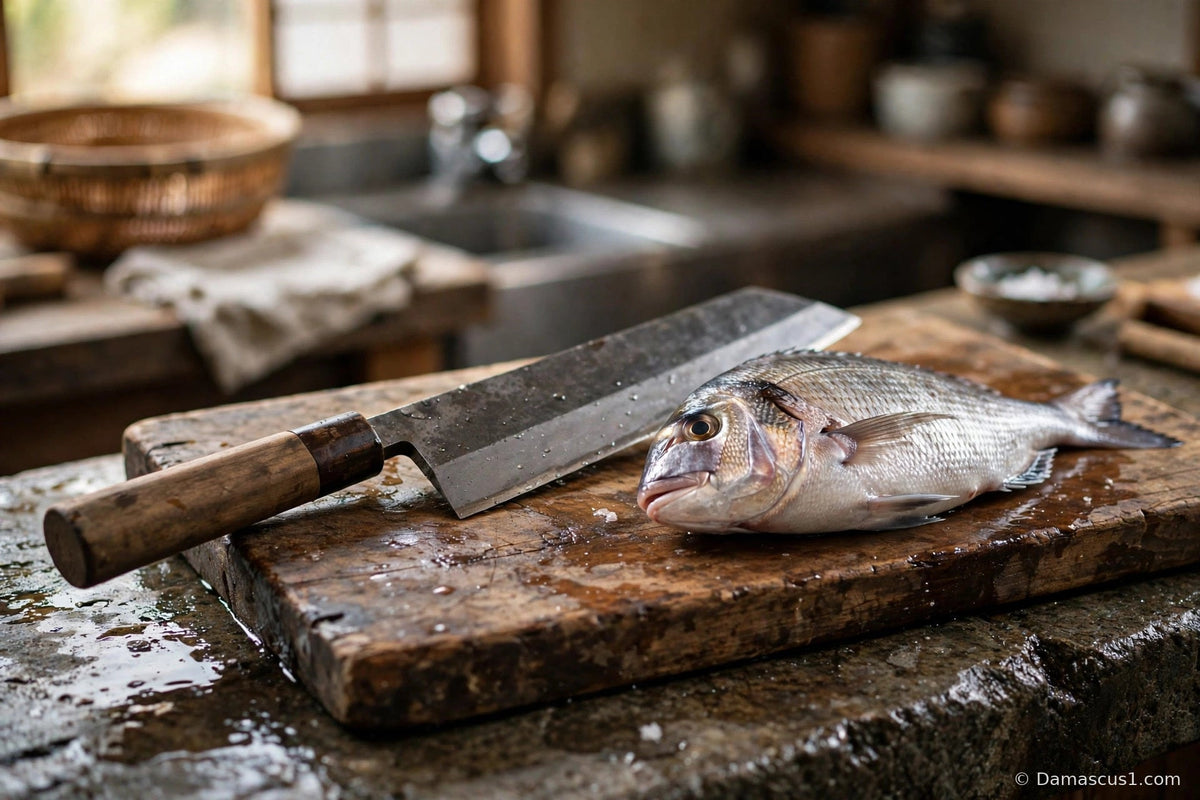
A whole fish, a board, and the one knife built for what happens next. Editorial scene — the knife shown is not a specific Damascus1 product.
Quick answer
The best deba knife for most people is a 165mm single-bevel deba in a steel they can maintain — carbon for the keenest edge, stainless for the easiest life. It is a thick-spined, heavy fish-butchery knife that beheads, splits a whole fish into three pieces, and powers through small bones by weight, not force.
Now the part no other page ranking for this keyword will tell you. Damascus1 does not sell a deba knife. We checked our full catalog — 122 products, live on November 14, 2026 — and there is no standalone deba in it. No traditional single-bevel deba. No double-bevel yo-deba. Nothing hiding under a fishy name in a set description, and we will not pretend otherwise to win a click. We make chef knives, Japanese-profile knife sets, block sets, and fixed blades for the field. A deba — the short, thick, single-bevel cleaver-knife this page is about — is not among them.
So why write the guide? Because the deba is the most mis-bought knife in the Japanese lineup, and it is mis-bought in a specific, expensive way. People see the shape, think "fish knife," and assume it is a bigger fillet knife. It is not. It is closer to a precision cleaver that happens to fillet. Buy it expecting a fillet knife and you will hate it within one fish. Buy it knowing what it actually is — a weight-driven breakdown tool with a specialist's edge and a specialist's sharpening routine — and it will change how whole fish feel in your kitchen for decades. A guide written by a maker with nothing to sell you in the category can afford to start there: with the truth about the tool, the full ranked field from the guides that do sell and test these knives, and a clear line between the reader who needs a real deba and the reader who needs something else entirely.
Every benchmark pick below comes from the page-1 guides ranking for this keyword today, attributed to them, with prices only where the November 14, 2026 teardown verified them. Where a Damascus1 knife genuinely serves a reader who breaks down fish only occasionally, we will label it for exactly what it is: a double-bevel alternative, never a deba. If you want to see that alternative territory before you read on, it lives in our chef's best kitchen blades collection. But do not start there. Start with the fish.
The deba knives at a glance
| Knife | Best for | Bevel / size | Price |
|---|---|---|---|
| Sakai Takayuki Blue #2 Mirror-Finish 180mm | Best traditional pro deba (ranked #1 by media.sakurajapaneseknife.com) | Single bevel, 180mm | ≈$663 (JPY-converted, as listed by media.sakurajapaneseknife.com, Nov 2026; line spans 120–240mm at $489–$1,301) |
| Sakai Jikko White #2 | Best white-carbon traditional pick (media.sakurajapaneseknife.com ranking) | Single bevel | Check current price |
| Yoshihiro Blue #2 Kasumi | Best blue-carbon kasumi-finish pick (media.sakurajapaneseknife.com ranking) | Single bevel | Check current price |
| Sakai Takayuki Ginsan | Best stainless traditional pick (media.sakurajapaneseknife.com ranking) | Single bevel, stainless | Check current price |
| Sakai Takayuki Kasumitogi 165mm | Best mid-price traditional buy (japan-craft-finds.com pick) | Single bevel, 165mm | $153 at Chubo (via japan-craft-finds.com, Nov 2026) |
| Kai Seki Magoroku Kinju ST 150mm | Best overall for home cooks (kitchnknife.com's roundup; rated 9.3 by sliceitright.com) | Single-bevel class, 150mm | Check current price |
| JapanBargain 6.25" | Best budget (kitchnknife.com's roundup) | 6.25" class | Check current price |
| Kai AK5063 6.5" (Ginju) | Most durable (kitchnknife.com's roundup); ~£70–100 in knifeexpert360.co.uk's UK ladder | 165mm class | Check current price (UK range ~£70–100 as listed by knifeexpert360.co.uk) |
| Tojiro Shirogami F-902 165mm | Best white-carbon value in the UK ladder (knifeexpert360.co.uk) | Single bevel, 165mm | ~£100–150 (as listed by knifeexpert360.co.uk, Nov 2026) |
| Masamoto KS 165mm | Best pro tier in the UK ladder (knifeexpert360.co.uk) | Single bevel, 165mm | ~£250–350 (as listed by knifeexpert360.co.uk, Nov 2026) |
| Tojiro DP Yo-Deba 240mm | Best double-bevel route (japan-craft-finds.com pick) | Double bevel, 240mm | ~$331 (via japan-craft-finds.com, Nov 2026) |
| Tojiro F-899 Ko-Deba 105mm | Best for small fish (ko-deba bonus pick, media.sakurajapaneseknife.com) | Single bevel, 105mm | Check current price |
| Damascus1 AUS-10-Labelled Kitchen Knife | Not a deba — double-bevel route for anglers who break down fish occasionally | Double bevel — confirm specs on the product page | $59.99 (live at damascus1.com) |
| Damascus1 6-Piece VG10 Damascus Japanese Kitchen Knife Set | Not a deba — best for the Japanese-profile set route (pieces not enumerated here) | Set — confirm contents on the product page | $399.99 (live at damascus1.com) |
| Damascus1 Premium Kitchen Knife Block Set | Not a deba — best for filling a whole kitchen from an empty block | Block set — confirm contents on the product page | $169.99 (live at damascus1.com) |
Read that table the way it was built. The top block is the real deba field, organised by the page-1 consensus: media.sakurajapaneseknife.com for the traditional pro tier, kitchnknife.com for the tested home-cook end, knifeexpert360.co.uk for the priced UK ladder, japan-craft-finds.com for the research-based mid-price and double-bevel picks, sliceitright.com corroborating the leaders with its ratings. The bottom three rows are ours, and they sit in the table precisely so nobody mistakes them for the rows above. They are not debas. One of them — the AUS-10-Labelled Kitchen Knife — is the honest answer to a narrower question: what do you use if you break down a fish six times a year, not sixty? We will come back to that. First, the tool itself.
A note on prices, because this category needs one. You will see a $153 Chubo listing, a ≈$663 converted flagship, and UK ranges in pounds on the same page, and that spread is real — a deba can be a working tool or a piece of Sakai craft tradition, and the prices follow. Prices here are carried only where the November 14, 2026 teardown verified them on a ranking page, attributed to that page, in that page's currency. Everything else says "check current price," because deba prices move, exchange conversions drift, and stale precision is just a lie with decimals. Check on the seller's own page, on the day you buy.
What is a deba knife used for?
Direct answer: A deba is used to break down whole fish: beheading, gutting, cutting through the rib cage and spine sections, and filleting the fish into three pieces — two fillets and the central bone frame — in the Japanese sanmai-oroshi method. Its thick spine and weight do the heavy work; its keen single-bevel edge does the clean fillet work.
That definition, carried by japan-craft-finds.com in its research-based guide, is worth slowing down on, because every word of it separates a deba from the knives it gets confused with. Beheading is a power cut. A whole fish's head comes off behind the gills with one committed stroke through bone and cartilage, and the knife that does it needs mass behind the edge — a fillet knife flexes and wanders there, and a chef knife's thinner spine makes you supply with your arm what the deba supplies with its build. The rib cage and the pin-bone line are power work too, smaller but just as unforgiving. Then, in the same session, with the same knife, the work turns delicate: long strokes along the frame to lift a fillet clean, the edge riding the bones so the meat comes away in one piece instead of in expensive shreds left on the skeleton.
One knife, two registers. That is the deba's whole design problem, and its thick-spined, single-bevel geometry is the answer to it — heavy enough at the spine to punch through the hard cuts without drama, keen enough at the edge to do the fine cuts without tearing. It is why the deba has survived in Japanese fish markets and restaurant kitchens in essentially this form for a very long time, and why it has no real Western equivalent. The Western kit splits the job: a cleaver or heavy chef knife for the head and bones, a flexible fillet knife for the fillets. The deba refuses the split. Whether that refusal suits you is the buying question this whole page is organised around — and it is a question about your fish, your frequency, and your sharpening stones, in that order.
What a deba is not used for matters just as much, and we will give it its own section below. For now, hold the short version: not frozen fish, not general chopping, not vegetables as a main job, not a loaner for a neighbour who wants to "try it on a chicken." It is a fish-butchery specialist. Specialists earn their drawer space by being superb at one thing, and the deba is superb at exactly one thing.
How is a deba built? The anatomy that does the work

Direct answer: A deba is built around three things: a very thick spine that gives the blade its working weight, a single-bevel edge ground on one side for a keen, precise cut that rides close to bone, and a relatively short, tall profile — most often 150 to 210mm — that keeps that weight controllable over a fish.
Pick up a deba for the first time and the spine is the shock. Beside a chef knife it looks almost crude — a thick wedge of steel, several times the spine thickness of a slicing knife, tapering toward a point that is sturdy rather than needle-fine. That thickness is not machismo. It is the engine. When the edge meets the joint behind a fish's head, or the rib bones on the way through, the mass behind the edge carries the cut through with a short, controlled stroke. You guide; the knife's weight works. This is why experienced fish cutters describe the deba as a knife you let cut. Forcing a deba — hauling on it, twisting it, levering with it — is fighting the design, and the design usually wins by chipping.
The edge is the opposite story: refined, and one-sided. A traditional deba is single-bevel, ground on one face only, with the other face essentially flat and slightly hollowed along the back — the ura. That geometry produces an edge that can be made exceptionally keen, and it changes how the knife behaves in the fillet stroke: the flat side rides against the bone frame while the bevel side pushes the meat away, so a practised hand can lift a fillet that comes off clean, with the frame left nearly bare. It also means the knife steers — the asymmetric grind wants to drift — and correcting that drift is technique, learned over fish, not over one fish. Handedness is built in, too. A right-handed single-bevel deba is ground for a right-handed cut; a left-handed version is a different, scarcer, usually dearer blade. Confirm handedness on the product page before you order, every time.
The profile ties the two together. Debas run short for their weight — the working range across page 1 is 150 to 210mm, with the ko-deba class down at 105 to 135mm for small fish — and tall at the heel, which gives knuckle clearance over a fish on the board and a deep heel section for the power cuts near the head. The point is compact and strong, made for working around the head, the collar, and the frame, not for the long sweeping slices a yanagiba makes through a finished fillet. Everything about the shape says the same sentence: this knife takes fish apart. It does not portion, garnish, or present them. Other knives in the Japanese lineup do those jobs, and our best chef knife guide covers the all-purpose end of that lineup for readers whose kitchen questions are broader than one species of work.
The spine is the engine: mass behind the edge is what carries a deba through the hard cuts. Editorial scene — the knife shown is not a specific Damascus1 product.
What size deba should I buy?

Direct answer: Buy 165mm for your first deba — it is the most-chosen first size in Tojiro's own guidance and the centre of the home-cook range. Go smaller, into 105–150mm ko-deba and short-deba territory, for small fish; go to 180–210mm only when the fish you actually break down are large enough to need the length and weight.
Size is where deba buying goes wrong most quietly. A too-long deba is not just awkward — its extra weight sits further from your hand, the tip works further from your eyes, and the power cuts that justify the knife get less controlled, not more. A too-short deba makes you saw at a head joint the knife should cross in one stroke. The fix is to size the knife to the fish, not to your ambition, which is why we built the asset this guide is organised around. Rivals give you a length range. Here is the range with the fish put back in it:
The fish-size → deba-length chart
| Fish you actually break down | Typical examples | Deba length | Notes |
|---|---|---|---|
| Small fish, whole, under ~25cm | Sardines, small mackerel, smelt, small trout, panfish | Ko-deba 105–135mm | The ko-deba class exists for exactly this work — the Tojiro F-899 105mm is media.sakurajapaneseknife.com's ko-deba bonus pick; homeplora.com's guide likewise lists the Kai Kinju 105mm ko-deba |
| Small-to-medium fish, ~25–40cm | Sea bream, sea bass, mid-size trout, snappers, porgy | 150–165mm | The home-cook centre: kitchnknife.com puts its best overall at 150mm and says 150–165mm suits most home cooks; 165mm is the default first buy |
| Medium fish, ~40–60cm | Salmon, larger sea bass, red snapper, bonito, small tuna loins broken at home | 165–180mm | The 180mm class is where the pro rankings live — media.sakurajapaneseknife.com's #1 Sakai Takayuki Blue #2 is an 180mm |
| Large fish, 60cm and up | Large salmon, yellowtail, big tuna sections, market-size whole fish | 180–210mm | Buy this length only when the fish demand it — weight and tip distance both climb fast |
| Very large / specialist work | Whole tuna-class breakdown, professional fish-market work | 210mm+ (incl. 240mm yo-deba class) | Professional territory; the 240mm Tojiro DP Yo-Deba (~$331 via japan-craft-finds.com) is the double-bevel entry in this class |
Read the chart honestly, against your last year of fish, not your best day of fishing. Most home cooks and most recreational anglers live in the first three rows. The fish are bream-sized, bass-sized, salmon-sized. That is why the consensus across page 1 lands where it lands: 150 to 165mm for the home centre, with 165mm as the single safest first buy — a size with enough heel and weight for a salmon's head joint and enough control for a bream's frame. japan-craft-finds.com, citing Tojiro's own guide, puts it plainly: 165mm is the most-chosen first deba size. When the maker whose knives fill the mid-price tier says that about its own range, it is worth believing.
Two more sizing cautions, both learned the expensive way by other people. First, measure your board and your storage before you measure blades: a 210mm deba is a heavy object that needs a strip, a saya, or a drawer arrangement that respects its edge, and it needs board room to work over a 60cm fish — if the fish does not fit your board, the knife length is the least of the mismatch. Second, do not buy the pro length as a proxy for seriousness. The Sakai Takayuki Blue #2 at 180mm (≈$663, as listed by media.sakurajapaneseknife.com) is a magnificent object, and for bream-sized fish it is simply more knife than the work asks for, at several times the price of the 165mm that fits the work better. In this category, fit is quality. The chart above, used honestly, will save more money and more fish than any brand decision on this page.
Breakdown in progress: power first, then precision, with the same blade. Editorial scene — the knife shown is not a specific Damascus1 product.
How do you break down a whole fish with a deba? Sanmai-oroshi, step by step

Direct answer: Sanmai-oroshi — literally "three-piece filleting" — takes a whole fish to two fillets plus the central bone frame. With a deba it runs: scale and gut, remove the head, then one long stroke along the spine from head to tail on each side, the flat of the blade riding the frame, finishing with rib and pin-bone cleanup.
This is the technique the knife exists for, and it deserves a plain walk-through, because page-1 roundups name it more often than they explain it. What follows is the standard sequence, described — not a claim that we filmed, tested, or timed it. Learn it on an inexpensive fish, with the knife you sized from the chart above, and expect the first few frames you leave behind to be more generous than the tenth. That learning curve is normal. It is also, honestly, part of the purchase: a deba buys you a skill, not just a tool.
Step 1 — Scale, gut, and wipe down. Scale the fish first if the skin is staying on for any part of the work, gut it, and wipe everything dry — fish, hands, board, handle. A deba's strokes are committed; a slippery grip turns commitment into sloppiness. Work with the fish steady, head to your left if you are right-handed, belly facing you.
Step 2 — Remove the head. Angle the blade behind the gill plate and pectoral fin, and cut down through the joint in one firm stroke, using the heel half of the blade where the weight lives. This is the cut the thick spine was built for. If you find yourself sawing, the knife is too small for the fish, or the stroke started too tentatively — reset and commit rather than grinding through.
Step 3 — First fillet: the long stroke. Open the cut at the head end, lay the flat side of the blade against the spine and frame, and draw the knife from head to tail in one long stroke, letting the edge find the bones and ride them. The single bevel does quiet work here: flat side to the frame, bevel side easing the meat away. Short sawing strokes tear; one long stroke lifts. Turn the edge through the tail and free the fillet.
Step 4 — Second fillet. Flip the fish — now you are working over the exposed frame — and repeat the stroke from the other side. This side is the honest teacher: the frame is visible, so you can see exactly how close your edge is riding, and adjust. When the second fillet comes away, you are holding the three pieces the method is named for: two fillets, one frame.
Step 5 — Rib cage and pin bones. On each fillet, trim the rib section with short, controlled cuts — the deba's sturdy point and heel earn their keep here — then feel along the pin-bone line with your fingertips and pull the pin bones with tweezers or pliers. No knife, deba included, pulls pin bones better than tweezers do. Anyone who tells you otherwise is selling you a knife.
Step 6 — Skin, if skinning. If the fillets will be skinned, many cutters switch tools here — a long, thin slicer or a flexible fillet knife suits the skinning stroke better than a thick deba does. Saying so in a deba guide is not heresy; it is the truth about a specialist. The deba's job was the breakdown. It did it. Let the next cut belong to the knife shaped for it.
Keep the frame, by the way. Fish frames make stock, and a clean sanmai-oroshi frame — head off, fillets lifted, little meat wasted — is the scorecard of the whole exercise. When your frames start coming away bare and your fillets whole, the knife has stopped being a purchase and started being a skill. That progression, fish by fish, is the real product a deba sells.
Three pieces: two fillets and the frame — the method's name and its scorecard. Editorial scene — the knife shown is not a specific Damascus1 product.
Deba vs fillet knife: what's the difference?
Direct answer: A deba is a thick, heavy, usually single-bevel breakdown knife that takes a whole fish apart, bones and head included. A fillet knife is a thin, flexible, double-bevel blade that only removes and portions fillets from a fish someone — or some other knife — has already broken down. Different jobs, different steel, no real overlap.
This is the confusion that mis-sells more debas than any other, so let us be blunt. If your fish arrives as whole fish — from a market, a dock, your own cooler — and your job starts with the head still on, you are in deba territory (or heavy-chef-knife-plus-fillet-knife territory). If your fish arrives already filleted, or your work starts once fillets exist — portioning, skinning, trimming silver skin — a deba is the wrong tool for every one of those strokes, and a fillet knife will embarrass it at each. The flexible fillet blade bends around a frame and slides under skin; the deba's thick wedge does neither, by design. The deba, in return, crosses a head joint in one stroke that would fold a fillet knife's tip and your confidence at the same time.
And the boning knife — the third name in this triangle, and the one closest to our own shelves — sits between them. A boning knife is a narrow, stiff-to-semiflexible double-bevel blade built to work around joints and bones in meat and poultry, and it handles occasional fish breakdown respectably precisely because it is sturdy, controllable, and ground on both sides, so it sharpens like every other Western-style knife you own. What it is not is a deba: it has neither the deba's spine mass for the head cut nor the single-bevel geometry for the frame-riding fillet stroke. What it is — and this distinction drives the honest buying advice later in this page — is the right tool for the angler who breaks down fish occasionally and cooks everything else daily. Frequency decides. Here is the triangle in one view:
| Deba | Fillet knife | Boning knife | |
|---|---|---|---|
| Primary job | Whole-fish breakdown: head, frame, fillets | Filleting and skinning only | Joints and bones in meat/poultry; occasional fish |
| Spine | Very thick — weight is the engine | Very thin, flexible | Narrow, stiff to semiflexible |
| Bevel | Traditionally single bevel | Double bevel | Double bevel |
| Through fish head / rib bones | Yes — designed for it | No — will fold or wander | Small work only; not built for head joints |
| Sharpening | Whetstones, single-bevel technique | Simple double-bevel care | Simple double-bevel care |
| Buy it if… | Whole fish are a weekly reality | Fillets arrive ready; you skin and portion | Fish are occasional; meat and poultry are weekly |
Our broader best kitchen knives hub places these specialists in the full kitchen picture, and the best knife set guide covers how the everyday blades divide the rest of the work. This page's job is narrower: keep the three fish-adjacent knives from being mistaken for one another, because each mistake costs a reader a fish, a knife, or both.
Carbon steel or stainless: which deba should you choose?
Direct answer: Choose white or blue carbon steel if you sharpen willingly and want the keenest, easiest-to-hone edge — and accept that the blade can rust if left wet. Choose stainless if your fish work is dockside, salty, rushed, or infrequent, and you would rather rinse, dry, and forget than maintain a reactive blade.
Page 1's ranked field is, at heart, a steel argument. media.sakurajapaneseknife.com's ranking runs Sakai Jikko White #2 and Yoshihiro Blue #2 Kasumi up with the Blue #2 flagship, then deliberately stocks the forgiving lane too — Sakai Takayuki Ginsan stainless and the SG2-powered Jikko Shiko. knifeexpert360.co.uk's UK ladder makes the same split at working prices: a Seki Japan white carbon 150mm at ~£70–100 beside stainless Kias at ~£25–100. The guides agree on the trade-off even where they disagree on picks, and the trade-off is genuinely simple.
Carbon — white steel first, blue steel close behind — is the traditional deba steel for a reason that has nothing to do with nostalgia. It takes a very keen edge, it sharpens willingly on whetstones, and in a knife whose fillet stroke depends on keenness riding bone, that matters every fish. The cost is written on the blade: carbon reacts. Left wet, left bloody, left in a dockside bucket while you deal with the rest of the catch, it will spot and, left longer, rust. The care routine is not hard — wash, dry fully, a whisper of oil if it will sit — but it is non-negotiable, and it is needed during a long session too, with a damp towel wipe between fish. Anglers who already baby their gear will not notice the burden. Anglers who hose everything down at the dock will.
Stainless trades a little of that ultimate keenness and whetstone eagerness for a blade that shrugs off the session. For the occasional-fish cook — the reader this page keeps honestly in view — that trade usually wins, which is why the stainless lane on page 1 is crowded and competent. Modern stainless debas are not dull compromises; they are the rational buy for salty, intermittent use. One more consideration tips some buyers: patina. A carbon deba used for fish develops a lived-in grey-blue patina that many cutters prize and some buyers, expecting a mirror to stay a mirror, read as damage. Know which buyer you are before the steel decides for you. For the wider steel picture across our own kitchen range — cores, cladding, and how VG10 sits against Damascus constructions — Damascus vs VG10 covers the ground this fish-specific page deliberately does not repeat. Confirm the exact steel of any deba on its product page before ordering; listings change, and summaries — including this one — age.
What should a deba never do?
Direct answer: A deba should never touch frozen fish, never serve as a general chopping knife, never pry, twist, or lever, and never go through a dishwasher. Its edge is keen but its geometry is specific: force it sideways or through frozen density and the failure mode is a chipped edge, not a finished cut.
Every specialist knife has a short list of jobs that destroy it, and the deba's list is shorter than most — which is another way of saying the knife is more specialised than most. Frozen fish is the headline prohibition, and it catches people because a half-thawed fish feels workable. It is not. Frozen flesh over bone is effectively a solid of uneven density; a keen single-bevel edge driven into it can chip where a cheap heavy cleaver would merely thud. Thaw fully, or use a beater knife for the frozen work and save the deba for the fish it was built for.
General chopping is the second trap, and it is a habit trap rather than a malice trap: the deba is sitting there, it is heavy, it feels cleaver-adjacent, and the onions are waiting. Resist. Through vegetables and general board work the thick wedge splits more than it slices, the single bevel steers through tall food, and every one of those strokes is wear on an edge you maintain by hand for fish. Your chef knife exists for this — it is the entire premise of best chef knife buying. Pry-and-twist abuse is third: the point working around a head joint will meet bone; the moment a cut stalls, reposition the fish rather than levering the blade, because a single-bevel edge tolerates straight load beautifully and sideways load barely at all. And the dishwasher — heat, chemistry, and rattling against other steel — is three insults in one cycle for any fine edge, carbon most of all. Wash by hand, dry fully, store the edge protected. That is the whole liturgy. It takes ninety seconds, and it is the difference between a deba that lasts decades and one that looks tired by spring.
Can a deba cut through bones?
Direct answer: Yes — through the bones it was designed for: a fish's head joint, rib cage, and spine sections, crossed with short, committed strokes that let the blade's weight work. No — through large, dense, or frozen bone, and never by twisting or levering when a cut stalls. Reposition the fish; never torque the edge.
This question sits in the People Also Ask box for a reason: it is the capability that separates a deba from every thin fish knife, and the one most easily overstated by sellers. The honest version is a bounded yes. In a fish sized to the knife — the chart above again — the head comes off cleanly, the ribs part under the heel, and the frame work is firm rather than violent. Scale the fish up beyond the knife, freeze it, or ask the edge to work sideways, and you have left the design brief. Buy the length your largest regular fish needs, keep the bones it meets within that brief, and the answer stays yes for the life of the knife.
Is a deba single bevel?
Direct answer: A traditional deba is single bevel — ground on one side, flat and slightly hollowed on the back — which is what makes its edge so keen and its fillet stroke ride so close to the frame. Double-bevel yo-debas exist for cooks who want the deba's weight and shape with Western-style sharpening and no steering to learn.
The single bevel is the deba's genius and its toll booth in one feature. Genius, because the geometry produces the keenest working edge in the fish kit and that frame-hugging fillet stroke no double-bevel blade quite replicates. Toll booth, because everything about ownership changes with it: the knife steers and you learn to compensate; it is handed, and a right-handed blade is simply the wrong knife for a left-handed cutter; and it sharpens by a technique — bevel work on the face, uraoshi on the back — that no pull-through gadget or guided rod system can perform for you. The double-bevel yo-deba, represented on page 1 by japan-craft-finds.com's Tojiro DP Yo-Deba 240mm pick (~$331), is the industry's honest compromise: deba mass and deba silhouette, ground on both sides, sharpening like a heavy chef knife and cutting straight for either hand. It gives up the last increment of frame-riding keenness. For a great many buyers — infrequent fish, no whetstone habit yet, a left hand in charge — that is not a compromise at all. It is the correct knife. Decide which side of that line you live on before you decide anything about brands, because the bevel decision will shape every session you ever have with the knife, long after the brand decision is forgotten.
How do you sharpen a deba knife?

Direct answer: Sharpen a single-bevel deba on whetstones in two parts: work the ground face along its bevel, keeping the shinogi line — the ridge where bevel meets blade face — crisp and even, then flatten and refresh the back with light uraoshi strokes so the edge stays keen and true. Never use a pull-through sharpener on one.
Single-bevel sharpening sounds forbidding and is, in truth, mostly patience with a picture in your head. The face of the blade carries the bevel: a wide, flat grind running from the shinogi line down to the edge. On the stone, you lay that bevel flat — the grind itself registers the angle for you, which is the quiet kindness of the design — and work the full length in smooth strokes, heel to tip, keeping pressure even so the shinogi line stays straight and the edge develops evenly. Raise a burr along the whole edge before you move on; a burr that skips a section means that section is not sharp yet, whatever the clock says.
Then turn the knife over for the part beginners skip and regret: uraoshi. The back of a single-bevel blade is not dead flat — it carries a shallow hollow, and its rim, the ura, must stay flat and polished where it meets the edge, or the edge cannot be truly keen. A small number of light, flat strokes on a fine stone — back laid down, no angle, no heroics — keeps that rim true. Too much back work flattens the hollow over years; too little lets the edge go dull in a way face-sharpening alone never quite fixes. Little and often is the whole doctrine, on both sides of the blade. Finish on the fine stone, strop if that is your habit, wash, and dry completely before the knife goes away — a carbon deba put away damp after sharpening will greet you with spots, as discussed above.
A double-bevel yo-deba, and every double-bevel alternative on this page, sharpens the familiar way: both sides, a consistent angle, the routine laid out in our guide to sharpening a Damascus knife, whose whetstone fundamentals — grit progression, angle discipline, burr checks — apply to any quality kitchen blade. What does not apply, to any of these knives, is the pull-through sharpener: its fixed V is ground for neither a single bevel nor a fine double-bevel edge, and a few careless pulls can undo a careful hour at the stones. If whetstones sound like a hobby you will never take up, read that sentence as buying advice, not sharpening advice: buy the double-bevel form, budget for professional sharpening a few times a year, and skip the traditional single-bevel entirely. The knife you can maintain beats the knife you cannot, every single season.
Two sides, two jobs: bevel work on the face, uraoshi on the back. Editorial scene — the knife shown is not a specific Damascus1 product.
Our knives, priced and placed honestly — alternatives, not debas
If the sections above walked you toward a traditional deba, buy one from the specialists in the table at the top — the Kasumitogi 165mm at $153 at Chubo (via japan-craft-finds.com) for the mid-price traditional route, the Sakai Takayuki Blue #2 if the pro tier is genuinely your water, the Tojiro DP Yo-Deba if you want the shape without the single-bevel apprenticeship. A maker who will only praise knives it sells is not guiding you. It is farming you.
If, instead, the honest summary of your fish life is "whole fish, sometimes" — a salmon a month, a good day at the dock a few times a season, a holiday fish that deserves respect — then a single-bevel specialist is the wrong purchase, and here is what we actually sell, labelled for what it actually is. None of the three below is a deba. Confirm the current price and full specification on each product page before ordering; listings are the final word.
For occasional fish breakdown — AUS-10-Labelled Kitchen Knife — $59.99. This is the boning-listed route, and it is the product this page exists to place honestly. Double-bevel, so it sharpens like the rest of your kitchen and cuts without a steering apprenticeship; narrow and sturdy in the boning-knife manner, so it works around frames, ribs, and joints in the occasional-fish role — and in the meat and poultry work most kitchens do far more often. It will not cross a big fish's head joint with a deba's one-stroke authority, and it will not ride a frame with single-bevel keenness, and we will not claim either. For six fish a year, it is the rational tool at a rational price — and unlike a carbon deba, it will not punish you for the fifty weeks it waits between fish. Readers weighing field work too should see how the same double-bevel logic plays outdoors in our best Damascus hunting knife guide. See the AUS-10-Labelled Kitchen Knife on damascus1.com — check current price and specs on the product page.
For the Japanese-profile set route — 6-Piece VG10 Damascus Japanese Kitchen Knife Set — $399.99. For the reader whose deba curiosity was really a pull toward Japanese profiles across the whole kitchen. We are deliberately not listing its pieces here — piece lists should come from the product page, not from a blog post's memory — so open the listing and read exactly what is in the set before you decide. It contains no deba that we claim; it is the set route for cooks whose daily work is broader than fish. See the Japanese Damascus set on damascus1.com — confirm contents and current price on the product page.
For the whole-kitchen reset — Premium Kitchen Knife Block Set — $169.99. The pragmatic end of the table. If the deba search began with an empty block and a drawer of dull generalists, a complete block set at this price solves the actual problem — every station covered, including the everyday blades that will handle the fish-adjacent trimming most weeks bring — for roughly the price of one mid-tier traditional deba. See the block set on damascus1.com — confirm contents and current price on the product page.
Three products, three honest jobs, zero debas among them. If your fish frequency earns the real thing, the ranked field at the top of this page is where your money belongs, and this guide will have done its job by sending you there with the right size, the right steel, and the right expectations.
When is a deba not worth it?

Direct answer: A deba is not worth it when whole fish are rare in your kitchen, when you will not maintain a single-bevel edge on whetstones, when your fish mostly arrives already filleted, or when the purchase is really about owning a beautiful Japanese object. Each of those buyers is better served by a boning or fillet route — or by buying the object knowingly, as an object.
Rivals skip this section because it un-sells the category. We can afford it, and the category is healthier for it. Run the honest audit. Frequency: count last year's whole fish. Under a dozen, a specialist that needs specialist care is a poor trade — the per-fish cost of ownership, in money and maintenance, dwarfs the pleasure, and the double-bevel route above covers the work. Maintenance: a traditional deba is a whetstone commitment with a rust clause. If that sentence reads as a burden rather than a ritual, believe yourself the first time. Starting material: if your fish counter, your club, or your family already delivers fillets, the deba's defining cuts — head, frame — never occur in your kitchen, and you would be buying a heavy knife to do a fillet knife's remaining jobs badly. Hands: left-handed buyers face a scarcer, dearer single-bevel market; if no true left-handed blade in your size and budget exists on a product page today, the yo-deba or the boning route is not a consolation. It is the correct purchase.
And the object motive deserves respect rather than mockery, stated plainly: Sakai-made debas are genuinely beautiful — the kasumi contrast, the mirror finishes at the top of media.sakurajapaneseknife.com's ranking, the whole craft lineage in one object. Buying one as an object, knowingly, is a legitimate pleasure. Buying one as a tool you will use weekly when your kitchen says otherwise is how good knives end up resented in drawers. Be honest about which purchase you are making, and either one can make you happy. Confuse the two, and neither will.
The deba's home water: whole fish, regularly. If this is your morning, the knife earns its keep. Editorial scene — the knife shown is not a specific Damascus1 product.
Shop Damascus kitchen knives
Prices checked November 21, 2026. The product page on the day you order is the final word.
- Japanese VG10 Damascus Chef Knife, 8.5 in.: $399.99
- Premium Kitchen Knife Block Set: $169.99
- 7-Piece Forged Damascus Kitchen Knife Set: $399.99
Damascus pocket knives for the cook who has everything
- Olive Wood Damascus Pocket Knife Set, 6.5 in.: $39.99
- Green Wood Damascus Pocket Knife Set, 6.5 in.: $39.99
- Buffalo Horn Damascus Pocket Knife Set, 6.5 in.: $39.99
- Stag Horn Damascus Folding Pocket Knife, 6.5 in.: $49.99
- Camel Bone Scrimshaw Damascus Folding Pocket Knife, 7.6 in.: $49.99
Damascus pocket knives under $50 · All handmade Damascus pocket knives
Frequently asked questions
What is a deba knife used for?
A deba is used to break down whole fish: beheading, gutting, cutting through the rib cage and spine sections, and filleting the fish into three pieces — two fillets and the bone frame — by the sanmai-oroshi method. Its thick spine and weight handle the hard cuts; its keen single-bevel edge handles the clean fillet strokes along the frame. It is not a general chef knife.
Deba vs fillet knife: what's the difference?
A deba is thick, heavy, and usually single-bevel — a breakdown knife that takes a whole fish apart, head and bones included. A fillet knife is thin, flexible, and double-bevel — it only removes, skins, and portions fillets that already exist. If your work starts with a whole fish, you need breakdown capability a fillet knife does not have; if it starts with fillets, a deba is the wrong tool.
What size deba should I buy?
Buy 165mm first — it is the most-chosen first deba size in Tojiro's own guidance (via japan-craft-finds.com) and the centre of the 150–165mm home-cook range kitchnknife.com recommends. Size to your fish with the chart above: ko-deba at 105–135mm for small fish, 150–165mm for small-to-medium fish, 180–210mm only when your regular fish are genuinely large. A deba too long for your fish is less controlled, not more capable.
Can a deba cut through bones?
Yes, through the bones it was designed for — a fish's head joint, ribs, and spine sections — using short, committed strokes that let the blade's weight work. No, through large, dense, or frozen bone, and never by twisting or levering when a cut stalls. Keep the fish sized to the knife, reposition rather than torque, and the edge will hold up for years of breakdown work.
Is a deba single bevel?
A traditional deba is single bevel: ground on one side, with a flat, slightly hollowed back, which gives it its keen edge and its frame-riding fillet stroke — plus steering to learn, fixed handedness, and whetstone-only sharpening. Double-bevel yo-debas, like the Tojiro DP Yo-Deba, keep the deba's weight and shape but sharpen like a Western knife and suit either hand. Choose the bevel before you choose the brand.
How do you sharpen a deba knife?
On whetstones, in two parts. Work the ground face flat along its bevel until a burr runs the full edge, keeping the shinogi line — the ridge where bevel meets face — crisp and even. Then lay the back flat on a fine stone for a few light uraoshi strokes to keep the back's rim true. Little and often, on both sides. Never a pull-through sharpener: its fixed angle fits neither a single bevel nor a fine double-bevel edge.
The bottom line
The deba rewards honesty about your fish the way few knives reward honesty about anything. Be honest about size, and the chart chooses your length. Be honest about frequency, and the deba-versus-boning decision makes itself. Be honest about your stones and your towel discipline, and the steel chooses itself. What is left after that honesty is a genuinely magnificent tool — heavy, keen, centuries-refined — bought for the work it was built for and used the way its makers intended, fish after fish, frame after clean frame.
We do not sell one. We checked again while writing this: 122 products on damascus1.com, November 14, 2026, and no deba among them. So take the size chart, take the ranked field from the specialists who stand above us on page 1 today, and buy the right knife from whoever sells it. And if the honest answer at the end of your audit is "not a deba — not at my fish frequency," you know where our kitchen stands: the chef's kitchen blades collection holds the double-bevel route — the AUS-10-Labelled Kitchen Knife at $59.99 for occasional breakdown, the Japanese set and the block set for the broader kitchen — each labelled for exactly what it is. That is the whole pitch. A guide you can trust on the knife we don't sell is the best reason we can give you to trust us on the ones we do.
Ready when you are: start with the fish-size chart, decide your length and your bevel, then browse the Damascus1 kitchen collection for the alternative routes — or take the benchmark deba picks above to the specialists and buy the real thing, knowingly. Either way, buy the knife your fish actually need.
Leave a comment: