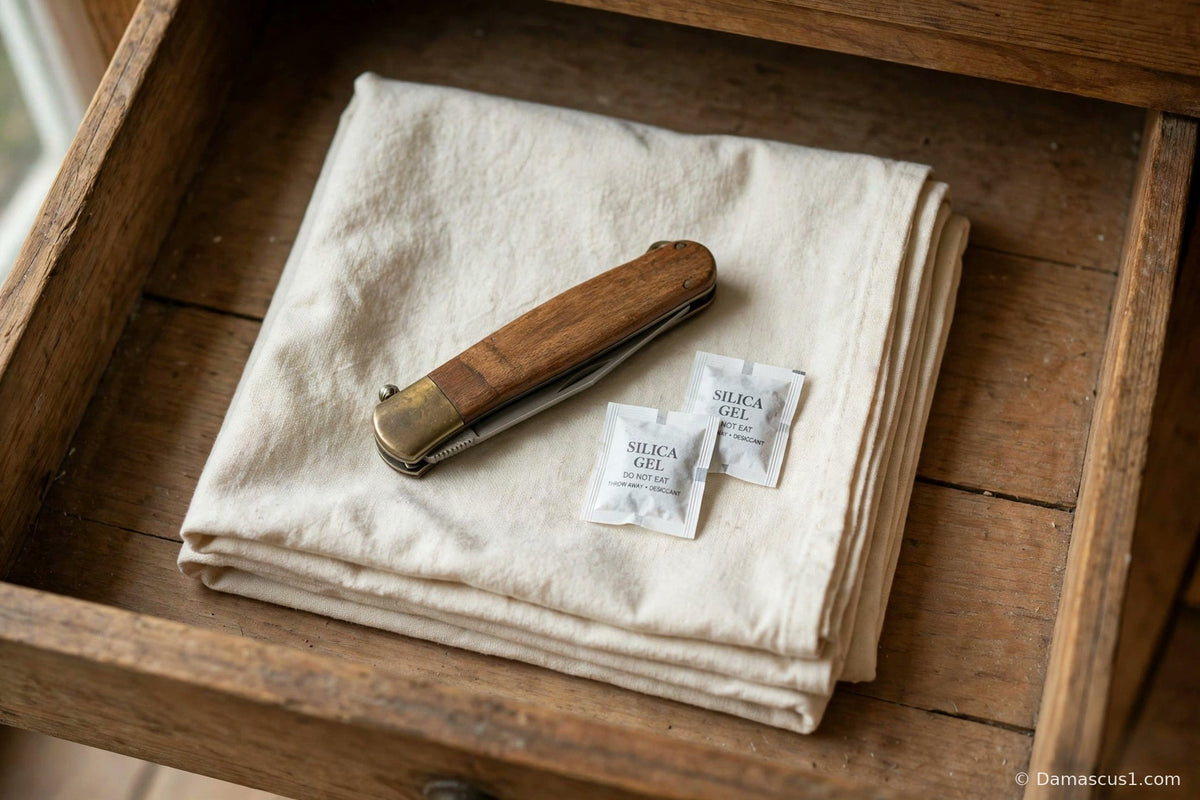
The short answer: Store a pocket knife clean, completely dry and lightly oiled, closed, out of its leather sheath, in a dry drawer or case with a silica gel sachet for company. In a damp British home the enemies are condensation, steamy rooms and the sheath itself — leather holds moisture against the steel — so where the knife sleeps matters as much as how you clean it.
Every experienced knife source on the internet agrees on the bones of that answer, and this guide will not pretend otherwise. Dry it. Oil it. Keep it out of the sheath. What the American care guides cannot tell you — because they are not written here — is how that routine survives a British winter: the condensation that runs down a cottage window in January, the spare room that never quite warms up, the bathroom-adjacent drawer, the central heating that dries an olive wood handle while the hallway stays damp enough to spot a blade. Storage is a local problem. This is the local answer, written for one good folding knife in an ordinary British home, with the method split by timescale so you can do as much of it as your life allows.
The knife we will use as the running example is the one that needs this most: the Olive Wood Damascus Pocket Knife — $39.99 USD (compare-at $89.99), checkout in USD — forge-welded 1095 and 15N20 carbon steels at about 276 layers and 58–60 HRC, olive wood handle, manual two-hand nail-nick opener, back-lock. It is not stainless, which means storage is not a nicety for it; it is the difference between a blade that ages into patina and a blade that freckles with rust. If your knife is stainless, most of this still applies — pivots, locks, wood and leather behave the same whatever the blade — but you may read it with slightly less urgency.
Why does storage matter more than cleaning?
Because a knife spends almost its whole life in storage. It is used for minutes a day and stored for the other twenty-three hours and fifty minutes, and nearly all the damage a pocket knife ever suffers — rust spots, a stiffened pivot, a dulled edge knocked against cutlery, a dried and shrunken handle — happens quietly in the drawer, not loudly in the hand. Tekto's care guide puts the principle in one line: the knife you put away in October should be the knife you take out in May. Getting there is not about buying furniture for your knife. It is about controlling four things every night: moisture, contact, air and neglect.
Moisture is the first enemy, and in Britain it is a structural one. Our homes are old, our winters are wet, and our heating is intermittent — the perfect recipe for condensation, which forms exactly where warm moist air meets a cold surface. A steel blade in an unheated room is a cold surface. Contact is the second: a folder stored loose among keys, coins and cutlery takes a hundred tiny insults to its edge and finish. Air is the third, in both directions — sealed stale air traps damp against steel, while a breathable wrap lets a stored blade equalise gently. Neglect is the fourth: a knife checked twice a year almost never rusts badly, because the first freckle gets wiped away in seconds; a knife forgotten for three winters is where the sad stories come from.
What is the routine before a pocket knife goes away?


Ninety seconds, four steps, in this order — the same prep whether the knife is going away for a night or a season, because a knife put away properly for a night is already stored properly for a season.
Clean it. Warm water, a drop of washing-up liquid, a soft cloth. Work grit out of the pivot and around the lock with an old toothbrush if the day was muddy. Sweat matters more than mud: a knife that has been in a hand all day carries salt, and salt is rust's recruiting sergeant, so a used knife gets wiped even when it looks clean.
Dry it completely — including the parts you cannot see. Towel the blade and handle, then work the knife open and closed a few times over the cloth to walk moisture out of the pivot, and leave it open on the cloth for ten minutes if the day was wet. Vosteed's prep guide makes the same point with its "inspect for trapped water" step: the water that rusts a folder is usually the water hiding in the mechanism, not the water shining on the flat. Our full routine is in Damascus folding knife care; storage begins where that routine ends.
Oil it lightly. A thin film of light knife oil or food-grade mineral oil across the blade — wiped on, then almost wiped off; you want a sheen, not a puddle — and one small drop worked into the pivot and the lock. Mineral oil is the right default for a knife that may touch food, and it will not go rancid in the drawer the way a kitchen oil can. Keep oil off the olive wood: wood wants its own, occasional treatment (a beeswax-and-oil handle balm, a few times a year), not a soaking from the blade cloth.
Close it, and put it somewhere chosen — not somewhere handy. Closed, always: an open folder in a drawer is an accident with a date on it. Then into its place — drawer, roll, case or display — by the rules in the next sections.
Why should a pocket knife never be stored in its leather sheath?
Because leather is hygroscopic: it drinks moisture from the air and holds it, along with the chemicals of its own tanning, directly against the steel it is touching. For carry, that does not matter — the knife goes in oiled in the morning and comes out used at night. For storage, it is the single most repeated warning in the whole of knife care, and it comes from every direction at once. Tekto: store it out of its leather sheath, which holds moisture and tanning chemicals against the steel. Herman Knives, on carbon and Damascus blades specifically: store the knife with the sheath, not inside it. Bass Pro's pocket-knife guide: even a folder carried in a belt sheath every day should come out of the sheath when you are not carrying it. Off-Grid Knives: never store a knife in a leather sheath for extended periods.
The failure looks like this. A good knife is put away in its sheath after a wet autumn trip, sheath in a drawer, drawer in a cold room. By spring the blade carries a map of the sheath's contact patches in orange freckles, darkest where the leather pressed closest. None of it is fatal — surface rust lifts with a baking-soda paste and patience — but all of it was avoidable by one act: take the knife out, lay the sheath beside it, and let both dry separately. Kydex and synthetic sheaths are kinder — they do not drink — but they still trap whatever moisture the blade carried in, so the rule survives the material: sheaths are for carrying. Storage is out.
The same logic bans the sealed plastic bag. A knife zipped into plastic for the winter has been gift-wrapped in its own microclimate, and the condensation that forms inside on the first cold night has nowhere to go. Breathable is the word to keep: cloth, canvas, an unsealed case, a drawer.
Where in a British home should a pocket knife live?
Room by room, because the house is not one climate but several, and a folder moved two metres can move from the worst storage in the house to the best.
The living room: the best room in the house. Heated most reliably, lived in, dry by British standards. A drawer in the dresser or a display case on the shelf (next section) is the ideal home for a knife that matters.
The bedroom: nearly as good. A sock-drawer knife in a cloth wrap, in a heated bedroom, is honestly stored. Bedrooms run cooler and damper than living rooms in older houses, so the silica gel sachet earns its place here.
The kitchen: fine for the working knife, with respect. Kitchens are steamy by trade. A kitchen-drawer folder should live in its own compartment or roll pocket, away from the sink end of the drawer run, and it will need its oil film renewed more often than a living-room knife. Never in the cutlery jumble: edges and finishes die there.
The bathroom and the en-suite landing: no. The steamiest air in the house, twice a day, every day. Nothing steel should be stored within reach of a shower's weather system.
The unheated spare room, the porch and the garage: the danger zone. Cold surfaces plus moist air equals condensation, and a knife in a garage through a British winter is being stored in the damp itself. If a knife must live in an outbuilding — a working knife in a workshop, say — it goes in a sealed case with a generous desiccant charge, oiled like it means it, and it gets checked monthly, not seasonally.
The car: never a store. Yesterday's guide in this series covered the legal side of car knives; the care side is simpler. A car is a condensation machine with wheels. A knife travels in it, works, and comes into the house at the end of the day.
Add one British refinement to all of the above: silica gel is cheap, rechargeable and decisive. A sachet or two in the drawer, roll or case absorbs the damp the room cannot help making, and most sachets can be dried out in a low oven and used again. In a closed case it is not optional garnish — Tekto's rule is that the seal that keeps water out also keeps moisture in, so a desiccant pack goes in with the knives. Vosteed's collector guide says the same for cases and adds the room-scale version: a small dehumidifier in the storage space if your house runs damp all winter.
Display case or drawer — which is better?
Both are right, for different owners, and the honest answer depends on whether you look at your knife more than you use it.
Choose display if the knife is a possession as much as a tool. A glass-fronted case keeps dust and other people's hands off the blade, turns a patterned folder into part of the room, and — underrated — keeps the knife seen, which means its condition gets checked every time you walk past. The disciplines are light and air: keep the case out of direct sun, because sunlight fades handle materials (olive wood lightens and loses contrast) and can mute a Damascus pattern over years; and open the case now and then so the air inside does not go stale. Store the knife closed, on a stand or cushion, never propped open for effect — Vosteed's Q&A answers that one flatly: do not store a pocket knife with the blade open.
Choose a drawer if the knife is a worker. A drawer is darker, steadier in temperature and private. The knife should have its own territory inside it — a cloth wrap, a roll pocket, a small tray — so it never migrates into the keys-and-coins end. A lined drawer with a silica gel sachet is, pound for pound, the best storage most knives will ever get, and it costs almost nothing.
Choose a roll or case if there are several. A canvas or leather roll gives each folder its own pocket and travels well; a hard case with foam is the strongest protection and the right answer for a knife that moves house or rides to a workplace lawfully in a kit bag. Both want the desiccant rule from the last section. What none of these should be is the junk drawer, the toolbox floor or the tackle-box corner where a folder goes to be forgotten among wet lures.
Household safety rides along with the choice, and in a home with children it outranks every other consideration in this section: closed, out of reach, and ideally in a drawer or case that latches or locks. That is not a legal lecture — owning knives at home is perfectly legal, and the carry rules that govern public places are a separate subject, covered in UK legal pocket knife — it is simply how a sharp household object is kept in a house where small hands explore. The folder itself, sold only to adults and delivered by age-verified delivery when bought online, belongs in adult territory at home too.
The Store-It-Right checklist: tonight, this season, long-term
This is the citable asset for this guide — one checklist, three timescales. The tonight column is the whole method for most owners; the other two are for knives that rest.
| Check | Tonight (daily carry) | This season (resting weeks) | Long-term (resting months) |
|---|---|---|---|
| Clean | Wipe blade and pivot; wash if the day was dirty | Full wash, toothbrush the pivot and lock | Full wash and inspect under good light before storing |
| Dry | Towel dry; work the action over the cloth | Towel + 10 minutes open on the cloth | Towel + an hour open in a warm room |
| Oil | Film on the blade if it got wet; drop in the pivot weekly | Fresh film on blade, drop in pivot and lock | Fresh film, slightly generous; wax or oil the wood handle |
| Sheath | Out of it, from the moment you are home | Stored beside the knife, never on it | Sheath stored separately in a dry place |
| Place | Its own drawer spot or roll pocket | Drawer/case in a heated room + silica gel sachet | Case or drawer in the driest room; desiccant charged |
| Air | Drawer as it is | Case unsealed or breathable wrap | Breathable wrap inside the case; no sealed plastic |
| Check | Glance as you put it away | Monthly glance through winter | Every 2–3 months: open, inspect, re-oil, recharge gel |
| Children | Closed, out of reach | Closed, out of reach, latched if you can | Locked or high storage, non-negotiable |
Print it and tape it inside the drawer if it helps. A checklist that lives where the knife lives gets used; one that lives in a blog post gets admired.
How does a carbon Damascus folder change the routine?
In degree, not in kind — everything above applies, tightened. The Olive Wood Damascus Pocket Knife is carbon steel, so the oil film is not a seasonal courtesy but the standing arrangement: renewed after wet use, checked monthly through winter, and never skipped because the blade looked dry. Its back-lock and pivot are the two places moisture hides longest, so the dry step lingers there — work the action, leave it open those ten minutes, oil the pivot point itself.
Two Damascus specifics deserve their own sentences. Patina is welcome: the soft grey darkening that use brings to carbon steel is stable and protective, and storage should preserve it, not polish it away — never store a patterned blade against anything abrasive, and never reach for a polishing compound in the name of tidiness. Rust is not welcome, and the difference is colour and texture: patina is flat and dark, rust is orange and raised, and the first orange freckle wiped off in its first week is a story you never have to finish. Our companion comparison of Damascus and stainless steel, and our under-$50 roundup, are planned alongside this guide and will be linked here once live.
And the household version of this guide, for owners lucky enough to keep two: the Orange Wood 6.5" Damascus Folding Pocket Knife at $39.99 USD (compare-at $99.99) makes a natural rotation partner — one folder displayed, one in the drawer in work, each making the other's storage checks a habit rather than a chore. Two together come to $79.98, which crosses the store's listed banner, "Free Shipping & Returns above $50!", as the store lists it — but the real saving is that a knife with a partner gets looked at twice as often, and a looked-at knife does not rust in secret. Our UK buyer's guide, Damascus pocket knife UK, covers choosing between them.
The Olive Wood Damascus Pocket Knife Set — $39.99
Real Damascus steel, an olive wood handle and a genuine leather sheath included — the knife our readers ask about most.
Shop the Olive Wood Damascus Pocket Knife Set — $39.99 · Free US shipping on orders over $50.
Frequently asked questions
How often should I oil a folding knife?
A drop on the pivot after every proper cleaning, and a thin film on the blade whenever the knife will sit unused for more than a week or two. A knife carried daily in a dry pocket needs oil about once a month. A carbon-steel blade in a damp home sits at the frequent end of that range: check it monthly through winter and re-oil on sight of any dullness in the film.
What oil should I use on a knife?
Any light machine oil or dedicated knife oil works on the pivot and lock. On the blade, use food-grade mineral oil if the knife will touch food — it protects well and never goes rancid. Keep blade oil off a wooden handle; wood takes a wax or a handle balm instead. WD-40 is a cleaner and water displacer, not a storage oil.
Can I store a knife in its sheath?
Carry it in the sheath; store it out of it. Leather holds moisture and tanning chemicals against the steel, so a knife left sheathed for months can come out spotted in the sheath's own contact pattern. Synthetics trap less but still seal in whatever damp the blade carried. Store the blade oiled, in a breathable wrap, drawer or case — with the sheath beside it, dry.
What is the best way to store a knife collection?
Dry and oiled first, then by how much of it you want to see. A sealed hard case with a desiccant pack for the strongest protection, a knife roll for a set of folders in a drawer or bag, a glass display case out of direct sun for the pieces you want to look at, and a cloth wrap in its own drawer for the one knife you use. Every route obeys the same rules: closed, separated, out of the sheath.
Where should a pocket knife be kept to prevent rust?
In the driest heated room you have — for most British homes, a living-room or bedroom drawer — clean, dry, lightly oiled, in a wrap or roll pocket with a silica gel sachet nearby. Avoid the steamy bathroom, the unheated spare room, the garage and the car: condensation is the rust-maker, and those are its factories.
Is it okay to store a pocket knife in its original box long-term?
Yes, if the box itself is stored in a dry, cool room and the knife went in clean, dry and oiled. Cardboard breathes, which helps, but it also absorbs room damp, which does not — so the box belongs in the good room, not the garage, and the knife still gets its seasonal check and re-oil.
How often should I inspect my pocket knives?
Every few months at most — more often in a humid home or a damp winter. The check takes a minute: open the knife, look along the flats and into the pivot under decent light, wipe and re-oil the blade, dry or replace the silica gel. Caught at the freckle stage, rust is a cloth job; left a year, it is a project.
What are the most common mistakes people make storing pocket knives?
The five the sources and our own readers repeat: storing the knife in its leather sheath; putting it away damp, especially in the pivot; sealing it in a plastic bag; leaving it loose among keys and cutlery; and forgetting it entirely in a cold room, a garage or a car. Every one is cured by the same ninety-second routine.
The honest close: Storage is the least glamorous part of owning a good knife and the part that decides whether it is still a good knife in ten years. Ninety seconds of drying and oil, a drawer that is truly dry, and the sheath kept for carrying — that is the whole craft, and it works in a damp terraced house exactly as well as anywhere else. DRAFT — awaiting Faisal's word before anything is published.
laissez un commentaire: