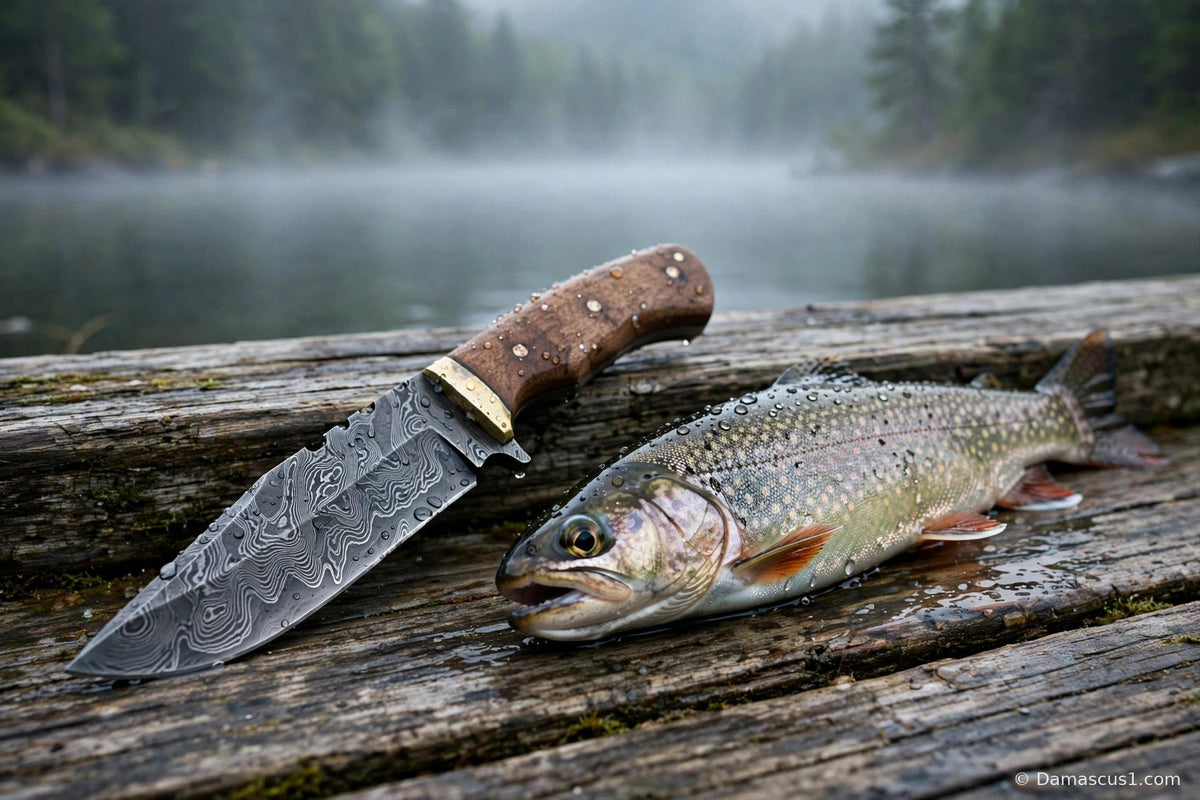
Direct answer: Choose a fish knife by the fish you actually clean: a flexible 6–7 inch fillet blade for panfish and trout, a 7–9 inch fillet for salmon and walleye-sized fish, a stiffer blade for heavy or bony species, a handle that grips when wet, and a steel whose care routine matches your habits — stainless for low-maintenance saltwater use, carbon-leaning steel only if you will rinse, dry, and oil it every time. No single knife does every fish well.
That answer contains no test results, and it does not need any. The original version of this article claimed extensive personal testing — species by species, calipers, months of trials, trips that anchored its advice. Those claims have been removed, all fourteen of them, listed in the checklist above. What remains is stronger without them: fish anatomy, blade geometry, and care habits are checkable facts that do not depend on trusting a narrator. You can verify every principle in this guide against the next fish you clean, which is exactly how buying advice should work.
One honest note about this store belongs at the top rather than buried at the bottom. Damascus1's verified range today is built around folding pocket knives and fixed-blade hunting and tracker knives — the tracker and hunting knife collection is where its outdoor fixed blades live. No dedicated thin, flexible fillet knife was verified in the live catalog on the day this guide was written, and this guide will not pretend otherwise. So the fillet sections below teach you how to choose a fillet knife well, from any maker, and the Damascus1 cards later cover the jobs those fixed blades genuinely do at a fish camp: the heavy work around the cleaning table, not the filleting itself. A guide that tells you what not to buy from its own store is a guide you can trust about the rest.
What type of fish knife do you actually need?
You need the type that matches the job in front of you: a thin, flexible fillet knife for removing fillets from the fish you catch most, a stiffer and shorter blade for gutting, scaling, and bait work, and a heavy fixed blade only for the camp tasks around the catch — never as a fillet substitute. Most anglers who fish one or two species well need one good fillet knife in the right length, not a roll of five.
Start with the fillet knife, because it is the knife this search is really about. Filleting is a guidance job, not a force job: the blade slides along a rib cage and spine it should follow rather than fight, which is why fillet blades are thin, narrow, and flexible, with a fine point for the first incisions and an edge that works by slicing rather than pressing. If the fish on your board are mostly panfish, trout, perch, and similar table fish, a shorter flexible blade gives you control around small rib cages. If salmon, walleye, redfish, or comparable mid-size fish are your norm, you need the length in the next section. If your catch runs to heavy, thick, or strongly boned fish, flexibility stops being a virtue mid-fillet and a stiffer blade earns its place.
The second knife in a fish kit is the utility blade: gutting, cutting bait, trimming, opening packaging at camp, and the dozen unglamorous jobs that would dull or abuse a fine fillet edge. This is where a sturdy folder or fixed blade belongs, and it is a real reason anglers own more than one knife without any collector logic involved. A fillet knife kept only for filleting stays sharp for the job that needs sharpness most; a working knife takes the abuse instead. Our best pocket knife guide covers the folder side of that pairing.
The third category — the heavy fixed blade — is the one this store sells, and its place in a fish camp is specific: fire and shelter work at camp, rope and line too heavy for a fillet blade, splitting kindling within reason, food prep on a camp board where a thick spine is no disadvantage, and general camp utility across a weekend. What it is not is a fillet knife. A 9.5-inch tracker profile is built thick and strong for exactly the forces a fillet blade is built to avoid. Using one to fillet is possible in the way driving a screw with a knife tip is possible — the honest advice is to use the right tool, and the best Damascus hunting knife guide places these blades in their proper field context.
There is also a short companion read worth your time before you buy anything: the store's handbook on Damascus fillet knives covers the fillet category from the Damascus side. Read both, then buy once.
How long should a fish knife blade be?

A fish knife blade should be a little longer than the fish you clean most: roughly 5–7 inches for panfish and trout, 7–9 inches for salmon, walleye, and similar mid-size fish, and 9 inches or more for large offshore fish. A blade shorter than the fish forces sawing strokes that tear flesh; a blade far longer than the fish becomes clumsy around small rib cages. Match the blade to your usual catch, not your best-ever catch.
Length is the easiest specification to get right and the one buyers most often buy for the wrong fish. The record fish in the photograph is not the fish on next Saturday's board. If nine trips out of ten end with trout-sized or pan-sized fish, the 6-inch class is your knife even if a longer blade would have been better on the tenth trip — and on that tenth trip, patience and two passes will do what length would have. Buy for the distribution of your real season, the same rule this store's other guides give for pocket knives and hunting knives, because it is the rule that survives contact with actual use.
Length also interacts with the way a fillet is taken. A proper fillet stroke should travel the length of the fish in one smooth draw wherever the anatomy allows. Each time a short blade has to restart mid-fish, the restart leaves a step in the flesh and wastes meat against the bone. Too much length creates the opposite fault: the tip wanders, the far end of the blade works at an angle your wrist did not intend, and precision around the rib cage — the part of filleting where meat is won or lost — gets worse, not better. The sweet spot is unglamorous and repeatable: blade slightly longer than the depth of the fish you clean most, in a profile thin enough to turn with the bones.
Fixed-blade camp knives play by different length logic, and confusing the two is a category error worth naming. A 9.5-inch tracker is long because camp work rewards leverage and reach, and its thickness is a feature everywhere except across a rib cage. Nobody should read its length as a fillet qualification. If you carry one to the water, carry it for the camp, and let a proper fillet blade — wherever you buy it — do the one job it was shaped for.
How flexible should a fish knife be, and why does spine thickness matter?
A fish knife should flex enough to follow a rib cage in a smooth curve without springing straight or folding — more flex for small, delicate fish, less for large or heavy-boned fish. Flex comes from spine thickness: thin spines bend and turn, thick spines stay straight and push through. As general guidance, fillet blades live at the thin end of the knife world, while camp and hunting blades are built several times thicker for strength. Judge flex in the hand, by design, not by a number on a listing.
Flexibility is the specification that separates a fillet knife from every other knife in your kit, so it deserves a careful explanation rather than a slogan. When you fillet, the blade travels along bones that curve. A blade with the right flex bows gently with that curve, keeping the edge against the bone for the full stroke, which is where the meat is recovered cleanly instead of left behind or taken with bone in it. Too stiff, and the blade bridges across the curve, either riding over meat or digging in. Too flexible for the fish, and the blade deflects off thick bone, wanders from the line you intended, and makes the cut feel vague — the fish-knife equivalent of steering with a loose wheel.
Spine thickness is the physical reason behind the feel. The spine is the unsharpened back of the blade, and its thickness is the single biggest driver of how much a blade bends. Fillet profiles are ground thin precisely so they can turn; general-purpose and hunting profiles are left thick precisely so they cannot. This is also why a fillet knife must never be used for prying, splitting, or camp abuse — the thinness that makes it good at its job makes it fragile at every other job — and why the thick camp blade cannot return the favour. Each design is honest at its own task. The dishonesty only enters when marketing claims one blade does both.
There is a simple in-hand check that needs no instruments, whatever a listing claims: support the blade near the tip with light pressure against a board edge and press the handle gently. A fillet blade should bow in a smooth, even curve and return true. A blade that flexes in one hinged spot, or that takes real force to bend at all, is telling you its category. Trust the curve over the copy. And when you read any guide's thickness figures — including general ranges like the ones above — treat them as orientation, not as measurements of a specific knife. A specific knife's dimensions belong on its own product page.
Carbon steel or stainless steel: which is better for a fish knife?
Stainless steel is better for most anglers, because fish work is wet work: it resists corrosion through long, damp days and forgives a delayed rinse. Carbon-leaning steels can take a very fine edge and reward owners who rinse, dry, and oil after every use — and punish owners who do not, with rust that starts at the cleaning table. Damascus blades, being layered, follow the care needs of their more demanding layer. Choose by your habits, honestly assessed, not by the edge you admire in theory.
The trade-off is real in both directions, and any guide that crowns one steel for everyone is skipping the part where your routine enters the equation. Stainless construction exists for environments exactly like a fish camp: water, salt spray in coastal fishing, fish oils and acids, a knife that may sit damp in a sheath or a boat compartment longer than it should. A stainless fillet knife rinsed at the end of the day and dried before storage will serve for years with minimal attention, which is why it is the default recommendation for saltwater anglers and for anyone who knows their maintenance will be imperfect.
Carbon-leaning and layered steels ask more and, for the right owner, give something back: an edge that many sharpeners find easier to bring to a fine finish, and — in Damascus's case — a patterned blade whose character is the whole point of owning it. The price of admission is a non-negotiable routine: rinse in fresh water promptly, especially after saltwater; dry completely; a thin film of food-safe oil before storage; never seal a damp blade in a sheath. Patina — the grey film that develops on carbon steel with use — is normal and even protective. Orange spotting is not patina; it is early rust, and it is a routine failure, not a steel failure. The full rust picture is in can Damascus steel rust?.
Where does that leave a Damascus buyer who fishes? With a clear-eyed division of labour. A layered blade is a beautiful camp and table knife for the owner who dries it, and our best hunting knife guide covers those blades on their own ground. For the fillet work itself, buy the steel your habits can support — stainless for most, carbon-leaning for the disciplined — from whichever maker states the material plainly. A guide on a knife store's blog that sends you to a competitor's fillet knife when that is the right tool is not confused about its job. Its job is that you fillet well and come back for the knives this store actually makes well.
What makes a fish knife handle work when it is wet?

A fish knife handle works when wet if it gives your fingers mechanical grip rather than relying on friction alone: texture, contour, or a shape that fills the palm and stops forward slide toward the edge. Smooth, polished handles that feel luxurious dry can become genuinely hazardous with wet, fish-slick hands. Judge a handle by imagining it at the worst moment of the job — tired hands, cold water, a fish that flips — not by how it photographs.
Fish handling is one of the most demanding grip environments any knife works in, because everything conspires at once: water, natural fish oils, cold that dulls finger feedback, and repetitive strokes that fatigue the hand into gripping harder and controlling less. Design answers that problem in a few checkable ways. Texture is the first: a surface with real tooth — textured synthetics, checked or naturally ridged materials — keeps purchase when a polished surface lets go. Contour is the second: a palm swell that fills the hand means the fingers guide rather than clamp, and a guard or a pronounced narrowing that stops the hand sliding forward is a safety feature, not a styling choice. Size is the third: a handle a fraction fuller than feels necessary in a dry showroom is usually right at the cleaning table, where a slightly larger grip can be held loosely and a small one must be squeezed.
Materials sort themselves by environment more than by price. Textured synthetic handles were developed for exactly this wet, abusive work and ask almost nothing in return. Stabilised wood and natural materials can serve well where their texture is preserved and they are dried after use, and they bring the character many buyers want — with the standing condition that natural materials stored damp deteriorate, at the dock as surely as in a drawer. For a dedicated fillet knife that will live wet, prioritise grip and rinse-and-go care. For the camp knife that joins it, the natural handles in this store's range — olive wood, buffalo horn, camel bone — are chosen for dry-hand and camp work, dried after wet days, and judged by the same rule as every handle in this guide: by the worst moment, not the photograph.
Fatigue deserves the last word in this section, because it is the quiet cause of most bad cuts. A handle that forces a hard squeeze to stay secure will, over a dozen fish, produce exactly the loss of control it was meant to prevent. The right handle lets a relaxed hand steer. When you handle a candidate knife, the question is not "does this feel secure while I grip it hard?" — almost everything passes that test for five seconds. The question is "does this stay put while I hold it gently?" That is the grip you will actually have on fish number twelve.
The Damascus1 fish-camp shortlist, compared honestly

Every price below was verified on the live Damascus1 site on October 16, 2026. Read the framing before the table: these are fixed-blade camp and hunting knives and one everyday folder. They are the knives to carry around the catch — camp work, heavy cutting, and utility — alongside a dedicated fillet knife chosen by the principles above. None of them is presented as a fillet knife, because none of them is one.
| Pick | Best for | Type and size | Handle | Price (verified Oct 16, 2026) |
|---|---|---|---|---|
| Olive Wood Fixed Blade Tracker | Best value fish-camp fixed blade | Fixed, 9.5" | Olive wood | $79.99 |
| Buffalo Horn Fixed Blade Tracker | Best substantial camp blade, dark horn character | Fixed, 9.5" | Buffalo horn | $89.99 |
| Camel Bone Fixed Blade Tracker | Best pale, traditional camp blade | Fixed, 9.5" | Camel bone | $89.99 |
| Olive Wood Pocket Knife | Best pocket utility knife for bait, line and camp jobs | Folding, 6.5" | Olive wood | $39.99 |
Product cards — priced, linked, and framed by the job
Best value camp blade — Olive Wood 9.5" Fixed Blade Tracker — $79.99. The fixed blade to live in the camp box: fire prep within reason, rope, camp kitchen work on a board, and the heavy jobs a fillet knife must be protected from. View the Olive Wood tracker.
Best substantial camp blade — Buffalo Horn 9.5" Fixed Blade Tracker — $89.99. Dense, dark horn on the same fixed platform, for the angler whose camp knife is also the knife they simply enjoy owning. View the Buffalo Horn tracker.
Best traditional camp blade — Camel Bone 9.5" Fixed Blade Tracker — $89.99. The pale, classic handle at full fixed-blade size. View the Camel Bone tracker.
Best pocket utility — Olive Wood Damascus Pocket Knife, 6.5" — $39.99. Bait, line, packaging, and the small jobs of a fishing day, in a folder that rides unnoticed until it is needed. Keep it for utility, not for filleting. View the Olive Wood pocket knife.
All three fixed blades sit in the tracker and hunting knife collection. A shipping note that affects pairing: the site currently shows free shipping & returns above $50 — each fixed blade clears that line on its own; the $39.99 folder does not, but pairs past it with any fixed blade. Confirm the offer at checkout, because offers change.
How do you care for a fish knife so it stays sharp and rust-free?

Care for a fish knife with a dockside rhythm: rinse it in fresh water as soon as the cleaning is done — immediately after saltwater — wash with a little soap if it is genuinely dirty, dry it completely, and store it dry, never sealed damp in a sheath. Carbon-leaning and layered blades get a thin film of food-safe oil before storage. Sharpen little and often; a fillet edge maintained in small touches never needs a heroic rescue.
Saltwater compresses every timeline in that routine, which is why coastal anglers should treat the rinse as part of the catch, not part of the homecoming. Salt left on any blade — stainless included — works while you drive home. Fresh water, a dry cloth, and two minutes at the dock prevent the spotting that otherwise gets discovered, with feeling, at the start of the next trip. Sheaths and rolls are for transport. Long-term storage is dry and open, with the sheath alongside, because a sealed damp sheath is the single most common rust story in every category of knife this store writes about.
Sharpening a fillet knife follows the same pattern-safe logic as any fine blade: work the bevel, keep the angle the edge was ground with, and prefer frequent light maintenance over rare heavy grinding. A thin fillet edge that is touched up while it is merely dull stays thin and true; one that is used until it tears flesh and then ground back hard loses the geometry that made it good. The full technique — whetstone grit choice, angle control, stropping — is in how to sharpen a Damascus knife, and it applies to fillet blades exactly as it does to kitchen blades. One habit specific to fish work: rinse and dry the blade before sharpening sessions too, because dried fish residue on a whetstone helps nobody.
Storage at home completes the picture. A fillet knife kept in its own sheath or roll, dry, separated from rattling tackle, keeps its edge and its finish. A knife thrown loose into a tackle box loses both, and then gets blamed for it. None of this care is specialised or expensive. It is a rhythm attached to a rhythm you already have — clean the fish, clean the knife, dry the knife, put it away dry — and it is the entire difference between a fish knife that serves a decade and one that disappoints by August.
How much should a good fish knife cost?

A good fish knife costs by category, not by legend: honest fillet knives from established makers cover a wide band from modest utility prices upward, and the right question is whether the length, flex, and steel match your catch and your habits at that price — not whether the listing is theatrical. At Damascus1, the camp companions in this guide are verified at $39.99 for the folder and $79.99–$89.99 for the fixed blades. Run the same value check on a fillet knife anywhere: design fit first, price second.
Two pricing traps guard this category, one at each end. At the cheap end, very low-priced fillet knives often save their money in exactly the places this guide taught you to check: steel that will not hold the thin edge the design requires, and handles whose wet grip was never really considered. At the expensive end, price can buy collectible materials and famous names that add nothing to a fish-cleaning afternoon. The honest middle — sound steel plainly stated, a handle designed for wet hands, dimensions published where you can read them — is where a working angler's money belongs, whichever store it is spent in.
Judge a listing the way this guide judges its own store. Does it state the blade material for that exact knife? Does it give a length you can match to your catch? Does it describe the handle in terms of grip, or only in terms of looks? A seller who answers those questions in plain language is selling a tool. A seller who answers with trip stories and superlatives is selling a narrative — and narratives, as the original version of this article demonstrated at length, are not evidence.
Frequently asked questions
What is the best fish knife for a beginner?
A mid-length, flexible stainless fillet knife — around 7 inches — is the best starting point for most beginners: long enough for common table fish, flexible enough to learn the rib-cage stroke, and forgiving on care while the rinse-dry habit forms. Add length later only if your actual catch outgrows it. Buy for the fish you catch this season, not the fish you hope to catch someday.
Can I fillet fish with a hunting or tracker knife?
You can, in the sense that any sharp edge can be made to work — but a thick fixed blade cannot flex around a rib cage, so it leaves meat, takes bone, and makes the job harder and less safe than it needs to be. Hunting and tracker knives are excellent camp knives, which is the role this guide gives the Damascus1 fixed blades. Filleting deserves its own thin, flexible blade.
What size fish knife do I need for salmon?
A 7–9 inch flexible fillet blade suits most salmon work: long enough to take the fillet in smooth, full strokes, flexible enough to follow the rib cage of a mid-size fish. For consistently large fish, step toward the longer end; for smaller trout-sized salmonids, the shorter end gives better control. Match the blade to the fish you clean most, as with every species.
How do I stop a fish knife from rusting?
Rinse it in fresh water straight after use — immediately after saltwater — dry it completely, oil carbon-leaning or layered blades lightly before storage, and never store it damp in a sealed sheath. Grey patina on carbon steel is normal; orange spots are early rust and a sign the routine slipped. Stainless lowers the stakes of a slip but does not excuse storing a knife wet and salty.
Does Damascus steel make a good fish knife?
Layered steel can make a beautiful, capable blade, and the store's own fillet handbook linked in this guide covers the category — but judge any Damascus fish knife by the same checks as any other: stated blade material on its product page, the right length and flex for your catch, a handle that grips wet, and a care routine you will actually keep, because layered blades should be dried and oiled. The pattern is a reason to love the knife, not a substitute for the checks.
What should I check before buying a fish knife online?
Check the stated blade material for that exact knife, the blade length against your usual catch, whether the design is genuinely thin and flexible for filleting or a general blade being marketed at anglers, the handle's wet-grip design, what is included, and the current price on the product page. If a listing leans on personal test stories instead of specifications, treat the stories as decoration and the missing specifications as the real information.
The bottom line: how to choose your fish knife
Choose by fish, flex, and habit: a flexible fillet blade a little longer than the fish you clean most, stainless unless your rinse-dry-oil routine is reliable enough for carbon-leaning steel, and a handle you can hold gently with wet hands. Then give the camp around the catch its own honest tools — a 9.5-inch fixed blade at $79.99–$89.99 for the heavy work and a $39.99 folder for utility — and let each knife do the job its shape was made for. That division of labour, not any single wonder blade, is what a good fish kit actually looks like.
Ready to build the camp side of your kit? Browse the Damascus1 tracker and hunting knife collection, pick the handle your hand will trust, and pair it with a fillet knife chosen by the checks above.
Prices verified against the live damascus1.com product pages on 2026-10-16 and subject to change. DRAFT — not yet published.
laissez un commentaire: