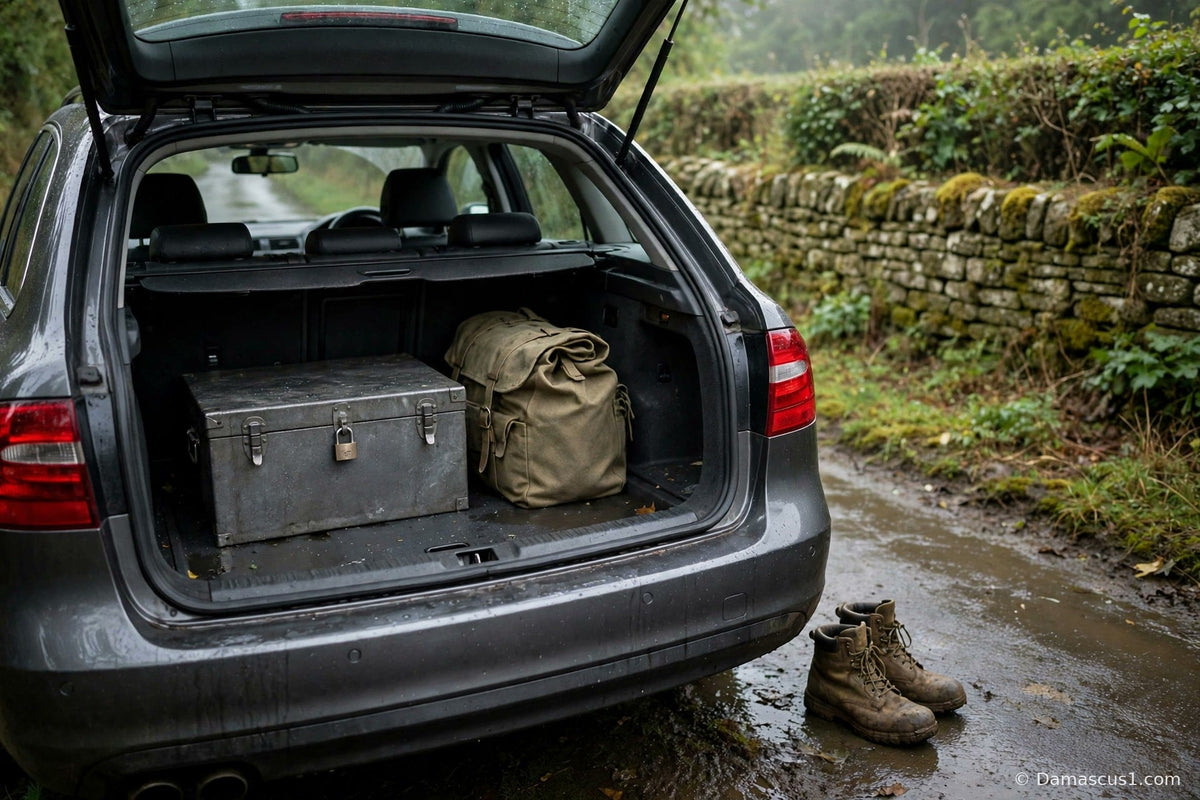
The short answer: Yes, you can carry a knife in your car in the UK — but the car gives you no shelter from the law. A car on a public road or in a public car park counts as a public place, so any knife beyond a small non-locking folder needs a specific, current good reason, and it should travel locked, out of reach, in the boot — never loose in the glovebox.
It is one of the most common knife questions in Britain, and it usually starts innocently. The fishing knife lives in the boot because that is where the tackle lives. The camping knife stays in the car from one trip to the next because unpacking is a faff. The work knife sits in the glovebox because the van is, effectively, the toolbox. None of those drivers thinks of themselves as "carrying a knife". All of them, in the eyes of the law, may be.
The confusion comes from a very British assumption: that your car is your private space, a little extension of your home on wheels. For most purposes it feels that way. For knife law it is not. This guide explains what "in public" actually means for a car, why the glovebox is the worst place in the vehicle and the boot — used properly — is the best, what counts as a good reason on a journey and what does not, and the simple routine that separates a lawful trip to the riverbank from an offence discovered at a routine stop. It is general information, not legal advice, and it is written for the driver who owns a perfectly ordinary knife and wants to transport it like a responsible adult.
Is a car a public place under UK knife law?
Yes — in practice, when the car is somewhere the public can be, the knife inside it is treated as being in a public place. Section 139 of the Criminal Justice Act 1988 makes it an offence to have a bladed or sharply pointed article in a public place without good reason or lawful authority, and the definition of a public place is broad: anywhere the public has access, or is allowed access, at the time. Streets, car parks, lay-bys, campsites and forecourts all qualify — and a vehicle parked on a public road or driven along one travels through public places the whole way.
The clearest plain-English summary comes from the bushcraft world. Jack Raven Bushcraft puts it like this: your car is neither a public nor a private place, it is a container — so if your car is in a public place, so are its contents. LegalClarity's UK carry guide reaches the same conclusion from the statute: a vehicle parked on a public road or driven on a highway is treated as a public place for these purposes, so leaving a knife in the glovebox or the boot without a good reason is an offence just as much as carrying one in your pocket. Camping Sites in Britain says the same in a single line: a public place includes your vehicle, and leaving a knife in your car still counts as possession in a public place.
That has a consequence many drivers miss. The law does not ask where in the car the knife is, as a first question. It asks why it is there at all. A locked box in the boot does not create a legal right to have the knife in the car — it supports a good reason you already have, by showing the knife is being transported for that reason and not kept to hand. Storage is evidence. It is not a permission slip.
There is one narrow exception, and it is worth stating exactly. Section 139 does not bite on a folding pocketknife that does not lock and has a cutting edge of 3 inches (7.62 cm) or less. A knife of that shape can be carried in public — including in a car — without needing a reason. Everything else needs one: every locking folder, whatever its blade length, every fixed blade, and every folder with a longer cutting edge. The courts settled the locking point long ago: a lock knife is not "immediately foldable at all times", in the police.uk wording, so it sits outside the exception even if its blade is short. Our explainer UK legal pocket knife covers that boundary in full.
Can you keep a knife in your glovebox?


No — the glovebox is the worst place in the car for a knife, and every serious UK source says so. It is within the driver's reach, it is where an officer will look early in any search, and a blade kept there reads as a blade kept handy. Jack Raven Bushcraft's advice is blunt: make sure the knife is not easily accessible in your car, which means you should not carry knives in the glovebox or anywhere else they can be easily reached. The camping guide agrees from the other direction: do not leave a blade in the glovebox or on the back seat between trips.
Think about what the glovebox says. A knife in the glovebox has no journey attached to it. It is not packed with the fishing kit or the camping kit; it simply lives in the car, reachable in two seconds, for no stated purpose. If you are stopped and asked why it is there, "it has always been there" is not a good reason — it is close to an admission that there is none. The same logic applies to the door pocket, the centre console and under the seat. Anywhere the driver can reach without getting out is, in practical terms, carrying the knife on your person with wheels around it.
There is a second, quieter problem with the glovebox: heat, damp and neglect. A car interior swings from frost to oven and back, condensation forms, and a carbon-steel blade left in a glovebox for months will show it. That is a care point rather than a legal one, but it points the same way. A knife that matters to you should not live in a car at all. It should travel, be used, and come home.
Is the boot any better than the glovebox?
Yes — the boot is where a knife with a good reason should travel, provided it is packed as cargo and not as equipment to hand. The distinction the law cares about is purpose, but the distinction an officer can see is presentation. A knife at the bottom of a rucksack, inside a locked box, in the boot, surrounded by the kit it belongs with, tells its own story: this blade is being transported to a job. A knife loose in the cabin tells the opposite story, whatever you say afterwards.
The strongest version of the boot routine comes, again, from people who carry blades for a living outdoors. Jack Raven Bushcraft carries bladed tools in a locked ammo box in the boot, with knives at the bottom of the rucksack rather than on top. Camping Sites in Britain advises keeping the knife stored in your pack, out of reach and out of sight, and only in hand when you are using it. LegalClarity makes the same point for fishing: a sheath knife properly packed in a tackle bag on the way to a fishing trip is likely to be a good reason; the same knife loose in a jacket pocket during the weekly shop is not.
Two honest cautions belong here. First, the boot is not a loophole. If there is no good reason for the journey — no trip, no work, no legitimate destination — a locked box in the boot does not manufacture one. Second, the boot is not a store. Both the camping guide and common sense agree: take the knife out when you get home. A knife that lives permanently in the boot has, in effect, been left in a public place permanently, and the good reason that covered Tuesday's fishing trip does not cover the following three weeks of school runs.
What counts as a good reason for having a knife in your car?
A good reason is a specific, current connection between this knife, this journey and a lawful activity — and the burden of proving it sits with the carrier, not the police. Section 139 names the shape of the defence rather than a list: good reason or lawful authority, with recognised examples including use at work, religious reasons and national costume. Beyond those, a court decides, case by case, whether the explanation holds. Police.uk gives the everyday examples drivers actually meet: taking knives you use at work to and from work, and taking a knife to be exhibited, used in theatre, film, historical re-enactment or religious observance.
For car journeys, the reasons that hold up share a pattern. They are happening now, they explain the particular knife, and the packing matches the story.
Work, there and back. A chef driving a knife roll to a restaurant, a carpet fitter with a trimming knife in a tool bag, a farmer or gamekeeper travelling to land where the knife will be used. The reason covers the journey to the work and the journey home — not the same knife riding in the car on a day off with no job attached. LegalClarity is explicit on that point: carrying a work knife with no connection to an upcoming job is not a good reason.
A trip in progress. Camping, fishing, hiking and bushcraft are recognised good reasons when they are genuinely under way. The camping guide's test is proportionality and company: a small fixed blade or a locking folder is defensible for camp cooking and bushcraft, the knife should be stored in your pack, and the rest of the kit — tent, stove, tackle — should be there to corroborate the trip. A locking folder such as the Olive Wood Damascus Pocket Knife at $39.99 USD travels lawfully in this frame: packed in the kit it belongs with, on the way to the place it will be used, and home again afterwards.
Transport itself. Driving a newly bought knife home from a shop, taking kitchen knives to be sharpened, moving house with the knife drawer packed in a box. The legislation does not list these as named defences, and a court ultimately decides — but the practical advice from every guide is identical: keep the item wrapped or boxed, sealed, and clearly being transported rather than readily accessible.
And the reasons that fail are just as consistent. "I forgot it was there" has been rejected by the courts — forgetting a blade left in a vehicle after a previous legitimate use is not a good reason, because the reason ended when the trip did. "Just in case" is not a reason. Self-defence is not a reason: there is no lawful reason to carry an offensive weapon for self-defence in the UK, and saying you keep a knife in the car for protection turns a transport question into something far worse. "I always keep it there" describes a habit, not a reason — and habits are exactly what the glovebox cases are made of.
Which knives can be in a car without a reason, and which cannot?
Not every blade in a car raises the same question. This table separates the three positions honestly — including where a Damascus folder sits, because pretending otherwise helps nobody.
| Knife | In the car without a reason? | How it should travel when you do have a reason |
|---|---|---|
| Non-locking folding pocketknife, cutting edge ≤3in (7.62cm) | Yes — the section 139 exception; no reason needed | Pocket, bag or boot; still use judgement about where you take it (schools, venues and events have their own rules) |
| Locking folding pocketknife, any blade length — including the Damascus hero below | No — a lock knife is outside the exception, even with a short blade | Closed, in a sheath or box, at the bottom of a bag, locked in the boot if you can; out of the car when the trip ends |
| Fixed-blade camp, bushcraft or filleting knife | No — good reason required | Sheathed, packed with the kit it belongs with (tent, tackle, work tools), inaccessible in the boot |
| Kitchen knives (chef's knife, block set) | No — good reason required | In a knife roll or block, boxed or wrapped for transport: to work, to be sharpened, or moving house |
| Multitool with a locking blade | No — treated as a lock knife | As a lock knife: packed away with work or outdoor kit, not loose in the cabin |
| Banned types — flick, gravity, butterfly/balisong, disguised, zombie-style (see our prohibited-types guide, PLANNED) | Never — illegal to own at all, in a car or anywhere else | Do not transport, buy or bring into the UK; if you already have one, ask your local police about surrender |
Read the middle rows as the working rule for most readers of this guide. The Olive Wood Damascus Pocket Knife — $39.99 USD, compare-at $89.99, checkout in USD — is a locking folder: forge-welded 1095 and 15N20 steel, about 276 layers, 58–60 HRC, olive wood handle, 6.5-inch model, manual two-hand nail-nick opener, back-lock, single-edged, not stainless. It is legal to own, legal to take camping, fishing and to work — and it is never a knife to keep in the glovebox or carry in the car "just because". Its warmer-handled sibling, the Orange Wood 6.5" Hunting Pocket Knife, also $39.99 USD (compare-at $99.99), sits in exactly the same legal position. Two knives bought together come to $79.98, which crosses the store's listed banner, "Free Shipping & Returns above $50!", as the store lists it — but how a knife travels home matters more than what it cost, and the delivery rules below are part of that.
How should you pack a knife for a car journey?
Pack it as cargo, not as kit to hand — closed or sheathed, wrapped or boxed, at the bottom of the bag it belongs with, in the boot, for the length of the journey it belongs to. That sentence is the whole method. Everything else is detail, but the detail is worth doing properly, because packing is the part entirely within your control.
Close it, sheath it, contain it. A folder travels closed, ideally in its sheath or a pouch so the edge and point are covered and the knife cannot open or shift. A fixed blade travels in its sheath, never loose. If you have a lockable box — the locked ammo box of the bushcraft guides is the classic — use it. A lock is not a legal requirement. It is visible evidence of transport rather than access, and it keeps the knife secure if the car is broken into.
Put it with its reason. The fishing knife goes in the tackle bag, with the tackle. The camp knife goes in the rucksack, under the stove and the food. The work knives go in the tool bag or knife roll. A knife packed among the things it is used with needs far less explaining than a knife packed alone.
Boot, not cabin. Bottom of the bag, bag in the boot. If your vehicle has no separate boot — a van, a hatchback with the seats down — the principle survives the layout: as far from the driver's hands as the vehicle allows, inside a closed container, under other kit.
Receipts and packaging help a new knife home. A knife just bought should travel in its packaging, with the receipt, straight home. That is one of the camping guide's listed good reasons — transporting a knife you have just bought — and the packaging is the proof. The same discipline applies to an online order that has just been delivered: it arrives by the age-verified route described in Can you buy knives online in the UK, and if you then drive it to a second home or a workshop, it goes boxed in the boot like any other transport.
Take it out at the end. The single most repeated instruction in the UK sources is the last one: do not leave the knife in the car overnight. Jack Raven's version is "take it straight into your home"; the camping guide's is "remove all knives, camping axes and larger tools from your car once the trip is over". A knife at home is a knife owned. A knife forgotten in a car is a problem waiting for a traffic stop.
The Boot Test: a six-point checklist before you turn the key
This is the original citable asset for this guide — six questions to ask before any journey with a knife in the car. If any answer is no, fix it before you drive, or leave the knife at home.
| # | Check | Why it matters |
|---|---|---|
| 1 | Can I name the reason for this knife, on this journey, in one sentence? | "Good reason" must be specific and current — a trip, a job, a delivery — not a habit or a precaution |
| 2 | Is the knife closed or sheathed, and inside a bag, roll or locked box? | Containment is the visible difference between transporting a tool and keeping a blade to hand |
| 3 | Is it in the boot, at the bottom of its kit — not the glovebox, console or door pocket? | Reach is the test officers and courts apply in practice: out of reach reads as cargo, within reach reads as carried |
| 4 | Is the rest of the kit with it — tent, tackle, tools, packaging, receipt? | Corroboration: the surrounding kit is what makes the reason believable without an argument |
| 5 | Is anything in the car banned outright — flick, gravity, butterfly, disguised, zombie-style? | No reason and no packing method makes a prohibited type lawful; it should not be in the car, or the house |
| 6 | Will it come out of the car when this journey ends? | The reason ends with the trip; a knife left in the car overnight has outstayed its defence |
Print it, photograph it, keep it in the boot if it helps. The checklist will not argue your case for you — only a real reason does that — but a driver who can answer all six honestly is a driver who has understood the law better than most of the internet has.
What should you do at stops along the way?
Keep the knife packed, keep the reason alive, and do not let a detour quietly end the trip the reason depends on. A petrol station stop on the way to a fishing trip, with the knife packed in the tackle bag in the boot, is part of the journey. The same car, the same knife, parked outside a supermarket three days later on the weekly shop, is not — the trip ended, and the reason ended with it.
The detour question is where honest drivers get caught out, because life is not a straight line between home and riverbank. The practical rule is proportion: a stop that is incidental to the journey — fuel, food, picking up your fishing companion — sits inside the reason. A stop that becomes the journey — the knife still in the boot while you spend the day somewhere unrelated — stretches it past breaking. If plans change and the fishing is off, the knife goes home first. It takes ten minutes and it is the cheapest insurance you will ever buy.
Overnight stops deserve a special mention. A knife packed in the boot for a camping weekend does not stop being transported because you slept — but a hotel car park is a public place, the car is unattended, and the prudent move is the one you would make at home: bring the kit bag in, or at minimum leave the knife locked in its box in the boot and say nothing boastful about it. Never carry it into the hotel bar, the restaurant or the town centre "because it was in my pocket". The reason lives at the campsite and on the road between. It does not follow you to dinner.
And if you are stopped? Be straightforward. Officers deal with anglers, campers, chefs and farmers every day, and a calm explanation that matches the packed kit in the boot is the end of most encounters. What escalates a stop is surprise — a blade found somewhere the driver did not mention, in a place the story does not explain. Our wider law guides cover the framework if you want it: Are locking knives legal in the UK for the own-versus-carry distinction, and Best Damascus pocket knife for choosing a folder that suits the work you actually do.
What happens if you get it wrong?
The penalties are serious, and they should be stated plainly rather than hinted at — hedged, because sentencing depends on the court, the circumstances and the record. Carrying a bladed article in public without good reason under section 139 carries a maximum of up to four years' imprisonment and an unlimited fine. A second conviction can attract a mandatory minimum custodial sentence for adults. Possessing a banned type is a separate and graver matter again, and using any knife in a threatening way — even an otherwise lawful one — is its own offence under the Prevention of Crime Act 1953 framework.
Just as important is what the law does with honest mistakes. Forgetting is not a defence: the courts have held that simply forgetting a blade left in a vehicle after a previous legitimate use is not a good reason. That single point is why this guide keeps returning to the end of the journey. Most car-knife trouble is not villainy. It is a fishing knife left in the boot since August, found in November, by which time the reason is three months dead. The law does not grade that on intention. It grades it on the reason you can prove on the day — which is why the routine matters more than the intention.
This section, like the whole guide, is general information and not legal advice. If you are charged, or if you are unsure whether a particular knife or journey is lawful, speak to a solicitor or ask your local police — both the Commons Library briefing and police.uk exist precisely because these questions deserve authoritative answers.
How does a Damascus folder fit the car rules?
Exactly like any other locking folder — the steel changes nothing, and the lock changes everything. Damascus is a material, not a legal category: a pattern-welded blade of 1095 and 15N20 is judged by the same tests as any other knife — does it lock, how long is its cutting edge, is its design prohibited, and why is it in the car. The hero folder locks, so it needs a good reason in the car, full stop. Anyone who tells you a Damascus knife is somehow exempt, or somehow more suspect, is selling you a story.
Where Damascus does change the car conversation is care. A carbon-steel pattern-welded blade is not stainless, and a car is a hostile cupboard: condensation on cold mornings, heat on summer afternoons, damp kit thrown in after a wet trip. Leave a Damascus folder in a boot for a season and you may come back to rust freckles on the flats and a dulled edge. The discipline that keeps you lawful — bring it in, every time — is the same discipline that keeps it beautiful: wipe it dry, oil it lightly, store it out of its sheath in a dry place. Our care guide, Damascus folding knife care, covers the routine, and How to sharpen a Damascus knife covers the edge. A knife treated that way will outlast the car it travels in.
If your driving genuinely needs a knife to hand every day — the farmer checking fences, the delivery driver cutting packaging all day — the honest options are the two the law itself offers: a non-locking folder within the 3-inch exception for the cabin, kept lawfully without a reason, or a locking work knife that travels as a tool of the trade, with the trade as its reason. What there is not, for anyone, is a third option where a locking blade lives in the glovebox because it is convenient. Convenience is the one reason the law has never accepted.
Two companion drafts are planned alongside this one — an ownership explainer for Damascus knives in the UK, and a prohibited-types guide covering butterfly knives and the other banned designs — and they will be linked here once live. For the gift buyer who arrived here by a different road: a knife given to an adult still has to travel home lawfully, and our UK gift guides, Damascus knife gift for men UK and the lock explainer Back-lock vs liner-lock, cover choosing the knife itself.
The Olive Wood Damascus Pocket Knife Set — $39.99
Real Damascus steel, an olive wood handle and a genuine leather sheath included — the knife our readers ask about most.
Shop the Olive Wood Damascus Pocket Knife Set — $39.99 · Free US shipping on orders over $50.
Frequently asked questions
Can you carry a knife in your car in the UK?
Yes, with conditions. A non-locking folding pocketknife with a cutting edge of 3 inches (7.62 cm) or less needs no reason. Any other knife — locking folder, fixed blade, longer folder — needs a specific, current good reason, such as a work journey or a camping or fishing trip in progress, and should travel packed out of reach in the boot. General information, not legal advice.
Is it illegal to keep a knife in your glovebox?
A glovebox knife is the weakest position in the car. The glovebox is within the driver's reach, so a blade kept there reads as a blade kept to hand rather than a tool in transport. Every UK guide advises against it: knives should travel in the boot, inside a bag or locked box, with the kit they belong with — and come out of the car when the journey ends.
Does a knife in the boot count as carrying it?
Yes. A car in a public place is treated as a public place for section 139 purposes, and its contents are treated the same way — the boot is not a private space the law cannot see. The boot is still the right place for a knife with a good reason, because packing it there, out of reach and contained, is strong evidence of genuine transport.
What is a good reason for having a knife in the car?
A specific, current reason tied to the journey: driving work knives to or from work, a camping, fishing or bushcraft trip genuinely in progress, taking a knife to be sharpened, moving house, or driving a newly bought knife home in its packaging. The burden of proving the reason is on the carrier, and a court decides whether it is accepted.
I forgot my fishing knife was in the boot. Is that a defence?
No. The courts have held that forgetting a blade left in a vehicle after a previous legitimate use is not a good reason — the reason ended when the trip did. That is why UK guides repeat one instruction above all others: take knives out of the car when the trip is over, and check the boot before unrelated journeys.
Can you carry a knife in your car for self-defence?
No. Self-defence is not a good reason under UK law, and there is no lawful reason to carry an offensive weapon for self-defence. Saying a car knife is kept for protection makes its legal position worse, not better. A knife in a car must be there as a tool for a lawful activity — work, outdoor pursuits or transport.
Can you drive a knife you have just bought home?
Yes — transporting a newly purchased knife home is a recognised good reason. Keep it in its packaging, with the receipt, ideally in the boot, and drive it home rather than around. Online purchases arrive separately under age-verified delivery rules: an adult aged 18 or over must receive the marked parcel in person, with no lockers or click-and-collect.
Are there knives you cannot have in a car at all?
Yes. Banned types — including flick knives, gravity knives, butterfly knives (balisongs), disguised knives and zombie-style knives — are illegal to own anywhere, including in a car or at home, and no good reason or packing method changes that. If you think you have one, do not transport it around; contact your local police for surrender advice.
The honest close: A car feels private, and knife law treats it as public — hold those two facts together and every other rule in this guide follows. Carry a knife in your car when the journey gives you a reason, pack it in the boot like the tool it is, and take it out when you get home. Do that, and the question in the title answers itself every time you drive. DRAFT — awaiting Faisal's word before anything is published.
laissez un commentaire: