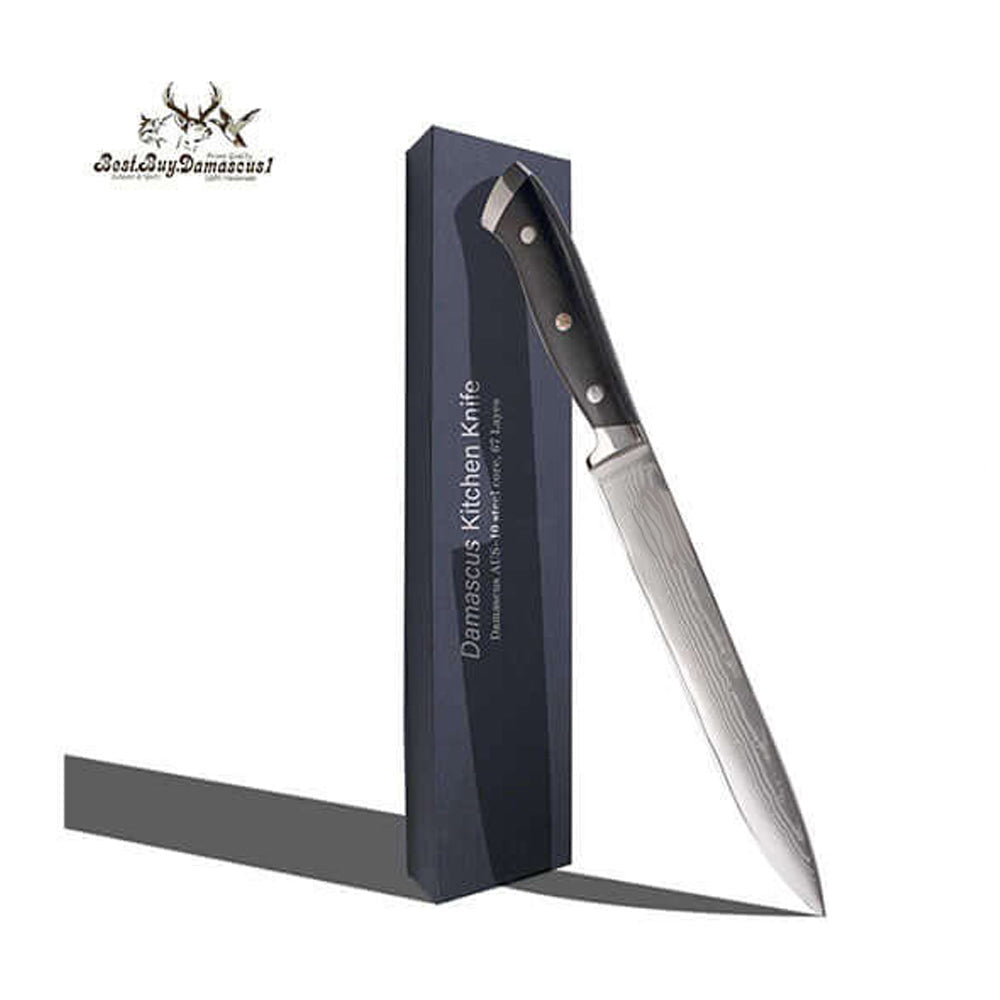
Direct answer: The best chef knife for most home cooks is an 8-inch blade that fits your hand, holds a keen edge, and costs little enough that you use it daily without ceremony. At Damascus1 the honest starting point is the G10 Handle Chef Knife at $34.99 (was $59.99, verified October 18, 2026) — or the Premium 7-Piece Block Set at $169.99 if your whole kitchen, not just one knife, needs solving. Browse the Chef's Best Kitchen Blades collection alongside this guide.
That answer will annoy two camps, and both annoyances are useful. The German camp will say a proper chef knife is forged, heavy, and costs what a Wüsthof Classic costs — roughly $170 in the current guides. The Japanese camp will say a proper chef knife is thin, hard, and light, and that anything else is a compromise. They are both describing real knives that real cooks love. What neither camp mentions is that most home cooks do not need a camp. They need one blade that dices an onion without drama, rocks through herbs, slices a chicken, and sharpens without a ceremony. This hub compares the three traditions — German, Japanese, and Damascus — by what they actually do at the board, prices the Damascus1 range live, and is upfront about its method: styles are compared on design and intended use, not on claimed hands-on testing of every knife named.
What is the best chef knife for most home cooks?
The best chef knife for most home cooks is an 8-inch, mid-weight blade with a curved belly for rocking, a handle that stays comfortable through a full prep session, and an edge you can restore at home. At Damascus1 today that brief is met by the G10 Handle Chef Knife at $34.99, with the $169.99 block set as the whole-kitchen alternative.
Why 8 inches keeps winning this argument: it is long enough for a cabbage, a melon, and a chicken, and short enough to control on a home board, in a home sink, with home-sized hands. Six-inch chef knives exist and suit small kitchens and small hands. Ten-inch blades exist and suit professionals with big boards and bigger confidence. But the category settled on 8 inches over generations for the same reason it settled on the shape itself — it is the size that disappears into the work. A knife you stop noticing is a knife doing its job.
Weight is the second half of the brief, and it is personal in a way spec sheets cannot settle. A heavier German-style knife does some of the work for you: its mass carries the blade through dense vegetables, and tired hands late in a long prep session appreciate the help. A lighter Japanese-style knife asks your arm to supply the motion and repays you with precision and less fatigue in fine, repetitive cutting. Neither is better. They are different bargains with your own arm, and the sections below help you work out which bargain your cooking actually wants.
And then there is the question nobody asks in the store and everybody asks at home: will you maintain it? A chef knife is not a purchase, it is a relationship with an edge. The best chef knife in the world, dull, loses to an ordinary knife, sharp, every single time. So this guide weighs sharpenability as a first-class spec — not an afterthought in a care box at the bottom, but a deciding factor in the recommendations themselves.
German, Japanese or Damascus: which chef knife style fits your cooking?

A German chef knife fits you if you rock-chop, cut dense and heavy produce, and want a tougher, more forgiving edge. A Japanese chef knife fits precise, up-and-down cutting and cooks who value a keen, light blade. A Damascus chef knife fits cooks who want a layered, patterned blade with a hard-working core — and the care habit that comes with it.
Walk the three traditions slowly, because each one is a philosophy before it is a product. The German style — Wüsthof and Zwilling are its famous names, and current guides still crown the Wüsthof Classic 8-inch at around $170 — is built around a softer, tougher steel tradition, a pronounced belly for rocking, a full bolster, and real heft. Its edge rolls rather than chips when it meets bone or a frozen surprise, it sharpens easily on almost anything, and it forgives the rough handling a busy family kitchen delivers. Its costs are weight and ultimate keenness: it will not take or hold the finest edge in this guide, and an hour of fine dice will let your arm know it was there.
The Japanese style goes the other way: harder steel, a thinner blade, a flatter profile, little or no bolster, and a handle that keeps the whole knife light. Push-cutting — straight down with a slight forward glide — is its home territory. It rewards good technique with cuts of a precision the German style cannot quite match, and punishes bad technique, twisting, and bone contact more readily. The budget end of the wider market is instructive here: test kitchens have recommended the Victorinox Fibrox Pro, around $45–$65 in current guides, for decades, precisely because it borrows the light, keen, no-drama virtues without the fragility or the price. Light and sharp is a real philosophy, not a luxury tier.
The Damascus style is best understood as construction rather than a third nationality. Damascus describes layered steel: contrasting layers forge-welded and patterned, usually built around or combined with a harder core that forms the actual edge. The wavy surface is the visible record of those layers. It is genuinely beautiful. It can be built in a German-leaning weight or a Japanese-leaning lightness, which is why this guide treats Damascus as a construction choice layered on top of the style choice, not instead of it. What it adds is character — every blade's pattern is its own — and what it asks is care: wash, dry, do not leave it wet. Our Damascus vs VG10 guide walks through the core-steel distinction without the marketing fog, and it is the companion read if steel is where your decision lives.
Which Damascus1 chef knives should you compare first?

Compare three entry points first. The G10 Handle Chef Knife at $34.99 is the single-blade starting point. The Premium 7-Piece Block Set at $169.99 is the whole-kitchen buy, chef knife included. The VG10 Nakiri at $44.99 is the vegetable specialist to add when your cooking proves you need one. Japanese sets at $334 to $449.99 are the upgrade tier, not the starting point.
Every price below was verified live on October 18, 2026. Prices can change; the product page on the day you order is the final word. One honesty note belongs in the table itself, because it shaped a recommendation: the Premium set's own product page describes it with both Japanese AUS10 Damascus language and German high-carbon language in different places. Those are different steel families. This guide does not smooth that over. If the steel designation decides your purchase, ask the seller to confirm which description applies to the set you would receive — a question you are allowed to ask any seller, ours included, and a habit worth carrying to every knife listing on the internet.
| Pick | Best for | Style / role | Price (verified Oct 18, 2026) |
|---|---|---|---|
| G10 Handle Chef Knife | Best for a first serious chef knife on a budget | Single chef knife, G10 handle | $34.99 (was $59.99) |
| Premium 7-Piece Block Set | Best for solving the whole kitchen in one buy | Set: chef, bread, slicing, santoku, boning, utility, paring + block | $169.99 |
| VG10 Nakiri | Best for vegetable-heavy cooking | Japanese vegetable specialist | $44.99 |
| Japanese Damascus sets (Chef's Best collection) | Best for the upgrade / gift tier | 6–9 piece Japanese sets, G10 handles listed | $334 (was $499.99) to $449.99 (was $599.99) |
Priced product cards — framed by the job, not the hype
Best budget start — G10 Handle Chef Knife — $34.99 (was $59.99). The single knife to buy if one knife is the brief. G10 is a hard-wearing, moisture-resistant handle material — the practical choice for a knife that will be washed, dried and used daily without being fussed over. Its product page describes the model in santoku-leaning terms as an 8-inch multipurpose blade; read that page for the model's own stated details before you order, and judge it as what it is: a $34.99 working chef knife, not a $170 trophy. View the G10 Handle Chef Knife.
Best whole-kitchen buy — Premium 7-Piece Block Set — $169.99. Seven pieces as listed on its page — 8″ chef, 8″ bread, 8″ slicing, 7″ santoku, 6″ boning, 5″ utility, 3.5″ paring — plus block storage, at a per-blade cost no single-knife purchase can touch. This is the pick our best kitchen knives hub also leads with, for the same reason: most home cooks do not yet know which single knife deserves an upgrade budget, and a season cooking with a set answers that question from real use. Steel note, repeated from the table because it matters: the page carries two steel descriptions — confirm with the seller if that decides you. View the Premium 7-Piece Block Set.
Best specialist add-on — VG10 Nakiri — $44.99. The flat-profiled vegetable knife: blade meets board along its whole edge, so vegetables slice cleanly without the accordion cuts a curved belly can leave. If your cooking is vegetable-heavy — and weeknight cooking increasingly is — this is the second knife most home cooks actually use, whatever the listicles say. View the VG10 Nakiri.
Best upgrade tier — Japanese Damascus sets — $334 to $449.99. More specification, bolder handles, gift-grade presence on the counter. Buy up here when you already know your habits and want refinement, or when the knife is a serious gift. Browse them in the Chef's Best Kitchen Blades collection, and compare against our best knife set guide before you spend at this level.
How big should a chef knife be, and how should it feel in your hand?
A chef knife should be 8 inches for most cooks: long enough for large produce and proteins, short enough for control on a home board. In the hand it should balance near the bolster or pinch grip, fill your grip without crowding, and let your knuckles clear the board. If any of those fail, the steel story does not matter.
Grip deserves a paragraph of its own, because most people hold a chef knife wrong for years and blame the knife. The working grip is the pinch grip: thumb and forefinger pinching the blade itself, just ahead of the handle, with the remaining fingers wrapping the handle loosely. It feels strange for a day and obvious forever after. It turns the knife into an extension of your hand instead of a tool your fist is carrying, and it is the single cheapest performance upgrade in all of cooking — it costs nothing and it works on a $34.99 knife exactly as well as on a $400 one.
Knuckle clearance is the quiet spec. A chef knife's blade is deep — spine to edge — for a reason: your guiding hand curls into a claw, fingertips tucked back, knuckles forward, and the flat of the blade rides against those knuckles as it rises and falls. A shallow blade forces your knuckles into the board's space and your fingertips into the edge's. When you compare knives, compare depth as seriously as length. It is the dimension that decides whether fast, safe cutting is even possible.
Balance is the last feel-test, and it is genuinely a test, not a number. Hold the knife in a pinch grip and let it sit. A German-style knife tends to balance a touch handle-heavy or neutral; a Japanese-style knife often balances at or ahead of the pinch. There is no correct answer — there is only the answer your hand stops noticing. If you cannot handle a knife before buying, buy from a seller whose returns terms you have actually read, and treat the first week of cooking as the audition it honestly is.
What steel makes the best chef knife — and what should you ignore?

The best chef knife steel balances three things: how keen an edge it can take, how long that edge survives real cooking, and how forgiving it is to sharpen at home. Hard core steels such as VG10 are prized for keen, durable edges. Softer steels sharpen easier and need it more often. No steel wins all three — ignore any listing that claims otherwise.
Steel talk gets mystical fast, so here is the grounded version. Hardness is a trade, not a score. A harder edge can stay keen longer and can also be less forgiving of twisting, prying and bone contact. A slightly softer edge gives some of that toughness back and sharpens with less fuss. Home cooking punishes both extremes rarely — you are not butchering all day, and you are not performing surgery. You want the broad, competent middle, maintained regularly.
Layer counts and exotic pairings are where listings go to mislead. A Damascus pattern tells you about construction — layers, folded and etched — and nothing, by itself, about how the edge will behave; the core steel and its heat treatment decide that. This guide therefore assigns no layer count and no hardness figure to the individual Damascus1 models above beyond what their own product pages state, and it directs you to those pages for the figures. Apply the double standard in reverse everywhere else: the more heroic a listing's numbers and the less checkable they are, the less they should move your decision.
There is also a Damascus-specific honesty habit worth building before you spend anything, anywhere: the window-light test. Hold a blade in window light and move it slowly. A genuine layered pattern has depth, shifts as the angle changes, and runs continuously across the blade, spine and edge included. A printed imitation looks flat and repeats itself. Our best Damascus chef knife set guide applies the same checks to sets, and the habit protects a single-knife purchase just as well.
How much should you spend on a chef knife?
Spend for the cooking you actually do. A sound single chef knife can start at $34.99 in the verified Damascus1 range; the famous German benchmarks sit around $170 in current guides; Japanese and Damascus upgrades run higher. Below the honest band, steel and finish usually suffer. Above it, you mostly buy refinement — which is fine, if refinement is what you want.
Lay the money out plainly, because vague ranges help no one at checkout. At $34.99, the G10 chef knife is a working tool at a stopgap price — the rational first serious knife, and cheap enough that its real job can be teaching you your own preferences: weight, grip, profile, care habits. At $169.99, the block set solves a whole kitchen and works out to roughly twenty-four dollars a blade before you count storage — the value anchor of this guide, and the buy most households should make if their current drawer is a jumble of dull singles. At $170 in the wider market, the German benchmarks buy you forged heritage and a bolster-and-heft philosophy with decades of testing behind it. At $334 and up in the Japanese sets, you are buying specification and presence. Notice the pattern: as price rises, you stop buying cutting — cutting was solved early — and start buying refinement, specification and pleasure. All three are legitimate things to buy. Just buy them knowingly.
What about the truly cheap chef knives, the ones in supermarket bins? Approach them the way you would any too-good arithmetic. The money came out of somewhere — steel, heat treatment, handle, finish, quality control. For a first apartment that needs anything at all, a cheap knife is a rational stopgap. Buy it knowing it is one, and do not let its habits convince you that you dislike cooking.
And a pairing rule that outranks every price tier: whatever you spend on the knife, reserve something for a decent board and a whetstone. A keen knife on a kind board, maintained in minutes, will out-cook a trophy knife dulled on glass and never sharpened. It will not be close.
Should you buy one chef knife or a whole knife set?

Buy one chef knife if your other kitchen knives are sound and you know your habits. Buy a set if your drawer is a jumble, you are equipping a kitchen, or you are gifting — a set covers every core job at a far lower cost per blade, with consistent handles and sharpening. Most households honestly need the set first, and the upgrade single later.
The one-at-a-time doctrine deserves respect and one qualification. It assumes you already know your own cooking in knife terms: whether you rock or push, whether chickens get broken down twice a month or twice a year, whether bread is a daily job or a holiday one. Most home cooks do not know — not yet. A sensibly priced set answers those questions by living in your kitchen. Six months in, the knives with wear tell you who you are as a cook. The one that never leaves the block tells you what not to upgrade. That self-knowledge is worth more than any single spec-sheet victory, and it is why our best kitchen knives hub and this hub give the same advice from two directions: set first for most, single upgrades after, specialists only when a recipe proves the need.
Gifting flips the logic entirely, and it is worth saying out loud. A single chef knife is a connoisseur's gift — wonderful if you know the recipient's hand and habits, risky if you do not. A handsome block set is a complete, generous, immediately usable present that requires the giver to know nothing about the recipient's grip. If the knife in question is a gift, completeness is the point. Buy the set. Add the engraving conversation separately if the gift is a pocket knife — that is a different guide, and a different kind of present.
How do you care for a chef knife so the edge actually lasts?

Care for a chef knife by washing and drying it by hand, storing it in a block, on a strip or in a guard — never loose in a drawer — honing lightly as needed, and sharpening on a whetstone before it goes truly dull. Keep Damascus-patterned blades dry, and never put a good chef knife in a dishwasher.
The dishwasher rule is absolute and worth explaining once. Detergent is abrasive, water jets bang an edge against racks and other metal, and heat-plus-moisture is unkind to handles and patterned steel alike. Thirty seconds at the sink — wash, dry, put it away — is the whole price of keeping a chef knife for years. People who say they have no time for that have time to replace knives. The arithmetic only runs one way.
Sharpening is the other half of ownership, and it is less intimidating than the internet makes it sound. A whetstone, a steady angle, and patience will maintain a chef knife's edge at home; the skill is learnable in an afternoon and useful for life. Our step-by-step how to sharpen a Damascus knife walks through grit, angle and stropping without mystique. The timing rule matters more than the technique: sharpen while the knife is merely dull-ish. Maintenance is light work. Rescue is heavy work, and owners who sharpen little and often almost never face it.
Storage completes the triangle. Loose in a drawer, edges collide with other metal every time the drawer opens, and hands go searching among blades — both problems, one solution. A block, a magnetic strip, or simple edge guards each solve it in their own way. Pick the one your kitchen has room for and use it every time, including when you are tired, especially when you are tired. Habits that only work on good days are not habits.
What should you check before you buy any chef knife?
Before you buy, check five things: the blade length and whether it suits your board and hands, the grip in a pinch hold if you can handle it, the steel story on the exact product page — including any conflicting descriptions — the care the blade asks for, and the seller's current shipping and returns terms. Those checks prevent nearly every chef knife disappointment.
The steel-story check leads the list because it leads every honest version of this guide, including the uncomfortable part about our own range. Product pages in this category do not always tell one clean story — the Premium set's page, as noted above, carries two steel families in different places. A trustworthy purchase starts with noticing that, and asking, rather than being handed a tidied summary. Any seller, at any price, who makes checking easy is behaving like a seller with nothing to hide. Any seller who punishes questions with vagueness has answered the only question that matters.
Price honesty comes next. The verified figures in this guide — $34.99 for the G10 chef knife, $44.99 for the nakiri, $169.99 for the set, $334 to $449.99 for the Japanese sets — were checked on October 18, 2026. Compare-at prices and sale prices move. If a figure on the live page differs from a figure here, the live page wins. And count the delivered total: the site currently shows free shipping and returns above $50, which the set and the Japanese sets clear on their own and a single $34.99 knife does not — though a chef knife plus the nakiri together do. Confirm at checkout, because offers change.
What do buyers ask most about the best chef knife?
Buyers ask most about the right size, whether German or Japanese style suits them, whether Damascus is practical for daily cooking, how much to spend, whether a set beats a single, and how much sharpening a good chef knife really needs. The short answers are 8 inches, by cutting style, yes with a dry-and-oil habit, knowingly, by household, and little and often.
What size chef knife do most cooks actually need?
Eight inches, for most cooks, most boards, most hands. It is long enough for large produce and proteins and short enough for control in a home kitchen. Choose 6 inches for small hands and tight spaces, and a longer blade only if your board, your hands and your confidence have all genuinely outgrown the standard.
Is a German or a Japanese chef knife better?
Neither — they are different bargains. German style brings weight, a rocking belly, a tougher and more forgiving edge, and easy sharpening. Japanese style brings lightness, a flatter profile, and a keener edge that asks for better technique and gentler handling. Choose by how you cut: rock-choppers lean German, push-cutters lean Japanese.
Is a Damascus chef knife practical for everyday cooking?
Yes, with a simple care habit: wash by hand, dry promptly, store it protected, sharpen little and often. The layered pattern is construction, not decoration pasted on, and the edge behaves like the core steel it is built around. If you know you will leave knives wet in a sink overnight, choose a plainer stainless knife without shame — honesty about habits beats aspiration at checkout.
How much should a first serious chef knife cost?
Less than the famous names suggest. In the verified Damascus1 range a working chef knife starts at $34.99, and the whole-kitchen set is $169.99 — roughly the price of one benchmark German single in current guides. Spend first on coverage and care tools; spend later, from experience, on the one blade your hand reaches for daily.
Can one chef knife really do everything in the kitchen?
Almost — and the almost is the honest part. A chef knife handles roughly eight of ten kitchen jobs superbly. Serrated work on crusts, in-hand paring, and travelling around bones are the jobs its specialists exist for. That is why the set exists. But if the budget allows exactly one blade, the chef knife is unambiguously the one.
How often does a chef knife need sharpening?
Touch it up whenever it stops biting cleanly — on a tomato skin, say — rather than on a calendar. For a home cook, that usually means light whetstone maintenance every few weeks of regular use, not a yearly rescue. Hone or strop between sharpenings if your knife's care guidance allows it, and never let a good edge go completely blunt before acting.
Where should you buy your chef knife?
Buy it where the size, steel story and price are stated plainly enough to check — including the parts that do not flatter the seller — and on the evidence of the verified October 18, 2026 range, that means starting with the Damascus1 kitchen collection, where a working chef knife begins at $34.99 and a whole kitchen is solved at $169.99. Confirm the details on the exact product page, and order the knife your hand will reach for daily.
Here is the whole decision, compressed. Start with the G10 Handle Chef Knife at $34.99 (was $59.99) if one blade is the brief. Choose the Premium 7-Piece Block Set at $169.99 if the whole kitchen is. Add the VG10 Nakiri at $44.99 when vegetables prove they deserve a specialist, and browse the Chef's Best Kitchen Blades collection when refinement — or a serious gift — is the real brief.
The best chef knife was never a trophy. It is the knife that is sharp on a Tuesday, comfortable in the twentieth minute, and boringly reliable for years. Choose by your cutting style, keep it dry, keep it sharp, and cook — that is what the title actually means in a real kitchen.
laissez un commentaire: