Replace one kitchen knife when one confirmed task is missing from an otherwise useful setup. Consider a set when several needed tools, suitable storage and a confirmed pack list make the complete purchase worthwhile. Neither route is automatically cheaper or better. Compare delivered costs for tools you will actually use, not the largest advertised piece count.
This worksheet helps you decide what to keep, what needs clarification and what to buy. It does not rank knives from hands-on testing, guarantee savings or establish a particular blade's performance. If an existing knife is damaged or its condition is uncertain, stop using it and seek appropriate advice before deciding whether maintenance or replacement is suitable.
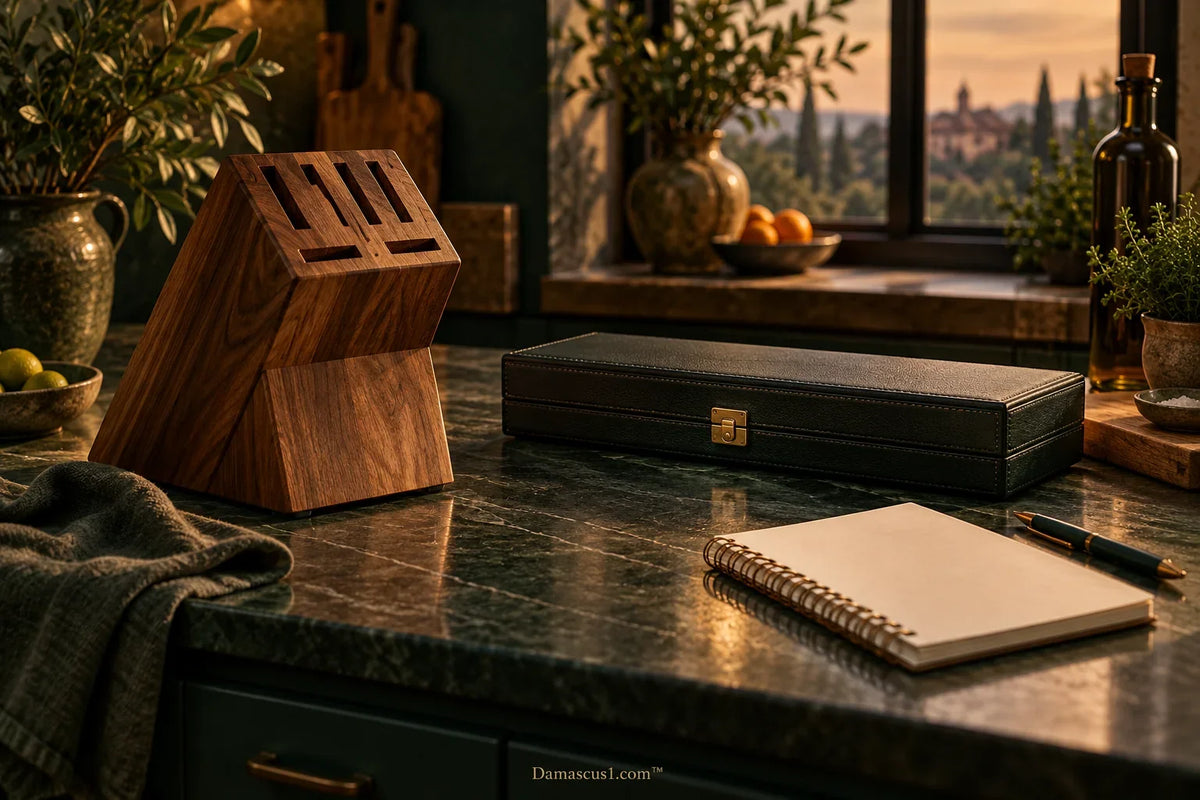
The cover and five interior images are AI-generated editorial illustrations of purchase planning. Empty blocks, closed cases and worksheets are conceptual props, not photographs of included products or evidence of a particular set's contents.
List cooking tasks before products
Start with meals you prepare in an ordinary week. Separate frequent work from occasional entertaining. You might regularly prepare vegetables and fruit, portion ingredients suitable for an appropriate kitchen knife, or cut bread. Record the task in plain language before assigning it to a product category. Avoid inventing a need because a set contains another blade shape.
List tools you already have and use comfortably, without conducting new performance tests. Note which routine tasks are covered and which create a real gap. If you rarely prepare a particular ingredient, using an existing suitable household tool or postponing that purchase may be more sensible than buying several specialist knives immediately.
Do not treat a menu as permission to use any knife on any material. Match purchases to the manufacturer's intended tasks and restrictions. Bone, frozen food, prying and other demanding uses require explicit suitability; this guide does not authorize them. A label such as chef knife or cleaver does not establish every use of a particular model.
Record who will use the purchase and their preferences. Handle comfort, familiarity, storage access and ability to follow care instructions affect daily usefulness. A photograph cannot confirm comfort in a particular hand. Ask about an appropriate inspection process and current return terms before assuming you can use and return a knife after a trial meal.

Separate a missing tool from a maintenance question
A knife that seems less useful than before does not automatically establish that a new set is needed. Record the observation without diagnosing it: perhaps the handle is damaged, the product no longer suits your routine, or you have a maintenance question. Ask the manufacturer or an appropriate professional about condition and suitable maintenance when needed.
Do not repeatedly test an uncertain edge, bend a blade or try an unfamiliar sharpening method to decide whether to replace it. Maintenance compatibility depends on the model and instructions. This worksheet concerns purchase planning, not structural diagnosis or sharpening tuition. It cannot establish whether professional service is appropriate for a damaged item.
Distinguish three outcomes. “Keep” means the existing tool covers a task and no unresolved condition question has been identified. “Clarify” means you need advice about condition, care or suitability. “Buy candidate” means a task is missing or replacement has been justified. Separate these categories so an unanswered maintenance question does not inflate the shopping list.
If replacing a knife because of discomfort or a storage problem, identify the constraint explicitly. A visually similar model may repeat the issue. A set may multiply it. Ask for dimensions and handle information relevant to your actual question, and record uncertainty that cannot be resolved remotely.
A task-to-tool worksheet
| Cooking task | Existing suitable tool | Status | Evidence needed |
|---|---|---|---|
| Frequent preparation | Record exact model | Keep, clarify or buy candidate | Condition or intended-use guidance |
| Recurring uncovered task | None confirmed | Buy candidate | Type and model suitability |
| Occasional specialist task | Record available option | Postpone or clarify | Frequency and appropriate tool |
| Storage | Record present arrangement | Keep or replace | Dimensions and compatibility |
Fill the table with your kitchen's facts. It deliberately avoids assigning a named knife to every task: intended use should come from exact product instructions rather than a generic example that may not fit what you own. Add a source beside each confirmed fact so it remains useful later.
Count useful tools, not merely pieces
A set may count a block, scissors, sharpener or another accessory as a piece. Those items can be useful, but they are not additional knives. Ask for the exact pack list for your selected option and group it into cutting tools, storage, maintenance items and other accessories. Keep total piece count as a description.
Mark each included item as a needed addition, a duplicate you will use, an uncertain item or an item you do not need. A duplicate is not automatically wasteful: two household cooks may have a practical reason for separate tools. Identify that reason rather than assuming every additional object adds equal value.
Do not assign equal value to all pieces by dividing the price indiscriminately. Dividing a set price by advertised count produces an arithmetic average, not a meaningful price for each knife. That average becomes misleading when it treats a block and a specialist knife as interchangeable units.
Our knife-set piece-count guide explains contents in more detail. Establish what is in the set, then return to this worksheet to decide whether those confirmed contents solve your task list. These are related but separate decisions.

Build two complete purchase baskets
Basket A is the individual route. Include only needed knives, compatible storage that must be bought separately, required protective accessories and any maintenance item made relevant by the manufacturer's instructions. Do not add an accessory just because it appears beside a product in a lifestyle image.
Basket B is the set route. Start with confirmed contents and identify what remains missing. An included block does not necessarily solve every storage need. An included maintenance tool is not automatically compatible with every existing knife. Add separate items only when their purpose and compatibility are established.
For each basket, record item subtotal, eligible discount if applicable, shipping, taxes and final checkout total. Compare the same destination and purchase date. Do not compare a list price on one side with a discounted delivered total on the other. If checkout has not supplied a charge, mark it unknown rather than zero.
There may also be an ownership cost after checkout, such as suitable storage or appropriate maintenance service. Record a confirmed cost separately from an estimate, with source and date. A short list of known costs and unanswered questions is more useful than an invented long-term savings percentage.
A reusable basket worksheet
| Cost or question | Individual route | Set route |
|---|---|---|
| Needed cutting tools | List exact models | Mark useful confirmed contents |
| Storage and protection | Included, separate or unknown | Included, separate or unknown |
| Item subtotal | Record amount and currency | Record amount and currency |
| Discount eligibility | Checkout-confirmed amount only | Checkout-confirmed amount only |
| Shipping and tax | Amounts or unknown | Amounts or unknown |
| Delivered total | Calculate when charges are known | Calculate when charges are known |
| Unresolved facts | List before purchase | List before purchase |
Use current listings without filling specification gaps
The Kitchen Knife — G10-Labelled Listing is an individual-product starting point. The Premium Kitchen Knife Block Set and Kitchen Knife Block Set — German-Labelled Listing are set starting points. Read each page's clarification notes before treating a historical title or URL as technical evidence.
These listings contain unresolved historical conflicts about model descriptions, contents or materials. This guide does not certify blade type, steel grade, origin, hardness, handle material or exact set contents. Ask which confirmed information applies to the option you intend to order. A lower displayed price does not answer a suitability question.
The kitchen knife set comparison helps collect those questions. The chef knife, santoku and nakiri guide explains general categories, but a category description cannot establish the geometry or intended use of a particular listing.
Do not borrow technical details from another brand's similarly named product or use another model's review as proof of performance. A relevant, genuine model-specific review provides one customer's experience. Current specifications, pack contents and purchase terms still need their own sources.

Make storage part of the decision
A single replacement may fit compatible storage you already own. A set may require a new location even with an included block. Record exact dimensions and compatibility before deciding either arrangement is more convenient. An included accessory can have little practical value if it does not fit your kitchen.
For a block, check footprint and the supported path for withdrawing the longest compatible knife. For drawer storage, check usable interior, organizer footprint, loaded height and handle access. Do not force a new knife into existing storage to discover fit. Obtain the maker's guidance and resolve missing dimensions first.
Use the block versus drawer worksheet. Record whether a compatible guard or sheath is part of the intended storage design. Keep storage dimensions separate from knife dimensions, especially when protection changes the object's outside size.
Consider cleaning and drying requirements for the entire arrangement. The storage maker's instructions and knife maker's guidance both matter. This guide does not claim that a block or drawer is universally more hygienic or that an unfamiliar storage product can go in a dishwasher.
Read current purchase and return terms
As checked on October 23, 2026, the refund policy describes 30 days from purchase and requires unused original condition, original packaging, intact tags and proof of purchase. Shipping fees are non-refundable. Read the complete current policy and ask about a trial, fit check or return process before relying on an assumption.
Do not build a budget on the assumption that you can use several knives, keep a favorite and return the remainder of a set. The policy does not establish that arrangement. Do not assume a single item and a complete set have interchangeable return handling. Ask for clarification before relying on an unusual plan.
The shipping policy links estimates to availability and selected options, describes destination restrictions and notes many weight-based rates. Keep the checkout total and order-specific shipping information with your worksheet. This article promises no universal free shipping, fixed arrival date or particular duty treatment.
When the parcel arrives, use the inspection checklist before use. Verify the model and confirmed contents while retaining packaging. A careful comparison before purchase is most useful when followed by an equally careful receiving check.

Work through two hypothetical kitchens
Imagine a household with suitable, familiar tools for usual vegetable preparation and small trimming tasks, but no confirmed bread-cutting option. Its sheet shows one gap. A large set containing replacements for useful existing tools does not become a better choice because its advertised average per piece is lower. First price the needed individual option with compatible storage, then compare that basket with the set's useful confirmed contents.
Now imagine a household furnishing a kitchen with no suitable knives or storage. Its worksheet may show several gaps. A confirmed set with appropriate tools and storage deserves closer consideration if dimensions, care requirements and delivered total are acceptable. The same set has a different practical value in these kitchens without a change in its quality.
These are decision examples, not claims about a product's suitability or expected savings. Do not assign invented prices to them and call the result a current offer. Use your task inventory and checkout-confirmed amounts. If contents are uncertain, both examples stop at clarification until the seller supplies missing facts.
Keep a simple decision record
Choose the individual route when one or a small number of genuine gaps are identified, model suitability is confirmed, and the complete basket makes sense with usable storage. You do not need to replace useful tools just to create a matching appearance.
Consider a set when several confirmed included items will be used, storage fits, care is manageable and the delivered total is acceptable. Keep the pack list with the decision. Value comes from the useful configuration received, not a promise that every household needs the same number of pieces.
Postpone either route when key facts are missing. “Need exact contents,” “need dimensions,” or “need material confirmation” are valid outcomes. Use Contact Us with the URL, selected option and short question list. A delayed decision is preferable to a purchase built on invented specifications.
Finish with one sentence: “I chose this option because it covers these confirmed tasks at this recorded delivered cost, with this storage plan.” If you cannot finish without guessing, revisit missing evidence. Keep the dated record so a promotion or larger piece count does not distract from why you were buying.
Keep price changes separate from a changed need
If an offer changes while you are researching, update the price row and checkout total rather than rebuilding the task inventory around the promotion. A discount can change affordability without creating a new cooking requirement. Record eligibility, the date checked and whether the discount actually applies to your basket. Avoid assuming that an old code combines with another offer.
If your needs change, update that separately. A second cook joining the household, a move to a kitchen with less storage, or a genuinely recurring new preparation task can justify revisiting the inventory. This distinction makes later decisions easier: you can see whether you are responding to a real kitchen change or simply a different displayed price.

Frequently asked questions
Is one kitchen knife always cheaper than a set?
No. Compare complete baskets for the same destination and date, including compatible storage, taxes and shipping. A displayed single price and average set price per piece do not establish the lower useful delivered cost.
When does a set make practical sense?
When several confirmed tools fill real needs, storage fits, care is suitable and total cost is acceptable. Confirm the pack list rather than relying on the largest printed piece count or an attractive product photograph.
Should I replace tools that cover my routine tasks?
Not solely to match a set's appearance. Record useful tools first. If condition or maintenance is uncertain, seek model-specific advice rather than diagnosing the issue through improvised tests. Keep unresolved questions separate from your shopping list.
Can I divide set price by piece count?
That arithmetic average does not value each useful knife. Counts may include storage, scissors or maintenance tools. Separate confirmed contents and compare configurations that solve your actual task list.
Does an included sharpener make a set more valuable?
Only if relevant and compatible with the knives you intend to maintain. Do not assume it suits every included blade or existing knife. Obtain the manufacturer's guidance before assigning it practical value.
Can I borrow specifications from a similar listing elsewhere?
No. Similar names and photographs do not establish identical materials, geometry, origin or accessories. Ask for facts for the selected model and option. Retain unresolved conflicts in the worksheet.
Should shipping be included in the comparison?
Yes. Record final checkout amounts for the same destination and method, including applicable taxes. Label an unknown charge unknown. A general banner or another customer's experience is not your delivered total.
What if I still cannot choose?
Identify the missing answer: intended use, contents, dimensions, storage or cost. Ask before buying. Browse the kitchen knife collection once your criteria are clear, then open individual listings for current details.
Editorial review: October 23, 2026. A purchase worksheet, not hands-on testing, a savings guarantee or model certification.
laissez un commentaire: